Categories
Common Sense national politics & policies regulation subsidy

Electric Class Warfare

Star Trek may have adversely affected American politics. Its techno-communist utopian militarism was one thing, its attitude towards engineering? Perhaps worse.

In how many episodes did Captain Kirk demand that Scotty push the warp drives further, or decrease the time required for a task — arbitrarily according to his need, not actual possibility?

And, because television: presto, it was done; just in time for the finale!

We see that in the push for electric vehicles (EVs). 

The EV mandates, explains The Epoch Times, “will likely cause a sizable wealth transfer from rural red regions of the United States to urban blue sections, and to wealthy Democrats who reside in them. . . .”

For while Democrats say they’re trying to “save the planet” from an increase in atmospheric carbon, really, analyst Robert Bryce counters, “it’s a type of class warfare that will prevent low- and middle-income consumers from being able to afford new cars.”

How? The EPA’s new “rules are the strictest in history and will effectively force carmakers to have one-third of new car sales be plug-in EVs by 2027 and more than two-thirds by 2032.” But according to the Texas Public Policy Foundation, “as much as $48,000 of the cost of the average EV sold in the United States is paid not by the owner but in the form of ‘socialized costs’ that are spread out among taxpayers and electricity consumers over a 10-year period.”

So the new rules will reduce the supply of gas-powered vehicles, driving up costs. And the increased number of already-subsidized vehicles will also be paid by taxpayers at large, while the benefits go to . . . mostly Democrats in the bluest counties of the bluest states, as statistics show.

In recent years, Democrats have prided themselves that their “blue states” subsidize “red states,” mocking the “rugged individualist” pretensions of the hapless bubbas in flyover country. But now such boasts ring hollow. 

This is the far-flung future? 

Subsidy and regulation spoil the Star Trek promise.

This is Common Sense. I’m Paul Jacob.


PDF for printing

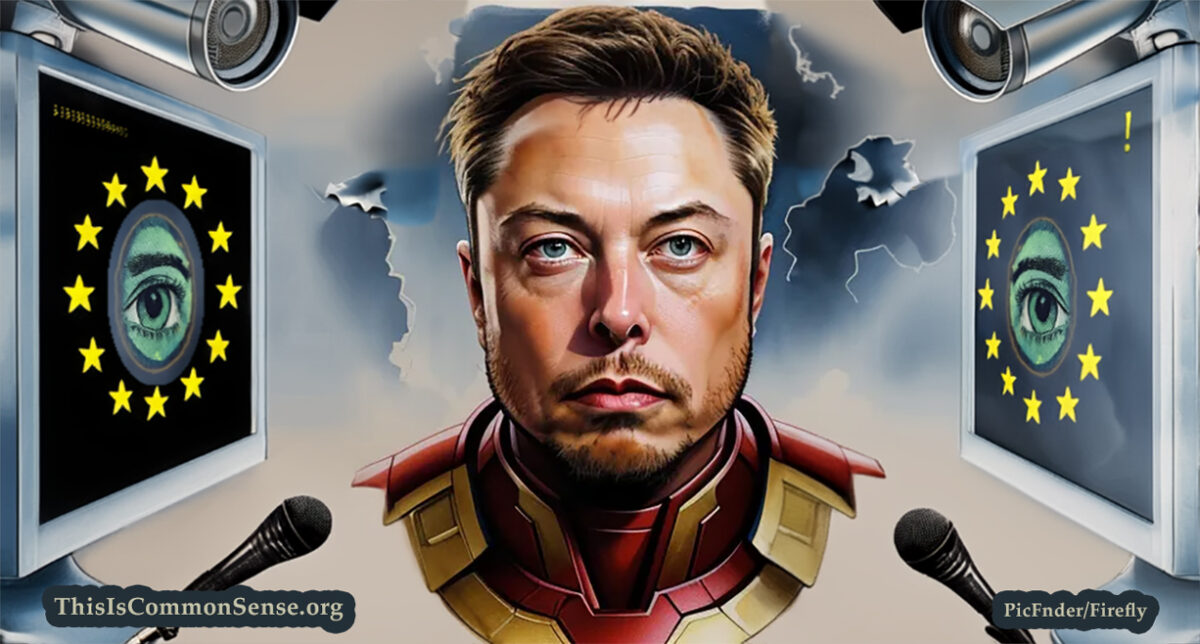
Illustration created with PicFinder and Firefly

See all recent commentary
(simplified and organized)
See recent popular posts
Categories
Thought

Ludwig von Mises

The capitalist system was termed “capitalism” not by a friend of the system, but by an individual who considered it to be the worst of all historical systems, the greatest evil that had ever befallen mankind. That man was Karl Marx. Nevertheless, there is no reason to reject Marx’s term, because it describes clearly the source of the great social improvements brought about by capitalism. Those improvements are the result of capital accumulation; they are based on the fact that people, as a rule, do not consume everything they have produced, that they save — and invest — a part of it.

Ludwig von Mises, Economic Policy: Thoughts for Today and Tomorrow (1979; Third Edition: 2006),
Categories
Today

Bergen-Belsen Liberated

On April 15, 1945, the Bergen-Belsen concentration camp was liberated.

Categories
FYI

Read Ludwig von Mises, Says Fighter, with Fury and Expletives

“I love America. I love the Constitution. I love the First Amendment. I want to carry . . . fucking guns. I love private property. And let me tell something: if you care about your fucking country, read Ludwig von Mises and the Six Lessons of the Austrian Economic School, motherfuckers.”

This rant by Brazilian fighter Renato Moicano, after a UFC victory, Joe Rogan in the ring officiating, went viral this weekend. But what does the fighter mean? What are the “six lessons” that Mises listed? Mises wrote a lot, after all.

A lot more than six lessons!

Turns out, “Money Moicano” is referring to the short book Ludwig von Mises wrote that is entitled, in America, Economic Policy. The book consists of six lectures, which is why, in Brazil, the book is called Six Lessons:

  1. Capitalism
  2. Socialism
  3. Interventionism
  4. Inflation
  5. Foreign Investment
  6. Politics and Ideas

The lessons of each section could be listed like this:

  1. A country becomes more prosperous in proportion to the rise in the invested capital per unit of its population.
  2. Economic calculation, and therefore all technological planning, is possible only if there are money prices, not only for consumer goods but also for the factors of production.
  3. The idea of government interference as a “solution” to economic problems leads, in every country, to conditions which, at the least, are very unsatisfactory and often quite chaotic.
  4. Inflation is a policy. And a policy can be changed.
  5. What is lacking in order to make the developing countries as prosperous as the United States is only one thing: capital — and, of course, the freedom to employ it under the discipline of the market and not the discipline of the government. 
  6. Ideas and only ideas can light the darkness. These ideas must be brought to the public in such a way that they persuade people. We must convince them that these ideas are the right ideas and not the wrong ones.

Moicano’s rant has conjured up quite a bit of interest and appreciation:

Categories
Thought

Tom Lehrer

When you attend a funeral,
It is sad to think that sooner o’
Later those you love will do the same for you.
And you may have thought it tragic,
Not to mention other adjec-
Tives, to think ofall the weeping they will do. But don’t you worry.

No more ashes, no more sackcloth,
And an armband made of black cloth
Will some day never more adorn a sleeve:
For if the bomb that drops on you
Gets your friends and neighbors too,
There’ll be nobody left behind to grieve.

Tom Lehrer, beginning of the song “We Will All Go Together When We Go,” An Evening (Wasted) With Tom Lehrer (1959), track 2.
Categories
Today

First Abolitionists

On April 14, 1775, the Society for the Relief of Free Negroes Unlawfully Held in Bondage, the first American organization committed to the abolition of slavery, was formed in Philadelphia.

On April 14, 1818, Noah Webster published his American Dictionary of the English Language, one of the first lexicons to include distinctly American words. The dictionary, which took him more than two decades to compile, introduced more than 10,000 “Americanisms.”

On April 14, 1988, representatives of the Soviet Union, Afghanistan, the United States, and Pakistan signed an agreement calling for the withdrawal of Soviet forces from Afghanistan. In exchange for an end to the disputed Soviet occupation, the United States agreed to end its arms support for the Afghan anti-Soviet factions, and Afghanistan and Pakistan agreed not to interfere in each other’s affairs.

Categories
Update

So, How Many U.S. Agencies Knew of the China-built Coronavirus in Advance? Fifteen?!?!

“At least 15 federal agencies knew from the beginning of the pandemic that EcoHealth Alliance and the Wuhan Institute of Virology were seeking federal funding in 2018 to create a virus genetically very similar if not identical to COVID-19,” informs Senator Rand Paul (R-Ky.) “Disturbingly, not one of these 15 agencies spoke up to warn us that the Wuhan Institute of Virology had been pitching this research.”

According to information on the U.S. Senate’s Homeland Security page, foreknowledge of the gain-of-function research program that led to the development of SARS-Cov-2 may have been rather widespread:

“Despite at least fifteen federal agencies having knowledge of the DEFUSE project in 2018,” the page continues, “its existence was not revealed to the public until 2021 and the involvement of NIH Rocky Mountain Lab in the initial proposal has never been previously disclosed. Dr. Paul expressed that the failure of these agencies to disclose their awareness of the risky research proposed in the DEFUSE project raises serious concerns.”

This reminds Common Sense of a catchphrase of the Watergate era: “What did the president know, and when did he know it?” But in 2020, the U.S. President was kept in the dark about the origin of the novel coronavirus — as was the American public. But a whole lot of members of the Administrative State knew a whole lot that they did not let on.

Who knew about the U.S.-subsidized origin of the Wuhan Institute-created virus, and when did they know it?

Rand Paul
Rand Paul wants to know.

Past coverage of the origin of the “novel coronavirus” here at Common Sense is extensive, but these four articles might be a place to start:

Categories
Thought

Sen. Howard Baker, Jr.

What did the president know, and when did he know it?

Senator Baker’s key question in the Watergate scandal.
Categories
Today

Thomas Jefferson

On April 13, 1743, Thomas Jefferson was born. Author of Notes on the State of Virginia and the first draft of the United States’ Declaration of Independence, Jefferson was also a scientist, philosopher, inventor, diplomat, and American politician. He also composed music, designed buildings, and translated works from his favorite French writers, whom he had met in his diplomatic missions to Paris: Volney and de Tracy.

Categories
education and schooling media and media people

Erroneous About the Eclipse

The View is not something to audit on a regular basis. It may decrease IQ. Nevertheless, we may have to defend Sunny Hostin for her silly ramblings on eclipses, cicadas, earthquakes, TDS and The Rapture. 

I’m not sure. She sure seemed to be saying that the recent eclipse and climate change were integrally related.

But the banter of the women was so light-hearted that maybe we shouldn’t hold her to high standards.

Besides, Whoopi was there to provide rational pedantry — no matter how inaccurate she was. (Contra Ms. Goldberg, there are thousands of cicada species, and you may respectably pronounce the word in a variety of ways). It could be that Sunny was merely trying to be funny about the Sun.

As the man said at the end of Chinatown, “Forget it, it’s The View.”

But how hopeless was Rep. Sheila Jackson Lee’s little lecture to the students at Booker T. Washington High School? She was instructing the students and taking credit for their “opportunity” to go outside and see the eclipse.

“A Full Moon is that complete, rounded circle which is made up mostly of gases,” she mis-explained, “and that’s why the question is why or how could we as humans live on the Moon? Are the gases such that we could do that?”

Well, no, the Moon is not mostly composed of gases. It possesses the scantest of atmospheres, but does have water — or so I last read.

Even eclipsing The View, sending embarrassing, ultra-ignorant politicians to teach astronomy in the inner cities is — Lunacy!

This is Common Sense. I’m Paul Jacob.


PDF for printing

Illustration created with PicFinder and Firefly

See all recent commentary
(simplified and organized)
See recent popular posts