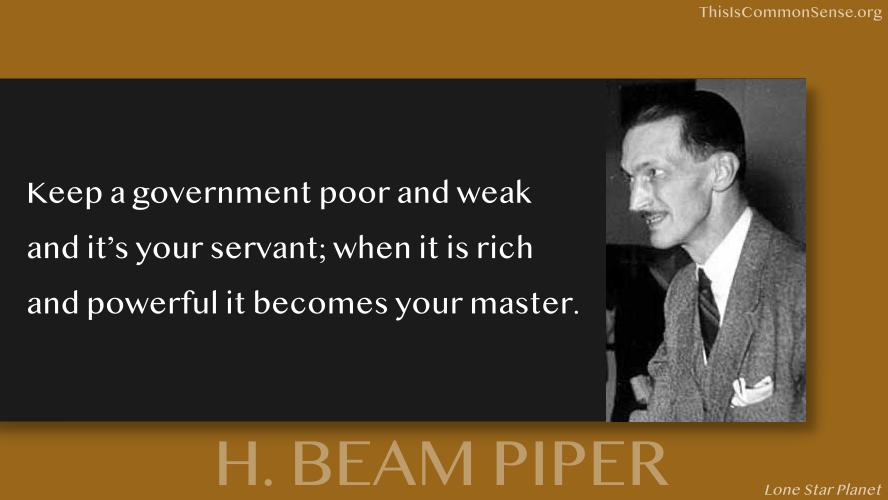
Keep a government poor and weak and it’s your servant; when it is rich and powerful it becomes your master.
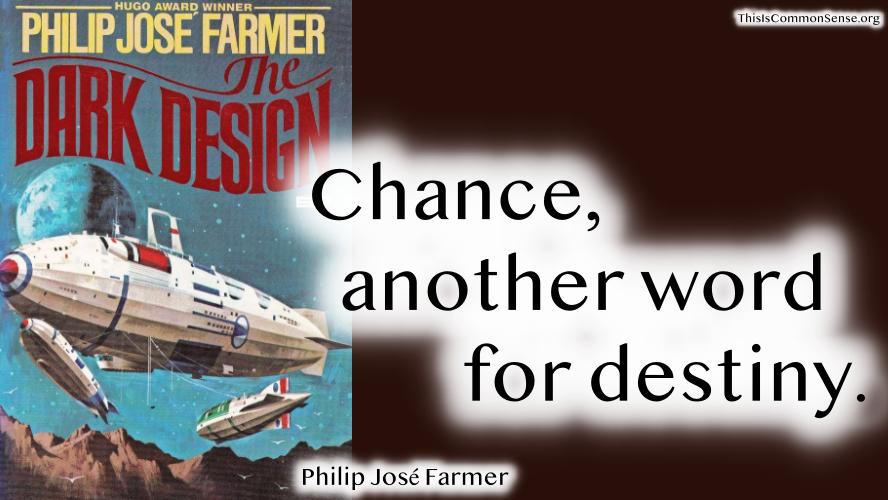
The character Colonel Andrew Jackson Hickock in H. Beam Piper‘sLone Star Planet (1958). This short novel has been published as A Planet for Texans, too, and its story idea was suggested by an infamous H. L. Mencken squib.
As the COVID pandemic experience is teaching us, there is something deeply wrong with medicine in America — if we did not know already. But we are ill, as Paul Jacob indicated on September 5, “Stay Puft America,” for other reasons, too. Like food.
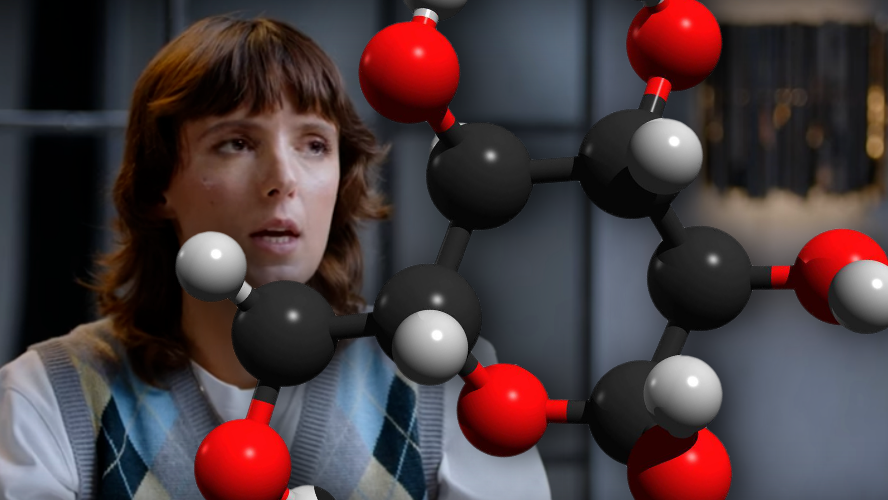
There are now many resources online, however, that may help us understand just how far off the mark our doctors and nutritionists have become. Comedian Jimmy Dore recently explained, to the best of his abilities, a case against using statins. The problem is not cholesterol, he says, but sugar.
The danger of sugar, and not just refined sugar and high fructose corn syrup, has been warned against for ages. A famous book in the 1970s made a big hit, but the Big Gov/Big Agribiz complex fought back with the Low Fat story, and we have been arguing about this ever since.
None of this can possibly be adjudicated on this site. What is true? What should you eat? What should and shouldn’t you do to prevent strokes and heart attacks and diabetes? These are questions to answer somewhere else than on ThisIsCommonSense.org.
But still, it may be worth listening to the latest guest on The Diary of a CEO podcast, Jessie Inchauspé:
What is wrong with our diets and our doctors? Increasing numbers of scientists and doctors have joined a legion of food faddists to blame sugar. But is it really a molecule that is to blame? Or is it . . . government? Could it be that the Big Gov/Big Biz paradigm has poisoned us? Is poisoning us?
It sure looks like this malign entity has worked mightily to make billions off the bad habits that regulators, subsidizers, and lobbyists have — behind the scenes of advertising and product placement — enticed us into.
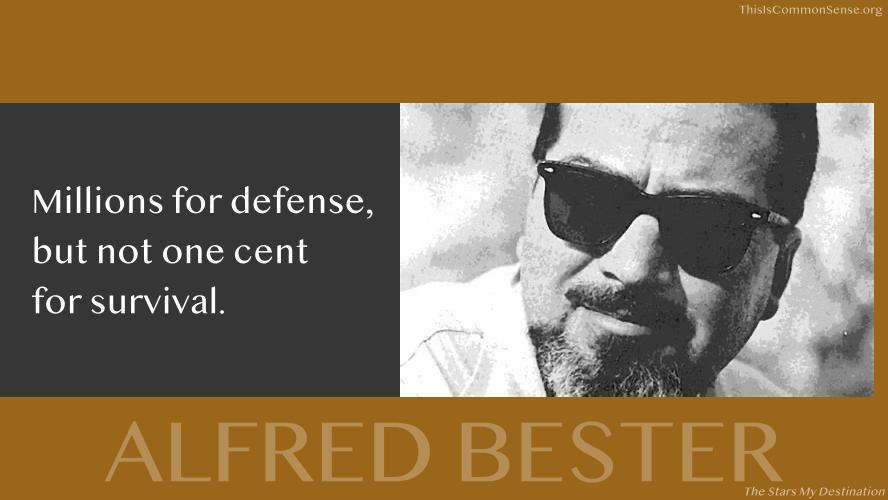
Millions for defense, but not one cent for survival.
Alfred Bester, The Stars My Destination, Chapter 16. The novel was first published under its author’s preferred title, Tiger! Tiger! (1956), in Britain.
On September 22, 1862, U.S. President Abraham Lincoln issued a preliminary proclamation that he would order the emancipation of all slaves in any state of the Confederate States of America that did not return to Union control by January 1, 1863. None returned, and the subsequent order, signed and issued January 1, 1863, took effect except in locations where the Union had already mostly regained control.
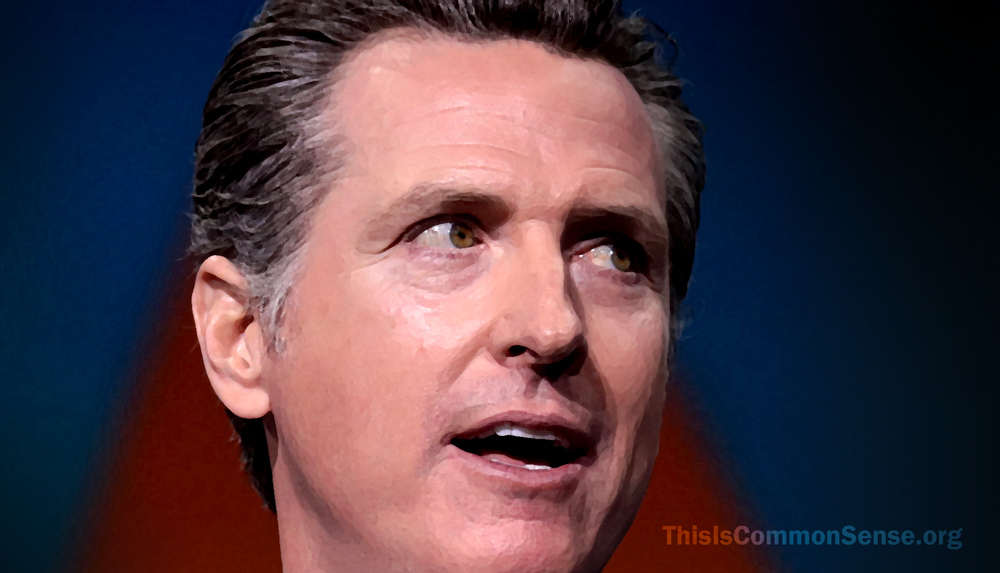
On July’s last day this year, Paul Jacob considered the sad self-parody that is “the governor of California, unhappy with a popular video.”
The full story turns out to have long legs:
The video’s maker may have thought he was covering every base by calling it a parody in the very title, an indignity of self-labeling that Jonathan Swift would never have permitted. People consuming Swift’s satire were left to figure out for themselves that when he proposed that the children of poor people be eaten to render them “beneficial to the publick,” he was engaging in satire.
In contrast, the Kamela Harris campaign ad parody in question is called “Kamala Harris Campaign Ad Parody.” Clear. Unmistakable.
Still, this video has not escaped the agenda of would-be censors like Governor Gavin Newsom. The parody uses a “deepfake” AI-generated voice that sounds like Harris. It’s even got the Harris Cackle. So Newsom wants to outlaw it.
“Manipulating a voice in an ‘ad’ like this one should be illegal,” he says. (Why?) “I’ll be signing a bill . . . to make sure it is.”
But as Reclaim the Net points out, California has already outlawed certain uses of deepfake media.
These forbidden uses do not, however, include parody, which is constitutionally protected speech.
Today’s update finds that the story became big news this week, as the governor did indeed sign the bill into law.
There have been many reactions, including by Dave Rubin, who got a rise out of California resident Drew Pinsky. “As goes California, so goes Canada and the EU . . . and now Brazil, too,” Dr.Pinsky who went on to characterize Newsom as a man who “thinks he is a trendsetter.” That’s a kind of power. The power to lead. Even if for evil, against the Constitution of the United States and the American free speech tradition.
But why is the story really coming up again, after a lag of several months?
The Babylon Bee. The satire site ultimate AI parody of Newsom had been making the social media rounds:
And that is not the only tweak of Newsom from the Christian humor site.
If Donald Trump fails to re-take the White House in November (and then for real in early 2025), his legacy may quickly devolve into a matter for historians, not live politics. After people calm down and the culture war stuff recedes (once again, if allowed by events), what will be left to argue over are a half-dozen major issues, which include war, mass migration . . . and tariffs.
Tariffs have long been Mr. Trump’s major hobby horse; he gets excited about 100 percent levies. The whole business about the “bloodbath” quote was his insistence that American auto industry will be destroyed if Trump himself doesn’t get the chance to erect ultra-high tariffs against automobiles from Mexico.
Trump looks at tariffs on foreign goods as harming foreign nations and helping us, the Americans.
But it is worth noting that economists from Adam Smith and David Ricardo onward have regarded tariffs as chiefly harming consumers within the country that erects them.
At Reason you can read Veronique de Rugy make the classic free-trade case, anew, in “No, Trump-Style Tariffs Do Not Grow the Economy.” If Frédéric Bastiat didn’t convince you, maybe de Rugy will.
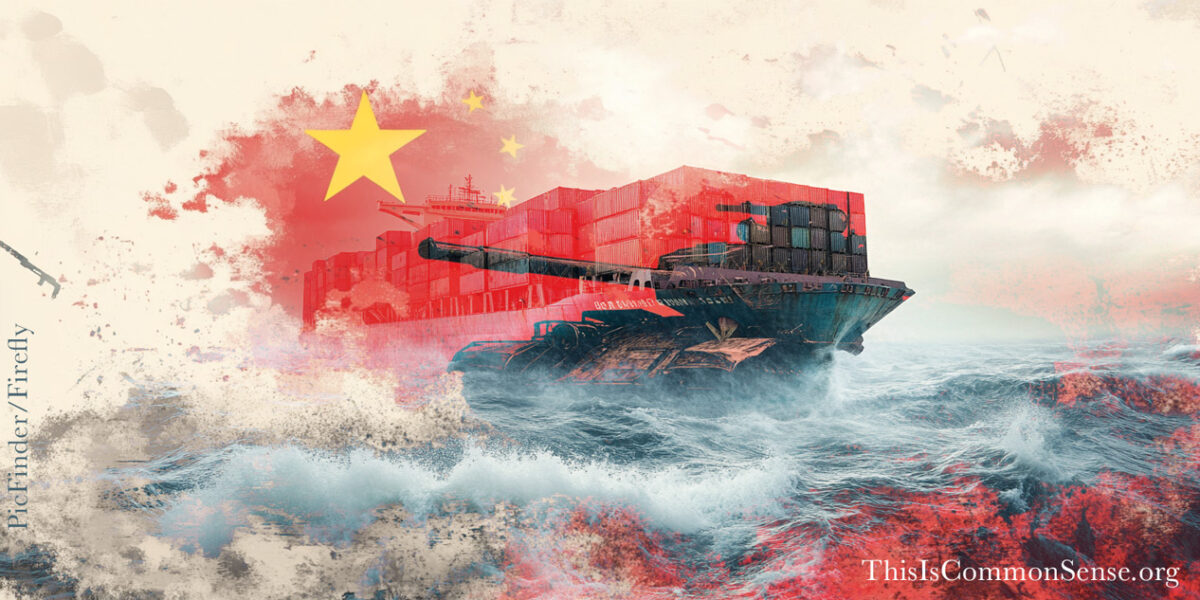
But something’s missing. Surrounding Trump’s talk against free trade in general and China in particular there was always another element that neither Bastiat nor de Rugy emphasize: free-trading with China helps Chinese and Americans, sure; gotcha — but it also helps the Chinese state, and its ruling Communist Party.
“Trump is an avowed restrictionist on both immigration and trade,” de Rugy writes. But both unchecked immigration and free trade present problems not economic so much as political. It’s about real bloodbaths, actual warfare, not metaphorical ones.
Even if Trump misdiagnosed the domestic economy, he saw problems with China perhaps more clearly than anyone else.
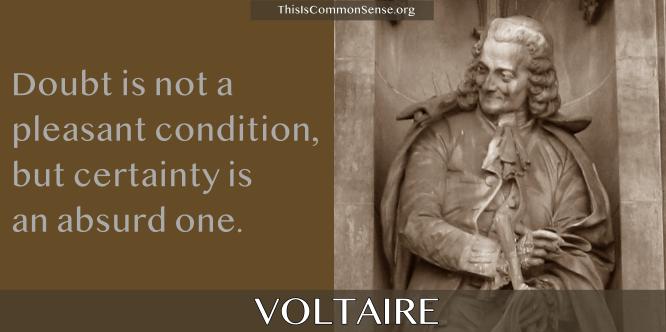
Le doute n’est pas un état bien agréable, mais l’assurance est un état ridicule.
Doubt is not a pleasant condition, but certainty is an absurd one.
François-Marie Arouet (Voltaire), Letter to Frederick William, Prince of Prussia (November 28, 1770). English: in S.G. Tallentyre (ed.), Voltaire in His Letters (1919), p. 232.