Categories
Today

A Bad Day for the Templars

At dawn on Friday the 13th, in October of 1307 — a date that lent weight to triskaidekaphobia, the fear of the number 13 — King Philip IV ordered de Molay and scores of other French Templars to be simultaneously arrested. The arrest warrant started with the words: “Dieu n’est pas content, nous avons des ennemis de la foi dans le Royaume” — “God is not pleased. We have enemies of the faith in the kingdom.”

These “Poor Fellow-Soldiers of Christ and of the Temple of Solomon,” most commonly known as the Knights Templar, figure heavily in the literature of Grand Conspiracies, and in the lore of heresy and the occult.

Categories
Update

Trump’s Tax Cuts & Hikes

In “Trump Vows to End Double Taxation for Overseas Americans,” Tom Ozimek begums by focusing on that title idea, promising to end double taxation on expatriates and encouraging expatriates to vote. But before the reader of The Epoch Times can reflect on foundational notions linking taxation and representation, the article moves to more interesting territory: tariff hikes.

While Trump has not released a detailed tax plan as part of his campaign for the White House, he has floated some tax policy proposals, including extending the expiring 2017 Tax Cuts and Jobs Act (TCJA) changes, exempting tips and overtime pay from tax, and leaning heavily into tariffs to support U.S. manufacturing.

The “leaning heavily into tariffs” program is one of the 45th President’s oldest obsessions, and it is always worth remembering that tariffs are a form of taxation. Harder to remember, but always important, are the lessons of classical political economy, which explained that a tariff is not a tax that “foreigners” pay: as economists put it, the incidence of the tax shifts onto the consumers residing within the “protected” boundaries of the state imposing the tariff. Basically, a tariff is a tax that consumers pay. No wonder such taxes are promoted by a few affected producers and laborers in the industry so protected, on the understandable rationale that tariffs effectively transfer wealth from the general mass of consumers to specific sets of producers.

Thus they work by the same political logic that most government interventions do, by focusing on the beneficiaries of the policies (a concentrated few) and taking attention away from those who bear the burden of the policies (the dispersed many).

At the Detroit event, the former president took aim at Chinese auto manufacturers building auto plants in Mexico with plans to export those vehicles to the United States.

“I will impose whatever tariffs are required, 100 percent, 200 percent 1,000 percent,” he said. “They are not going to sell any cars into the United States with those plants.”

It is pure demagoguery. But effective, especially if you fall for the encouragement of empathy for the concentrated (and much-ballyhooed) batch of beneficiaries while giving no thought to all the consumers harmed.

Categories
Thought

Gerald Massey

They must find it hard to take Truth for authority who have so long mistaken Authority for Truth.

Gerald Massey, “A Retort,” from Gerald Massey’s Lectures (c.1900).
Categories
Today

The West Indies

On October 12, 1492, Christopher Columbus landed on an island in the Bahamas, thinking he had reached “the Indies.”

The main islands of the Caribbean (south of the Bahamas) were, for many centuries, known as “the West Indies,” perhaps to both contextualize and commemorate Columbus’s mistake.

Categories
media and media people social media

TikTok Astroturf

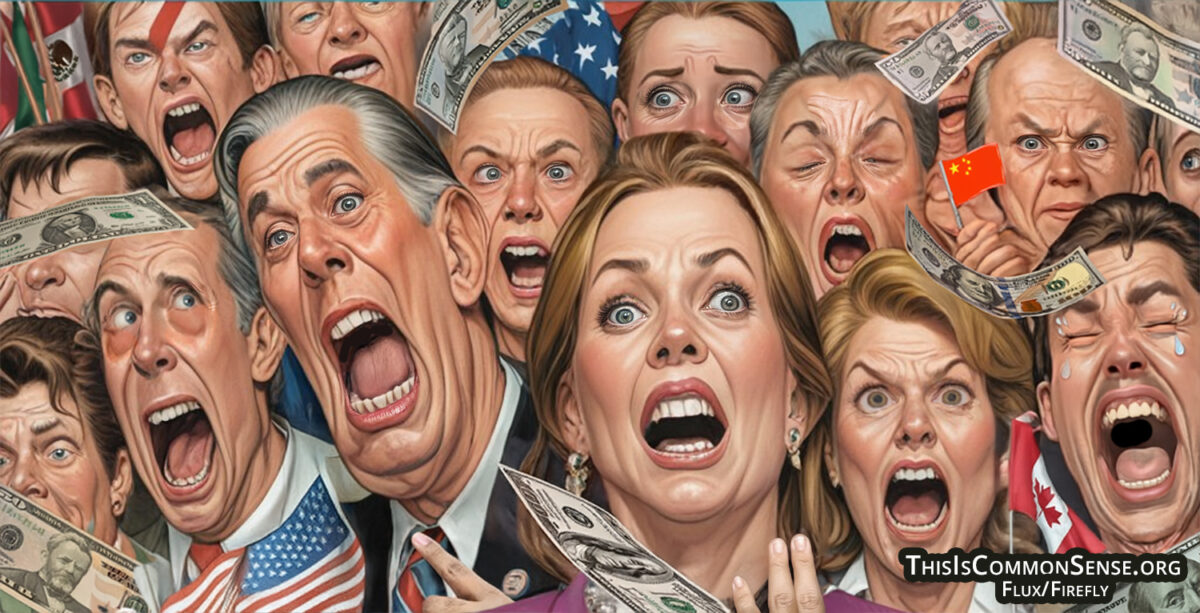
According to sociologist Jacques Ellul, propaganda is not rhetoric; it’s not you and me expressing our opinions and trying to persuade others; it’s not our letters to editors of newspapers or the “memes” we share online. Propaganda is the coordination of many forms of social influence, of many media. States are usually involved, or political parties (wannabe states) or huge interest groups (which can be bigger than many states).

If, however, you secretly get paid to push a message in a specific way, you may be a propagandist.

Take TikTok.

This is the video-sharing social media site so popular with young people. It’s been controversial; I’ve discussed it before. But I’m no expert. Still, I was not surprised to learn that Democrats have been paying “social influencers” on that platform to serve up the Democratic Party line.

A TikToker named Madeline Pendleton made a video about how the Democrats offered “nearly $15,000” to talk about “how awesome the Democratic Party is.” She found the idea ridiculous, characterizing the offer as a way to distract attention from the party’s “genocide.” But she recognizes that it can be effective. Many of her “mutuals” on TikTok are indeed spouting the same lines that she was “pitched” by Democrats, and they did so within 48 hours of her receiving the offer.

She went on to say that she received two offers: one to make ongoing videos up to the election, and the other to scarify Heritage Foundation’s Project 2025, which she is no fan of, but thinks is not that big a deal.

“You guys should be aware that that when you see videos like that, the Democrats are actively paying people to talk about how awesome the Democrats are.”

Awesome propagandists, anyway.

This is Common Sense. I’m Paul Jacob.


PDF for printing

Illustration created with Midjourney and Firefly

See all recent commentary
(simplified and organized)
See recent popular posts
Categories
Thought

David Brin

A sane being wished for peace and serenity, not to be the mortar in which the ingredients of destiny are finely ground.

David Brin, The Uplift War (1987).

Categories
Today

A Revolution Remembered

October 11, 1890, marks the founding of the Daughters of the American Revolution.

On the same date in 1976, President Gerald R. Ford approved a congressional joint resolution, Public Law 94–479, to appoint, posthumously, George Washington to the grade of General of the Armies of the United States, as part of the bicentennial celebrations.

John J. Pershing (1860 – 1948) is the only other American to attain this high title, and the only one to achieve it while alive.

Categories
crime and punishment education and schooling First Amendment rights

Don’t Mention the Menace

“It was a chaotic ending to the public comment period during Tuesday night’s Loudoun County [Virginia] School Board meeting,” reports WJLA, the ABC affiliate in our nation’s capital, “when Chair Melinda Mansfield ended that portion of the hearing after giving multiple warnings to parents raising concerns about a current student with alleged gang ties [who] was arrested last year for carrying a gun and making threats to kill a classmate.”

Well, a public official did indeed put parents on notice not to talk further about the problem they came to discuss. However, a student who carries a firearm to school and threatens to murder his or her peers does perhaps warrant some smidgen of dialogue. 

“According to sources with knowledge of the situation,” WJLA informs, “the student is allegedly connected to the MS-13 gang and is in the U.S. illegally.”

Parent Abbie Platt divulged that her “daughter is terrified to go to school with him.”

Four parents addressed the school board regarding this student; each was cut off by the board’s chair who accused them of “breaking the school board policy” by “providing information that could identify the student.”

“Everything that was brought up in this public comment is already public knowledge,” explains Tiffany Polifko, a parent and former school board member, telling the board that to “stop your constituents from speaking” is a classic violation of the First Amendment.

A spokesperson for Loudon County Public Schools defended the board’s speech squelching: “Even some minor details could lead . . . to the identity of a student, that’s just not a situation we’re comfortable with, that we’re going to accept.”

So, your kid needs to accept the risk of brutal torture and death, and you need to be quiet about it — because even discussing the danger might reveal the identity of the murder-and-mayhem-threatening student.

Those are public school priorities. 

This is Common Sense. I’m Paul Jacob. 


PDF for printing

Illustration created with Midjourney and Firefly

See all recent commentary
(simplified and organized)
See recent popular posts

Categories
Thought

Doris Lessing

There is only one way to read, which is to browse in libraries and bookshops, picking up books that attract you, reading only those, dropping them when they bore you, skipping the parts that drag — and never, never reading anything because you feel you ought, or because it is part of a trend or a movement. Remember that the book which bores you when you are twenty or thirty will open doors for you when you are forty or fifty — and vice versa. Don’t read a book out of its right time for you.

Doris Lessing, Introduction to The Golden Notebook (1962).
Categories
Today

The Big Book Debuts

On October 10, 1957, Ayn Rand’s dystopian/utopian (quasi-science fiction) novel of ideas, Atlas Shrugged, was published. Written to advance an individualist, freedom/free-market point of view and to show the consequences of statist ideology, it became one of the most influential and literarily successful didactic novels ever written.

Atlas Shrugged appeared on The New York Times Bestseller List for 21 weeks, and continued to sell thereafter, averaging 74,000 copies per year in the 1980s, over 95,000 copies per year in the ’90s, and in 2011 sold 415,000 copies. Atlas Shrugged has also appeared on numerous “best of” lists. In 1991 the Book of the Month Club and Library of Congress asked readers to name the most influential book in their lives: Atlas Shrugged came in second only to the Bible. Numbered among the book’s fans have been many artists, politicians, and thinkers, not least of whom was Ludwig von Mises.