November 18, 1493, Columbus caught first sight of the island now known as Puerto Rico.
Columbus Sees Puerto Rico
November 18, 1493, Columbus caught first sight of the island now known as Puerto Rico.
The re-election of an out-of-office president, for the second time, brings to mind an oddity of the convention of the ordinal numbering of the United States Presidents — those under the Constitution.
George Washington was the first; John Adams the second, and so on the list runs until we get to the curious case of one man, Stephen Grover Cleveland, who is regarded as both the 22nd & 24th presidents. All because the 23rd president, Benjamin Harrison, served between his two presidencies.
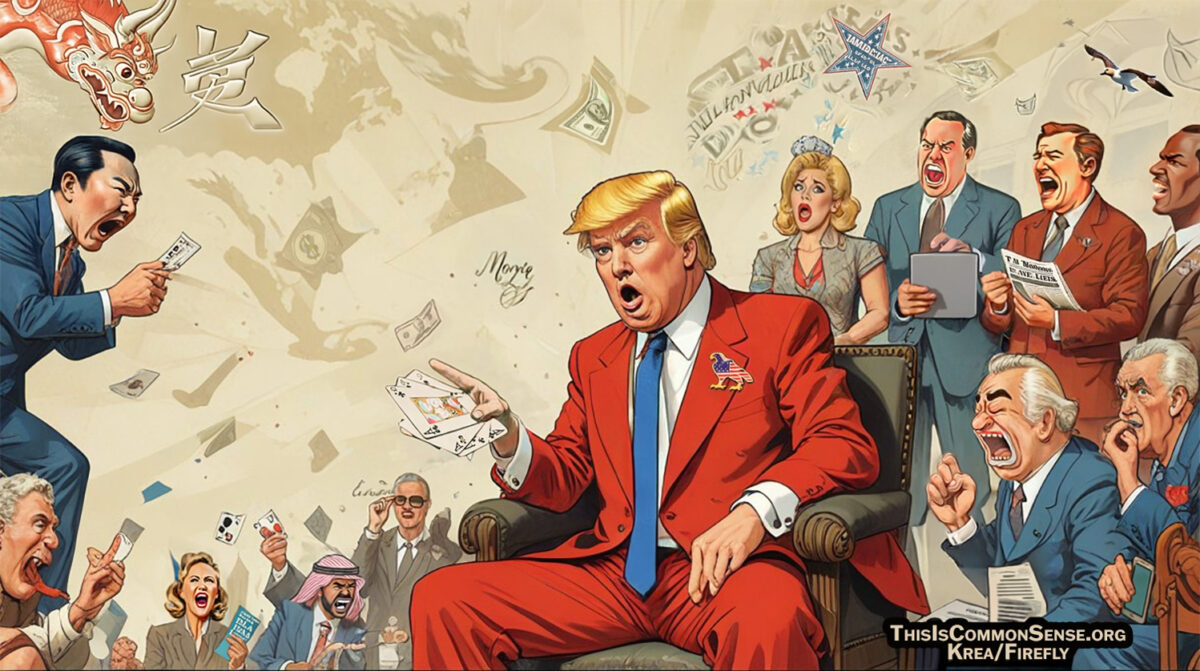
Now it is happening to Donald John Trump. He is listed as the 45th president of the United States, having served from 2017 through January of 2021. Now, re-elected after an “interregnum” of the 46th president, Joe Biden, Trump is slated to serve as the 47th president.
It is apparent that, according to this convention, what is being ordered with numbers is the presidencies, not the presidents as such. And it is assumed that a second (or third, or fourth) term in office is the same presidency as the first term of a president, unless broken in sequence by the term of another president.
An odd convention.
ἔστιν ἄρα ἡ ἀρετὴ ἕξις προαιρετική, ἐν μεσότητι οὖσα τῇ πρὸς ἡμᾶς, ὡρισμένῃ λόγῳ καὶ ᾧ ἂν ὁ φρόνιμος ὁρίσειεν. μεσότης δὲ δύο κακιῶν, τῆς μὲν καθ᾽ ὑπερβολὴν τῆς δὲ κατ᾽ ἔλλειψιν:
Virtue then is a settled disposition of the mind as regards the choice of actions and feelings, consisting essentially in the observance of the mean relative to us, this being determined by principle, that is, as the prudent man would determine it. And it is a mean state between two vices, one of excess and one of defect.
Aristotle, Nicomachean Ethics, Book II, translated by Harris Rackham. The illustration of the philosopher is a line engraving by P. Fidanza after Raphael Sanzio.
The United States Congress held its first session in Washington, D.C., on November 17, 1800.
Last Monday, Paul Jacob covered the brewing story of Federal Emergency Management Agency supervisor Marn’i Washington, who told FEMA workers on the ground in Lake Placid, Florida, not to help households with Trump signs in the yard. Since then we’ve learned more. The problem wasn’t just a rogue supervisor.
The next day, the New York Post offered a juicy headline: “FEMA worker accused of telling staff to skip hurricane-ravaged Trump homes claims it was common practice: ‘This is not isolated.’”
The Post article relied heavily on an episode of the Roland S. Martin podcast on YouTube:
Her explanation may not be what you have seen reported, however. The idea at FEMA, Ms. Washington says, is a policy of “avoidance and de-escalation.” The trouble with Trump supporters, FEMA lore has it, is that they tend to be rude or otherwise resistant to FEMA help. So the agency, to avoid conflict, avoids some natural disaster victims as a policy. Washington says she did nothing wrong, or out of the ordinary.
FEMA is a controversial agency within the federal government, with a bad reputation amongst many Americans, not just Trump supporters. That hardly needs verification. Ms. Washington insists that the logs of FEMA workers will justify her claims.
The culprit solely responsible for inflation, the Federal Reserve, is continually engaged in raising a hue-and-cry about “inflation,” for which virtually everyone else in society seems to be responsible. What we are seeing is the old ploy by the robber who starts shouting “Stop, thief!” and runs down the street pointing ahead at others.
Murray N. Rothbard, The Case Against The Fed (1994), as quoted by Douglas French, “The Case Against the Fed: How Do We Eliminate Inflation and the Boom-Bust Cycle” (FEE, November 1, 1995).
On November 16, 1914, the Federal Reserve Bank of the United States officially opened.
The Institute for Justice and its clients, Ben and Hank Brinkmann, suffered a defeat in a recent eminent domain case, Brinkmann v. Southold, New York, when the U.S. Supreme Court declined to take the case.
IJ notes that the three justices in favor, Thomas, Gorsuch, and Kavanaugh, “took the unusual step of recording their votes publicly.” But four votes were needed.
The two brothers own a chain of hardware stores. In 2016, they found an apparently ideal place for a new store in Southold, New York.
Although the property they bought was commercially zoned, the town government imposed one arbitrary and expensive obstacle after another to prevent construction. Finally, it used eminent domain to seize the property.
Though blatant, the town’s arrogant and capricious behavior was accepted by lower courts.
“Government shouldn’t be able to get away with these abuses of power,” the brothers say, “and shining a light on them like we did with the help of IJ will continue to build public support so that one day no one will have to go through what we have.”
Sometimes, when the bad guys go all out to violate the rights of people who are willing to go all out to defend those rights, unfortunately it’s the bad guys who “win,” if you want to call getting away with it a victory.
But the good fight is itself a kind of victory, and it will lead to victories for others.
This is Common Sense. I’m Paul Jacob.
See all recent commentary
(simplified and organized)
See recent popular posts
On November 15, 1777, the Continental Congress approved, and sent to the states for ratification, the “Articles of Confederation — after 16 months of deliberation. The first article gave the official name of the confederacy:
The Stile of this Confederacy shall be
The United States of America.
There is no human quality more attractive than the courage of the weak.
Gene Wolfe, Home Fires (2011), Reflection 1.