Categories
Thought

Harriet Tubman

I was the conductor of the Underground Railroad for eight years, and I can say what most conductors can’t say — I never ran my train off the track and I never lost a passenger.


Harriet Tubman, as quoted in Mary Biggs, Women’s Words: The Columbia Book of Quotations by Women (1996), p. 2.

Categories
Accountability crime and punishment folly ideological culture media and media people national politics & policies

Story, Story, Story

David Brooks has a story to tell you.

His New York Times op-ed, yesterday, “The Danger of Single Story,” builds on a good premise: “each individual life contains a heterogeneous compilation of stories. If you reduce people to one, you’re taking away their humanity.”

Brooks puts a political edge on what otherwise might sound like a lesson in manners with his next sentence: “American politics has always been prone to single storyism — candidates reducing complex issues to simple fables. This year the problem is acute because Donald Trump and Bernie Sanders are the giants of Single Storyism.”

Brooks then asserts that Trump and Sanders share a similar story that they beat to death, “the alien invader story.”

You can see how it applies to Trump, a staunch opponent of illegal immigration. Aliens invade!

But Brooks recognizes that Sanders’s story is about “the evil entity called ‘the banks.’” Not exactly alien. This menace is home-grown.

Then our pundit moves on to issues not in the single-story vein of Trump and Sanders, and how what seem to be opposite stories (incarceration prevents crime; too much incarceration is a moral horror) can both be true.

Crime is low right now, but Brooks devotes most of this putative paean to multiple crime stories. The third Bernie story he takes a bite of, the $15 minimum wage, belies the Single Storyism charge. That is, the point of his essay.

Way to go, sophisticate.

He also draws a complete non sequitur: “Raising the minimum wage to $15 may make sense in rich areas.” Nothing he wrote gives any credibility to that. At best the hike would do nothing.

This is Common Sense. I’m Paul Jacob.


Printable PDF

David Brooks, dichotomy, dualism, false, minimum wage, crime, illustration


Common Sense Needs Your Help!

Also, please consider showing your appreciation by dropping something in our tip jar  (this link will take you to the Citizens in Charge donation page… and your contribution will go to the support of the Common Sense website). Maintaining this site takes time and money.

Your help in spreading the message of common sense and liberty is very much appreciated!


Categories
Thought

Benedetto Croce

Morality, and the ideal of freedom which is the political expression of morality, are not the property of a given party or group, but a value that is fundamentally and universally human. . . . No people will be truly free till all are free.

Benedetto Croce was an Italian philosopher and outspoken anti-fascist.
Categories
Today

F-Word Defined

The Manifesto of Fascist Intellectuals was first published in Il Mondo, then by most Italian newspapers on April 21, 1925 — the national, anniversary-day celebration of the Founding of Rome (ca.  April 21, 753 BC).

Nowadays, all sorts of people call their political opponents “fascist,” often on the shakiest of rationales. It might be a good idea to look up this original document, for a good idea what politics’ “f-word” originally meant. Here is an excerpt:

Fascism was . . . a political and moral movement at its origins. It understood and championed politics as a training ground for self-denial and self-sacrifice in the name of an idea, one which would provide the individual with his reason for being, his freedom, and all his rights. The idea in question is that of the fatherland. It is an ideal that is a continuous and inexhaustible process of historical actualization. It represents a distinct and singular embodiment of a civilization’s traditions which, far from withering as a dead memory of the past, assumes the form of a personality focussed on the end towards which it strives. The fatherland is, thus, a mission.

The manifesto was written by Giovanni Gentile, in support of the regime of Benito Mussolini (pictured above).

Categories
Accountability moral hazard national politics & policies political challengers responsibility

Obscene Amounts

Actor George Clooney, star of the current Coen brothers picture, Hail Caesar!, is a major fundraiser for Hillary Clinton. When asked on NBC’s Meet the Press if the $353,000 per couple dinner he organized last Friday constituted an “obscene amount of money,” he answered, simply, “yes.”

Clooney went on to explain, “It’s ridiculous that we should have this amount of money in politics.”

He’s an advocate for campaign finance reform. He is, specifically, “against” Citizens United, though he doesn’t know that it isn’t a law but a Supreme Court case that overturned previously passed legislation that regulated what people and corporations could do to support or oppose (or mention) candidates in elections. The government, authorized by the campaign finance legislation, had suppressed a movie.

Interestingly, that movie was a polemical documentary against . . . Hillary Clinton.

Campaign finance regulation has been shown to help incumbents. Not unexpectedly, since the regulations are written by sitting legislators against their competitors.

But “getting money out of politics” would advantage other groups, too. For example, one consequence of limiting political donations would be to nudge challengers to (a) be rich and mostly self-funding (like Trump is said to be), and (b) be more demagogic, leveraging the “free” publicity from major media.

More demagogues aren’t needed.

But then, the whole issue is demagogic, appealing to the knee-jerk reaction of everyday people who are, indeed, often nonplused by how others spend their money.

As for Clooney, he’d like not to have to spend money for his candidate.

We’d all like the important things in life to just happen. But it turns out we have to work for what we want.

This is Common Sense. I’m Paul Jacob.


Printable PDF

George Clooney, Campaign finance, money, big money, election, Hillary Clinton


Common Sense Needs Your Help!

Also, please consider showing your appreciation by dropping something in our tip jar  (this link will take you to the Citizens in Charge donation page… and your contribution will go to the support of the Common Sense website). Maintaining this site takes time and money.

Your help in spreading the message of common sense and liberty is very much appreciated!


Categories
Thought

Bradley A. Smith

The next time you download a book on Kindle, buy a Michael Moore screed at Barnes & Noble, or order up a political movie from video on demand, remember that it is the Supreme Court’s decision in Citizens United that guarantees you the right to do so.


Bradley A. Smith, “Newsflash: First Amendment Upheld,” Wall Street Journal.

Categories
Today

New Amsterdam

On April 20, 1657, freedom of religion was granted to the Jews of New Amsterdam (which was later renamed New York City).

Categories
Accountability general freedom government transparency moral hazard national politics & policies political challengers responsibility

Big-Dollar Impact

Last Saturday, The Washington Post’s top-of-the-front-page headline blared, “50 donors with outside impact.”

If that doesn’t curdle your blood, readers were further warned of a new “Gilded Age.” Yes, in concentrated fundraising the Post heard “echoes of the end of the 19th century, when wealthy interests spent millions to help put former Ohio governor William McKinley in the White House.”

McKinley. The horror. The echoes.

Hopefully, self-immolations can be kept to a bare minimum as Americans discover the report’s main (only) thrust: 41 percent of $607 million contributed to 2,300 super PACs this election cycle has come from just 50 donors . . . at least, if you also aggregate gifts from the relatives of these 50 folks and their business interests as well.

Isn’t that terrifying? Destructive of democracy? Are our elections simply being bought by the billionaires?

No. No. And no.

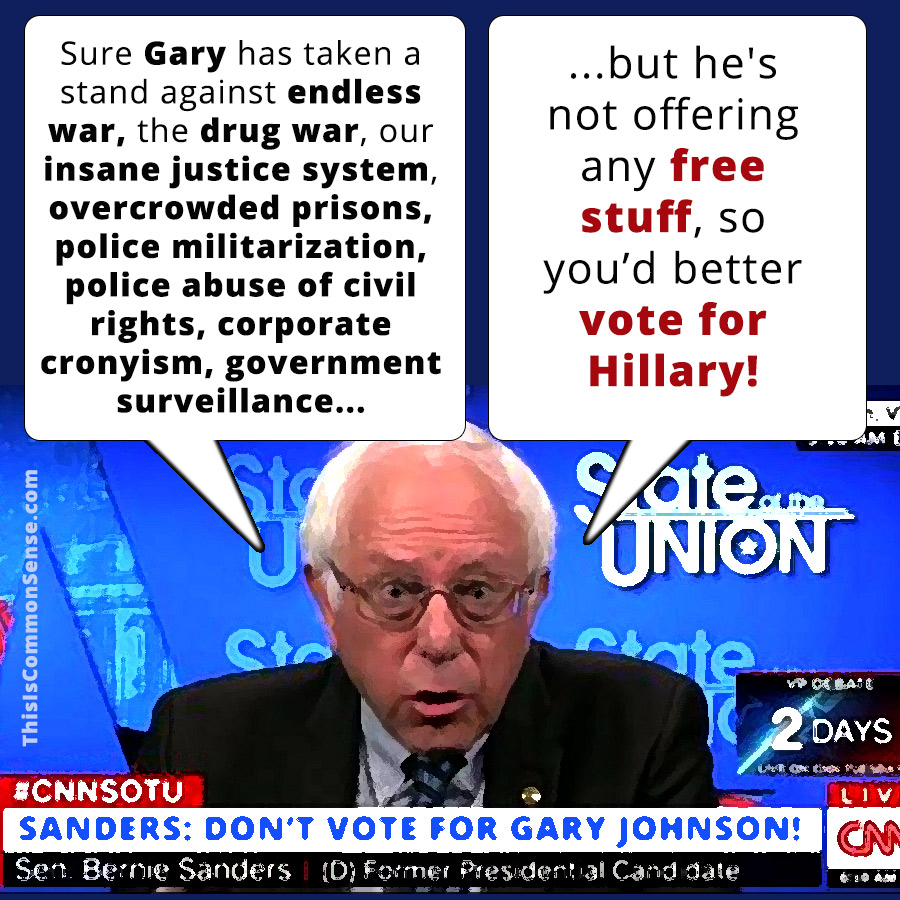
Any common sense analysis of this year’s presidential contests, both Republican and Democrat, must acknowledge that big money did not trump. Pun intended. Sen. Bernie Sanders is now outraising Hillary Clinton with millions of small donations — not “millionaires and billionaires.” Jeb Bush’s massive financial warchest made no discernible difference.  Even the Post concedes “the mixed impact that big-money groups have had on the presidential contest so far.”

Mixed? Name a single state where “big spending” determined the outcome.

Ideas matter. And securing the resources to advance and advertise ideas obviously matters, too. Same goes for candidates — and their ideas.

More money, more campaign spending, means more ideas and candidacies can reach the political marketplace. That’s where voters, not big donors, do the deciding.

This is Common Sense. I’m Paul Jacob.

Printable PDF

campaign finance reform, contributions, Hillary Clinton, Bernie Sanders, corruption


Common Sense Needs Your Help!

Also, please consider showing your appreciation by dropping something in our tip jar  (this link will take you to the Citizens in Charge donation page… and your contribution will go to the support of the Common Sense website). Maintaining this site takes time and money.

Your help in spreading the message of common sense and liberty is very much appreciated!


Categories
Today

The Revolution Begins

On April 19, 1775, the American Revolution began when the “shot heard around the world” was fired between the 700 British troops on a mission to capture Patriot leaders Sam Adams and John Hancock and to seize a Patriot arsenal and the 77 armed minutemen under Captain John Parker waiting for them on the Lexington town green. The Battle of Lexington ended with eight Americans killed and ten wounded, along with one wounded British soldier.

In Concord, a couple of hours later, British troops were encircled by hundreds of armed Patriots. The British commander ordered his men to return to Boston without directly engaging the Americans, but on the 16-mile journey they were constantly attacked by Patriot marksmen firing at them Indian-style from behind trees, rocks, and stone walls. By the time the British reached the safety of Boston, nearly 300 soldiers had been killed, wounded, or were missing in action. The Patriots suffered fewer than 100 casualties. (See Liberty’s Kids for a video on these events, or the video featured on this page.)

On April 19, 1782, John Adams secured the Dutch Republic’s recognition of the United States as an independent government.

Categories
Thought

Thomas Jefferson

He who receives an idea from me, receives instruction himself without lessening mine; as he who lights his taper at mine, receives light without darkening me.


Thomas Jefferson, Letter to Isaac McPherson (1813).