Categories
Today

Senator Revels

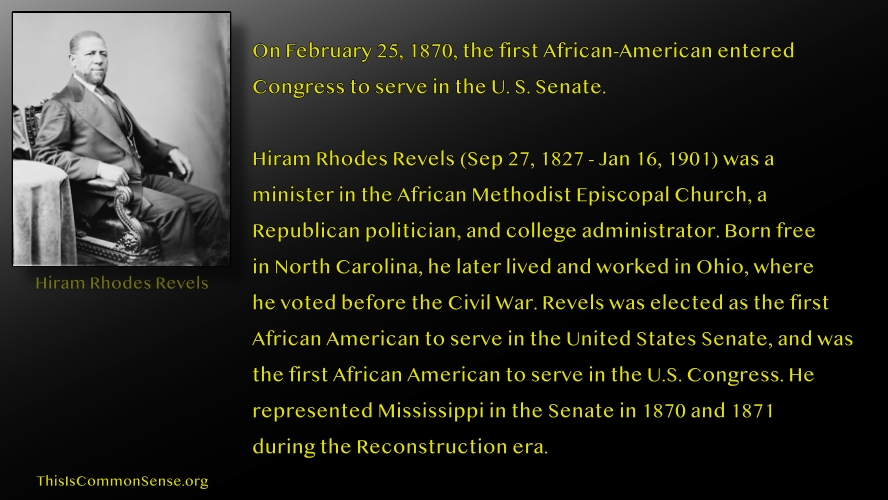
On February 25, 1870, the first African-American entered Congress to serve in the U. S. Senate.

Hiram Rhodes Revels (Sep 27, 1827 – Jan 16, 1901) was a minister in the African Methodist Episcopal Church, a Republican politician, and college administrator. Born free in North Carolina, he later lived and worked in Ohio, where he voted before the Civil War. Revels (pictured above) was elected as the first African American to serve in the United States Senate, and was the first African American to serve in the U.S. Congress. He represented Mississippi in the Senate in 1870 and 1871 during the Reconstruction era.

Categories
Today

Mr. Marbury

On February 24, 1803, the Supreme Court, in Marbury v. Madison, established the principle of judicial review. William Marbury was a businessman appointed as a “midnight judge” by lame duck president John Adams. He became the plaintiff in Marbury v. Madison.


On February 24, 1917, United States ambassador to the United Kingdom, Walter Hines Page, was shown the intercepted Zimmermann Telegram, in which Germany offered to give the American Southwest back to Mexico were Mexico to declare war on the United States.

Categories
Today

Galileo’s Gift

On February 22, 1632, Ferdinando II de’ Medici, Grand Duke of Tuscany, received the first printed copy of Galileo’s Dialogue Concerning the Two Chief World Systems (Dialogo sopra i Due Massimi Sistemi del Mondo). The Grand Duke was the dedicatee.

Galileo’s Dialogo is a witty and entertaining defense of the Copernican system, where the Sun is at the center of “the universe.” This was opposed to the traditional view — held by Aristotle and Ptolemy — of an Earth-centered system, as represented by an armillary sphere.

Only two systems appear in the Dialogo; Galileo pitting what we now call the Ptolemaic system with the Copernican, nowhere mentioning the Tychonic system then favored by most astronomers, one in which the Sun and Moon and stars revolve around Earth, but the planets revolve around the Sun.

Once published, Pope Urban VIII gave orders for the Dialogo to be recalled and summoned Galileo to Rome for trial.

Categories
Today

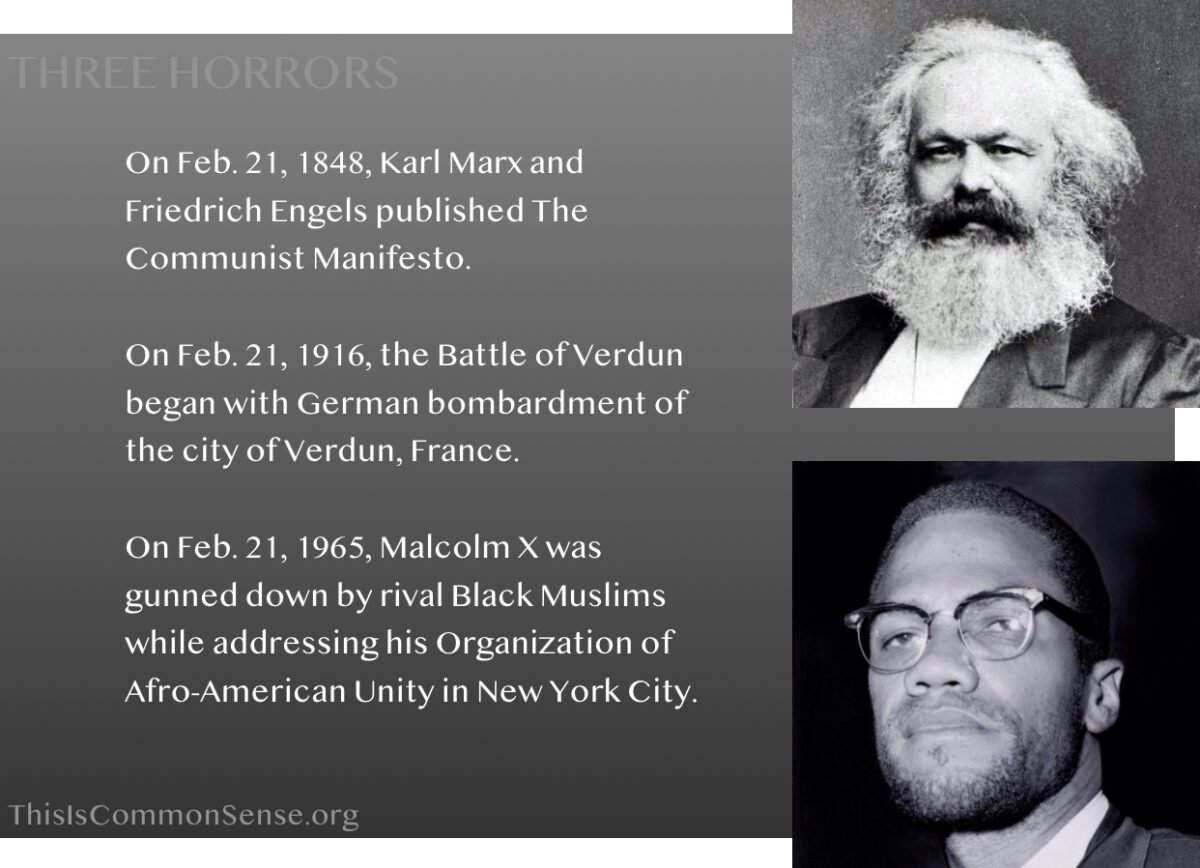
Three Horrors

On Feb. 21, 1848, Karl Marx and Friedrich Engels published The Communist Manifesto.

On Feb. 21, 1916, the Battle of Verdun began with German bombardment of the city of Verdun, France.  For ten months, the longest single engagement of the First World War, German forces attacked the French along a 20-kilometer front crossing the Meuse River. When the battle ended, with no change in the strategic position of either army, the combined death toll was over 300,000 (out of over 700,000 casualties).

On Feb. 21, 1965, Malcolm X was gunned down by rival Black Muslims while addressing his Organization of Afro-American Unity in New York City.

Categories
Today

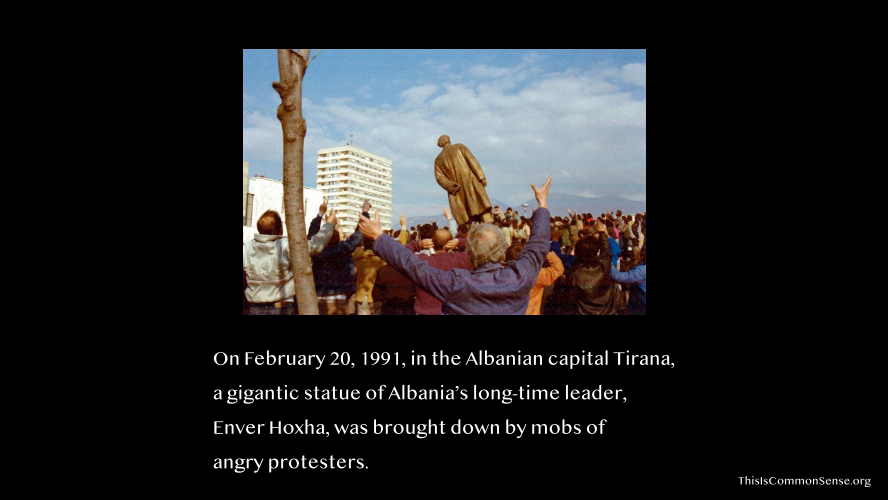
Enver Hoxha

On February 20, 1991, in the Albanian capital Tirana, a gigantic statue of Albania’s long-time leader, Enver Hoxha, was brought down by mobs of angry protesters.

Categories
Today

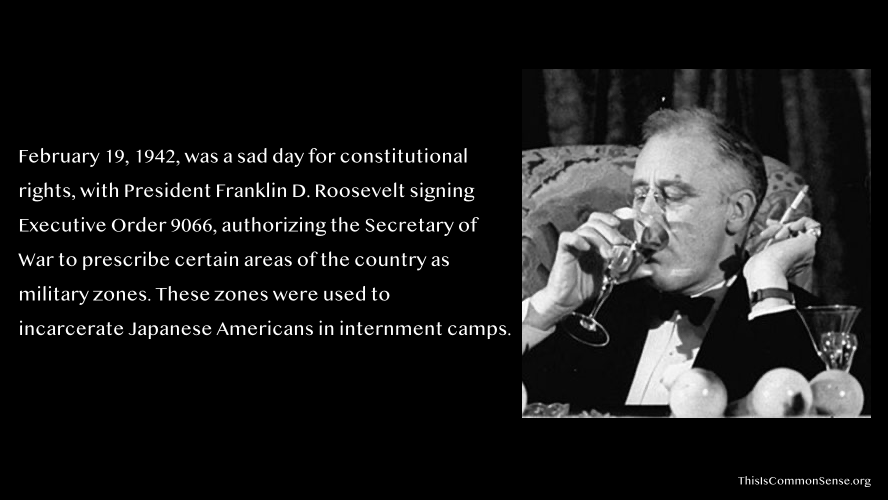
U. S. Military Zones

February 19, 1942, was a sad day for constitutional rights, with President Franklin D. Roosevelt signing Executive Order 9066, authorizing the Secretary of War to prescribe certain areas of the country as military zones. These zones were used to incarcerate Japanese Americans in internment camps.

Categories
Today White Rose

White Rose

On February 18, 1943, Hans and Sophie Scholl, a brother and sister, were arrested at the University of Munich for secretly (or not so secretly) putting out leaflets calling on Germans to revolt against Adolf Hitler and the Nazi regime.

In the previous year Hans had founded a group of students, who called themselves “The White Rose.” The group wrote and distributed six leaflets aimed at educated Germans. The leaflets made their way across Germany and to several other occupied countries. The Allies later dropped them all over the Third Reich.

Categories
Today

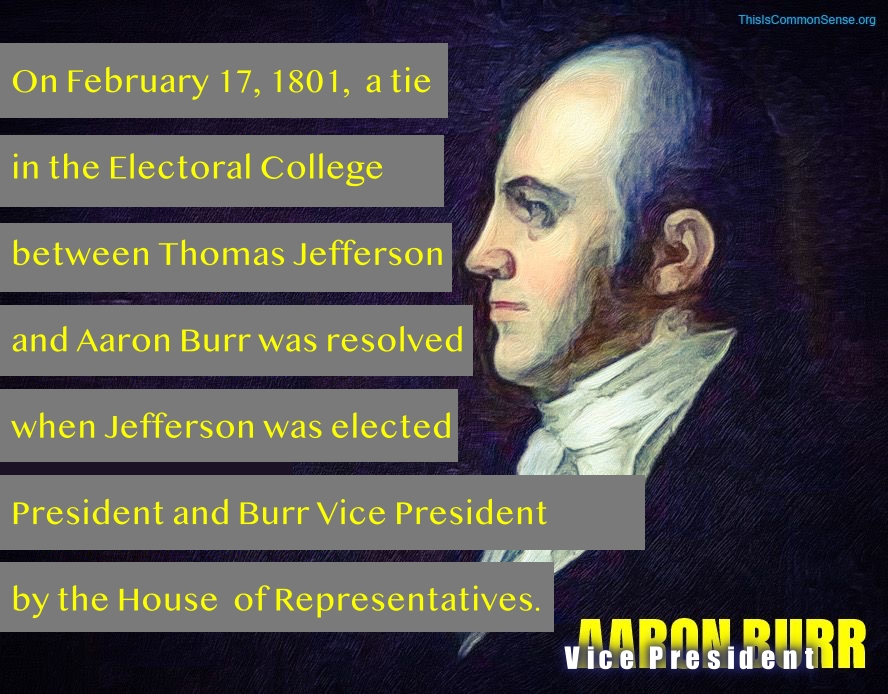
Jefferson vs. Burr

On February 17, 1801, a tie in the Electoral College between Thomas Jefferson and Aaron Burr was resolved when Jefferson was elected President and Burr Vice President by the House of Representatives.

Categories
Today

Silver Coinage

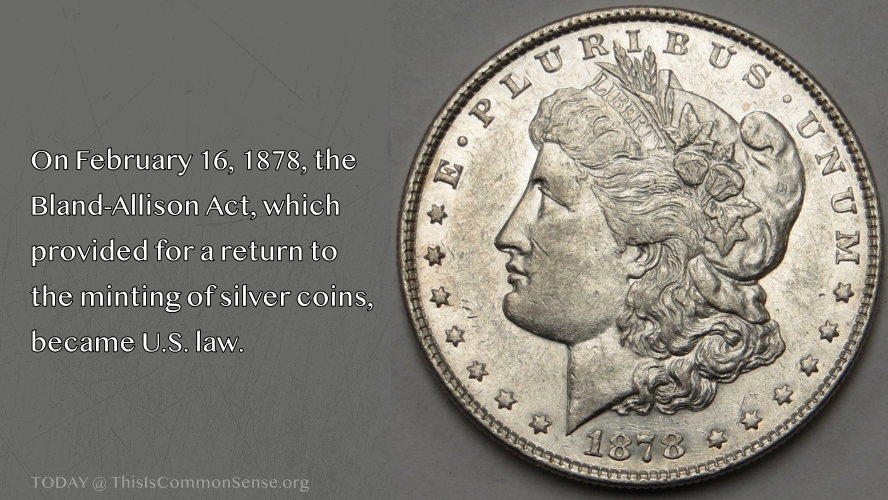
On February 16, 1878, the Bland-Allison Act, which provided for a return to the minting of silver coins, became U.S. law.

Categories
Today

Remember the Maine

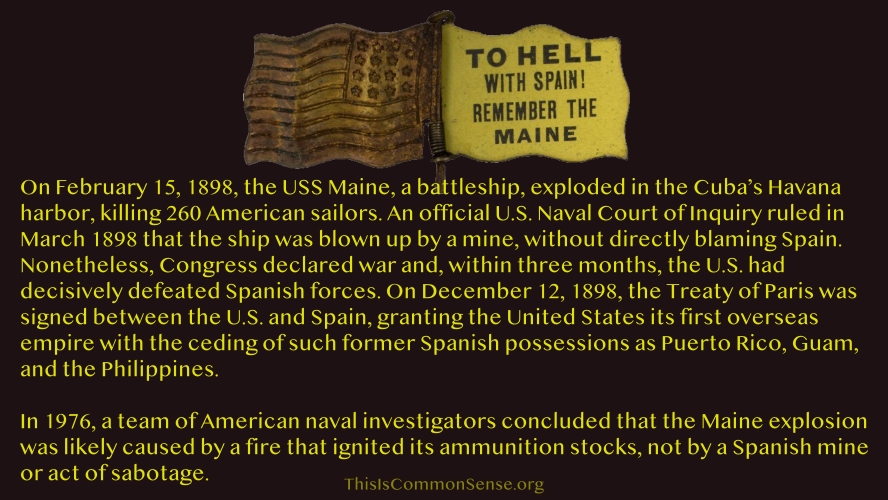
On February 15, 1898, the USS Maine, a battleship, exploded in the Cuba’s Havana harbor, killing 260 American sailors. An official U.S. Naval Court of Inquiry ruled in March 1898 that the ship was blown up by a mine, without directly blaming Spain. Nonetheless, Congress declared war and, within three months, the U.S. had decisively defeated Spanish forces. On December 12, 1898, the Treaty of Paris was signed between the U.S. and Spain, granting the United States its first overseas empire with the ceding of such former Spanish possessions as Puerto Rico, Guam, and the Philippines.

In 1976, a team of American naval investigators concluded that the Maine explosion was likely caused by a fire that ignited its ammunition stocks, not by a Spanish mine or act of sabotage.