Categories
Today

A King Shot

King Umberto I of Italy was assassinated by the anarchist Gaetano Bresci on July 29, 1900. After shooting the monarch multiple times, Breschi was wrestled to the ground and almost lynched. Upon his arrest, he said “I did not kill Umberto. I have killed the King. I killed a principle.” This did not prove immediately true, for Umberto’s 31-year-old son, Victor Emmanuel III, succeeded his father to the throne. What Bresci spawned was the terrorist craze of anarchists trying to kill heads of state and captains of industry, itself a kind of self-defeating principle, since the peoples of the world turned decidedly against the anarchists.

Categories
Today

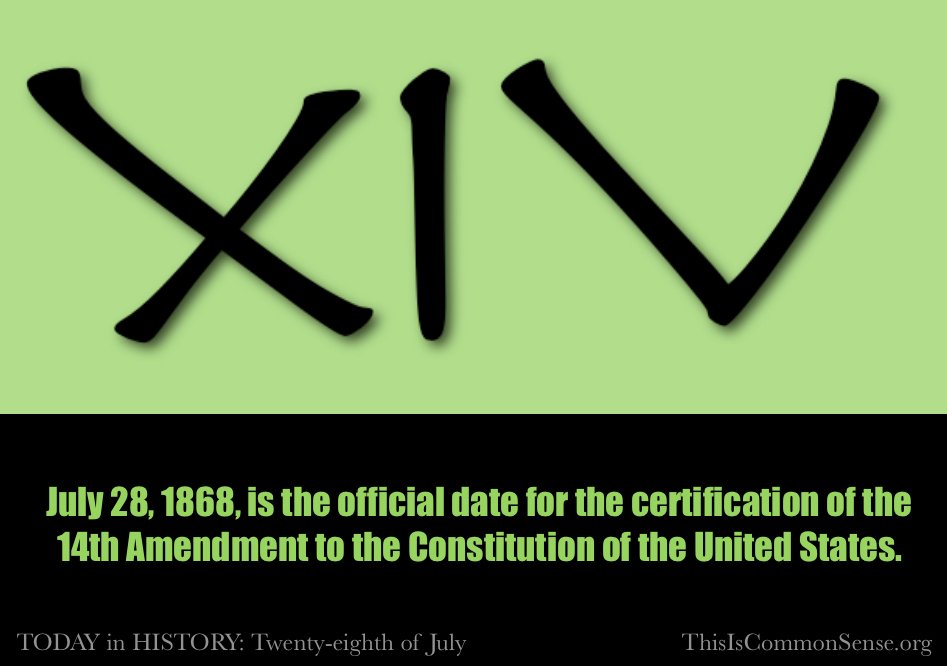
The Fourteenth

July 28, 1868, is the official date for the certification of the 14th Amendment to the Constitution of the United States.

Section 1. All persons born or naturalized in the United States, and subject to the jurisdiction thereof, are citizens of the United States and of the State wherein they reside. No State shall make or enforce any law which shall abridge the privileges or immunities of citizens of the United States; nor shall any State deprive any person of life, liberty, or property, without due process of law; nor deny to any person within its jurisdiction the equal protection of the laws.
Section 2. Representatives shall be apportioned among the several States according to their respective numbers, counting the whole number of persons in each State, excluding Indians not taxed. But when the right to vote at any election for the choice of electors for President and Vice President of the United States, Representatives in Congress, the Executive and Judicial officers of a State, or the members of the Legislature thereof, is denied to any of the male inhabitants of such State, being twenty-one years of age, and citizens of the United States, or in any way abridged, except for participation in rebellion, or other crime, the basis of representation therein shall be reduced in the proportion which the number of such male citizens shall bear to the whole number of male citizens twenty-one years of age in such State.
Section 3. No person shall be a Senator or Representative in Congress, or elector of President and Vice President, or hold any office, civil or military, under the United States, or under any State, who, having previously taken an oath, as a member of Congress, or as an officer of the United States, or as a member of any State legislature, or as an executive or judicial officer of any State, to support the Constitution of the United States, shall have engaged in insurrection or rebellion against the same, or given aid or comfort to the enemies thereof. But Congress may, by a vote of two-thirds of each House, remove such disability.
Section 4. The validity of the public debt of the United States, authorized by law, including debts incurred for payment of pensions and bounties for services in suppressing insurrection or rebellion, shall not be questioned. But neither the United States nor any State shall assume or pay any debt or obligation incurred in aid of insurrection or rebellion against the United States, or any claim for the loss or emancipation of any slave; but all such debts, obligations and claims shall be held illegal and void.
Section 5. The Congress shall have power to enforce, by appropriate legislation, the provisions of this article.

Categories
Today

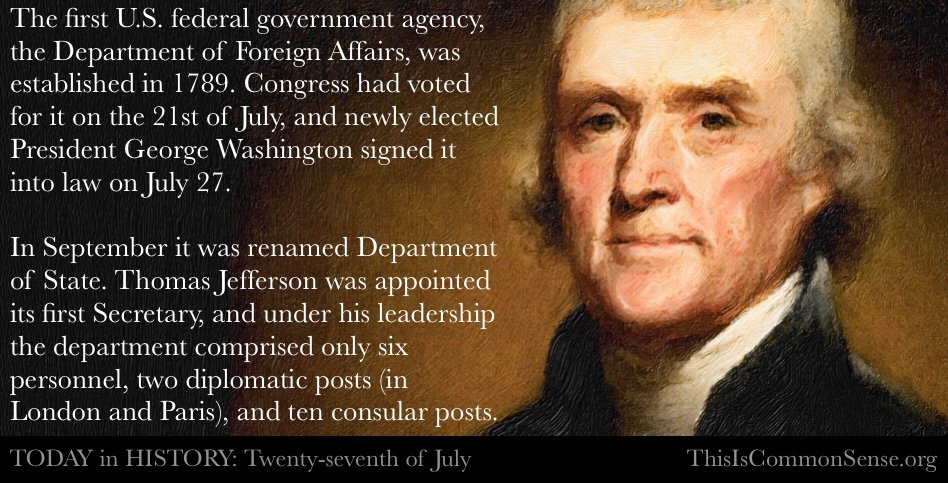
Department of State

The first U.S. federal government agency, the Department of Foreign Affairs, was established in 1789. Congress had voted for it on the 21st of July, and newly elected President George Washington signed it into law on July 27.

In September it was renamed Department of State. Thomas Jefferson was appointed its first Secretary, and under his leadership the department comprised only six personnel, two diplomatic posts (in London and Paris), and ten consular posts.

Categories
Today

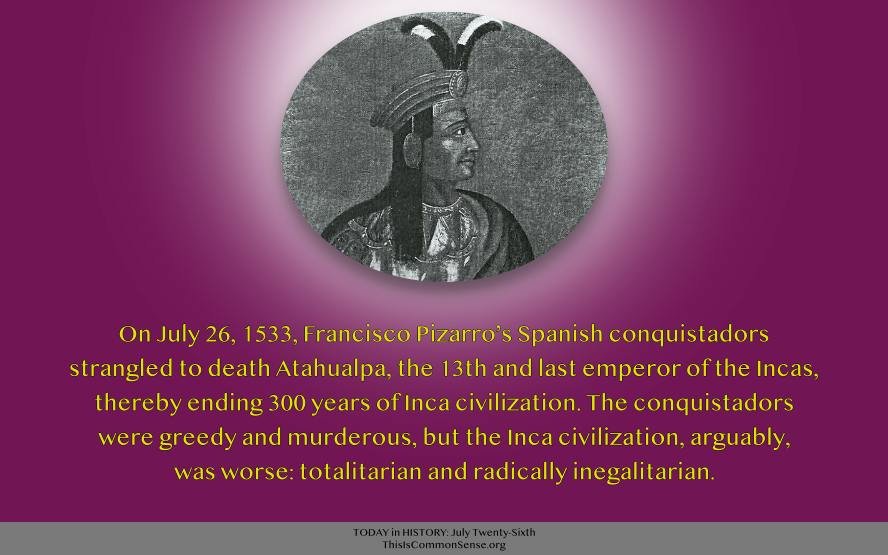
Atahualpa

On July 26, 1533, Francisco Pizarro’s Spanish conquistadors strangled to death Atahualpa, the 13th and last emperor of the Incas, thereby ending 300 years of Inca civilization. The conquistadors were greedy and murderous, but the Inca civilization, arguably, was worse: totalitarian and radically inegalitarian. But they made great high-mountain roads. (Arguments about infrastructure promoted by Big Government continue to this very day. And it is quite possible that an earlier civilization made the roadways, which the Inca merely renovated.)


On this day in 1948, U.S. President Harry S. Truman signed Executive Order 9981 desegregating the U.S. military.

Categories
Today

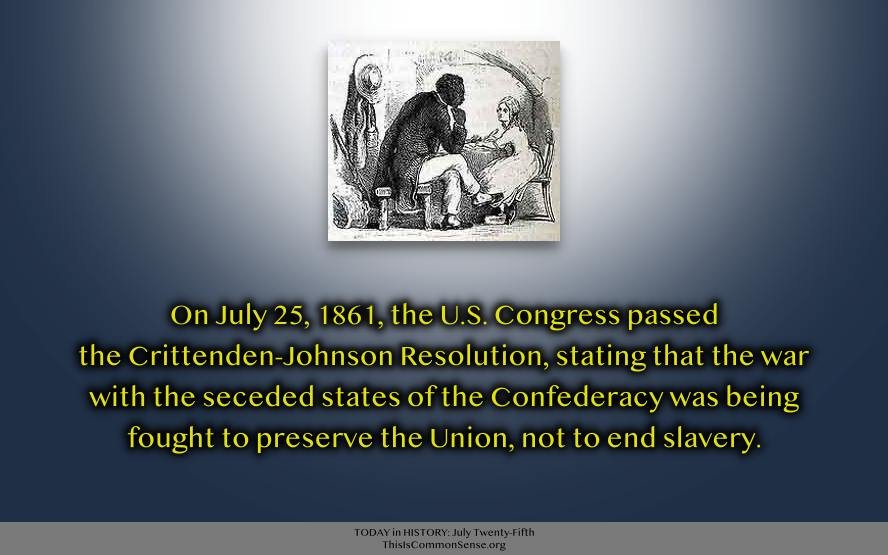
A Fine Point of the War

On July 25, 1861, the U.S. Congress passed the Crittenden-Johnson Resolution, stating that the war with the seceded states of the Confederacy was being fought to preserve the Union, not to end slavery.

Categories
Today

The Watergate Dam Breaks

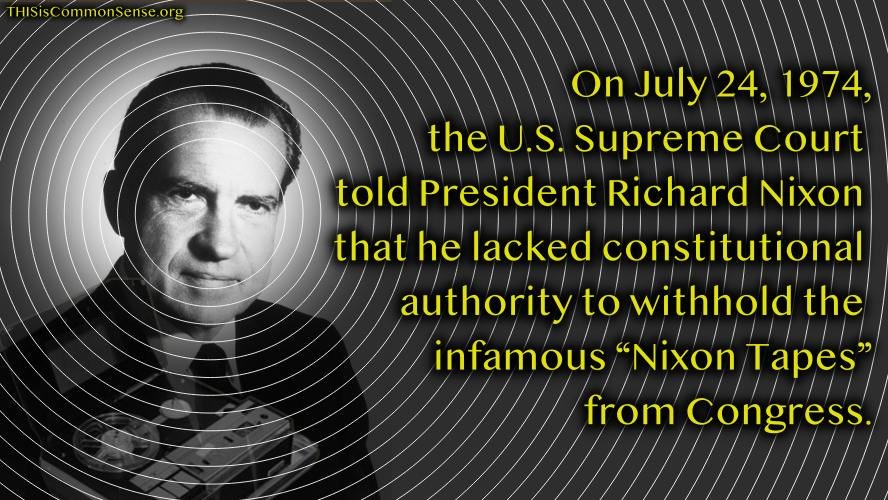
On July 24, 1974, the U.S. Supreme Court told President Richard Nixon that he lacked constitutional authority to withhold the infamous “Nixon Tapes” from Congress.


On July 24, 1487, citizens in Leeuwarden, Netherlands, went on strike against a ban on foreign beer.

On the same day of 1823’s calendar, slavery was abolished in Chile.

July 24 serves as Pioneer Day in Utah and as Simón Bolívar Day in Bolivia, Ecuador, Colombia, and Venezuela.

Categories
Today

Huxleyian A.F.

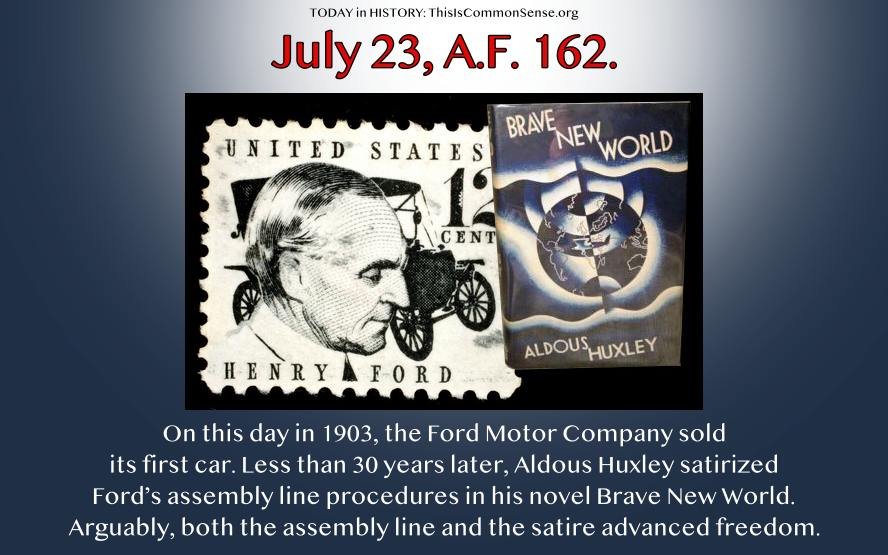
On this day in 1903, the Ford Motor Company sold its first car. Less than 30 years later, Aldous Huxley satirized Ford’s assembly line procedures in his novel Brave New World. Arguably, both the assembly line and the satire advanced freedom.

Today is July 23, A.F. 162. The “A.F.” is not what “af” means in popular online abbreviation, but “in the Year of Our Ford” — “After Ford,” specifically.

Categories
Today

Holding at Nine

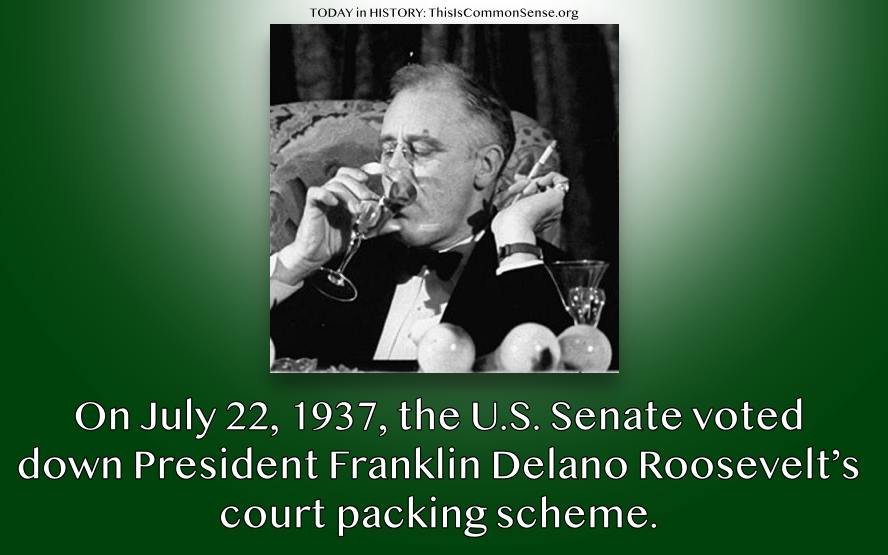
On July 22, 1937, the U.S. Senate voted down President Franklin Delano Roosevelt’s court packing scheme.

Categories
Today

Monkeyshine, Moonshine

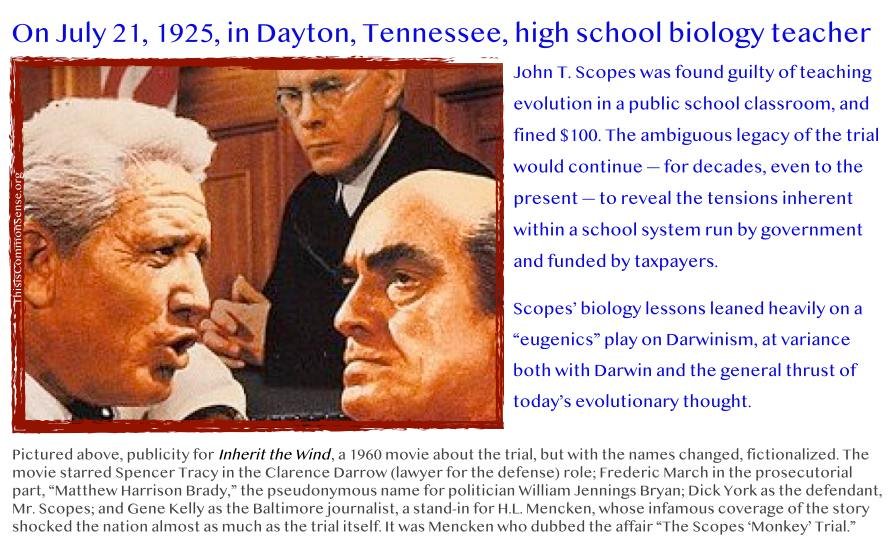
On July 21, 1925, in Dayton, Tennessee, high school biology teacher John T. Scopes was found guilty of teaching evolution in a public school classroom, and fined $100. The ambiguous legacy of the trial would continue — for decades, even to the present — to reveal the tensions inherent within a school system run by government and funded by taxpayers.

Scopes’ biology lessons leaned heavily on a “eugenics” play on Darwinism, at variance both with Darwin and the general thrust of today’s evolutionary thought.


Today is the 56th anniversary of the Apollo 11 mission’s perambulation upon the Moon, on July 21, 1969. Neil Armstrong and Buzz Aldrin walked upon the surface of Mare Tranquillitatis for about two hours and 15 minutes. They spent over 21 hours on the surface, total, most of it inside the Lunar Module, at the site they called Tranquillity Base, before launching to rejoin astronaut Michael Collins in lunar orbit and returning to Earth on the 24th.

Categories
Today

The Count Tracy

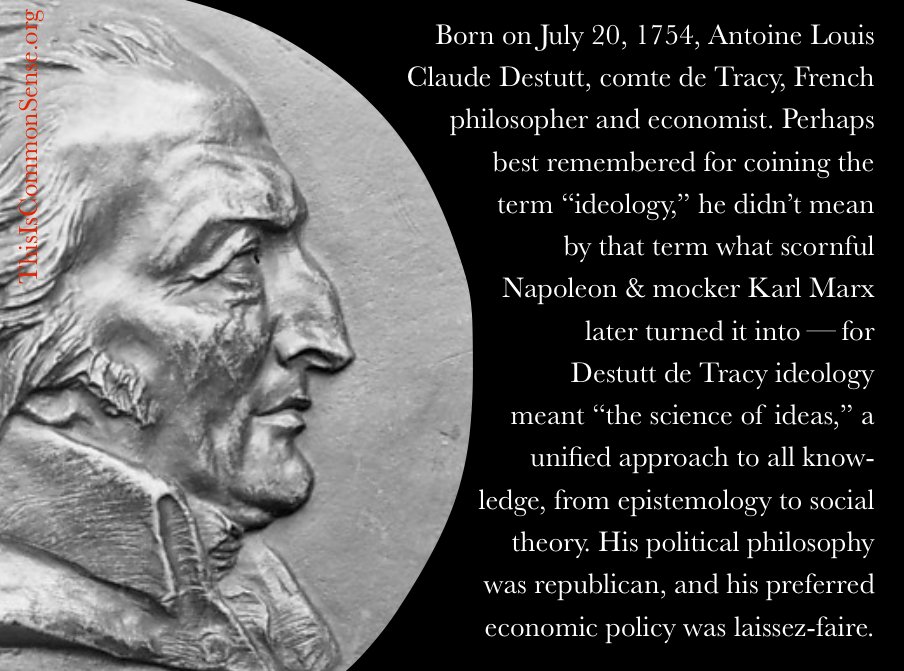
Born on July 20, 1754, Antoine Louis Claude Destutt, comte de Tracy, French philosopher and economist. Perhaps best remembered for coining the term “ideology,” he didn’t mean by that term what scornful Napoleon and communist Karl Marx later turned it into — for Destutt de Tracy ideology meant “the science of ideas,” a unified approach to all knowledge, from epistemology to social theory.

Though his family had been enobled twice, he renounced the title and entered the 1789 Estates General conference as a member of the Third Estate. During the Reign of Terror, he was imprisoned, and would have been executed had not Robespierre been pushed to the scaffold ahead of him.

Two of his books became popular in early 19th century America, his commentaries on Montesquieu’s Spirit of the Laws, and his Traité de la volonté, which Thomas Jefferson, the editor of the American edition, retitled A Treatise on Political Economy. Tracy’s economics was of a deductivist stripe, familiar to readers of later economists such as Nassau Senior and Ludwig von Mises.

Destutt de Tracy’s political philosophy was republican, and his preferred economic policy was laissez-faire.


NASA’s Apollo 11 landed two humans on the Moon — Commander Neil Armstrong and lunar module pilot Buzz Aldrin — on July 20, 1969, at 20:17 UTC.