It is not religion but revolution which is the opium of the people.
Simone Weil, Gravity and Grace (1947; 1972), p. 140.
Categories
Simone Weil

It is not religion but revolution which is the opium of the people.
Simone Weil, Gravity and Grace (1947; 1972), p. 140.
[F]reedom means having no masters except your own consciences and common sense.
Poul Anderson, The Stars Are Also Fire (1994), p. 16.
[T]here is a tendency in descendants to be like their progenitors, and yet a tendency also in descendants to differ from their progenitors. The work of nature in making generations is a patchwork — part resemblance, part contrast. In certain respects each born generation is not like the last born; and in certain other respects it is like the last. But the peculiarity of arrested civilisation is to kill out varieties at birth almost; that is, in early childhood, and before they can develop. The fixed custom which public opinion alone tolerates is imposed on all minds, whether it suits them or not.
Walter Bagehot, Physics and Politics (1872).
The human soul has need of truth and of freedom of expression.
Simone Weil, Draft for a Statement of Human Obligation (1943).
The need for truth requires that intellectual culture should be universally accessible, and that it should be able to be acquired in an environment neither physically remote nor psychologically alien.
The great difficulty which history records is not that of the first step, but that of the second step. What is most evident is not the difficulty of getting a fixed law, but getting out of a fixed law; not of cementing (as upon a former occasion phrased it) a cake of custom, but of breaking the cake of custom; not of making the first preservative habit, but of breaking through it, and reaching something better.
Walter Bagehot, Physics and Politics (1872).

To know how just a cause we have for grieving is already a consolation.
George Santayana, The Life of Reason: The Phases of Human Progress; Vol. IV, Reason in Art (1906).
Humor is what happens when we’re told the truth quicker and more directly than we’re used to.
George Saunders, The Braindead Megaphone (2007).
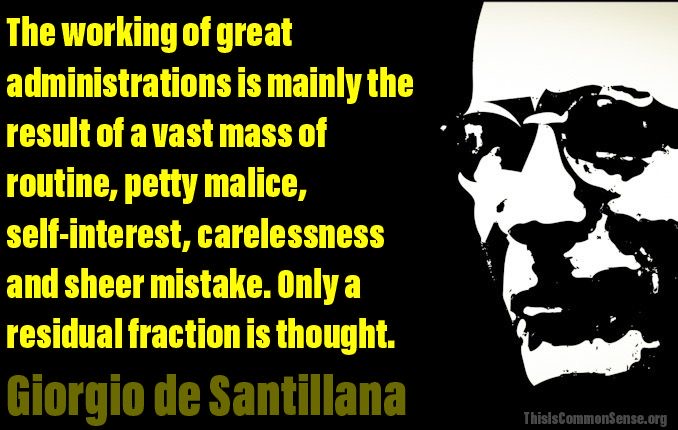
The working of great administrations is mainly the result of a vast mass of routine, petty malice, self-interest, carelessness and sheer mistake. Only a residual fraction is thought.
Giorgio de Santillana, The Crime of Galileo (1958).

The mind celebrates a little triumph whenever it can formulate a truth.
George Santayana, The Life of Reason: The Phases of Human Progress; Vol. IV, Reason in Art (1906).
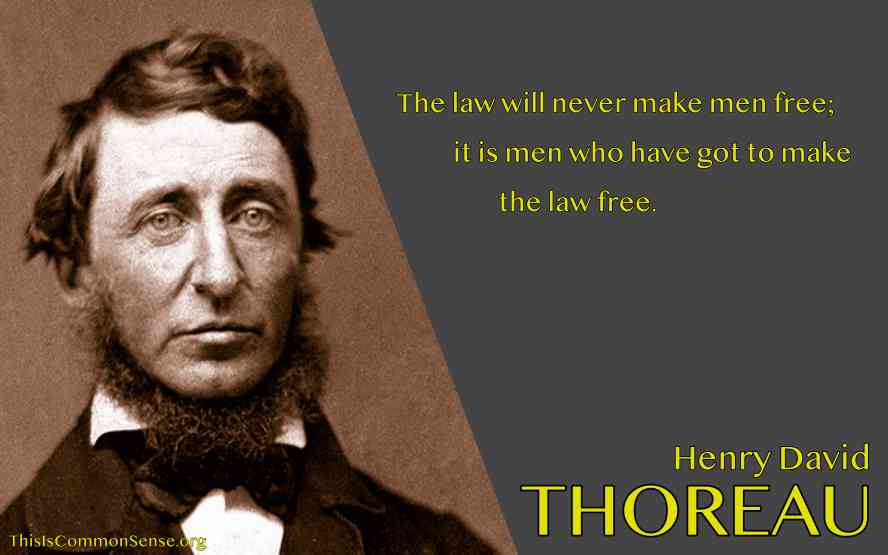
Henry David Thoreau, “Slavery in Massachusetts” (1854).
The law will never make men free; it is men who have got to make the law free.