People who want to police “hate speech” hate speech.
Comedian Jimmy Dore on John Papola’s Dad Saves America podcast (March 13, 2025).
Categories
Jimmy Dore

People who want to police “hate speech” hate speech.
Comedian Jimmy Dore on John Papola’s Dad Saves America podcast (March 13, 2025).

We must make our election between economy and liberty, or profusion and servitude. If we run into such debts, as that we must be taxed in our meat and in our drink, in our necessaries and our comforts, in our labors and our amusements, for our callings and our creeds, as the people of England are, our people, like them, must come to labor sixteen hours in the twenty-four, give the earnings of fifteen of these to the government for their debts and daily expenses; and the sixteenth being insufficient to afford us bread, we must live, as they now do, on oatmeal and potatoes; have no time to think, no means of calling the mismanagers to account; but be glad to obtain subsistence by hiring ourselves to rivet their chains on the necks of our fellow-sufferers. Our landholders, too, like theirs, retaining indeed the title and stewardship of estates called theirs, but held really in trust for the treasury, must wander, like theirs, in foreign countries, and be contented with penury, obscurity, exile, and the glory of the nation. This example reads to us the salutary lesson, that private fortunes are destroyed by public as well as by private extravagance. And this is the tendency of all human governments. A departure from principle in one instance becomes a precedent for a second; that second for a third; and so on, till the bulk of the society is reduced to be mere automatons of misery, and to have no sensibilities left but for sinning and suffering. Then begins, indeed, the bellum omnium in omnia, which some philosophers observing to be so general in this world, have mistaken it for the natural, instead of the abusive state of man. And the fore horse of this frightful team is public debt. Taxation follows that, and in its train wretchedness and oppression.
Thomas Jefferson, Letter to Samuel Kercheval (June 12, 1816). The Latin phrase bellum omnium in omnia means “war of all things against all things,” and is Jefferson’s play upon bellum omnium contra omnes, a Latin phrase meaning “the war of all against all,” which is the formulation that Thomas Hobbes gave to human existence in the state of nature in De Cive (1642) and Leviathan (1651). Jefferson is certainly tipping his hat to his friend C.-F. Volney’s concept of this sort of war carried on within modern states, as discussed in The Ruins (1802), the bulk of which Jefferson himself translated from the French.
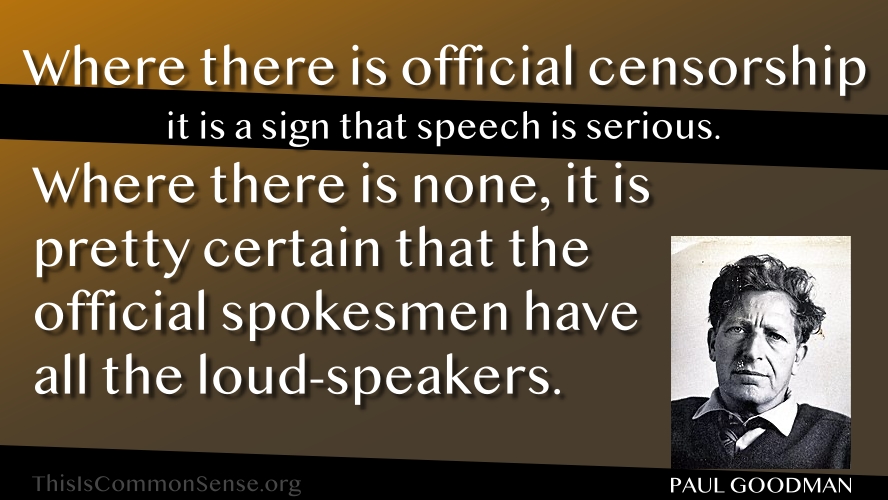
Where there is official censorship it is a sign that speech is serious. Where there is none, it is pretty certain that the official spokesmen have all the loud-speakers.
Paul Goodman, Growing Up Absurd (1956), p. 40.
Science is made up of so many things that appear obvious after they are explained.
The character “Pardot Kynes” in Frank Herbert‘s Dune (1965).

Alas, if man is blind, shall his misfortune be also his crime? I may have mistaken the voice of reason; but never, knowingly, have I rejected its authority.
Constantin François de Chassebœuf, comte de Volney, The Ruins, or, Meditation on the Revolutions of Empires (1793; second English-language translation, the Philadelphia edition, 1802).

Mary Wollstonecraft, A Vindicaton of the Rights of Woman (1792), chapter 4.
Men . . . submit every where to oppression, when they have only to lift up their heads to throw off the yoke; yet, instead of asserting their birthright, they quietly lick the dust and say, let us eat and drink, for to-morrow we die. Women, I argue from analogy, are degraded by the same propensity to enjoy the present moment; and, at last, despise the freedom which they have not sufficient virtue to struggle to attain.

It is desperately hard these days for an average child to grow up to be a man, for our present organized system does not want men. They are not safe.
Paul Goodman, Growing Up Absurd (1956), p. 14.

When time and labor had developed riches, cupidity restrained by the laws, became more artful, but not less active. Under the mask of union and civil peace, it fomented in the bosom of every state an intestine war, in which the citizens, divided into contending corps of orders, classes, families, unremittingly struggled to appropriate to themselves, under the name of supreme power, the ability to plunder every thing, and render every thing subservient to the dictates of their passions; and this spirit of encroachment, disguised under all possible forms, but always the same in its object and motives, has never ceased to torment the nations.
Constantin François de Chassebœuf, comte de Volney, The Ruins, or, Meditation on the Revolutions of Empires (1793; second English-language edition translated by Thomas Jefferson & Joel Barlow, Philadelphia, 1802).

Never have the young taken themselves so seriously, and the calamity is that they are listened to and deferred to by so many adults. A society that takes its solemn adolescents seriously is headed for serious trouble. How humorless and laughable the solemn young! One realizes that one of the chief differences between an adult and a juvenile is that the adult knows when he is an ass while the juvenile never does.
Paul Goodman, Growing Up Absurd (1960).
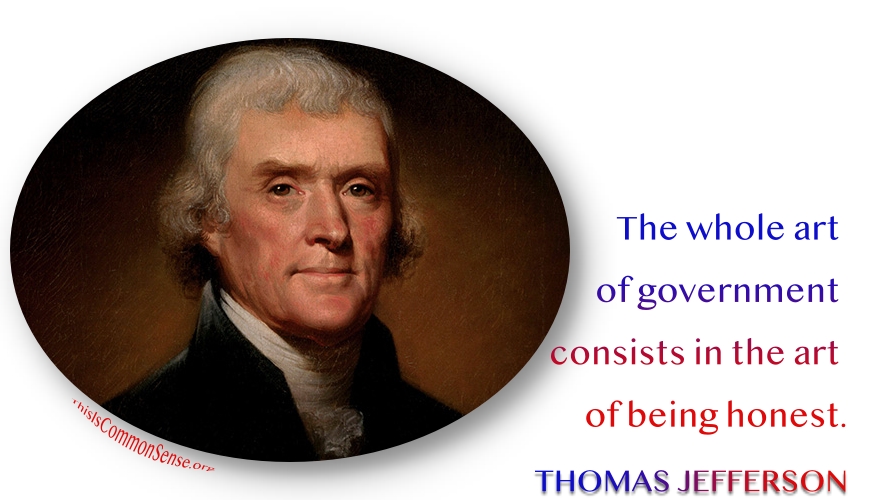
The whole art of government consists in the art of being honest.
Thomas Jefferson, A Summary View of the Rights of British America (1774).