Categories
Thought

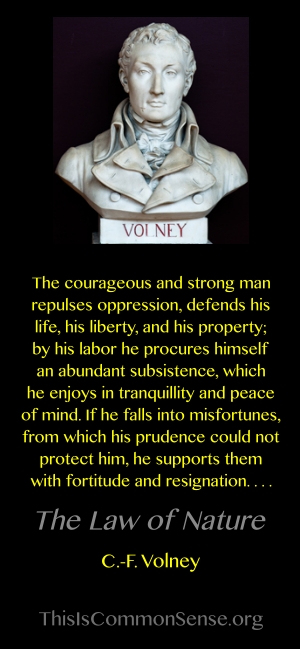
C.-F. Volney

Q. Are courage and strength of body and mind virtues in the law of nature?
A. Yes, and most important virtues; for they are the efficacious and indispensable means of attending to our preservation and welfare. The courageous and strong man repulses oppression, defends his life, his liberty, and his property; by his labor he procures himself an abundant subsistence, which he enjoys in tranquillity and peace of mind. If he falls into misfortunes, from which his prudence could not protect him, he supports them with fortitude and resignation; and it is for this reason that the ancient moralists have reckoned strength and courage among the four principal virtues.”

Constantin-François de Chassebœuf (1757–1820), Comte de Volney, The Law of Nature, Chapter VIII.
Categories
Thought

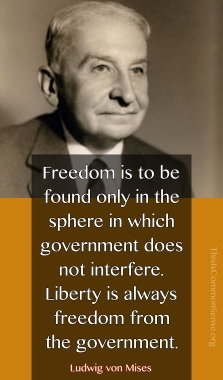
Ludwig von Mises

Freedom is to be found only in the sphere in which government does not interfere. Liberty is always freedom from the government.

Ludwig Edler von Mises, “Liberty and Property” (1958).
Categories
Thought

Comte de Volney

Who knows but that hereafter some traveller like myself will sit down upon the banks of the Seine, the Thames, or the Zuyder Zee, where now, in the tumult of enjoyment, the heart and the eyes are too slow to take in the multitude of sensations? Who knows but he will sit down solitary amid silent ruins, and weep a people inurned and their greatness changed into an empty name?

Constantin-François de Chassebœuf (1757–1820), Comte de Volney, The Ruins; Or, Meditation on the Revolutions of Empires: And The Law of Nature, Chapter II (Thomas Jefferson, translator).
Categories
Thought

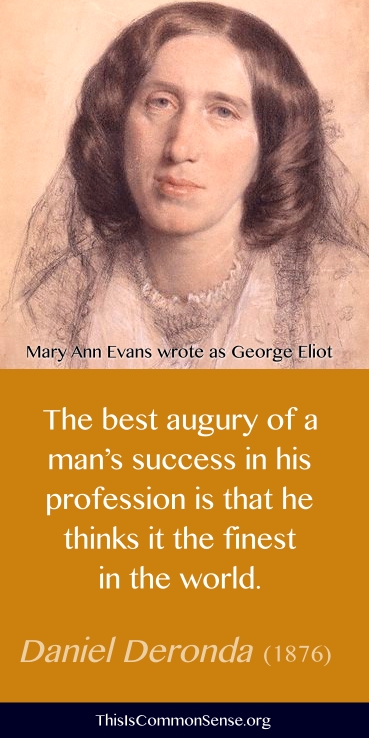
George Eliot

The best augury of a man’s success in his profession is that he thinks it the finest in the world.

Mary Ann Evans, writing as George Eliot, Daniel Deronda (1876).

Categories
Thought

C.-F. Volney

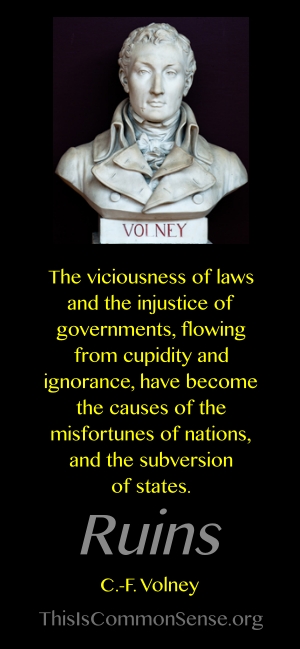
The perpetual play of the passions having produced incidents not foreseen — their conventions having been vicious, inadequate, or nugatory — in fine, the authors of the laws having sometimes mistaken, sometimes disguised their objects; and their ministers, instead of restraining the cupidity of others, having given themselves up to their own; all these causes have introduced disorder and trouble into societies; and the viciousness of laws and the injustice of governments, flowing from cupidity and ignorance, have become the causes of the misfortunes of nations, and the subversion of states.

Constantin-François de Chassebœuf (1757–1820), Comte de Volney, The Ruins; Or, Meditation on the Revolutions of Empires, Chapter IX (Thomas Jefferson, translator).
Categories
Thought

Anthony Trollope

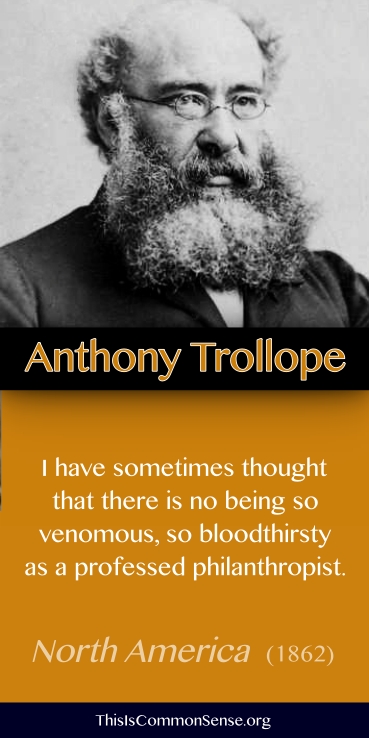
I have sometimes thought that there is no being so venomous, so bloodthirsty as a professed philanthropist.

Anthony Trollope, North America, Ch. 16 (1862).
Categories
Thought

George Eliot

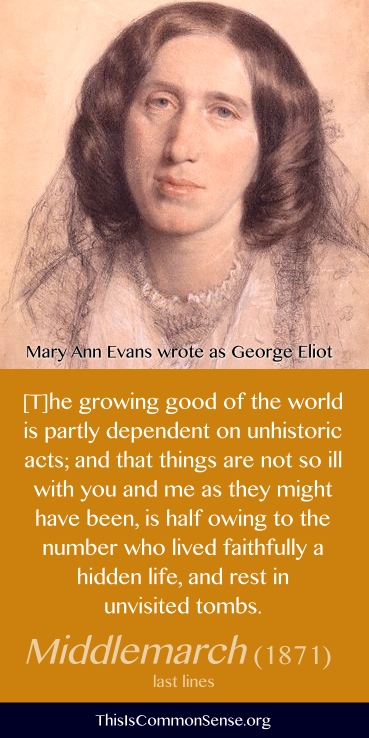
[T]he growing good of the world is partly dependent on unhistoric acts; and that things are not so ill with you and me as they might have been, is half owing to the number who lived faithfully a hidden life, and rest in unvisited tombs.

Mary Ann Evans writing as George Eliot, Middlemarch (1871).
Categories
Thought

Lord Acton

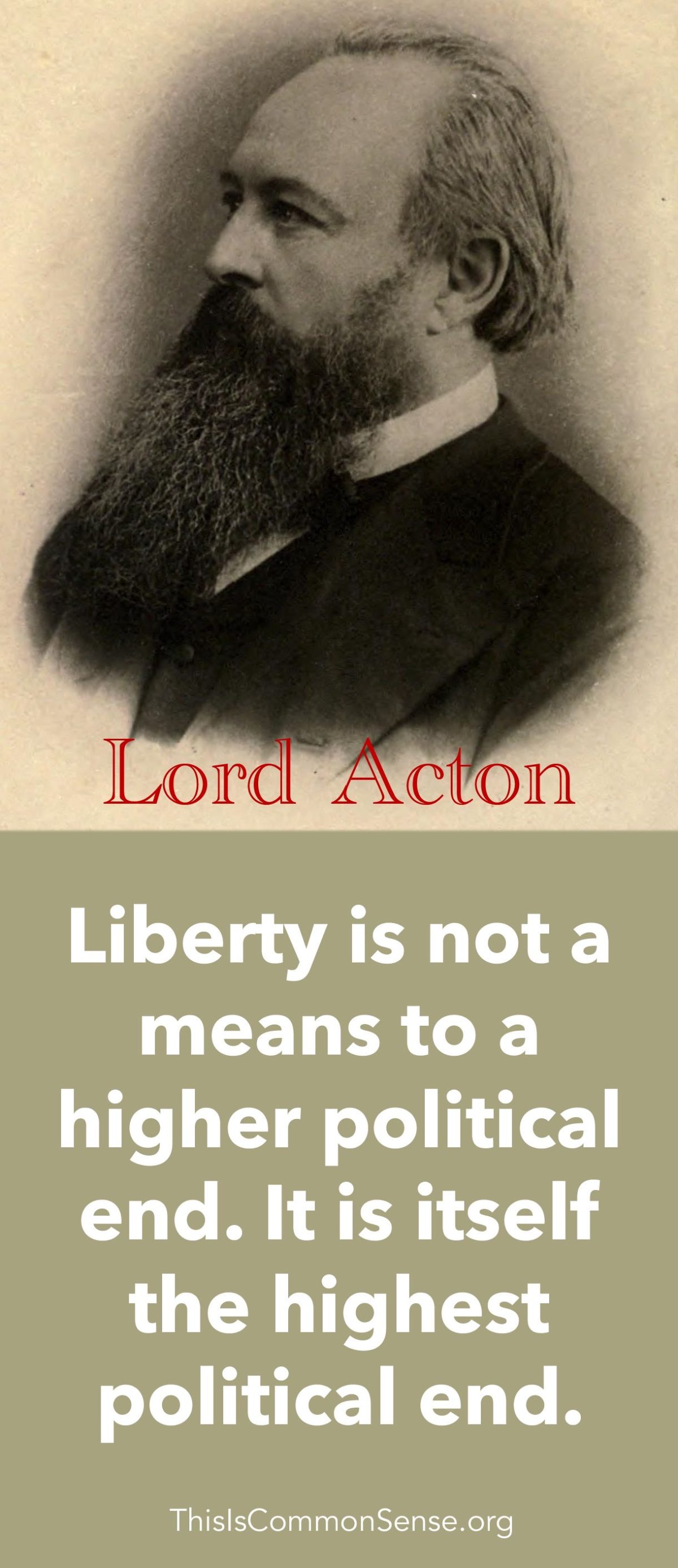
Liberty and good government do not exclude each other; and there are excellent reasons why they should go together. Liberty is not a means to a higher political end. It is itself the highest political end. It is not for the sake of a good public administration that it is required, but for security in the pursuit of the highest objects of civil society, and of private life.

John Dalberg-Acton, 1st Baron Acton, The History of Freedom in Antiquity (1877).
Categories
Thought

J.H. Levy

Our intellectual and moral natures come into play only when we discriminate and decide for ourselves. Just so far as this discrimination and decision are taken away from us, we are deprived of the most essential element of our manhood and womanhood, and are turned into mere tools propelled from without. That any community can, in the long run, gain by thus dwarfing and paralyzing the humanity of its members — that we could long succeed, even for administrative purposes, under such a system, is the notion of a moral spendthrift.

Joseph Hiam Levy, The Outcome of Individualism (Third Edition, 1892).
Categories
Thought

Lord Acton

It is bad to be oppressed by a minority, but it is worse to be oppressed by a majority. For there is a reserve of latent power in the masses which, if it is called into play, the minority can seldom resist.

Lord Acton, “The History of Freedom in Antiquity,” 1877.