This term in its particular application means “that dominion which one man claims and exercises over the external things of the world, in exclusion of every other individual.”
In its larger and juster meaning, it embraces every thing to which a man may attach a value and have a right; and which leaves to every one else the like advantage.
In the former sense, a man’s land, or merchandise, or money is called his property.
In the latter sense, a man has a property in his opinions and the free communication of them.
He has a property of peculiar value in his religious opinions, and in the profession and practice dictated by them.
He has a property very dear to him in the safety and liberty of his person.
He has an equal property in the free use of his faculties and free choice of the objects on which to employ them.
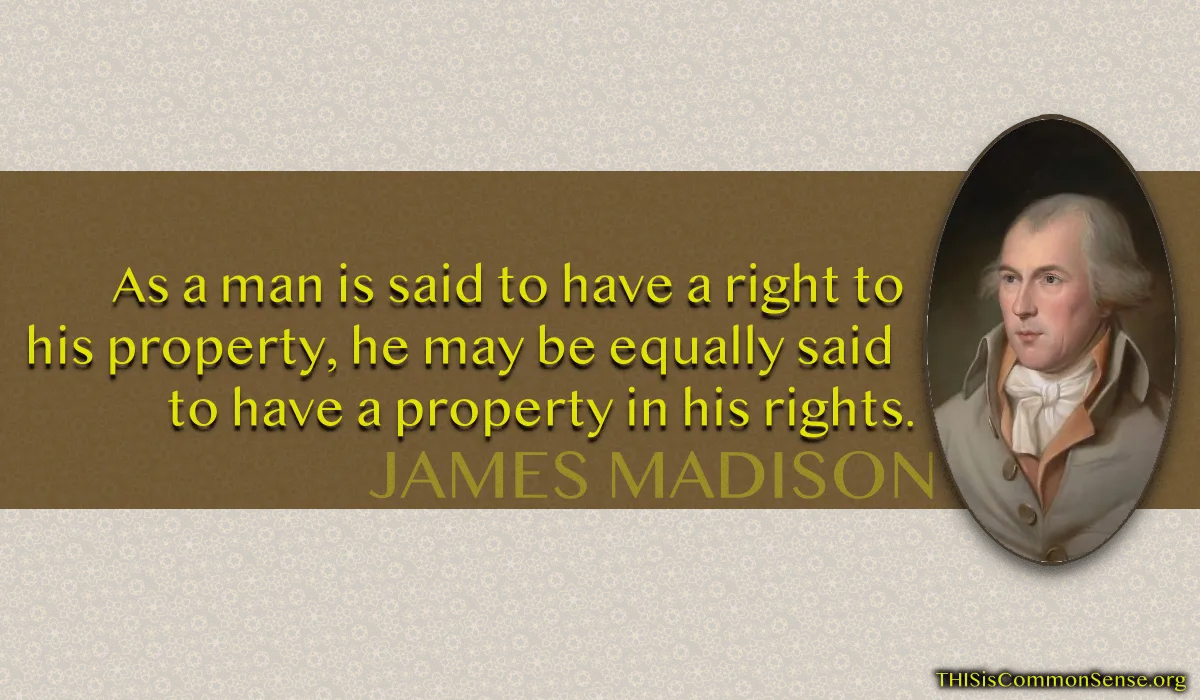
In a word, as a man is said to have a right to his property, he may be equally said to have a property in his rights.
Where an excess of power prevails, property of no sort is duly respected. No man is safe in his opinions, his person, his faculties, or his possessions.
Where there is an excess of liberty, the effect is the same, though from an opposite cause.
Government is instituted to protect property of every sort; as well that which lies in the various rights of individuals, as that which the term particularly expresses. This being the end of government, that alone is a just government, which impartially secures to every man, whatever is his own.
According to this standard of merit, the praise of affording a just securing to property, should be sparingly bestowed on a government which, however scrupulously guarding the possessions of individuals, does not protect them in the enjoyment and communication of their opinions, in which they have an equal, and in the estimation of some, a more valuable property.
More sparingly should this praise be allowed to a government, where a man’s religious rights are violated by penalties, or fettered by tests, or taxed by a hierarchy. Conscience is the most sacred of all property; other property depending in part on positive law, the exercise of that, being a natural and unalienable right. To guard a man’s house as his castle, to pay public and enforce private debts with the most exact faith, can give no title to invade a man’s conscience which is more sacred than his castle, or to withhold from it that debt of protection, for which the public faith is pledged, by the very nature and original conditions of the social pact.
That is not a just government, nor is property secure under it, where the property which a man has in his personal safety and personal liberty, is violated by arbitrary seizures of one class of citizens for the service of the rest. A magistrate issuing his warrants to a press gang, would be in his proper functions in Turkey or Indostan, under appellations proverbial of the most complete despotism.
That is not a just government, nor is property secure under it, where arbitrary restrictions, exemptions, and monopolies deny to part of its citizens that free use of their faculties, and free choice of their occupations, which not only constitute their property in the general sense of the word; but are the means of acquiring property strictly so called. What must be the spirit of legislation where a manufacturer of linen cloth is forbidden to bury his own child in a linen shroud, in order to favor his neighbour who manufactures woolen cloth; where the manufacturer and wearer of woolen cloth are again forbidden the economical use of buttons of that material, in favor of the manufacturer of buttons of other materials!
A just security to property is not afforded by that government, under which unequal taxes oppress one species of property and reward another species: where arbitrary taxes invade the domestic sanctuaries of the rich, and excessive taxes grind the faces of the poor; where the keenness and competitions of want are deemed an insufficient spur to labor, and taxes are again applied, by an unfeeling policy, as another spur; in violation of that sacred property, which Heaven, in decreeing man to earn his bread by the sweat of his brow, kindly reserved to him, in the small repose that could be spared from the supply of his necessities.
If there be a government then which prides itself in maintaining the inviolability of property; which provides that none shall be taken directly even for public use without indemnification to the owner, and yet directly violates the property which individuals have in their opinions, their religion, their persons, and their faculties; nay more, which indirectly violates their property, in their actual possessions, in the labor that acquires their daily subsistence, and in the hallowed remnant of time which ought to relieve their fatigues and soothe their cares, the influence will have been anticipated, that such a government is not a pattern for the United States.
If the United States mean to obtain or deserve the full praise due to wise and just governments, they will equally respect the rights of property, and the property in rights: they will rival the government that most sacredly guards the former; and by repelling its example in violating the latter, will make themselves a pattern to that and all other governments.
James Madison, “Property,” National Gazette (March 27, 1792).