The positive testimony of history is that the State invariably had its origin in conquest and confiscation. No primitive State known to history originated in any other manner.
Categories
Albert Jay Nock
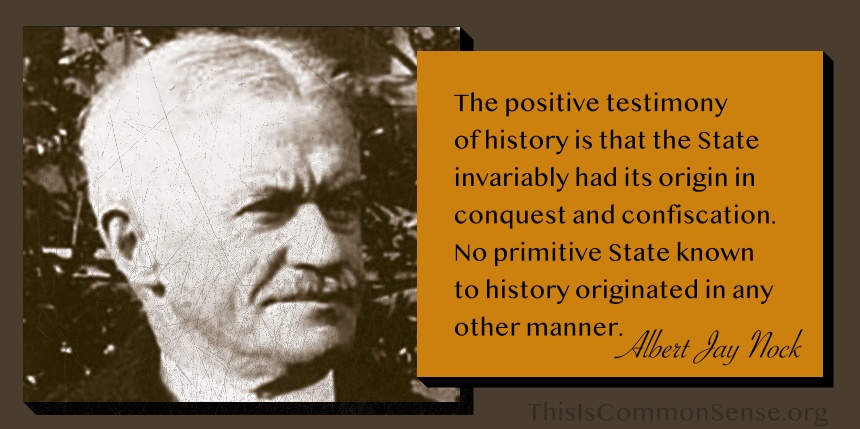
The positive testimony of history is that the State invariably had its origin in conquest and confiscation. No primitive State known to history originated in any other manner.
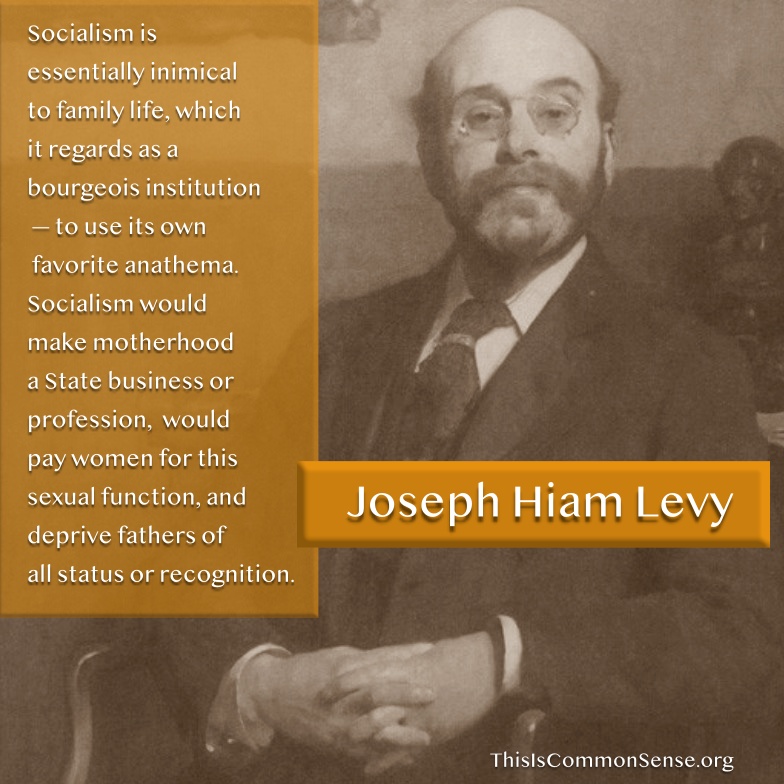
Socialism is essentially inimical to family life, which it regards as a bourgeois institution — to use its own favorite anathema. Socialism would make motherhood a State business or profession, would pay women for this sexual function, and deprive fathers of all status or recognition.
Joseph Hiam Levy, The Outcome of Individualism, Third Edition (1892).
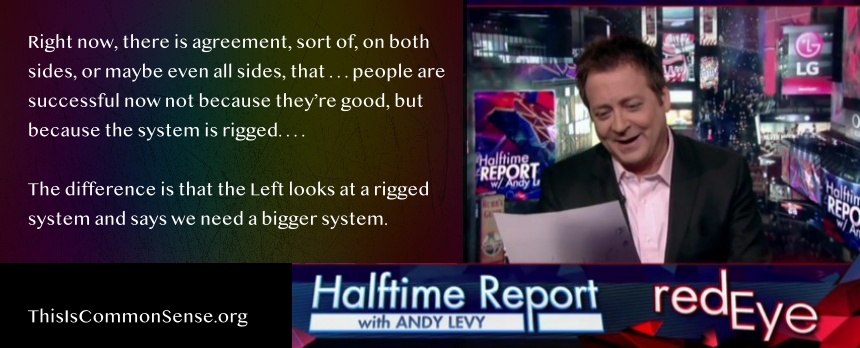
“Right now, there is agreement, sort of, on both sides, or maybe even all sides, that . . . people are successful now not because they’re good, but because the system is rigged. . . .
“The difference is that the Left looks at a rigged system and says we need a bigger system.”
Andy Levy, February 20, 2016.
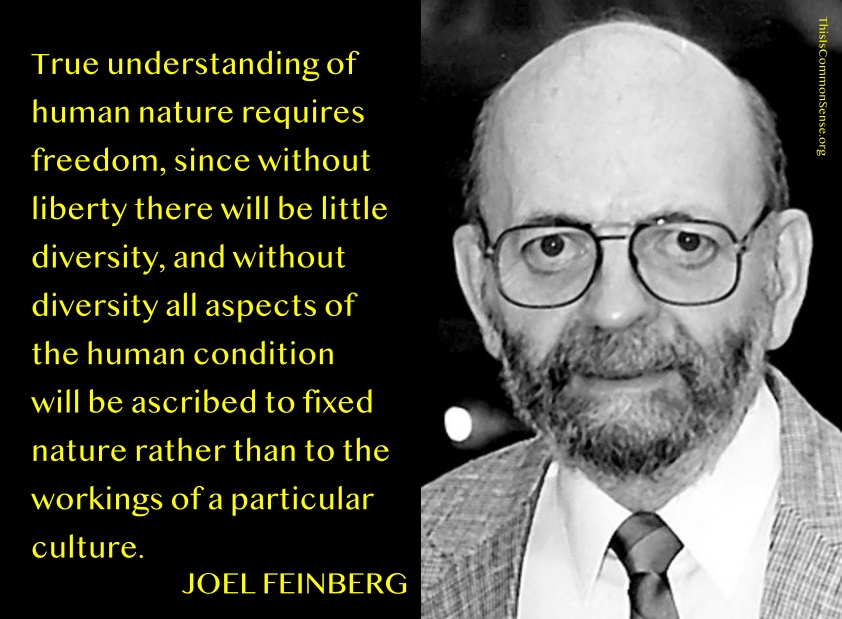
[T]rue understanding of human nature requires freedom, since without liberty there will be little diversity, and without diversity all aspects of the human condition will be ascribed to fixed nature rather than to the workings of a particular culture.
Joel Feinberg, Social Philosophy (1973), p. 22.
Civilization is an enormous device for economizing on knowledge.
Thomas Sowell, Knowledge and Decisions (1980; 1996.
The smart way to keep people passive and obedient is to strictly limit the spectrum of acceptable opinion, but allow very lively debate within that spectrum — even encourage the more critical and dissident views. That gives people the sense that there’s free thinking going on, while all the time the presuppositions of the system are being reinforced by the limits put on the range of the debate.
Noam Chomsky, The Common Good (1988).
Man is subject to the passing of time. He comes into existence, grows, becomes old, and passes away. His time is scarce. He must economize it as he economizes other scarce factors.
Ludwig von Mises, Human Action: A Treatise on Economics (1949).

Inflation is always and everywhere a monetary phenomenon in the sense that it is and can be produced only by a more rapid increase in the quantity of money than in output.
Milton Friedman, The Counter-Revolution in Monetary Theory (1970).

If social conditions did not fulfill the wishes of the reformers, if their utopias proved unrealizable, the fault was seen in the moral failure of man. Social problems were considered ethical problems. What was needed in order to construct the ideal society, they thought, were good princes and virtuous citizens. With righteous men any utopia might be realized.
The discovery of the inescapable interdependence of market phenomena overthrew this opinion. Bewildered, people had to face a new view of society. They learned with stupefaction that there is another aspect from which human action might be viewed than that of good and bad, of fair and unfair, of just and unjust. In the course of social events there prevails a regularity of phenomena to which man must adjust his actions if he wishes to succeed. It is futile to approach social facts with the attitude of a censor who approves or disapproves from the point of view of quite arbitrary standards and subjective judgments of value. One must study the laws of human action and social cooperation as the physicist studies the laws of nature. Human action and social cooperation seen as the object of a science of given relations, no longer as a normative discipline of things that ought to be — this was a revolution of tremendous consequences for knowledge and philosophy as well as for social action.
Ludwig von Mises, Human Action: A Treatise on Economics (1949).
The most important thing to remember is that inflation is not an act of God; inflation is not a catastrophe of the elements or a disease that comes like the plague. Inflation is a policy — a deliberate policy of people who resort to inflation because they consider it to be a lesser evil than unemployment. But the fact is that, in the not very long run, inflation does not cure unemployment.
Inflation is a policy. And a policy can be changed. Therefore, there is no reason to give in to inflation. If one regards inflation as an evil, then one has to stop inflating.
Ludwig Edler von Mises, fourth lecture from Economic Policy: Thoughts for Today and Tomorrow (1979; 1995; 2006).