Categories
Thought

Gustave Le Bon

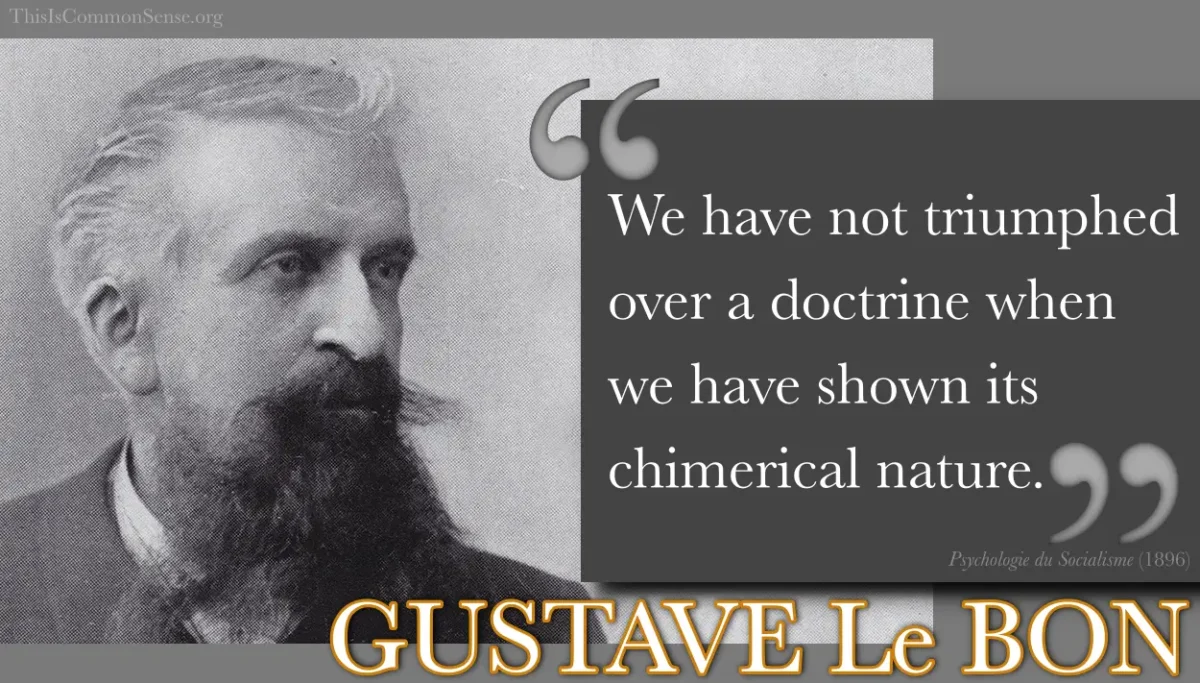
We have not triumphed over a doctrine when we have shown its chimerical nature.

Gustave Le Bon, Psychologie du Socialisme (1896), translated as The Psychology of Socialism (1899). Passage offered here last week, but this sentence stood out. Worthy of emphasis.
Categories
Thought

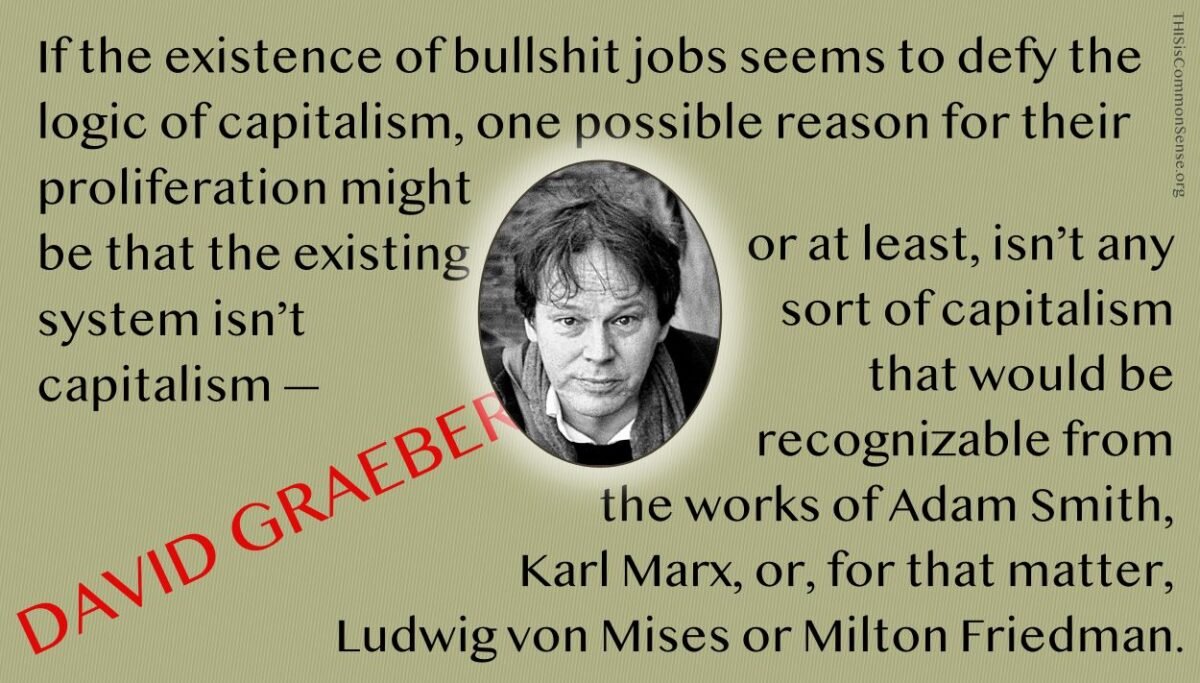
David Graeber

If the existence of bullshit jobs seems to defy the logic of capitalism, one possible reason for their proliferation might be that the existing system isn’t capitalism — or at least, isn’t any sort of capitalism that would be recognizable from the works of Adam Smith, Karl Marx, or, for that matter, Ludwig von Mises or Milton Friedman.

David Graeber, Bullshit Jobs: A Theory (2018).

Categories
Thought

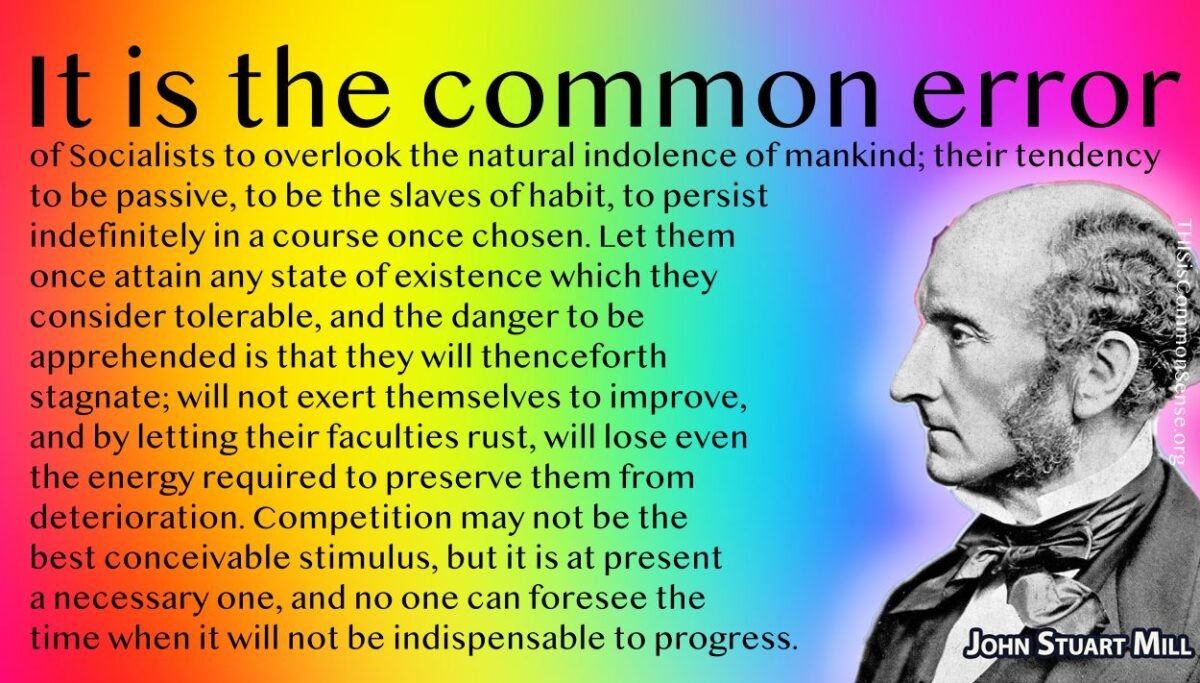
J.S. Mill

It is the common error of Socialists to overlook the natural indolence of mankind; their tendency to be passive, to be the slaves of habit, to persist indefinitely in a course once chosen. Let them once attain any state of existence which they consider tolerable, and the danger to be apprehended is that they will thenceforth stagnate; will not exert themselves to improve, and by letting their faculties rust, will lose even the energy required to preserve them from deterioration. Competition may not be the best conceivable stimulus, but it is at present a necessary one, and no one can foresee the time when it will not be indispensable to progress.

John Stuart Mill, Principles of Political Economy (1848; 1871), Volume II, Book IV, Chapter 7.

Categories
Thought

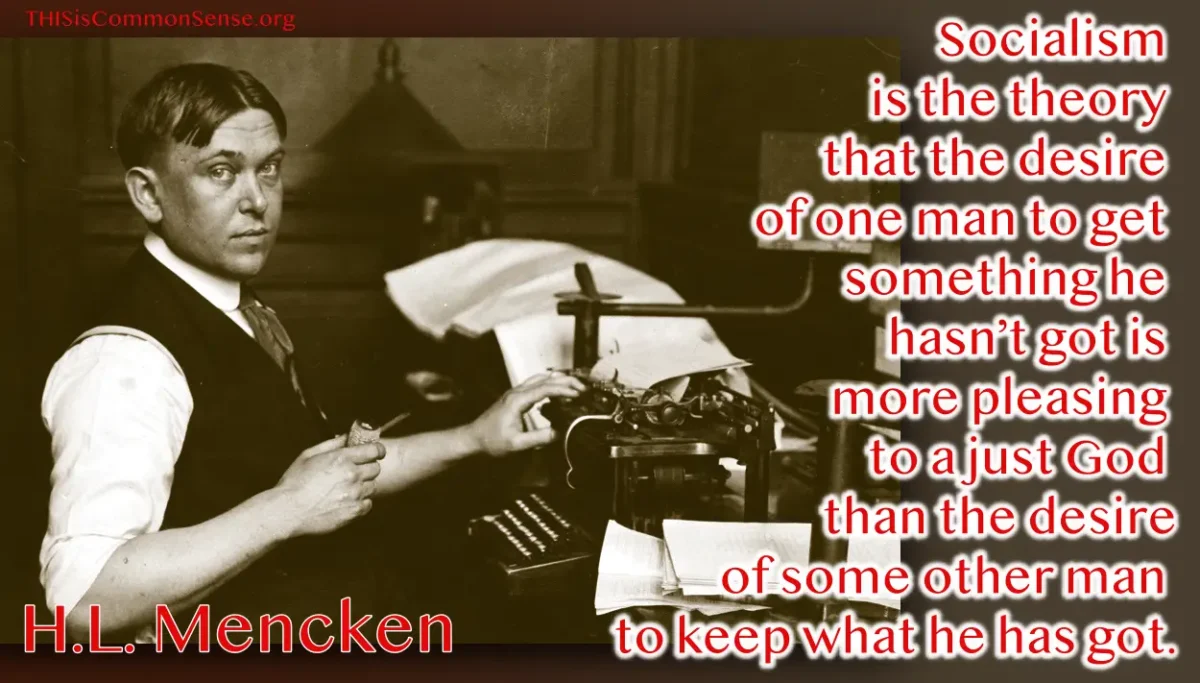
H.L. Mencken

Socialism is the theory that the desire of one man to get something he hasn’t got is more pleasing to a just God than the desire of some other man to keep what he has got.

H.L. Mencken, A Little Book in C Major (1916) p. 51.
Categories
Thought

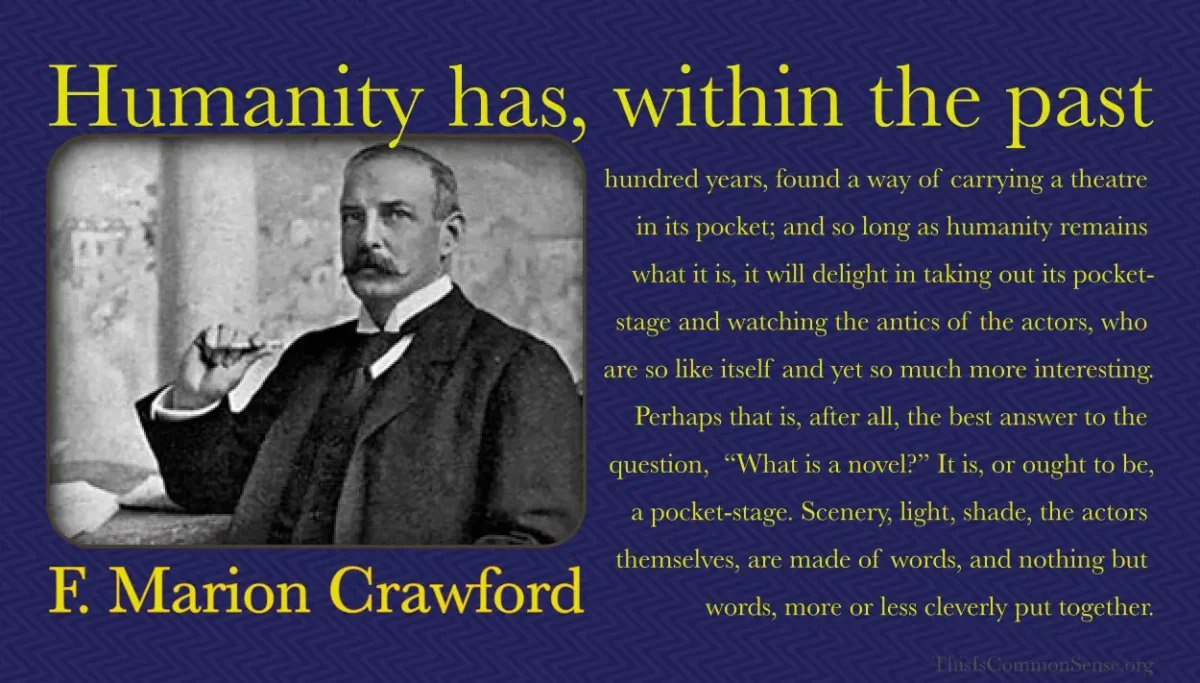
F. Marion Crawford

It may fairly be claimed that humanity has, within the past hundred years, found a way of carrying a theatre in its pocket; and so long as humanity remains what it is, it will delight in taking out its pocket-stage and watching the antics of the actors, who are so like itself and yet so much more interesting. Perhaps that is, after all, the best answer to the question, “What is a novel?” It is, or ought to be, a pocket-stage. Scenery, light, shade, the actors themselves, are made of words, and nothing but words, more or less cleverly put together. A play is good in proportion as it represents the more dramatic, passionate, romantic, or humorous sides of real life. A novel is excellent according to the degree in which it produces the illusions of a good play — but it must not be forgotten that the play is the thing, and that illusion is eminently necessary to success.

Francis Marion Crawford, The Novel: What It Is (1882), Chapter VIII.
Categories
Thought

Doris Lessing

There are certain types of people who are political out of a kind of religious reason. . . . I think it’s fairly common among socialists: They are, in fact, God-seekers, looking for the kingdom of God on earth. A lot of religious reformers have been like that, too. It’s the same psychological set, trying to abolish the present in favor of some better future — always taking it for granted that there is a better future. If you don’t believe in heaven, then you believe in socialism. When I was in my real Communist phase, I and the people around me really believed — but, of course, this makes us certifiable — that something like ten years after World War II, the world would be Communist and perfect.

Doris Lessing, novelist, as quoted in “Doris Lessing on Feminism, Communism and Space Fiction,” Lesley Hazelton, New York Times Book Review (July 25, 1982).

Categories
Thought

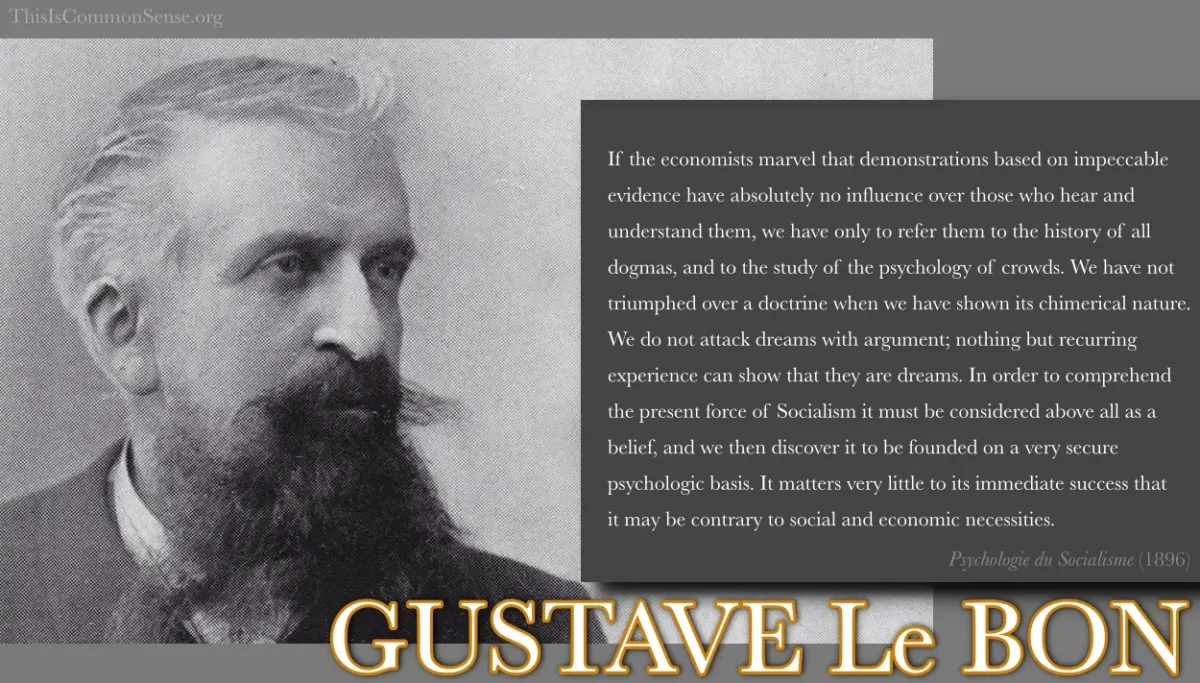
Gustave Le Bon

If the economists marvel that demonstrations based on impeccable evidence have absolutely no influence over those who hear and understand them, we have only to refer them to the history of all dogmas, and to the study of the psychology of crowds. We have not triumphed over a doctrine when we have shown its chimerical nature. We do not attack dreams with argument; nothing but recurring experience can show that they are dreams. In order to comprehend the present force of Socialism it must be considered above all as a belief, and we then discover it to be founded on a very secure psychologic basis. It matters very little to its immediate success that it may be contrary to social and economic necessities. The history of all beliefs, and especially of religious beliefs, sufficiently proves that their success has most often been entirely independent of the proportion of truth that they might contain.

Gustave Le Bon, Psychologie du Socialisme (1896), translated as The Psychology of Socialism (1899).
Categories
Thought

F. Marion Crawford

A man who believes he is beaten is already more than half conquered.

Francis Marion Crawford, Mr. Isaacs (1882), Chapter VIII.
Categories
Thought

Robert Heilbroner

It turns out, of course, that Mises was right. The Soviet system has long been dogged by a method of pricing that produced grotesque misallocations of effort. The difficulties were not so visible in the early days of Soviet industrialization or in the post-Second World War reconstruction period. The dams and mills and entire new cities of the nineteen-thirties astonished the world, as did the Chinese Great Leap Forward of the nineteen-fifties, which performed similar miracles from a still lower base. But those undertakings, like the building of the Pyramids or the Great Wall, depended less on economic coordination than on the political capacity for marshalling vast labor forces. Inefficiency set in when projects had to be joined into a complex whole — a process that required knowing how much things should cost. Then, as Mises foresaw, setting prices became a hopeless problem, because the economy never stood still long enough for anyone to decide anything correctly. 

Robert Heilbroner admitting, seven decades after Ludwig von Mises published “Economic Calculation in the Socialist Commonwealth” (1920), that central planning boards could not order goods by value, since there existed no private property and capital markets with which to do the task; in “After Communism,” The New Yorker (September 3, 1990). Heilbroner was a life-long socialist and author of the popular history of economics, The Worldly Philosophers (1953).
Categories
Thought

Ludwig von Mises

Without economic calculation there can be no economy. Hence, in a socialist state wherein the pursuit of economic calculation is impossible, there can be — in our sense of the term — no economy whatsoever. In trivial and secondary matters rational conduct might still be possible, but in general it would be impossible to speak of rational production any more. There would be no means of determining what was rational, and hence it is obvious that production could never be directed by economic considerations. 

Ludwig von Mises, “Die Wirtschaftsrechnung im sozialistischen Gemeinwesen,” Archiv für Sozialwissenschaft und Sozialpolitik, volume 47, issue 1, pp. 86–121, translated into English by S. Adler as “Economic Calculation in the Socialist Commonwealth,” for F.A. Hayek, editor, Collectivist Economic Planning (1935).