Categories
Accountability crime and punishment folly general freedom ideological culture media and media people moral hazard nannyism privacy property rights responsibility tax policy too much government U.S. Constitution

Brave New Paternalism

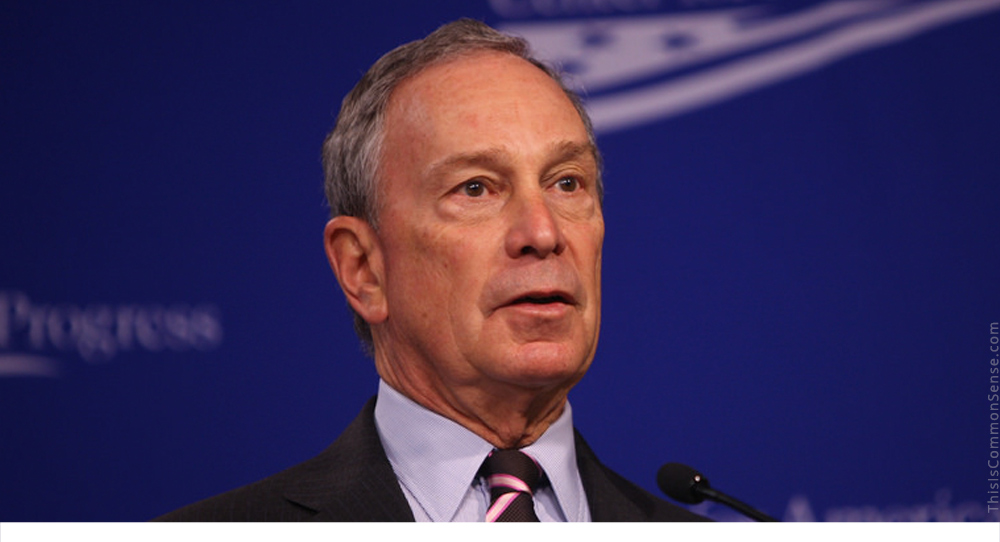
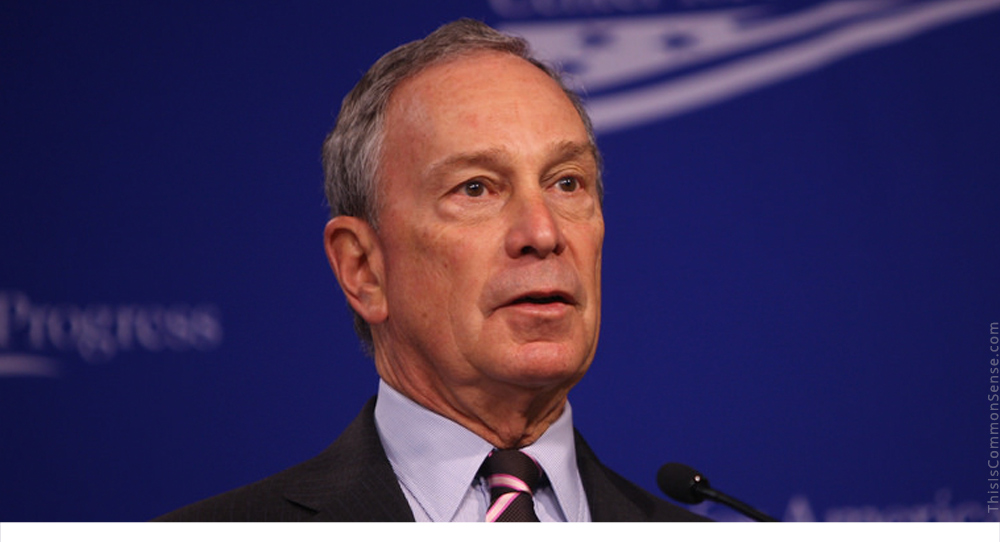
Michael Bloomberg is rich. He’s also in politics — a public health crusader.

And, for years, he “has personally funded and promoted all sorts of regressive taxes and regulations in an attempt to push people around,” the folks at Americans for Tax Reform tell us. “He uses the coercive power of the government to force people to live their lives as he sees fit.”

Onstage at a globalist event, One-on-One with Christine Lagarde — who is managing director of the International Monetary Fund — Bloomberg blurts out his approach to government policy regarding what he calls “those people.”

“If you raise taxes on full sugary drinks,” he says, “they will drink less and there’s just no question that full sugar drinks are one of the major contributors to obesity and obesity is one of the major contributors to heart disease and cancer and a variety of other things.”

Against the charge often made that such taxes fall heaviest upon the poor, he is forthright. Regressive? “That’s the good thing about them because the problem is in people that don’t have a lot of money.”

Notice that he is not talking about a public service campaign to help people learn how to drink (and eat) better. And he is not talking about removing all the government policies that have encouraged bad eating and drinking habits (as well as lethargy) — the government programs to encourage the overuse of high fructose corn syrup; the welfare state’s poverty trap that stifles life at the lower incomes; the subsidized consumption of food and drink — he wants to add another government program.

He can only see betterment by increased governmental bullying.

This is Common Sense. I’m Paul Jacob.


PDF for printing

Michael Bloomberg, tax, policy, nanny state, vice, social engineering, statist, technocrat

Photo by Center for American Progress

Categories
Accountability free trade & free markets local leaders porkbarrel politics tax policy too much government

Selling Us Out

Last week, Maryland’s Legislature enacted an $8.5 billion package of tax breaks and infrastructure improvements to lure Amazon into building its second corporate headquarters in Montgomery County, Maryland, bordering Washington, D.C.

State Senator Roger Manno, the only legislator from the county to vote against the subsidy, dubbed it “a $5 billion tax break for the richest man in the world. . . .”*

Today, the Montgomery County Council will consider a further proposal to streamline its zoning process, cutting in half the time the county takes to review a proposed development.

“We are trying to make sure our processes are consistent with everybody else,” County Executive Ike Leggett explained, adding that the county now “sometimes takes 100 to 120 days, while many other jurisdictions are much less than that.”

Did Leggett say “consistent with everybody else”? Well, the new zoning rules won’t apply to every business, just those planning to hire 25,000 workers. Or more.

“It’s neutral to the employer,” County Council President Hans Riemer slyly suggested. “It’s a proposal that would allow any really large employer to come in and build under certain terms.”

But only Amazon would be large enough.

“Really what it does is it creates predictability, reliability,” offered Riemer. But wouldn’t every other business also benefit from “predictability” and “reliability”?

“I think the Amazon proposal made the county realize . . . that it needed to look at some of its practices and where it has been criticized,” noted Bob Buchanan, chairman of the Montgomery County Economic Development Corporation. “We were more process versus results.”

And the county intends to remain that way . . . for “every” current business.

This is Common Sense. I’m Paul Jacob.

 

* He was referring, of course, to Amazon founder and owner of the Washington Post, Jeff Bezos.


PDF for printing


Categories
national politics & policies Second Amendment rights tax policy too much government

Was the Line Crossed?

Everybody has a limit, a point after which they reach for the nearest weapon and fire.

Or, in normal politics, withdraw support and go on the attack.

But it is not normal politics right now.

In mid-March, a Congressman from Long Island expressed his frustration with the Trump administration by saying, “This is where the Second Amendment comes in, quite frankly, because you know, what if the president was to ignore the courts?”

Days after this pol darkly implied insurrection, attacking gun rights became, on our Democratic Congressman’s end of the spectrum, a cause célèbre. Obviously, there remains a strong tension between politically opposing gun rights and the commonsense acknowledgment of the vital political function of the Second Amendment.* Lines are drawn all over the place.

But last week a very different line was crossed.

Donald Trump signed the latest Omnibus whopper. And a few of the gonzo president’s biggest Internet supporters — including the oddest, anarchist Stefan Molyneux — could take no more. Trump’s fatal flaw, Molyneux stated, “is his desire to shovel the money of the unborn into the Great White Shark maw of the military-industrial complex.” Molyneux identifies “the largest military budget in human history” as what Trump wanted in exchange for betraying his base.

So, you can see where Mr. Molyneux draws the line of support.

Meanwhile, others are wondering about Trump’s own line on trade policy. With much ballyhoo and bluster, he raised tariffs on steel — and then, quietly, exempted most of America’s steel trading partners.

Crazyman? Or genius?

The line between those two concepts is notoriously gray.

This is Common Sense. I’m Paul Jacob.

 

* In my weekend column I noted that “when the populace is armed sufficiently to realistically repel tyranny, the calculations of self-interested politicians per what they can get away with changes.” Guns can remain holstered, most of the time.


PDF for printing


Categories
Accountability folly free trade & free markets general freedom moral hazard national politics & policies responsibility tax policy too much government

Billionaire Theater

“I need to pay higher taxes,” Bill Gates told CNN’s Fareed Zakaria on Sunday.

He was making a case against Republican tax cuts, but his actual argument? Insignificant. It’s just another unlearned, narrow-perspective “growing inequality” farrago. But his conclusion intrigues . . . as a man-bites-dog story, because people have this goofy idea that rich people are somehow against government and for reduced taxes.

They aren’t. Not even most of the richest.

“I’ve paid more taxes, over $10 billion, than anyone else,” says the man worth $90 billion, “but the government should require the people in my position to pay significantly higher taxes.”

Why? To spend his money better than he could?

Were all the wealth of America’s billionaires confiscated whole and that sum would actually pay off the federal debt (which I doubt), what do you think Washington politicians would do? Go on the straight and narrow and never over-spend again?

No. Politicians would take the new influx of funds as a signal to go on an even bigger spending binge.

But what about his mere income tax increase notion? What then? As sure as the Blue Screen of Death it would be applied down to millionaires, too. And then rates for less-than-millionaires would likely go up. We have a history with this. And what would that do?

It would hit up-and-coming entrepreneurs the hardest. It would nip Bill Gates’s company’s competition in the bud.

But surely Gates wouldn’t be mercenary in his theatrical play for media adoration, would he? 

Not Saint Bill!

This is Common Sense. I’m Paul Jacob.


PDF for printing


Categories
Accountability general freedom ideological culture media and media people national politics & policies political challengers porkbarrel politics Regulating Protest responsibility tax policy too much government

“Our Agenda Was Common Sense”

The Republican Party doesn’t need to bury the corpse. Its victim has been assimilated, like the Borg did with alien peoples in the Star Trek universe, or maybe it was just soaked up as if the GOP were a giant fungus amongus.

So, what’s dead? The Tea Party, which was killed by partisanship, says Matt Kibbe, President and Chief Community Organizer at Free the People. He admits that the movement’s obituary has been written many times, but, he argues, “this time is different. Republicans, now controlling both the legislative and executive branches, jammed through a ‘CRomnibus’ spending bill that strips any last vestiges of spending restraint from the budget process.”

Kibbe identifies the Tea Party’s central theme simply: “Our agenda was common sense: We demanded that Washington politicians stop spending our money like it was theirs, and keep out of our health care. But in Washington, common sense is often seen as radical.”

This, he insists, was not a partisan movement.

But only Republicans played to it. Kibbe calls Sarah Palin a “political huckster” who “helped hijack our purpose,” and fingers Mitt Romney as the man who scuttled Tea Party “political momentum” in 2012. “And then Donald Trump split the Tea Party right down the middle, and that was the end.”

Nail in the coffin? The recent budget deal.

Kibbe signs the autopsy, but assures us: “American principles of individual freedom, fiscal responsibility, and constitutionally limited government, are all still very much alive.”

I sure hope so. But it takes more than a handful of Freedom Caucus members on Capitol Hill to realize it in practice.

Like a new citizen movement.

This is Common Sense. I’m Paul Jacob.


PDF for printing


Categories
Accountability crime and punishment general freedom government transparency ideological culture moral hazard national politics & policies Regulating Protest tax policy too much government

Still at Large

Blogger Paul Caron, dean of Pepperdine Law School, still counts the days since we learned that the IRS was blocking applications for nonprofit status from right-leaning groups at the behest of former IRS honcho Lois Lerner.

Now years later, the agency can still arbitrarily victimize any one of us. Nor have Lerner and other bad guys been brought to justice. Lerner collects a six-figure pension, instead.

And so, on Day 1699, Caron highlighted Kimberly Strassel’s proposal that President Trump make 2018 “the year of civil-service reform — a root-and-branch overhaul of the government itself. Call it Operation Drain the Swamp.” Exhibit A? The IRS and civil “servants” like “Lois Lerner, the IRS official who used her powers to silence conservative nonprofits.”  

And on Day 1709, Caron called our attention to Lerner’s attempt to suppress a deposition she gave in June “for a civil suit that victims [of IRS targeting] brought in 2013.” Lerner thinks we have no right to know why she felt justified in discriminating against applicants for tax-exempt status based on their political viewpoint.

Unfortunately, not everyone cares about justice as much as Caron.

Consider an obtuse Washington Post editorial pretending that the IRS didn’t really target conservative groups. Instead, “conservative groups, their allies in Congress and the IRS itself all bear responsibility” for the appearance otherwise.

And the aftermath.

Uh huh. If only victims of the abuse of power would stop being so indelicate as to object!

This is Common Sense. I’m Paul Jacob.


PDF for printing


Categories
Accountability general freedom moral hazard nannyism national politics & policies privacy tax policy

Hey, It’s Your Money

I leave it up to you how to spend your own money. You decide, based on your own circumstances and priorities.

Oh, you don’t need my permission?

Of course not.

But some people think that if you spend your own money on your own priorities in accordance with your own judgment, it is indeed a problem. At least when you get to keep more of your own money because of tax cuts.

President Trump has often suggested that recipients of new corporate tax cuts will spend the additional money mostly on increasing wages and hiring new workers. Yet some major corporations reportedly say that they will spend the additional money on paying dividends or buying back shares. Maybe others will buy more advertising, storage space or tools. Various commentators fret. But why should a firm hire new workers if other expenditures would be more productive at the moment?

Of course, in the long run, a company that is more profitable and successful can hire more people and can pay them more.

But wages are not the only expense that companies must cover in order to be successful in the long run. Managers do, and should, devote resources first to the improvements that they conclude are most urgent. That a company’s resources increase because of a tax cut doesn’t alter the necessity or reasonableness of pursuing economic goals in accordance with one’s best judgment.

An approach that, to be sure, also benefits present employees as well as future ones.

This is Common Sense. I’m Paul Jacob.


PDF for printing


Categories
Accountability crime and punishment folly general freedom government transparency ideological culture moral hazard Regulating Protest tax policy

Been Burned

“They’ve been burned. They’ve been hammered. They’ve been bludgeoned,” George Washington University law professor Miriam Galston explained to the Washington Post. “They’re trying to survive.”

In this heartbreaking discussion at this special time of year, the “they” are the poor, long-suffering folks . . . at the Internal Revenue Service.

According to the Post analysis, “conservatives” have schemed to “scale back the IRS and shrink the federal government.” (I guess this is supposed to tear at every American’s heartstrings.) Notably, they “capitalized on revelations in 2013 that IRS officials focused inappropriately on tea party and other conservative groups based . . . Among conservatives, the episode has come to be known as the ‘IRS targeting scandal.’”

Note that term of art: episode.

The Post saw no scandal, however — despite the IRS having admitted to harassing, blocking and delaying Tea Party and conservative groups from exercising their most fundamental First Amendment rights to freedom of association and freedom of speech, in some cases for four years.

Instead, the Post decries the response to this gross violation of citizens, a congressional check on the power — and budget — of the agency responsible: reducing the budget for the Exempt Organizations division of the IRS from $102 million in 2011 to $82 million in 2016.

Heavens, Washington is never supposed to work like that! It actually approaches . . . accountability.

The budget cuts, along with hefty settlements the IRS is now paying to victimized groups that sued, make it less likely the IRS will repeat this scandalous . . . episode.

“To many, the IRS targeting of Tea Party and conservative and even some progressive groups is not a scandal,” my Sunday Townhall.com column concluded. “To me, that’s the biggest scandal of all.”

This is Common Sense. I’m Paul Jacob.

 

N.B. The title reference is to Neil Young’s song, Burned, which begins, “Been burned, and with both feet on the ground . . .”


PDF for printing

IRS, I.R.S., corruption, taxes, budget, tears


Categories
Accountability folly ideological culture media and media people national politics & policies tax policy too much government

The Hyperbole Is Falling

A mad killer is on the loose!

That is one way to get attention . . .

The sky is falling!

You are getting the idea . . .

Trump is literally Hitler!

Extravagant hyperbole is not necessary to criticize the current President. Indeed, as Chicken Licken and the Boy Who Cried Wolf demonstrate, that can backfire. Especially when you are complaining about something on which Trump has proved to be pretty darn good — the tax bill, for instance.

Nevertheless, as it passed through Congress, Democrat pols and the major media dinosaurs have doubled down on overstatement: A “middle-class con job” was Sen. Ron Wyden’s characterization; singer-actress Barbra Streisand (presumably now living in Australia or Canada), re-tweeting a New York Times piece on “the Great American Tax Heist,” accused Trump of pushing the bill for “personal gain”; Bernie Sanders calls it a “tax cut for billionaires” who, instead of being helped, he says, should be “asked to pay more in taxes.”

Yes, the richest (by and large) will get the most reductions, since they pay the most taxes already. Bernie should be reminded that it is the very nature of taxes that “ask” is the wrong active verb. And calling a cut in what’s taken from taxpayers a “heist” is too absurd for commentary.

It does look like most taxpayers will get tax relief. That’s good. Alas, the debt may grow larger, depending on the economic growth spurred by the tax reform. But I notice that the Democrats tend to complain about deficits only when Republicans are in charge. And vice-versa.

Partisan Derangement Syndrome at work.

This is Common Sense. I’m Paul Jacob.


PDF for printing


Categories
Accountability ballot access general freedom government transparency initiative, referendum, and recall local leaders national politics & policies political challengers responsibility tax policy term limits too much government

What Unlimited Government Costs Us

“Olympia can’t restrain itself,” Tim Eyman wrote the other day, a judgment on legislative irresponsibility hardly unique to the Evergreen State. Citizens around the country have cause to lament the difficulty of obtaining anything close to a good legislature.

Too often the merely “bad” would constitute a significant improvement.

Which is why legislators need to be put on a short leash. Limits on government must be written into law, where possible into either the U.S. Constitution or state constitutions, so the limits cannot be tampered with by legislators, good or bad.

Washington State initiative guru Tim Eyman, cited above, has made a career of working for just those kinds of limits. In 2007, Eyman and the citizen group Voters Want More Choices petitioned onto the statewide ballot a requirement that any tax increase must receive a two-thirds vote from both legislative chambers.

Voters passed the measure* in 2007, 2011 and 2012.

In an email to supporters this month, Eyman presents data — an “amazing real-world comparison” — to help us understand how effective the limits were . . . while they lasted.

He notes that “with the 2/3 rule in effect from 2008-2012, those 5 legislative sessions cost the taxpayers $6.894 billion” in increased taxes.

And he compares that to the five years (2013-2017) since the state’s highest court struck down the voters’ two-thirds mandate: “WITHOUT the 2/3 rule, those 5 legislative sessions cost the taxpayers $23.679 billion.”

“Without the fiscal discipline imposed by citizen initiatives,” Eyman concludes, “politicians cannot hold back.”

Now we have hard evidence for what unlimited government costs us: more than three times more!

This is Common Sense. I’m Paul Jacob.
 

* Washington State’s ballot initiative process allows voters to pass simple statutes but not constitutional amendments. For two years after passage, legislators must garner a two-thirds vote to override a ballot initiative. After those two years, only a simple majority is required.


PDF for printing