Categories
Accountability crime and punishment folly free trade & free markets general freedom ideological culture nannyism national politics & policies

Digs at the Gig Economy

In Texas’s progressive enclave of Austin, the government has regulated Uber and Lyft out of the city.

Massachusset’s uber*-progressive Sen. Elizabeth Warren cautions that the “much-touted virtues”of the “gig economy” that these services represent are actually dark signs of the times, providing workers a false “step in a losing effort to build some economic security in a world where all the benefits are floating to the top 10 percent.”

Vermont’s Sen. Bernie Sanders, the independent candidate for the Democratic Party’s presidential nomination, is also no fan. Why? These services are not regulated.

Sanders’s charge that these person-to-person (P2P) ride-sharing services are “unregulated” is of course the opposite of the truth. They are self-regulated for safety and efficiency in ways that taxi services never were. How much extra value did governments add, with their regulations of the taxicab industry? They just reduced competition and made cabs more expensive.

P2P online cooperation is revolutionary. And “progressives” are stuck in the past, itching to suppress that revolution. “Initially,” writes Jared Meyer in the July issue of Reason, “hostility mostly came from state and municipal governments, at the behest of local special interests.” But as the services became more popular, opposition shifted. To the national Democrats like Sanders, Warren and . . . Hillary Clinton. She promises to “crack down on bosses who exploit employees by misclassifying them as contractors or even steal their wages.”

Par for the course: the Internet provides more opportunity than ever, and all some progressives see are the old socialist fears of “exploitation” and “greed” . . . while they greedily suck up to unions and special interests.

The bright side, Meyer argues, is that they are on the losing side.

This is Common Sense. I’m Paul Jacob.


*I guess the pun here is intended. Or not. You choose, P2P style.


Printable PDF

Uber, Lyft, sharing, economy, HIllary, Bernie, illustration


Categories
Accountability ideological culture media and media people nannyism national politics & policies property rights responsibility

The Climate Cassandra

Thirty years ago, in June, 1986, the Senate Environment and Public Works Committee met to consider the problems of ozone depletion, the greenhouse effect, and climate change.

Present at those hearings was today’s climate Cassandra, James Hansen, then of the Goddard Institute of Space Studies. And he was predicting that “global temperatures should be nearly 2 degrees higher in 20 years,” according to Associated Press reporting at that time.

There was some sloppiness either in Hansen’s account, or the AP’s, for in one part of his testimony Hansen claimed that his institute’s climate models projected, for “the region of the United States, the warming 30 years from now is about 1 1/2 degrees C, which is about 3 F.”

Ronald Bailey, the science writer over at Reason, tries to make sense of this mess of numbers, models, and predictions.

Oh, and actual, tabulated results.

Hansen’s predictions went, as Bailey put it, “definitively off the rails when tracking the temperature trend for the contiguous U.S. between 2000 and 2016. Since 2000, according to the NOAA calculator, the average temperature trend has been downward at -0.06 F degree per decade.”

That’s not the whole picture, though: “global temperatures have increased by 0.51 C degree since 1986, so perhaps the man-made global warming signal has finally emerged.”

No matter, though, as Bailey notes, “the United States and the Earth have warmed at considerably slower pace than Hansen predicted 30 years ago.”

Which suggests that Hansen’s models may be inspired more by wish, fear, and ideology than genuine science.

So, to those who wish to rush to “do something” (anything?) to combat “climate change,” take it slow. Follow the pace of the Earth itself.

This is Common Sense. I’m Paul Jacob.


Printable PDF

Global warming, climate change, illustration


Categories
Accountability crime and punishment general freedom nannyism national politics & policies

Beggar Thy Philanthropist

Making up petty rules and enforcing them is one thing governments do well.

On Monday I warned about the dangers of asking too much from government. I think, today, I’ll make the opposite warning: of not asking enough.

Mandatory seatbelt laws were enacted (sometimes by citizens initiative and referendum) to save people’s lives. But the reason many police and local jurisdictions like these laws is that it gives them a chance to engage in shakedowns, entrapping citizens into non-compliance, and then socking them with fines.

In Regina, Saskatchewan, a man pulled up to an intersection and saw a down-and-outer with a sign. He felt sorry for him, so, as he pulled up, he unbuckled his seat belt and pulled three bucks in change out of his pocket. And dropped the three dollars on the curb.

A few moments later, police stopped him, and handed him a ticket. The “homeless guy” with the sign turned out to have been an undercover cop, and the few moments without a seat belt was enough to charge our philanthropist $175 Canadian.

Though an obviously preposterous misuse of police time and attention, and an abuse of the citizenry, Regina’s police force remains adamantine, claiming that “this is nothing new. It’s part of a project that has police watching for traffic violations at intersections.”

Because this sort of thing only hits people almost at random, but the benefits are concentrated on police coffers, it’s hard to organize against such nonsense. Which is precisely why such nonsense goes on.

Still, we must prevent such abuse at the local level, if we’re ever to control the federal leviathan.

This is Common Sense. I’m Paul Jacob.


Printable PDF

seatbelt, trap, police, Regina, Saskatchewan, illustration


Categories
Accountability crime and punishment general freedom moral hazard nannyism national politics & policies privacy property rights

A New Way to Steal

The fight against government theft of private property, through “civil forfeiture,” just got a little harder.

There’s a new technology available: ERAD card scanners.

And the Oklahoma City Police Department’s joint interdiction team has them, and can use the scanners to take money from you without your consent.

What money, in particular? The money you have stored in pre-paid debit cards.

ERAD stands for Electronic Recovery and Access to Data, and the ERAD Group, Inc., stands to make a lot of cash from the technology. Police around the country want to be able to take the funds secured in debit cards. It’s the latest thing in the war against the war against the War on Drugs.

Drug traffickers, we’re told, hide dozens of such cards in vehicles transporting drugs.

It’s not enough that police can, in the course of investigating a crime — without conviction, mind you; indeed, without charges being filed — confiscate the cards themselves.

The police also want to be able to siphon the money out of those cards.

Which leads to corruption. Which is already rife in civil forfeiture usage, as a recent Oklahoma state audit found — missing money, misused funds, that sort of thing.

The cavalier way in which government officials defend expropriation by ERAD scanners is chilling. In an Oklahoma Watch article, reporter Clifford Adcock relates the official explanation: “These cards are cash, not bank accounts. . . . Individuals do not have privacy rights with magnetic stripe cards.” Why not? Because the information on the strip “literally has no purpose other than to be provided to others to read.”

That’s so open to logical criticism you could drive a confiscated truck fleet through it.

This is Common Sense. I’m Paul Jacob.


Printable PDF

ERAD, gift card, civil asset, forfeiture, stealing, theft, drug war


Categories
moral hazard nannyism national politics & policies responsibility too much government

Sit, UBI, Sit: Play Dead

This weekend, the Swiss people rejected the idea of a Universal Basic Income (UBI) with a whopping 77 percent against.

That’s the kind of overwhelming result that one finds in America for, say, term limits. And 23 percent, you might notice, is about the percentage of the population in America of hard-core “liberal” progressives, the kind of people usually in support of such measures.

In Switzerland’s case, it was a measure put on the ballot by one group, Bien-CH. But if you are thinking “socialism,” the group insists that that’s the wrong way to think about the plan. UBI is needed, the group’s website says, “to grease the wheels of the capitalist economies” facing a declining need for workers as a result of technological advance.

Yes, UBI is a policy designed to accommodate the coming horde of robots! How? By “increasing demand” by spreading out wealth from the connected-to-tech few to the witless-about-tech many. (How vulgar Keynesian.)

The Swiss government urged a No vote, fearing a need to raise taxes by fifty percent. Quite a hike.

Meanwhile, the notion garners worldwide interest, and even libertarian social scientist Charles Murray promotes this guaranteed income idea (under a different initialism), mostly to streamline the costly bulk of the welfare state.

I’m dubious.

After all, about our latest industrial revolution, in artificial intelligence and in robotics: I say open up labor and entrepreneurial markets from excessive regulation, and allow networking advances to transform capitalism on its own terms, with person-to-person (P2P) cooperation (think AirBnB and Uber and Lyft) and much more.

The best is coming, I bet. If clunky proposals like UBI don’t get in the way.

This is Common Sense. I’m Paul Jacob.


Printable PDF

Swiss, Switzerland, UBI, Universal Basic Income, socialism, robots, illustration


Categories
ideological culture media and media people nannyism national politics & policies Regulating Protest too much government U.S. Constitution

The Long Road to Citizens United

Everybody is familiar with the standard theory regarding the Citizens United decision. Former comedian and current earnest socialist Sarah Silverman puts it this way: “Every politician takes money from Big Money, ever since it was made legal with Citizens United.”

Like most folks who talk this way, she doesn’t give a squeak of context. She barely even indicates that it was a Supreme Court case, 2010’s Citizens United v. Federal Election Commission. She does not mention at all that the ruling overturned the FEC’s act of suppressing a political movie.

But there is a much wider context than such bare facts — and if you want a good synopsis, you could hardly do better than read my friend Krist Novoselic’s calm, reasoned “look at the history of attempts to regulate independent campaign expenditures.”

This “modern history” started with what the New York Times called Richard Nixon’s “revolution in political financing.” The Federal Election Campaign Act of 1971 “required detailed disclosure of campaign contributions; set campaign contribution limits to candidates, parties and committees; set expenditure limits on campaigns, independent groups and individuals and created the first public financing of presidential campaigns and national conventions.”

And almost immediately the law began suppressing political speech and advertising. And led to a long series of court cases.

And decisions.

And revisions.

That define our times.

Krist (with whom I serve on the board of FairVote.org) provides the context you need to see through what he aptly calls “the hype” about “Citizens United,” as well as how the decision correctly removed the license given to the FEC’s role as “state censorship board.”

This is Common Sense. I’m Paul Jacob.


Printable PDF

Krist Novoselic, Citizens United, free speech, fairvote.org


Categories
Accountability government transparency nannyism national politics & policies responsibility

Disneyland vs. Politicians

Last week, when asked by reporters about the arguably deadly wait times that vets have endured (or not), Veterans Affairs Secretary Bob McDonald replied, “What really counts is how does the veteran feel about their encounter with the VA. When you go to Disney, do they measure the number of hours you wait in line? . . . What’s important is: What’s your satisfaction with the experience?”

The national commander of the American Legion, Dale Barnett, calls the remark “an unfortunate comparison”:

“People,” after all, “don’t die while waiting to go on Space Mountain.”

The secretary also errs about Disney, as Fox News’s Neil Cavuto noted. Disney does measure the time people must wait in line. The for-profit company goes out of its way to entertain folks while they wait.

But the clowns running the Veterans Administration shouldn’t take up entertainment.

Fix the problem.

Democrats Hillary Clinton and Sen. Bernie Sanders both seek to throw more money at the VA. They seem most concerned in protecting the Veterans Administration, not veterans. And Sanders’s real beef turns out  to be with Disney.

Donald Trump, the presumptive Republican nominee, tweeted: “Obama’s VA Secretary just said we shouldn’t measure wait times. Hillary says VA problems are not ‘widespread.’ I will take care of our vets!”

But will he? Through the VA system?

A zillion reform efforts have failed.

Let’s demand more than a simple promise sans details.

Do congressmen wait months to get a medical appointment? No. Then why not close the VA and give veterans the same healthcare coverage as our (pardon the term) representatives?

On this Memorial Day, who comes first: the vets or the politicians?

This is Common Sense. I’m Paul Jacob.


Printable PDF

V.A., VA, Veterans Administration, Disneyland


Photo credit: Xiaojun Deng on Flickr


Categories
Accountability folly free trade & free markets general freedom ideological culture moral hazard nannyism national politics & policies property rights responsibility too much government

Fatherland, Socialism and Death!

The fall of Venezuela is an atrocity.

The comic elements are clear enough — the further you remove yourself from the poverty, chaos, and collapse. We can wallow in a bit of Schadenfreude, taking glee as some American leftists squirm to explain why the socialist paradise they ballyhooed a mere three years ago now tail-spins to the grave.

The collapse of this socialist experiment offers an enormous level of tragedy. It’s not pretty.

The country’s leader, President Nicolas Maduro, makes his predictable desperation play. Rather than confront his own errors, and the futility of making socialism work in anything like a rigorous form, he boasts. “Venezuela Leader Says US ‘Dreams’ Of Dividing Loyal Military,” reads yesterday’s Reuters report. While no doubt true, this is one of those cases where whatever we dream to the north, our dreams are better than their current reality.

Of course the Venezuelan military should turn on Maduro, Hugo Chavez’s inheritor, protecting the right of recall, which Maduro is denying. By painting the U. S. as the bad guy, Maduro hopes to unite his people — especially his armed forces — around him. That’s what a desperate demagogic dynast does. Citizens and subjects traditionally abandon skepticism about their leaders when they feel threatened from the outside.

Which is one reason it would be a mistake for the U. S. to intervene.

Reuters poetically reports that the military is still united behind the socialist government, and resists the recall referendum, singing “Fatherland, Socialism, or Death!”

Wrong conjunction. Not “or” but “and” . . . if you insist on socialism.

The government, military pressure or no, should allow the recall vote, and soon.

This is Common Sense. I’m Paul Jacob.


Printable PDF

Venezuela, store, socialism, column


Categories
Accountability crime and punishment folly free trade & free markets ideological culture moral hazard nannyism national politics & policies

A Vapor’s Chance in Hell

There is a big difference between government designed to protect our rights and a government tasked with protecting us from ourselves.

You couldn’t find a better example of this than the current Federal Drug Administration and its regulation of vaping.

Vaping is the imbibing of water vapor laced with nicotine and other ingredients. It is designed to replace the smoking of tobacco cigarettes. It is much, much less harmful than smoking. The genius of this innovation is that while it looks a lot like smoking, it involves no smoke. But it does involve inhaling, and blowing out wisps of . . . well, vapor.

It’s safer than smoking because smoking tobacco involves burning organic (and inorganic) matter, which puts tars and other chemical substances into one’s lungs.

But the competing companies that make the product are not allowed to tell us about its advantages.

New regulations of the e-cigarette industry from the FDA prohibit a lot of truth-telling in advertising. “Even if a few companies survive the shakeout caused by the FDA’s onerous regulations,” Jacob Sullum writes in Reason, “they will not be allowed to tell consumers the truth about their products.” It appears that “any intimation that noncombustible, tobacco-free e-cigarettes are safer than the conventional, tobacco-burning kind” places them under a category that simply must “be marketed only with prior approval.”

The legal judgments Sullum quotes will make you sicker . . . than your first cigarette puff.

Paternalistic government designed to save us from our vices ends up blocking us from actually lessening the bad effect of those vices.

Some help.

This is Common Sense. I’m Paul Jacob.


Printable PDF

vape, vaping, smoking, law, regulation, unintended consequence, illustration, photo


Photo credit: micadew on Flickr


Categories
education and schooling folly ideological culture nannyism national politics & policies too much government

Toiletarianism

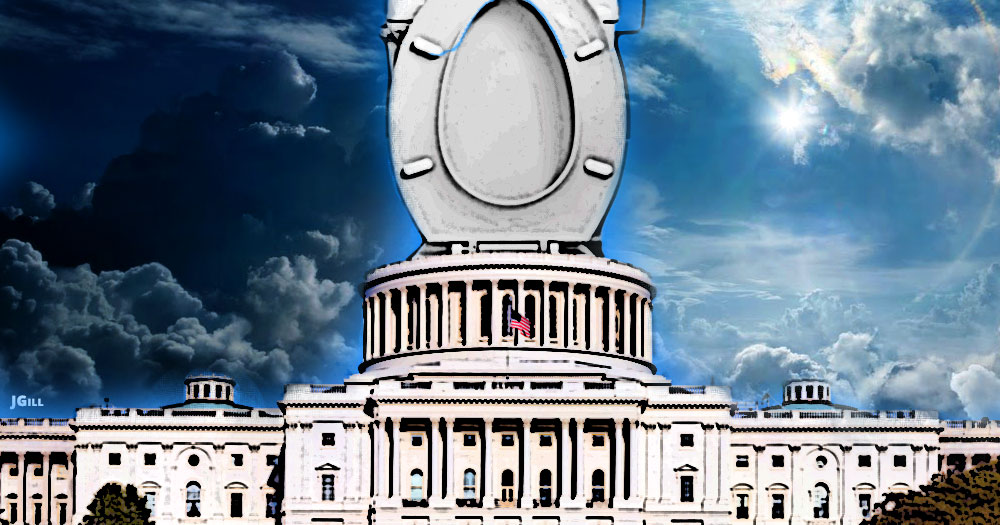
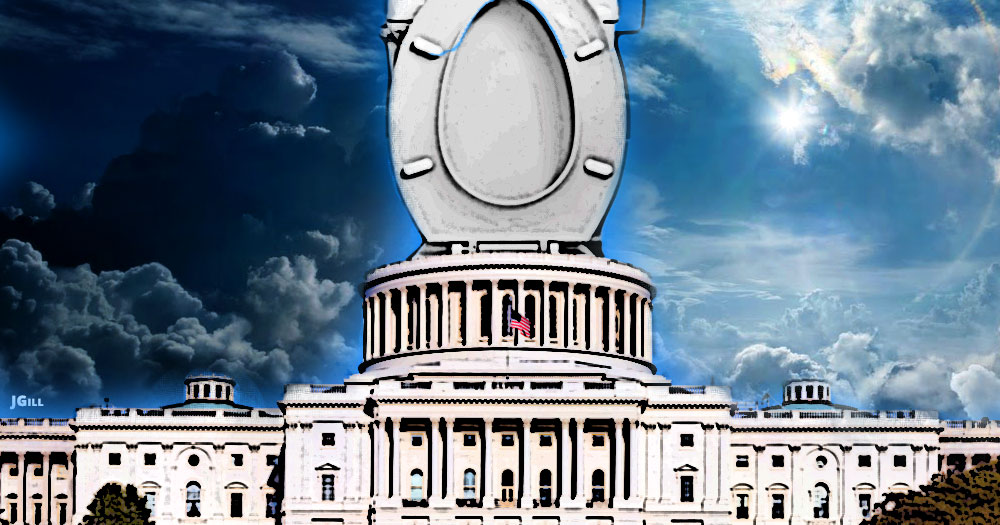
President Obama and other politicians are taking a wide stance over the nation’s public restrooms. Important bathroom policy will finally be determined at the highest levels.

Last week, public educators nationwide received a legalistically-worded letter from the Departments of Justice and Education explaining how to legally treat transgender students under Title IX of the Civil Rights Act. CNN boiled it down to “Fall in line or face loss of federal funding.”

Friendly federal “guidance” comes after dueling lawsuits between the Feds and North Carolina over that state’s House Bill 2, which establishes statewide restroom regulations. Those regs require that transgender folks use the bathroom appropriate to the sex listed on their birth certificate (whether Kenyan, Canadian or other).

Obama wants Americans to choose the restroom matching their self-chosen “gender identity.” Conservatives seem most worried that his policy is so loosely defined as to allow non-transgender male persons to simply claim to be transgender in order to shower with the girls volley-ball team or lurk in the powder room.

“Have we gone stark raving nuts?” questioned Sen. Ted Cruz, proclaiming: “Grown adult men, strangers, should not be alone in a bathroom with little girls.”

In California, there’s legislation to force businesses to make “all single-stall public restrooms” gender neutral. “Let’s make a clear statement that, if you want to go pee, by all means help yourself,” argued the proposal’s author.

Transgender people should be treated with care and respect, as should every person. But do we really need a national bathroom policy designed for maximum division in an election year?

Before politicians solve today’s glaring non-problem in public restrooms, they should solve a real problem first.

Just one.

This is Common Sense. I’m Paul Jacob.


Printable PDF

toilet, bathroom, trans, transgender, sex, gender, law, folly