Categories
Common Sense general freedom individual achievement judiciary U.S. Constitution

Racial Justice Advanced

[mks_dropcap style=”letter” size=”60″ bg_color=”#ffffff” txt_color=”#000000″]I[/mks_dropcap] don’t know if Juan Williams is right about who qualifies as America’s most influential thinker on race. But I hope he is.

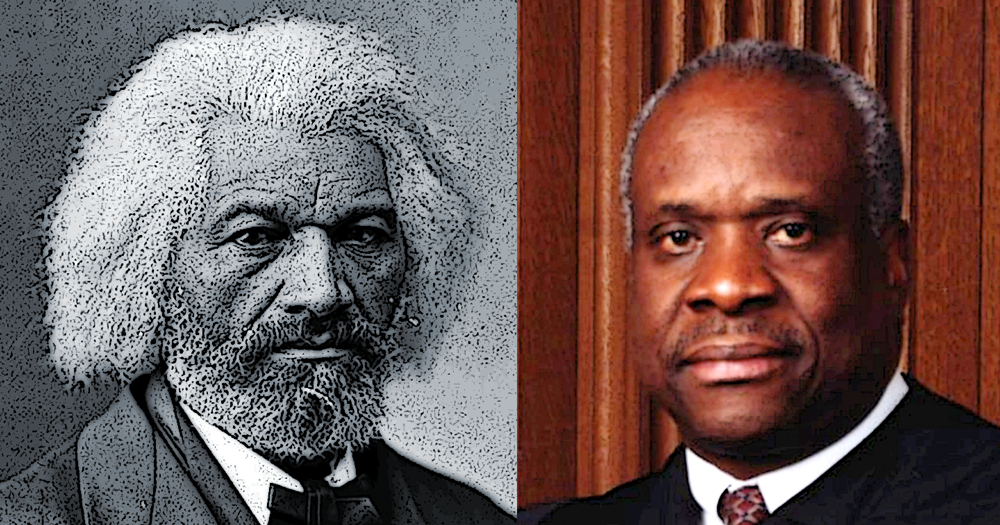
In a Friday Wall Street Journal op-ed, Fox News’s liberal-leaning political analyst and author of Thurgood Marshall: American Revolutionary (1998), argues that our country’s most important influencer of thought on race is neither some current and trendy academic writer nor our current president (or his outgoing attorney general). Instead, it is none other than Supreme Court Justice Clarence Thomas.

While more famous figures of African-American descent have dominated the news talk shows and airwaves and popular consciousness, Justice Thomas has gone about “reshaping the law and government policy on race by virtue of the power of his opinions from the bench.” While previous African-American racial activists and thinkers have striven to defend the rights of black people, Justice Thomas, “the second black man on the court, takes a different tack. He stands up for individual rights as a sure blanket of legal protection for everyone, including minorities.”

Opposed to “perpetual racial tinkering,” Thomas has marshaled Frederick Douglass’s words to make his case: “What I ask for the Negro is not benevolence, not pity, not sympathy, but simply justice.” And justice, in Clarence Thomas’s judgment, does not entail a constant rescue-worker attitude towards minorities, or other disadvantaged folks. It requires nothing other than equality of rights before the law.

And perhaps some hard work on the part of the disadvantaged.

Hats off, then, to Juan Williams for recognizing the importance of Thomas’s common sense contention that “black people deserve to be treated as independent, competent, self-sufficient citizens.”

This is Common Sense. I’m Paul Jacob.

Categories
general freedom nannyism property rights responsibility too much government

Why the Tiny Domicile

[mks_dropcap style=”letter” size=”60″ bg_color=”#ffffff” txt_color=”#000000″]T[/mks_dropcap]he “tiny house” movement has gained momentum. More and more people — especially young people and childless people — see the virtue of very small houses. They are cheaper, can be made energy-efficient, have an almost necessarily smaller “environmental footprint,” and are mobile.

And I can see the attraction. For one thing, a tiny house would be easier to clean than what I have. For another? Snug. Many of the efforts are very cleverly designed and built. And certainly for young singles, they make a great deal of sense.

But, wouldn’t you know it, there is a problem here. Government.

Urban housing authorities, zoning boards, and the like, have not exactly been accommodating to this new development.

Which is, in its way, typical, and typically frustrating. After all, many of the reasons folks are looking to tiny houses result from government regulation in the first place. City, metro and county governments have been so poorly accommodating to diversity in housing demands that costs have risen horribly.

This is all explained over at Reason, which draws the bureaucratic environment of the nation’s capital in relation to tiny homes: “they’re illegal, in violation of several codes in Washington D.C.’s Zoning Ordinance. Among the many requirements in the 34 chapters and 600 pages of code are mandates defining minimum lot size, room sizes, alleyway widths, and ‘accessory dwelling units’ that prevent tiny houses from being anything more than a part-time residence.”

This leaves Reason’s featured tiny home owner in yet another bad-government-induced limbo: “allowed to build the home of his dreams — he just can’t live there.”

We need tiny government. Or at least tiny-accommodating government. Really… both.

This is Common Sense. I’m Paul Jacob.

Categories
free trade & free markets general freedom too much government

The Two Americas

Dear Reader: This “BEST of Common Sense” comment originally aired on July 4, 2007. A longer version published at Townhall.com was picked up by Rush Limbaugh and read on his radio show. —PJ

Could Democratic presidential candidate John Edwards actually be right about something? Not where to go to get a haircut, mind you, I mean about there being two Americas.

There is the vibrant America . . . and the stagnant one.

There is the America of ever-increasing wealth, innovation, creativity, new products and services. Choices galore.

And there is the politician’s America: The regulated America, the subsidized America, the earmarked America. The failing America.

In one America, it is what you produce that gets you ahead. In the other, it’s who you know.

In one America, to earmark some money means setting aside funds (into savings) for a purchase — a car, house, college.

In the other America, to earmark is to grab from taxpayers to give to cronies. It is the highest rite of career politicians: Buying their votes with other people’s money. Oh, there have been reforms, sure. But a recent bill in the House had 32,000 earmark requests.

In one America, we decide what we pay for. We choose constantly about little things and big. We call the shots. Or we walk down the street and associate with someone else. So we have some faith in those we work with.

In the other America, we vote. But we rarely get what we vote for.

Maybe that’s why the new Democratic Congress just registered the lowest approval rating in poll history.

It surely isn’t because folks love the Republicans.

This is Common Sense. I’m Paul Jacob.

Categories
general freedom ideological culture media and media people too much government

Herd Immunity

Hillary Clinton and Barack Obama gave cautious support for the anti-vaxxer cause a few years ago. No scandal.

But only now that Republican politicians Chris Christie and Rand Paul have talked about the risks of (as well as of parental rights and responsibility regarding) childhood vaccination has the issue of mandatory vaccination finally hit big.

Ronald Bailey offers a more modest proposal. “Vaccination is arguably the greatest public health triumph of the past century,” he  begins.  But he argues not for mandating vaccines, but for social pressure: “person-to-person shaming and shunning.”

That is one traditional (and less politically extreme) way to solve such problems.

But what is that problem, at base? Those who fear a negative personal effect from vaccination (and there are some, though the “autism” charge appears to be bogus) become “free riders,” as economists like to put it. They gain a de facto immunity without having to pay — either in money or in the small risk that vaccination does demonstrate.

This particular free rider benefit depends on the concept of “herd immunity.” That’s the conjectured level of protection for individuals who lack biological immunity by the overwhelming presence of vaccinated people in a population who are immune. (The disease can’t spread because it hits too many dead ends in healthy hosts.)

As has been often noted the last few days, though the anti-vaxxer trend has mainly tended to “infect” (as a “meme”) urban populations of left-leaning folks — epitomized by Hollywooders Jenny McCarthy and Jim Carrey — the new backlash against anti-vaxxer rights has come strongest from the left-leaning media.

The Republican “offenders” provide cover?

Apparently, those of the Democratic herd think they have immunity . . . to criticism.

This is Common Sense. I’m Paul Jacob.
Categories
free trade & free markets general freedom too much government

Against Enabling Segregation

Rosa Parks, born February 4, 1913, became a symbol of the Civil Rights Movement for her actions on December 1, 1955. Ordered to move from the first row of the “colored” section after seats reserved for white passengers had filled up, Parks refused.

“When that white driver stepped back toward us, when he waved his hand and ordered us up and out of our seats, I felt a determination cover my body like a quilt on a winter night.”

Economist Thomas Sowell believes that the conflict might never have even come up as an issue, had the bus been privately run.

“Why was there racially segregated seating on public transportation in the first place?” he asked on the occasion of her death in 2005. “[T]here was certainly plenty of racism in the South, going back for centuries. But racially segregated seating” did not have the same unbroken history. Sowell pointed out that no matter what their own views, owners of the private transit lines of the 19th and early 20th century lacked motive to enforce segregation and thereby alienate many of their passengers.

When markets aren’t overrun by politics, both buyers and sellers must focus on the value they want from trade — a good product or competent service. Participants are penalized if they routinely set aside those benefits in order to indulge an animus.

In the 20th century, the trend towards taxpayer-funded mass transit displaced economic incentives with political ones.

Only governments can force entire industries to routinely act on an irrational prejudice.

This is Common Sense. I’m Paul Jacob.

Categories
general freedom too much government

More Civilization

Civilization is a choice, a habit, a line in the . . . sand.

For modern, prosperous society to progress, to grow more healthy and wealthy and wise, most of us have to agree on a small set of principles. Mostly, we must agree not to rush to violence at the merest provocation.

There has to be a lot of negotiation to get anything done. At least, in a free and open civilized society.

Terrorism is the repudiation of this principle.

The main perpetrators of terrorism these days hail from Muslim peoples. But there are non-Muslim terrorists, too. Many of the “school shootings” and similar violent acts in America and even in Europe rarely get listed as terrorism, though they certainly look terroristic. And most don’t have anything to do with Islam.

Even when Muslims are the ones committing the terrorism, their victims are often also Muslim.

Some folks estimate that as many as 95 out of a hundred terrorist victims are Muslim. Why? Because so much of this violence goes on in countries like Iraq, Pakistan, and Afghanistan.

While this estimate is probably too high, the fact that Muslims themselves are the most common victims of Muslim violence suggests that the underlying problem is the lack of institutions in those lands that hold to the choice — the habit — of civilization.

So, yes: tyranny is at the root of the problem.

Americans, if we want fewer terrorists, might want to restrain our governments from propping up or closely allying ourselves to “Muslim” dictatorships, then.

This is something we can control.

This is Common Sense. I’m Paul Jacob.

Categories
First Amendment rights general freedom Second Amendment rights

Wanted: Armed Satirists

I have a suggestion. Bear arms.

Commenting on the terrorist attack on Charlie Hebdo, a Reason.com reader points to a profile of Henry Jarvis Raymond (1820-1869) at the website of Green-Wood cemetery.

At the moment, the most urgently relevant detail of Green-Wood’s profile is not Raymond’s co-founding of The New York Times, his politics or his friendship with Abraham Lincoln, but how he defended his paper against threat of assault.

“During the ‘high tide’ of the Confederacy . . . Raymond fought to rally public opinion in favor of the Union. When draft rioting mobs approached the offices of The New York Times in July 1863, Henry Raymond held them off with three Gatling guns he had obtained from the army.”

Charlie Hebdo has been attacked by Islamo-terrorists before. In 2011, its Paris office was badly damaged by a firebomb unleashed in reply to a “Charia Hebdo” issue of the satirical magazine.

At least since that attack, then, the risk to Charlie Hebdo staff for ridiculing Islam, Islamism and/or Muhammad* has not been merely theoretical. I applaud the fact that they have fearlessly persisted in their satiric mission despite what happened — and are fearlessly persisting now despite a much steeper cost.

But if you’re in that situation, please don’t just brave the odds. Even the odds. Ensure that personnel are well-trained in the use of firearms, and that these weapons are easily accessible at all times.

And if you’re a government, make bearing arms easy.

This is Common Sense. I’m Paul Jacob.

* It may be worthwhile pointing out — as many have — that the satirists were not narrowly ridiculing one culture, that of Muslims; they have been and are across-the-board satirists, mocking politicians, clerics and partisans of most (if not all) stripes. Further, though widely considered a left-wing magazine, its editorial policy has never fallen into the lefty rut of blaming only the West and bending backward to defend foreign criminals and tyrants.

Categories
general freedom

Don’t Aid and Abet

Some countries are ratcheting up their regulation of foreign Internet companies. These efforts, a New York Times article explains, “increasingly” oblige firms like Google, Facebook and Twitter to mull “which laws and orders to comply with,” which to resist.

The juggling act is nothing new. Cyber-companies have always wrung their hands about which tyrannical demands to obey.

On the one hand, we have such praiseworthy examples as Google’s eventual decision, in 2010, to stop censoring its search results in China. In consequence, the Chinese government kicked Google off its Internet.

More recently, Turkey sought to prevent leaked documents from being distributed via Twitter, demanding that Twitter block posts providing access to those documents. When Twitter refused, the Turkish government blocked its service. But it then lost a court battle over the issue even as users found ways to skirt the ban.

Also heartening is the fact that, so far, American tech firms seem determined to reject a new Russian imperative that they store user information on Russian servers.

But the firms do sometimes obey demands — saying they must abide by laws that, however lamentable, are verifiably on the books — and such obedience does amount to abetting repressive efforts.

Here’s what I suggest, instead: always say No.

Never agree to help violate the rights of users, even if your services are formally banned as a result. Instead, use your ingenuity and resources to help people end-run the obstacles to free expression that governments keep imposing.

This is Common Sense. I’m Paul Jacob.
Categories
general freedom local leaders

Charity T-Tissue

As the year unrolls, maybe we should take some time to celebrate the little things in life that matter so much.

For reasons I am sure we can all understand, we don’t talk about toilet tissue much. But it is, nevertheless, one of the great products of our civilization.

Can you imagine living without it?

Well, for many poor people, and certainly for the vast throngs of unemployed in our ever-lengthening depression, sometimes it’s hard to afford even a little nicety/necessity like that.

Danny Westneat, writing in the Seattle Times, tells us of Leon Delong, who for the last 15 years has been collecting unused, “stub” rolls of toilet tissue from the janitors of the Evergreen City’s toniest skyscrapers, and giving them to food banks and pantries. For charity.

The ritzier places dare not risk a toilet roll running out. So the janitorial staff at these office buildings replace rolls every night. And were left with half-used/three-quarters-used tissue rolls.

Perfectly usable. But not suitable for those businesses that feared leaving any single restroom customer in an uncomfortably tissue-less condition. First rule: Avoid panic-inducing situations.

So, after retiring, Delong collected these stub rolls and made it his vocation to deliver them to the charities — where they went like “T-bone steaks.”

He’s now retiring from this charitable work, for health reasons, but can take pride in his moniker, “The Toilet Paper Guy.”

Others plan to fill his role.

It goes to show: There are many opportunities out there to do good. Some quite unexpected.

This is Common Sense. I’m Paul Jacob.

Categories
general freedom

Common-Sense Canine

If at first you don’t succeed . . .

Persistence. That’s the lesson of an animal rescue shown in a video of unknown provenance, most likely recorded in Southeast Asia, that appeared on the Internet toward the end of 2014.

As the video opens, we see that a small tawny-haired, yelping dog had somehow fallen into a well. Rescuers are lowering a rope into the water. The pooch has only one way to escape — by grabbing the rope with her teeth. Which she does.

Nine out of ten times, though, she can’t hold on long enough for a rescuer to grab her and pull her out. She keeps dropping back into the water.

Discouraging.

But the tenth time proves the charm. Some combination of dog-learning and human-learning results at last in a successful retrieval. The dog has done the only thing it could do to save itself, and kept doing it until it worked.

The advice to “keep trying” is regularly balanced with the advice to know when to “cut your losses.” But, often, it’s neither possible nor advisable to cut our losses no matter how tough things get. Switch strategies, maybe. But not give up.

We can’t conclude, for example, that “this U.S. government thing is not working out, let’s cut our losses.” We just have to keep working to reform its institutions and policies no matter how often we get flung back into the well. It’s the only way we win.

This is Common Sense. I’m Paul Jacob.