
Category: general freedom
In recent years there has been a great burgeoning of public debate about ideas. Politics. Ethics. UFOs. You name it.
This “burgeoning” has mostly taken place online.
Some people are so good at it that they have made their whole livings at it, parlaying advertisements and donations into successful careers.
But this has not gone unnoticed.
They are under attack.
A cabal of highly connected financial and Internet platform professionals have coordinated their attention against Alex Jones, “Sargon of Akkad,” and others. Patreon is the latest to get involved, having ousted Lauren Southern off the company’s donation intermediary service, and now the aforementioned Sargon (Carl Benjamin, an Englishman). And behind all this there lurks the shadowy decisions and machinations of PayPal and Mastercard.
I have covered some of this in the past, here at Common Sense. But too much of it has passed by, as if in my peripheral vision. I know these de-platformings have taken place, however, and am somewhat alarmed.
Not for myself, so much, as my main gig is political activism: helping citizens place ballot measures before voters through Liberty Initiative Fund and protecting the ballot initiative process with Citizens in Charge Foundation. Common Sense was not conceived to be a profit center, but a herald, a communication platform.
Still, like everything, the program does cost money and must prove its worth. Which is why I cherish my many donors to Common Sense. Thank you. You really do help keep the Common Sense coming — after nearly 20 years!
Something big is brewing. In our culture. In our country. Across the globe. Free speech is under attack. Corruption is rampant at all levels of government. Socialism seems on the march.
From assisting the police camera ballot measure that passed in Ferguson, Missouri, to last November’s ballot initiative on “citizen only voting” that prevailed in North Dakota, Liberty Initiative Fund knows that real change can better come from the grassroots and the ballot box than from the halls of Congress in Washington.
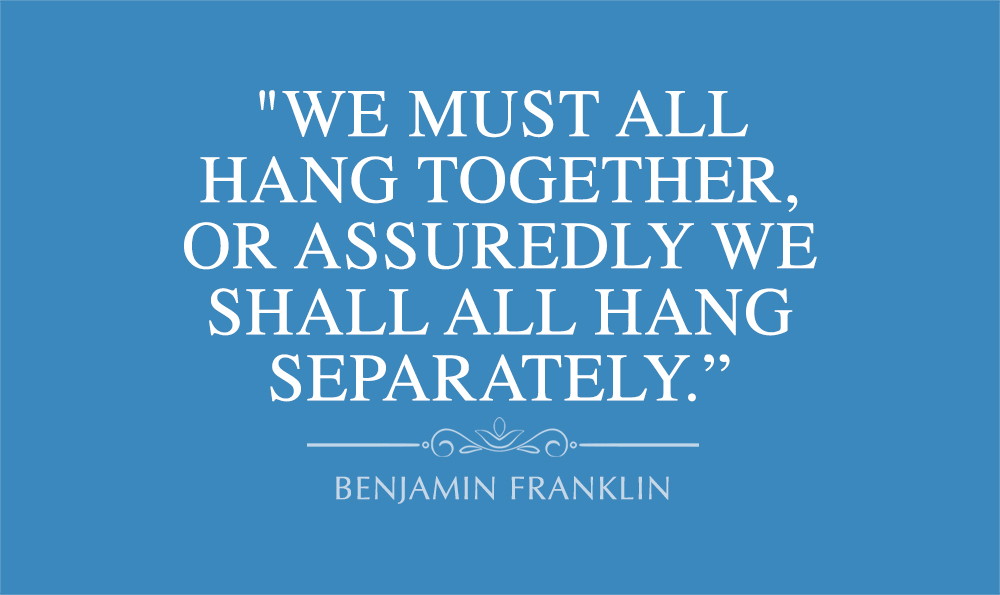
Those of us who cherish individual freedom must work together to change laws and policies. We have to hang together — or, as Ben Franklin reminded, “most assuredly we will all hang separately.”
How long will we be able to speak out politically?
I do not know.
But here is something we do know for sure. It is the last day of the year. If you have been planning on making a charitable donation for the cause of limited and accountable government, freedom of speech and press and association, this site, “Common Sense with Paul Jacob,” gratefully accepts donations . . . and could not carry on without the help of “people like you.”
By which I mean patriots. Thoughtful people concerned about the future.
And donations to Common Sense are fully tax deductible!
Please help us in this important work. Support us with dollars if you can. And keep forwarding my daily commentary, telling friends, and taking a stand for FREEDOM.
This is Common Sense. Common effort is the key. Oh, and I’m Paul Jacob.
See all recent commentary
(simplified and organized)
See recent popular posts

“Of all the enemies to public liberty war is, perhaps, the most to be dreaded, because it comprises and develops the germ of every other. War is the parent of armies; from these proceed debts and taxes; and armies, and debts, and taxes are the known instruments for bringing the many under the domination of the few. In war, too, the discretionary power of the Executive is extended; its influence in dealing out offices, honors, and emoluments is multiplied; and all the means of seducing the minds, are added to those of subduing the force, of the people. The same malignant aspect in republicanism may be traced in the inequality of fortunes, and the opportunities of fraud, growing out of a state of war, and in the degeneracy of manners and of morals engendered by both. No nation could preserve its freedom in the midst of continual warfare.”
—James Madison, Political Observations, Apr. 20, 1795 in: Letters and Other Writings of James Madison, vol. 4, p. 491 (1865)
Categories
Precious Gifts

There’s a quiet on Christmas morning . . . after Santa has come and gone . . . and the kids are still sound asleep . . . sugar plum fairies dancing to their gentle snoring.
A moment to stop and think.
I hope they’ll like their presents; they always do. There’s so much love my wife and I want to share, to give to them.
Of course, the biggest gifts are never under the tree. The most important being a stable home, with love, and the freedom for children to grow into themselves.
My parents gave me that . . . along with the bicycles and baseball gloves and some really good books. I’ve tried to be the same kind of parent.

Another incredible endowment I’ve enjoyed is to be born in a country “conceived in liberty.” A place where individual citizens are the sovereigns, creating government to be a servant and not a master. Land of the free.
What a gift!
But Tom Paine told us that, “What we obtain too cheap, we esteem too lightly, ’tis dearness only that gives everything its value. Heaven knows how to put a proper price upon its goods; and it would be strange indeed if so celestial an article as FREEDOM should not be highly rated.”
Freedom is under siege. And, therefore, we who love freedom, grateful for our historic luck, must come together to protect our “expensive” gift.
Some may get discouraged after setbacks, but none of us got involved in politics because we like “the game” and figured we’d pile up a shelf of trophies. We’re engaged because we must be and we seek victories because, as Churchill once put it, “without victory, there is no survival.”
In 1776, on this very day, General George Washington and his soldiers of the American Revolution crossed the Delaware River to score a surprise military victory against the British at Trenton, New Jersey.
Thank goodness, for these brave patriots and their muskets. Three Americans gave their lives in the battle. To secure our liberty.
Today, the Gift has been handed to us. Not to play with on Christmas morning and forget about, not to let get broken without our fixing it, but to protect and defend and cherish.
My commentary strives to illuminate, at times amuse and, most of all, to motivate toward action, bringing citizens together. Citizens in Charge protects the initiative process — the best weapon citizens have to cut taxes, term-limit politicians, stop the drug war, protect property rights, and place limits on government. The Liberty Initiative Fund partners with leaders across the nation putting measures on the ballot to protect freedom and hold government accountable.
Thanks for your gifts to these efforts and to the many other important ones. We aim to protect the precious gift of freedom.
This is Common Sense. I’m Paul Jacob. Merry Christmas! Happy Holidays!

See all recent commentary
(simplified and organized)
See recent popular posts
Categories
And So It Begins

“Your time is up, white people,” South African politician Hlengiwe Mkhaliphi offered.
This woman, who belongs to the Economic Freedom Fighters, a “far left” political party, is defending something Frédéric Bastiat would have dubbed the very worst kind of “legal plunder”: in this case, a land grab from white farmers to give to (some) blacks, without compensation.
“White South Africans could be forced to give up their own homes from next year as the nation’s government steamrolls through plans for land expropriation,” Zoie O’Brien reports for Britain’s Daily Mail. Why? Well, “over claims ‘Africa’s original sin’ must be reversed.”
There will be no reversal, of course. Not of “Africa’s original sin,” which, I dare suggest, mischaracterizes the problems of South Africa.
And yes, I know, it is complicated, since “many in the nation see the move as retribution.” For past white supremacist racial policies.
But justice simply cannot be two wrongs. For what is happening in South Africa is the gearing up for a mass crime.
They call it “land reform,” of course. Lots of tragedies begin that way. Ask the people of the country formerly called Rhodesia.
I’ve referred to South Africa’s gross dysfunction before. There appears to be an instinctive media downplaying of this matter, largely because of past racism and the “white people bad” mentality now too common.
Your time is up, white people. Racism. Sure. (No point in just calling it “reverse racism.”) A crime against the owners of property. The wrong way to address problems, surely.
And ominous, for rarely does an enormity like this stop just there.
This is Common Sense. I’m Paul Jacob.

See all recent commentary
(simplified and organized)
See recent popular posts

When an assault on individual rights achieves a certain depth of irrationality, the Supreme Court is capable of common sense. Even unanimous common sense.
The 8-0 ruling in Weyerhaeuser v. U.S. Fish and Wildlife Service pertains to the desire of the U.S. Fish and Wildlife Service to designate over 1500 acres of Louisiana land a “critical habitat” of the dusky gopher frog. The designation means that owners may not develop the land that they own in even the simplest ways without consulting with/begging permission from bureaucrats.
If a property owner has an actual right to his own property, the government cannot properly commandeer even one square inch of it to appease Lithobates sevosus. Give the creature a YouTube video and leave it at that.
But sevosus doesn’t even inhabit the so-called “critical habitat.”
The frog is not on the property!
This fact enabled Chief Justice John Roberts (not always clear on the meaning of words) the chance to emphasize that words have meaning. “According to the ordinary understanding of how adjectives work, ‘critical habitat’ must also be ‘habitat,’” Roberts clarified. “Only the ‘habitat’ of the endangered species is eligible for designation as critical habitat.”
Concurring, pundit George Will says that the decision represents “a recuperative moment for the court” and delivers “a chastisement of the administrative state, the government’s fourth branch, which is one too many.”
Is this ruling as thoroughgoing as it should be? No. Nevertheless, the decision is surely a victory for minimal common sense. Of which we could use more.
And more, also, of maximal common sense.
I’m Paul Jacob.

Photo credit: US Department of Agriculture
» See popular posts from Common Sense with Paul Jacob HERE.

“Riddle me this,” William Rainford tweeted during the big national #MeToo civil war over the Senate’s confirmation of Supreme Court Justice Brett Kavanaugh. “Why would the accuser of Kavanaugh take a polygraph, paid for by someone else and administered by private investigator in early August, if she wanted to remain anonymous and had no intention of reporting the alleged assault?”
Dr. Rainford, Dean of the National Catholic School of Social Service at the Catholic University of America, was on a roll.
“Swetnick is 55 y/o. Kavanaugh is 52 y/o,” began a now-removed tweet about another accuser. “Since when do senior girls hang with freshmen boys? If it happened when Kavanaugh was a senior, Swetnick was an adult drinking with&by her admission, having sex with underage boys. In another universe, he would be victim & she the perp!”
Interesting questions. But for students at his university, enraging. Some were angered enough to walk out of class and demand his resignation.
Rainford was suspended and last week resigned as Dean.
Back in September, Will Rainford profusely expressed his contrition in a Cultural Revolution-style statement: “My tweet suggested that [Julie Swetnick] was not a victim of sexual assault. I offer no excuse. It was impulsive and thoughtless and I apologize.”
Strange, then, that media coverage of this case fails to even mention that Swetnick and her attorney, Michael Avenatti, have now been referred to the Department of Justice for possible prosecution for making allegedly false statements to Congress.
Swetnick and Avenatti can, however, expect to receive better treatment than an administrator in an establishment of higher education who dares ask unpopular questions that trigger progressives.
This is Common Sense. I’m Paul Jacob.
N.B. This edition of Common Sense is condensed from last weekend’s Townhall column by Paul Jacob.

» See popular posts from Common Sense with Paul Jacob HERE.
Categories
Thanksgiving 2018



A paper in the august science journal Nature,* on the oceans’ “thermal inertia” and the ominous temperature rise therein, has been corrected. But not before the BBC (and other media outlets) ballyhooed the results in the usual “climate change”/“global warming” narrative: “Climate change: Oceans ‘soaking up more heat than estimated’” (Nov. 1).
The paper’s initial new (and alarming) estimate, however, proved wrong.
Over at Real Climate, one of the co-authors clarified the changes that had to be made: “The revised uncertainties preclude drawing any strong conclusions with respect to climate sensitivity or carbon budgets . . . but they still lend support for the implications of the recent upwards revisions in” . . . well, I will let you make sense of it.
I am not a climate scientist, nor do I pretend to be one on the Internet.
What is important to note is that the “strong conclusions” reported on were found to be groundless.
Mistakes were made.
How were those mistakes identified?
They were caught at the ClimateEtc. — not an “august science journal” — published online at judithcurry.com.**
Nic Lewis, the astute blogger, identified a major source of the inaccuracy in the original paper as having arisen “primarily because of the inappropriate assumption of a zero error in 1991.”
We have just witnessed science in action — the public testing of published findings.
“The bad news,” Dr. Roy Spencer reminds us on his Global Warming blog, “is that the peer review process, presumably involving credentialed climate scientists” — note the dig — failed to catch the error “before publication.”
The crucial science happened afterwards, online.
This is Common Sense. I’m Paul Jacob.
* “Quantification of ocean heat uptake from changes in atmospheric O2 and CO2 composition,” by L. Resplandy, R. F. Keeling, et al.
** I have had occasion to mention climate scientist Judith Curry in the past.

» See popular posts from Common Sense with Paul Jacob HERE.

Democracy can degrade into other things, even strong-man rule. To avoid such degradation, we have a ready prophylactic. Term limits. Which hamper would-be dictators-for-life, including entrenched oligarchs in the legislature.
Many countries illustrate the point. But take Peru, where the new head of state, Martin Vizcarra, has been combatting political corruption by supporting a referendum to impose term limits and other reforms on Peru’s Congress. Voters weigh in on December 9.
The congressional term limit would be a ban on consecutive terms. Peru’s presidency itself is limited, too weakly in my judgment, by a ban on consecutive terms. A former president may run again after a term out of office. But this is much better than having no presidential term limits.
Vizcarra got the top job early this year when his predecessor resigned because of corruption charges. The former vice president wasn’t very popular at first. But Vizcarra’s fight against corruption and for legislative term limits has changed things. The new guy now enjoys a 61 percent approval rating.
May I offer a suggestion to our own head of state?
Americans, too, are heartily sick of corrupt incumbents.
We, too, would love to see congressional term limits.
Instead of voicing only occasional strong support for efforts to impose them, President Trump could make it a crusade. Push for the idea as loudly and eloquently as he can, day in, day out. The future of the country is at stake.
And it would boost his approval ratings.
This is Common Sense. I’m Paul Jacob.

» See popular posts from Common Sense with Paul Jacob HERE.