Categories
Fifth Amendment rights Fourth Amendment rights national politics & policies

Time to Slap Grabby Hands

Is the House of Representatives readying itself to do something to limit civil asset forfeiture initiated by federal agencies?

The legislation has emerged from the Judiciary Committee, so there is hope.

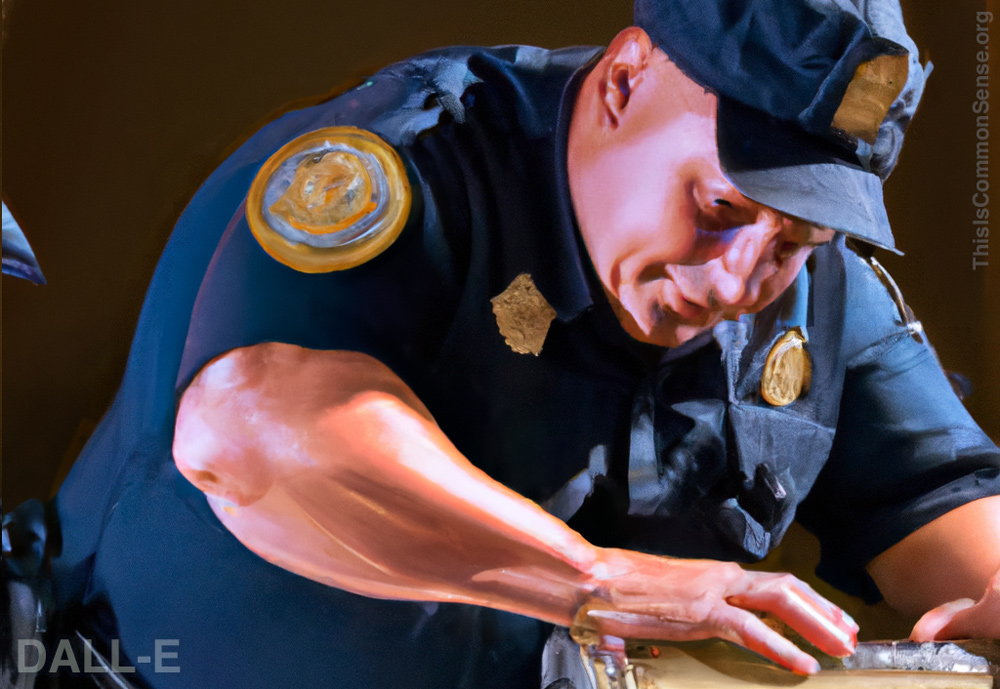
The Fifth Amendment Integrity Restoration Act (FAIR) would impose substantial limits on federal civil asset forfeiture — on the power of officers to grab someone’s cash or other belongings on the unsupported suspicion that it was involved in a crime.

Currently, this power to steal based on zero evidence and zero due process remains untrammeled. And forfeited funds thus grabbed can then be spent by the agencies that did the asset-grabbing. 

Victims must spend years in the courts to get their stuff back, if they ever do.

FAIR would require “clear and convincing evidence” of wrongdoing. It would also prohibit law-enforcement agencies from being able to spend forfeited funds, eliminating a perverse incentive to rob people naïve enough to be carrying “too much” cash for whatever reason.

At National Review Online, Jill Jacobson says that the bill is “a step in the right direction” but doesn’t go far enough. Arguing on the premise of innocent until proven guilty, she insists “there is no reason why federal law enforcement should be seizing personal property from everyday citizens on tenuous suspicion.” 

Or even non-tenuous suspicion, I would add, for not everyone strongly suspected of doing wrong can be proven to have done wrong. And citizens caught on the wrong end of a government official’s steely gaze should not be regarded as a public resource. 

The reform isn’t finished until civil asset forfeiture is abolished altogether.

This is Common Sense. I’m Paul Jacob.


PDF for printing

Illustration created with PicFinder.ai and DALL-E

See all recent commentary
(simplified and organized)
See recent popular posts

Categories
folly Fourth Amendment rights property rights

Can They Do That?

Residential tenants in Zion — and their landlords — can breathe a sigh of relief.

The Zion, Illinois, government can no longer send officials to barge into rented homes at will to conduct obnoxious inspections.

The inspection regime was instituted in 2015 by a mayor who blamed an excess of renters for the town’s financial troubles. The motive for the searches, then, may have been to make it more uncomfortable to rent in Zion. Seriously. As dumb and thuggish as that.

Robert and Dorice Pierce and their landlord were among the victims of this regime.

When an inspector showed up at the Pierces’ door, they told him to get a warrant. But judges don’t generally accept “important to harass tenants” as a reason for issuing warrants. In any case, any respect for constitutional constraints was incompatible with the very nature of these intrusive practices.

So Zion’s response was to threaten the landlord, Josefina Lozano, with daily and mounting fines until she compelled the Pierces to capitulate. That’s when the trio turned to the Institute for Justice and decided to go to court.

This was familiar territory for IJ, which in the 1990s had successfully fought a similar inspection regime in Park Forest, Illinois.

And now, after three years of judicial proceedings, IJ and its clients have secured a consent decree prohibiting the warrantless inspections and prohibiting the fines.

But those who enacted this outrageous regime deserve a reprimand more stern than merely a loss in court. 

This is Common Sense. I’m Paul Jacob.


PDF for printing

Illustration created with PicFinder.ai and DALL-E2

See all recent commentary
(simplified and organized)
See recent popular posts

Categories
Accountability Fourth Amendment rights international affairs media and media people

Freedom Isn’t the Danger

After reading the Honorable Justice Paul Rouleau’s “Report of the Public Inquiry into the 2022 Public Order Emergency,” you may demand a palette cleanser.

Matt Taibbi wrote a full article, “The West’s Betrayal of Freedom.” 

I’m going to quote an anarchist

For both Taibbi and me, Justice Rouleau’s bizarre defense of Prime Minister Justin Trudeau’s leveraging of emergency powers to freeze truckers’ bank accounts during last year’s lockdown protests leaves a bad taste in the mouth.

If you have a taste for freedom.

Which people in the news media, as well as in government (but do I repeat myself?), decreasingly demonstrate. Mr. Taibbi, reacting to both Rouleau’s report and mainstream journalistic coverage, notes the general tenor of both, which he says read “like all the tsk-tsking editorials in the West you’ve read since Trump, which used every crisis to hype the idea that freedom = danger.”

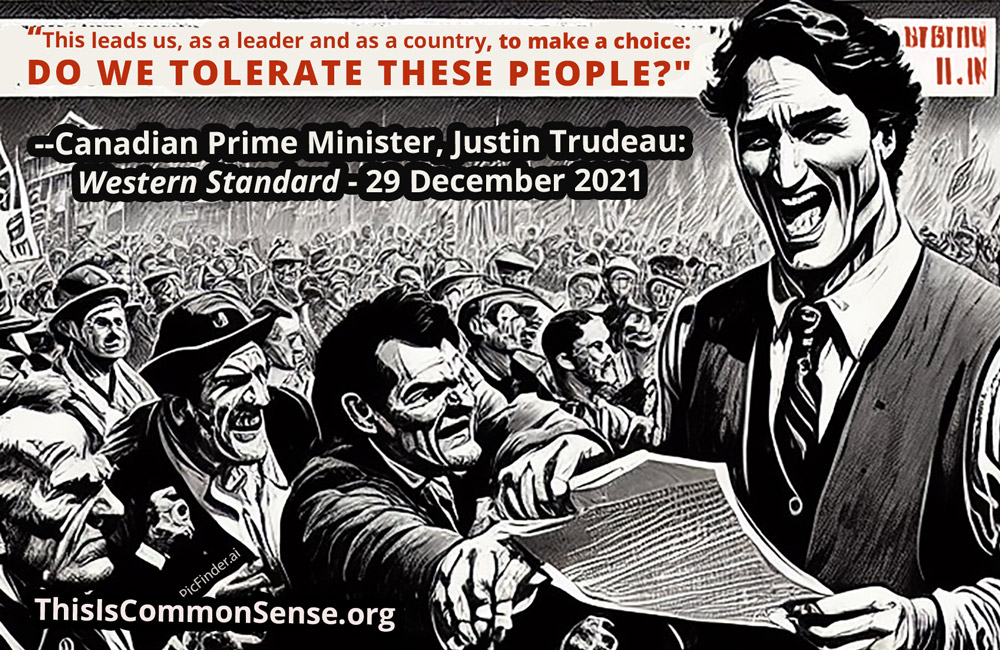
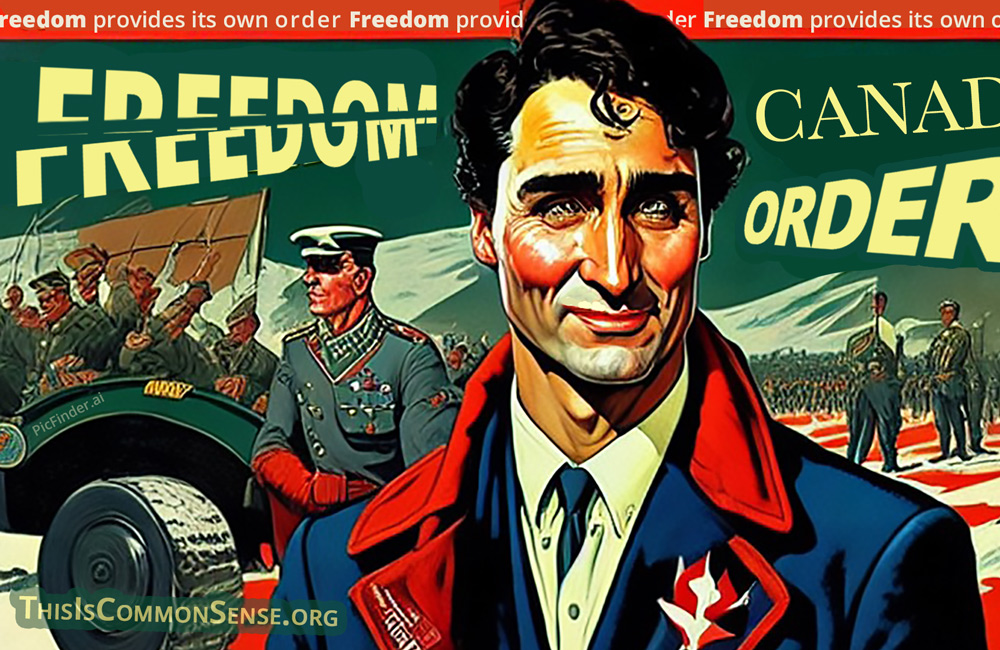
Rouleau excuses the tyrannical (anti-protest, anti-free-speech, anti-due-process) Canadian government’s attack upon the truckers because it “met a threshold.” You see, “Freedom cannot exist without order.”

But that’s placing the matter downside up. Freedom provides its own order

It just so often happens to be an order that tyrants don’t like.

Freedom creates order: when neither you nor I infringe upon the other’s sphere of life, that is an epitome of orderliness. Crime and government (but do I repeat myself?) upset that harmony.

“Liberty,” explained P. J. Proudhon, is “not the daughter but the mother of order.”*

When politicians forget that freedom provides the order we need, they make anarchists look good.

This is Common Sense. I’m Paul Jacob.


* Proudhon, the first major writer to treat “anarchist” as a non-pejorative, was arguably not an Antifa-type anarchist — and the full quotation, presented here on Tuesday, talks about a Republic. Make of that what you will.

PDF for printing

Illustration created with PicFinder.ai

See all recent commentary
(simplified and organized)
See recent popular posts

Categories
Fourth Amendment rights general freedom tax policy

Not Inadvertent

Maybe we can put a stop to the assault on the privacy of donors to political causes.

By “we” I mean The Buckeye Institute and the Institute for Free Speech, who have teamed up to challenge “a decades-old law that forces the IRS to demand that nonprofit charities hand over the private information of their largest donors every year.”

The IRS itself admits that collecting this personal data “poses a risk of inadvertent disclosure.”

Also a risk of fully advertent disclosure. 

The IRS has often been used to harass the political enemies of federal officials in a position to tell the agency what to do.

Buckeye Institute President Robert Alt reports the Institute’s own experience as Exhibit A. In 2013, soon after it had urged Ohio to reject Obamacare-inspired efforts to expand Medicaid, the Institute was subjected to an IRS harassment-audit.

The specter of this investigation was a scary one for the Institute’s major donors, who reasonably assumed that the audit was retaliatory. They worried that if their own names came up during the audit, they too would be subject to IRS attention. Many donors drastically scaled back their giving so they’d be less of a target; others stopped donating altogether.

Prospects for the Institutes’ litigation are good. The U.S. Supreme Court determined in a 2021 ruling that the government must at least consider “the potential for First Amendment harms before requiring that organizations reveal sensitive information about their members and supporters.”

Anonymity in political activism has a long American history — from the start, actually.

It’s what democracy looks like.

This is Common Sense. I’m Paul Jacob.


PDF for printing

Illustration created with DALL-E2

See all recent commentary
(simplified and organized)
See recent popular posts

Categories
Fifth Amendment rights Fourth Amendment rights international affairs

The Chinazis Next Door

The Russians Are Coming! The Russians Are Coming!

This 1966 comedy about the accidental grounding of a Soviet submarine off the coast of New England was nominated for four Academy Awards and captured the Golden Globe Award for best motion picture.

But a remake exclaiming “The Chinese Are Coming!” would be old hat: They’re already here

“The People’s Republic of China has opened at least three police stations on Canadian soil as part of an alleged attempt by the country’s security state to keep an eye on the Chinese-Canadian diaspora,” The National Post informed last month.

“Canada-based dissidents of the Beijing government have long warned Canadian authorities that they face organized harassment from Chinese authorities,” The Post added.

A new report by Safeguard Defenders, a Spain-based foundation working for human rights in Asia, reveals there are now 54 of these Chinese “service stations” in 30 countries . . . including one in New York City.

The organization warns of “China’s growing global transnational repression,” explaining that in the last year 230,000 expats were “persuaded to return” to China but “these returns are often obtained by visiting extreme sanctions on the families of those targeted, such as asset seizures and prohibition from seeking government health care or education.”

In another recent report noted by The Globe and Mail, “the United Nations human-rights office said it found ‘patterns of intimidations, threats and reprisals’ against Uyghurs and other Chinese nationals living overseas who had spoken out against Beijing.”

Just last week, “El Correo published direct corroboration from Chinese authorities” of “illegal policing operations” with an anonymous Chinese official telling the Spanish paper, “The bilateral treaties are very cumbersome, and Europe is reluctant to extradite to China. I don’t see what is wrong with pressuring criminals to face justice. . . .”

The message to Chinese dissidents is clear: “You’re not safe anywhere.”

Are we?

This is Common Sense. I’m Paul Jacob.


PDF for printing

Illustration created with DALL-E

See all recent commentary
(simplified and organized)
See recent popular posts

Categories
crime and punishment Fourth Amendment rights general freedom

Fourth Amendment Dead?

Unconstitutional actions are constitutional.

A federal judge doesn’t say so explicitly, but that’s what his ruling amounts to.

The case, which we discussed previously, involves U.S. Private Vaults, a Beverly Hills company that the Federal Bureau of Investigation raided last year. The company has been fined $1.1 million for money laundering because it let dealers anonymously keep cash in its safe deposit boxes.

Judge Gary Klausner concedes that the FBI lied to obtain a warrant, planning to seize the property of all boxholders whether or not there was any evidence of a crime against a given boxholder. And to this day, “specific criminal conduct has not been alleged against customers.” Nevertheless, Klausner ruled that despite the lie, it was constitutional for the FBI to grab the boxes’ contents.

Of course, if the warrant authorizing the FBI to ignore Fourth Amendment protections against unreasonable searches and seizures had been honestly solicited, that still would not have transmuted unconstitutional actions into constitutional ones.

“The court does not deny that the government had an improper motive when it applied for its warrant,” observes Rob Johnson, an attorney with the Institute for Justice, which is representing the boxholders.

“But it says that fact is irrelevant unless the improper investigatory motive was the only reason that the Government opened the safety deposit boxes. . . . If today’s shocking decision stands, it will set a dangerous precedent that will allow the FBI and other law enforcement agencies to bypass the Fourth Amendment.”

Thankfully, the Institute for Justice doesn’t regard the case as closed. It will appeal.

This is Common Sense. I’m Paul Jacob.


PDF for printing

Illustration created with DALL-E

See all recent commentary
(simplified and organized)
See recent popular posts

Categories
First Amendment rights Fourth Amendment rights

The Bidening

It does seem — because of the raids and surveillance and things targeting critics of the regime — that the Biden administration (“the Biden”) is out to get its political opponents.

John Hinderaker of Powerline notes a few recent tip-of-the-iceberg actions by the Biden or its political allies.

The Dilbert comic strip by Scott Adams was suddenly dropped from 80 newspapers after the strip began mocking certain modish pieties about diversity. We’ve learned that ostensibly private censorship is often done at the behest of government or politicians eager to muzzle somebody.

The Biden issued a slew of subpoenas to persons associated with the Trump administration for documents about efforts to challenge the 2020 election results. Nearly all these pertain “to activities that are plainly lawful,” observes Hinderaker.

The Biden seized the cell phone of Mike Lindell, CEO of MyPillow and infamous skeptic of the 2020 election results. He’s accused of identity theft and damaging a computer related to an alleged breach of Colorado voting machines, accusations that Hinderaker regards as implausible on their face. “This all has to do with his opposition to the regime.”

Although the Biden may provide rationales for the targeting, these tend to be paper-thin. Why? Probably because the Biden wants you to know exactly why all this banana-republic stuff is happening. You are expected to take the micro-thin excuses as a hint — so that you will adopt a paranoid stance.

And to avoid saying or doing anything that may get you, too, targeted by the Biden.

This is Common Sense. I’m Paul Jacob.


PDF for printing

Illustration created with DALL-E

See all recent commentary
(simplified and organized)
See recent popular posts

Categories
Accountability Fourth Amendment rights

Unjust “Investigation”

Can we trust the FBI to stick to the rule of law and defend our rights?

Yesterday I more than suggested that the answer is “No.” 

Adding more fuel to this negative judgment, last week Eric Boehm at Reason told the tale of a Federal Bureau of Investigation raid upon safe deposits. 

“The FBI told a federal magistrate judge that it intended to open hundreds of safe deposit boxes seized during a March 2021 raid in order to inventory the items inside,” Boehm writes, “but new evidence shows that federal agents were plotting all along to use the operation as an opportunity to forfeit cash and other valuables.”

When asked why he robbed banks, Willie Sutton’s response, reportedly, was “that’s where the money is!” He actually didn’t say it, but FBI personnel understand the operative principle all too well . . . regarding safety deposit boxes. 

Convictions? Hah! 

They seize property on an expected-revenue-based rationale.

Since “details regarding the planning and execution of the FBI’s raid of U.S. Private Vaults arenow out in the open,” Boehm goes on to explain, it looks like the FBI has to say bye-bye to “more than $86 million in cash as well as gold, jewelry, and other valuables from property owners who were suspected of no crimes.”

The plot’s been foiled, it appears, but will the culprits within the FBI be prosecuted?

Seems unlikely.

Truth is, the culture at the FBI has never been good. Barring defunding (which would be politically difficult) perhaps FBI agents should be restricted to just investigation, stripped of their weaponry, forced to rely on state and local lawmen — and perhaps the U.S. Marshals — to make any searches and arrests at all. 

This is Common Sense. I’m Paul Jacob.


PDF for printing

See all recent commentary
(simplified and organized)
See recent popular posts

Illustration assist from DALL-E

Categories
Common Sense Fifth Amendment rights First Amendment rights Fourth Amendment rights general freedom Second Amendment rights Tenth Amendment federalism

July 4, 2022 Independence Day

Independence Day

Those core ideas of independence and liberty still matter — perhaps now more than ever.

And to help take Common Sense with Paul Jacob beyond 2022, join . . .

Thanks for your contribution!


See all recent commentary
(simplified and organized)
See recent popular posts

Categories
Fifth Amendment rights Fourth Amendment rights

The War Against Cash Carriers

Michigan’s lawmakers and governor seem determined to remind us that history is no nonstop march into the light.

In the Great Lake State, the latest confirmation is a return to virtually unrestricted legalized cash-grabbing at the airport, reversing halfhearted reforms of several years earlier.

After those reforms were enacted, a traveler had to be toting in excess of $50,000 before officials a Michigan airport could be “justified” in confiscating his cash on a mere suspicion that it is associated with a crime.

But now, because of legislation just signed by Governor Whitmer, the threshold has been knocked down to $20,000.

Maybe you must be naïve to carry so much cash where police and other functionaries can easily get at it, but as Dan King of the Institute for Justice observes, you don’t have to be a criminal. And traveling with cash is not a crime.

Around the country, innocent persons have often run afoul of civil forfeiture laws that let authorities steal money earned by others without any showing that the money is ill-gotten.

With help from organizations like Institute for Justice, people who make the mistake of traveling with substantial cash — to buy a truck, open a bank account, whatever — just might get their money back after spending months in the courts. 

And suffering much anxiety. 

For the officials who cause the anxiety, both the thefts and any temporary judicial setbacks amount to just another day at the office.

This is open thievery by the State, turning cops into robbers.

Opposing it is Common Sense. I’m Paul Jacob.


PDF for printing

See all recent commentary
(simplified and organized)
See recent popular posts