Categories
First Amendment rights insider corruption local leaders

Vindictiveness vs. the First Amendment

Finally, the city council of Castle Hills, Texas, is doing the right thing by Sylvia Gonzalez, accepting a settlement to resolve years of litigation against the city for violating her First Amendment rights.

In 2024, the U.S. Supreme Court ruled in her favor, agreeing that courts may properly consider evidence that an arrest is retaliatory.

According to Gonzalez’s lawsuit, in 2019 city leaders had lashed out against the councilwoman for her support of a nonbinding petition to remove a city manager. The city’s weapon? A rarely used law that it wielded against her for “briefly and inadvertently having the petition among her papers” during a heated council meeting; she allegedly tried to “steal” her own petition.

Gonzalez was arrested and spent a day in jail — the real reason, according to her lawsuit, being her criticism of local leaders.

The settlement means that statewide training on “First Amendment retaliation” (presumably, how to avoid engaging in it) will be offered throughout Texas and, for Castle Hill officials, will be mandatory.

The city must also pay $500,000 in damages to Gonzalez.

Anya Bidwell, an attorney for the Institute of Justice, which represented Gonzalez in the suit, observes that the First Amendment “doesn’t come with handcuffs. This outcome sends a message to officials everywhere: if you retaliate against critics, you can be held to account.”

Let’s hope that not a whole lot of training is needed to safeguard local freedom of speech. The issue is not that complicated.

This is Common Sense. I’m Paul Jacob.


PDF for printing

Illustration created with Krea and Firefly

See all recent commentary
(simplified and organized)
See recent popular posts

Categories
crime and punishment First Amendment rights international affairs social media

Quit Banging on Brits

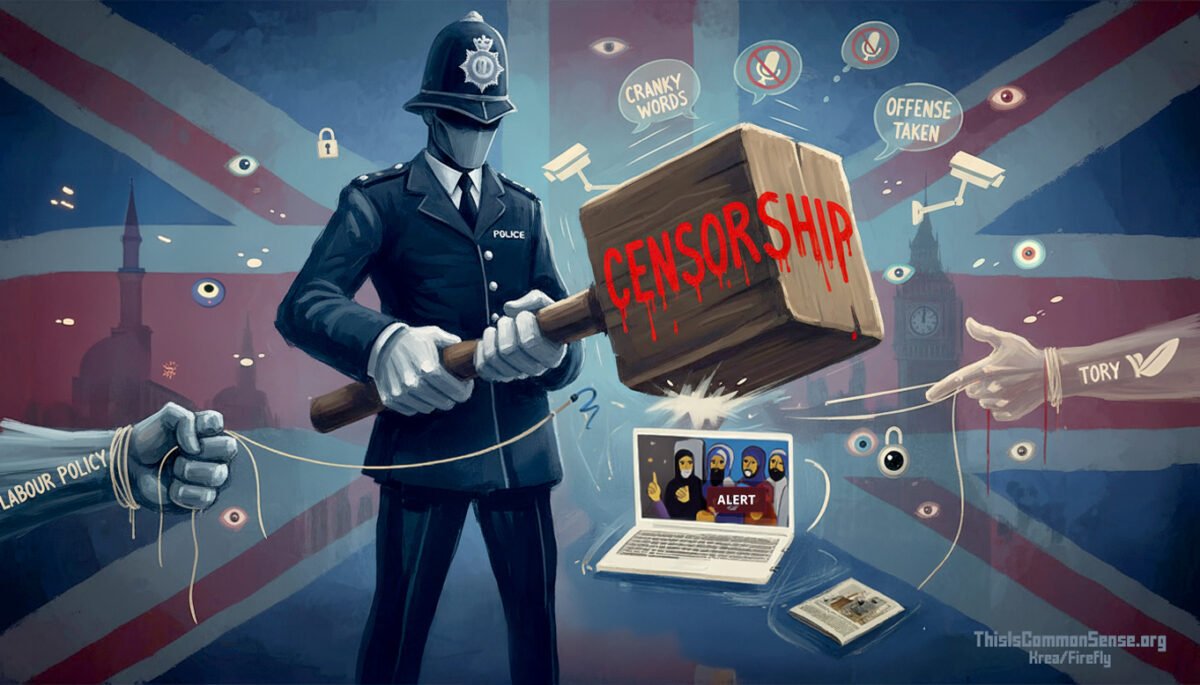
We hear so much bad news about censorship coming out of the United Kingdom that it’s almost shocking when something good happens instead.

That good news is a retreat from harassing innocent people for posting online too freely for the taste of British police enforcers.

In the big picture, the change in policy by the Metropolitan Police Service is but a minor tactical withdrawal in the pursuit of a censorship agenda that is otherwise proceeding on all fronts. It’s not so minor for people like, say, comedy writer Graham Linehan.

Several weeks ago, Linehan was arrested at Heathrow Airport by five armed officers.

“I was arrested at an airport like a terrorist, locked in a cell like a criminal, taken to hospital because the stress nearly killed me, and banned from speaking online.” His sin was posting a few tweets critical of transgender activists.

The charges against Linehan have been dropped. 

And from now on, says the Met, it will stop investigating “non-crime hate incidents.” A spokesperson explains that the commissioner “doesn’t believe officers should be policing toxic culture war debates. . . .” 

The “non-crime hate incidents” will still be logged, though.

The policy of harassing Britons for cranky words has been softened before, by the Tories. When Labour came in, the new government promptly hardened things again.

And further caution: Met policy is not government policy. 

So this particular hammer for banging upon speakers daring to offend the easily offendable could come swinging down again at any moment.

This is Common Sense. I’m Paul Jacob.


PDF for printing

Illustration created with Krea and Firefly

See all recent commentary
(simplified and organized)
See recent popular posts
Categories
First Amendment rights general freedom ideological culture

Two Ways of Walking Away

“The First Amendment prohibits the government from restricting free speech,” explained Michael J. Reitz in The Detroit News. But what about individuals and non-government groups? 

“Free speech doesn’t compel you to listen. You can walk away,” Mr. Reitz goes on to say.

In the piece, reprinted by the Mackinac Center for Public Policy, Reitz wonders, however, whether this “agree to disagree” attitude is enough to keep free speech alive. He believes that “as a society, we show our commitment to free speech through our willingness to listen, discuss and debate. It’s not consistent to say I value another person’s right to speak if I refuse to engage.”

A liberal attitude — in a social, perhaps non-political sense — is what Reitz advises: tolerant of differences; not prone to anger at hearing an opposing view; engaging logically and fairly with differing opinions; but free to take it or leave it without fearing recrimination, retribution or retaliation.

This right to walk away may define free speech, but Reitz argues that we mustn’t all walk to our bubbles in anger.

An old saw, recently popularized, insists that “we have freedom of speech, but we don’t have freedom from the consequences of speech.” In a free society, you may say what you like on your property, on your dime, but some people may shun you. Or fire you. And that’s OK.

What’s not an acceptable “consequence” of freedom of speech? Being silenced by the government, or the mob, either with petty violence or maximum force. Too many people use the “no freedom from consequences” cliché as an excuse to harass people at their work. Or bank. This is where it gets difficult. 

Since one neither has a right to a specific job nor to force a bank to accept one’s money on account, purely social pressure to de-bank, de-platform, or get someone fired, fits in a free society. But is Reitz correct that, legality aside, when such social pressure is common, and one-sided, free speech is doomed?

Perhaps society is doomed, in multi-lateral wars of us vs. them. 

This is Common Sense. I’m Paul Jacob.


PDF for printing

Illustration created with Midjourney and Firefly

See all recent commentary
(simplified and organized)
See recent popular posts

Categories
First Amendment rights privacy

Permit to Harass, Interrupted

Minnesota’s permit to harass has been interrupted — not halted, because a federal court has granted only a preliminary injunction.

Nancy Brasel, the district judge, has for now blocked Minnesota’s law requiring grassroots advocacy groups to publicly disclose the names and addresses of their vendors because she expects that this requirement will indeed be ultimately thrown out.

Violating, as it does, freedom of speech.

One of the targets of the law is Minnesota Right to Life. One of its vendors dropped MRL with a thud in the middle of a campaign. As MRL’s executive director, Ben Dorr, notes, the challenged law mostly hands “a ready-made ‘enemies list’ to our political opponents.” He counts seven vendors who refused to work with his organization after being harassed by abortion rights proponents.

This harassment is the apparent reason for the disclosure regulation’s existence. When the names and locations of vendors who facilitate spread of political messages is forcibly disclosed, this allows opponents of the message to stoop to any low, such as harassing companies that provide services to organizations trying to get the word out.

What the harassers hope to accomplish, and sometimes do, is frighten vendors into dropping clients who engage in advocacy.

The thugs who would impede speech any way they can sometimes speak of “transparency” as if it were an end in itself. Whether transparency is desirable depends on the context. Citizens have every right to know how much government spends, and on what, and why — transparency is necessary there, because governments belong to citizens. But no crook or bully has an inalienable right to all the information about innocent people that he needs in order to go after them.

This is Common Sense. I’m Paul Jacob.


PDF for printing

Illustration created with Krea and Firefly

See all recent commentary
(simplified and organized)
See recent popular posts
Categories
First Amendment rights international affairs

Pigs Not Flying Over England

It can’t govern itself. But the UK, eager to govern the United States, is trying to impose fines on the loose-talk website 4Chan for ignoring British censorship demands.

Preston Byrne, a lawyer representing 4Chan, has responded to UK regulator Ofcom’s attempt to impose the fines — more than $26,000 to start — with instructions to get lost.

Ofcom Enforcement Czar Suzanne Cater says that this fine “sends a clear message that any service which flagrantly fails to engage with Ofcom and their duties under the Online Safety Act can expect to face robust enforcement action.”

How robust, though? 

Byrne: “4chan’s constitutional rights remain completely unaffected by this foreign e-mail. 4chan will obey UK censorship laws when pigs fly. In the meantime, there’s litigation pending in DC. Ofcom hasn’t yet answered. . . .

“That fine will never be enforced in the USA. The UK is welcome to try to enforce it in an American court if they disagree.”

The Trump administration has stressed its opposition to the UK’s global-censorship agenda. So what is going on here? 

It appears that when some people over-zealously seek to dominate others, the weaker they are the more desperate — and in their desperation they become more belligerent. Since the United Kingdom is in no position to launch an invasion of the United States in order to force us . . . well, they might just shut up already. 

Britain’s leadership is in disarray. The country is very weak — a least, unless it teams up with a more powerful country, like China. Which is what the UK indeed seems to be doing

This is Common Sense. I’m Paul Jacob.


PDF for printing

Illustration created with Krea and Firefly

See all recent commentary
(simplified and organized)
See recent popular posts

Categories
First Amendment rights international affairs privacy

Private Chat, Back Now in Europe?

We seem to have Germany — not a typo: Germany — to thank for the fact that one of the most intrusive EU gambits attacking freedom of speech is about to fail.

The proposal would let governments monitor all private chat messages, via mandatory back doors, without bothering with such trivialities as warrants, probable cause, evidence.

The European Union centralizes many assaults on liberty that member countries are supposed to supinely accept once enacted. But it can’t ignore individual members as proposals are still en route to becoming law. And the German government, often not exactly a beacon when it comes to free speech, has now made its opposition to this particular mode of surveillance and censorship loud and clear.

As Germany blocked the plan, first announced in 2022, German Justice Minister Stefanie Hubig said that “unprovoked chat control must be taboo in a constitutional state. . . . Germany will not agree to such proposals at EU level.”

Parliamentary leader Jens Spahn of the Christian Democratic Union also uttered some common sense, explaining that warrantless monitoring of chats “would be like opening all letters as a precautionary measure to see if there is anything illegal in them. That is not acceptable, and we will not allow it.”

Although the proposal is not yet quite dead, the German opposition makes it extremely unlikely that EU bosses can go further with it.

Great spirit, German officials. Cheers to now applying this principle consistently — as is required of principles.

This is Common Sense. I’m Paul Jacob.


PDF for printing

Illustration created with Krea and Firefly

See all recent commentary
(simplified and organized)
See recent popular posts

Categories
First Amendment rights government transparency ideological culture social media

Google Confesses All

Google is no longer silent about whether the Biden administration pushed Google to censor customers for their viewpoints. 

Under Biden, Google censored YouTube content creators under federal pressure, specifically about COVID-19. But Google did muzzle discourse on other matters, such as disputes about the legitimacy of the 2020 election, as a result of its own policies that it now says are “sunsetted” along with policies resulting from its submission to a rogue administration.

Its own role is important because we know that a tech giant can effectively resist federal pressure to censor on the basis of the principles of the company’s leaders.

The proof is how Twitter changed course while Biden or his autopen was still the president. Twitter revamped its policies after Elon Musk ascended to the helm, starting to welcome back those who had been censored under the previous owners.

Yes, Elon Musk found himself under assault from every direction from a variety of federal agencies; which, it seemed, were acting as if in concert with and at the behest of a foiled Biden administration. Musk’s opposition to censorship and documentation of administration pressure to censor was not risk-free.

Now Google is following suit. When restoring freedom of speech is lots less risky.

Let’s hope Google’s words now decrying censorship, and its still-in-progress efforts to make things right — inviting the return of former YouTubers whose channels it had censored, for example — will render the company less eager to cooperate when the next pro-censorship administration takes power.

This is Common Sense. I’m Paul Jacob.


PDF for printing

Illustration created with Krea and Firefly

See all recent commentary
(simplified and organized)
See recent popular posts

Categories
First Amendment rights national politics & policies partisanship

Who Is the Lawfare King?

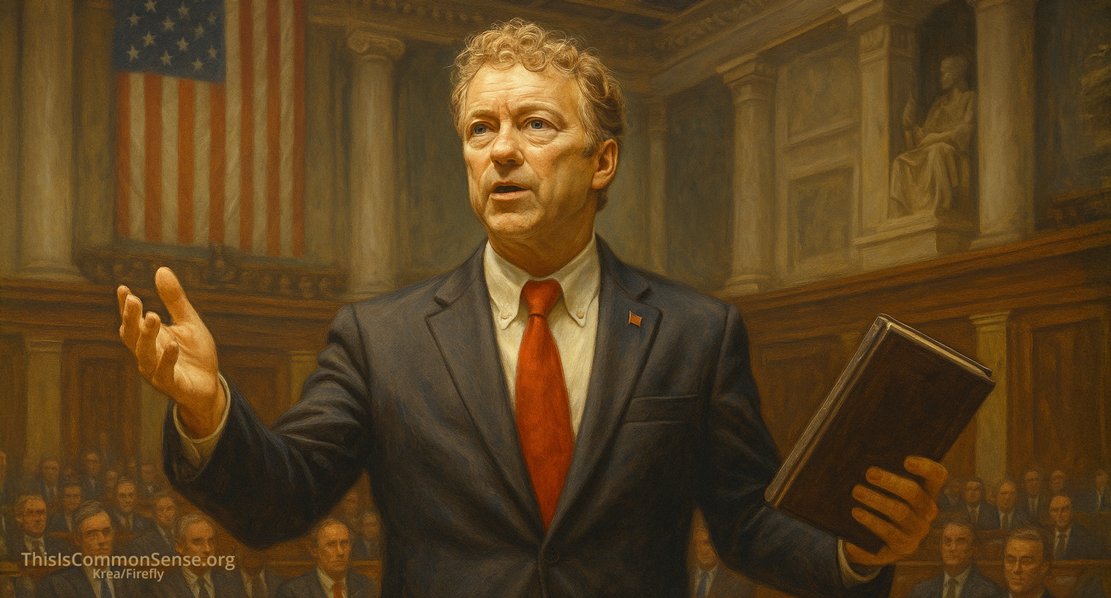
Last Sunday on Meet the Press, Sen. Rand Paul (R-Ky) addressed two areas where President Trump has stumbled in recent days, losing many conservatives and civil libertarians: censorship and lawfare. 

“Senator,” Kristen Welker asked, “do you believe that President Trump is sending the message that he only supports free speech when it’s speech that he agrees with?”

“Well, I can’t control everything the president says. And I don’t think that having the FCC weigh in on licenses is right. I will fight that,” the junior senator from Kentucky declared. “But I can tell you that throughout government, the censorship apparatus that Biden had put in place is gone.”

Under President Biden, the senator explained, employees and ex-employees of both the FBI and Department of Homeland Security set up offices inside Twitter, while “Facebook was told to take down information concerning the origins of the Covid virus” under threat of “being broken up by antitrust. So we have had official censorship going on for many years now, and everybody on the left just looked the other way. 

“They actually had an office, an office of censorship.”

Welker then inquired if he thought it was “appropriate for the president to direct the attorney general to go after his political opponents”?

“I think lawfare in all forms is bad,” Rand Paul replied. “What they did to Donald Trump was an abomination. But yes, it is not right for the Trump administration to do the same thing.

“We need to get politics out of the judicial system as much as we can. But we can’t do it without acknowledging that the king of lawfare was Biden.”

True enough, with the full title: Marionette Censor Joe, King of Lawfare, First of His Name If Not of His Kind.

This is Common Sense. I’m Paul Jacob.


PDF for printing

Illustration created with Krea and Firefly

See all recent commentary
(simplified and organized)
See recent popular posts
Categories
First Amendment rights national politics & policies too much government

Free Jimmy

Last Friday (and Saturday), we supported the right of ABC’s corporate leaders to ignore bullying comments by Federal Communications Commission (FCC) Chairman Brendan Carr and produce the late-night show, “Jimmy Kimmel Love!” to their heart’s content.  

I’m happy to hear that ABC will bring Kimmel back tonight.

Not glad because I like him or will watch his show. I don’t. I won’t. I’d cancel him were it up to me. But freedom’s tops, so I get especially jazzed when people stand up to demand it. 

And concerned when those in power attempt to take it away.

The very potent public backlash against the idea that ABC was muscled by the Trump administration into suspending Kimmel’s show is why it has returned. That’s a healthy sign of our political culture. Plus, take note that this pushback against the FCC chairman and President Trump hasn’t come just from the Left but also, as The Wrap reports, from many prominent conservatives including “Tucker Carlson, Ben Shapiro and Ted Cruz.”

What Kimmel alleged — that the murderer of Charlie Kirk was somehow MAGA — was not only “without evidence” but clearly contradicted by the evidence. As well as being asinine on its face. And more than a bit callous.

Still, freedom of speech means the freedom to say what you think, no matter how boneheaded, whether those in power like it or not. 

Sinclair Broadcast Group, owner of the largest chain of ABC affiliates, has already announced that its stations will not be airing Kimmel’s program. As is their right.

Stick with freedom of speech, Mr. President. For all.

This is Common Sense. I’m Paul Jacob. 


PDF for printing

Illustration created with Krea and Firefly

See all recent commentary
(simplified and organized)
See recent popular posts

Categories
First Amendment rights social media

Apology Request Denied

The UK police picked the wrong elderly cancer patient to badger for exercising her right to freedom of speech.

Whatever Deborah Anderson said on social media, it wasn’t harsh enough to justify clapping on the irons and hauling her away. Just a knock on the door and a polite request to Do the Right Thing. But polite in the way a mailed fist in a marshmallow glove is polite.

Anderson: “I’m a member of the Free Speech Union and I’m an American citizen. . . . I’ll have Elon Musk on you so quick your feet won’t touch. . . . You’re here because somebody got upset? Is it against the law? Am I being arrested?”

Officer: “You’re not being arrested.”

Anderson: “Then what are you doing here?”

“My plan was, if you were admitting that it was you who wrote the comment, you could just make an apology to the person.”

“I’m not apologizing to anybody. I can tell you that.”

“The alternative would be that I have to call you in for an interview. . . .”

Somebody complained to the police, and somehow that’s enough all by itself, regardless of the nature of the complaint, for the police of the United Kingdom to leap into nonsensical action.

Anderson then asked whether there are “no houses that have been burgled recently? No rapes, no murders?” Good question, but ineffectual. Not his task at the moment, the officer said.

At least we can be proud of one of these two interlocutors.

This is Common Sense. I’m Paul Jacob.


PDF for printing

Illustration created with Krea and Fireflly

See all recent commentary
(simplified and organized)
See recent popular posts