Categories
folly general freedom ideological culture media and media people nannyism national politics & policies too much government

The Weight of Politics

Folks sure go crazy over diets. And that’s without the insanity of politics à la mode.

Consider the new Trump Diet — actually, several of them.

Actress Lena Dunham pledged to move to Canada if Donald Trump won last November. Instead, she stayed to offer a new weight loss scheme. “Everyone’s been asking like, ‘What have you been doing?’” she told Howard Stern. “And I’m like, ‘Try soul-crushing pain and devastation and hopelessness and you, too, will lose weight.’”

So, there is hope!

Conversely, comedian Judd Apatow complains, “It’s very hard to lose weight in the Trump era.” The acclaimed Hollywood producer, director and writer adds, “Most of us are just scared and eating ice cream.”

Not Barbra Streisand. Oh, yes, she tweeted: “Donald Trump is making me gain weight.” But she made it clear that “after the morning news, I eat pancakes smothered in maple syrup!” At least, her new song, “People, People Who Need Pancakes,” is moving up the scales — er, charts.

With mixed results for shedding pounds in the U.S., let’s graze elsewhere.

Certainly, no diet regime has been as successful, nor as rigorously tested, as the Maduro Diet — made famous in Venezuela by President Nicolás Maduro. The entire socialist nation is on it, and a new survey discovered that three of four Venezuelans lost “at least 19 pounds” during 2016.

Think socialism doesn’t produce results? Fat chance.

Still, such a steady diet of politics is hard to stomach. Instead, maybe we better concentrate on exercising . . .

. . . our freedom.

This is Common Sense. I’m Paul Jacob.


PDF for printing


Categories
Accountability folly free trade & free markets local leaders moral hazard nannyism porkbarrel politics responsibility too much government

Small Target, Big Subsidy

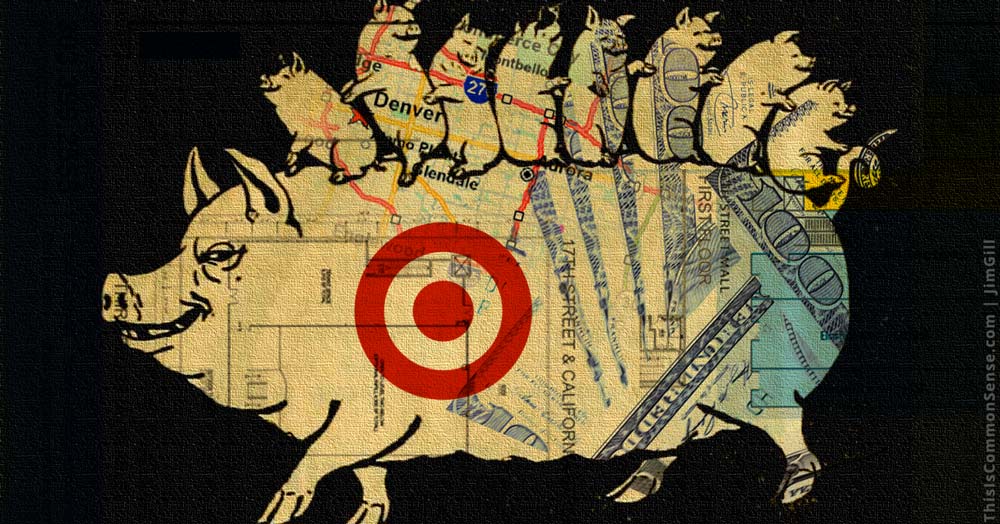
Something has gone wrong when, to get a tenant to move into an empty space in your prime-location building, you need a $4 million subsidy.

And when I say “prime location,” I’m not engaging in Trumpian over-statement. The downtown Denver, Colorado, property location sees over 35,000 pedestrians per day . . . and that’s with the primo slot empty.

But to get that slot filled, the owners have negotiated with the city government to nab a $2 million “incentive” to fix the place up for Target, which is thinking of leasing the location to put up a smaller-than-usual “flexible-format” store. Oh, and another $2 million for “operational” costs, which seems to be some kind of a loan to be paid back from taxes to be collected — and shared by the city for 20 years with the owners.

In other words, it’s the darnedest business deal you’ll ever see (and never get): up-front money not from a bank or investors, but from Denver’s city government “BIF” — Business Investment Fund — which is obviously part of a convoluted scheme fed by taxes and devised by . . . people I wouldn’t trust with my money.

Structuring deals like this is how modern cronies — er, cities — operate, I know. Am I alone in judging it corrupt on the surface and corrupting in the details?

If prime commercial property has gone unused for about a decade — as this three-storied mall space has — I’d think that maybe the owners have set the rents too high or the city has been a bit too greedy with taxes.

Or both.

This is Common Sense. I’m Paul Jacob.

Printable PDF


Categories
general freedom ideological culture initiative, referendum, and recall national politics & policies responsibility too much government

Adios, California?

Californians account for more than one of every ten Americans.

For now.

Three years ago, an initiative sought to split the mega-state up. Had that measure succeeded, the U.S. Congress would have decided whether to permit the Golden State to become six separate states — with ten more U.S. Senators.

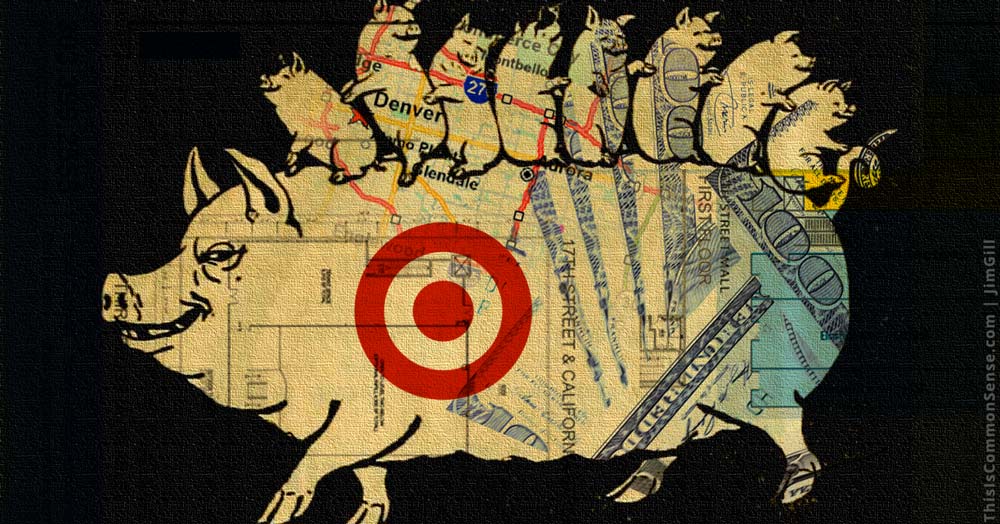
Now, a group called “Yes California” is petitioning for a 2018 ballot measure on leaving these United States altogether: Secession. “California could do more good as an independent country than it is able to do as just a U.S. state,” says its website.

Supporters argued in a recent Washington Post feature that California “subsidizes other states at a loss.” Indeed, it’s one of 14 states that get less money back from the federal government than paid in taxes.

And there’s Trump. Opposition to the president is palpable. California provided Hillary Clinton with a 4.3 million popular vote margin over Republican Donald Trump, 1.5 million more than her national margin.

“It’s understandable why the election of an evil white supremacist swindler as president,” wrote Zócalo Public Square’s Joe Mathews in the Fresno Bee, “has given the idea of California independence such currency.” Nonetheless, he opposes #CalExit as divisive and “not very Californian.”

Nationally, for partisan reasons, Republicans may cheer it, while Democrats shudder.

Me? I’m for self-determination.

But, remember: Northern Californians have been agitating to secede from the state since 1941. Those desires are picking up steam — especially with trepidation over whether the Oroville dam will hold. Folks feel unrepresented in the state capitol.*

And they are. Already 21 of the 23 northernmost counties have made declarations to form the State of Jefferson.

Let Californians decide . . . county by county.

This is Common Sense. I’m Paul Jacob.
 

* Note that Trump won by a landslide in the counties that would comprise Jefferson, our would-be 51st state.


Printable PDF


Categories
Accountability folly ideological culture moral hazard nannyism national politics & policies responsibility too much government U.S. Constitution

Tough Luck, Chumps

Advertised as a big deal ahead of time, the debate didn’t get much play afterwards.

Especially from the Left blogosphere.

Why?

Billed as about the “future of ObamaCare,” it was really about what should replace ObamaCare.

The CNN debate pitted Sen. Ted Cruz, well-known Republican opponent of the Affordable Care Act*, against Sen. Bernie Sanders, well-known “independent” proponent of what he likes to call the “Medicare for All single-payer program.”

Upshot? While either Bernie or Ted may possibly be construed to have won, there was indeed one certain loser, ObamaCare itself.

Sen. Sanders conceded nearly every charge Sen. Cruz lobbed at the program. He merely countered with his support for treating health care “as a right, not a privilege” (a leftist farrago from days of yore) and moving on to single-payer medicine.

That’s how bad ObamaCare really is. Its chosen champion refused to champion it.

The basic tension was best summed up between “town hall” questioners Carol, suffering from multiple sclerosis, who asked Cruz to promise continued coverage for cases like hers, and LaRonda, a woman with a chain of hair care shops who cannot afford insurance for herself or her employees and also cannot expand her company because at 50 employees the ACA would force her to provide insurance.

Cruz expressed his sympathy for Carol, but seemed to meander around her request for a guarantee. He also evaded** a straightforward answer re: “healthcare as a right.”

Sanders was a tad more honest, in effect giving the “tough luck” answer that the entrepreneur just “should” pay*** for her employees’ medical insurance.

Well, we sure are all “paying” for ObamaCare, one way or another.

This is Common Sense. I’m Paul Jacob.
 

* Which is the same thing as ObamaCare. Some folks purportedly hate ObamaCare but love the ACA. No reader of Common Sense, of course.

** Cruz concluded the debate better, alluding to an old SNL skit about a recording session wherein the cowbell ringer always wanted “more cowbell” in every take. “It was government control that messed this all up. And Bernie and the Democrats’ solution is more cow bell, more cow bell.”

*** “[I]f you have more than 50 people, you know what, I think — I’m afraid to tell you — I think you will have to provide health insurance.”


Printable PDF


Categories
Accountability crime and punishment moral hazard nannyism national politics & policies property rights too much government U.S. Constitution

Watcha Gonna Do?

At a White House meeting last week between President Trump and law enforcement officials, a Texas sheriff raised a concern about legislation introduced by a state senator to require a conviction before police could take someone’s property.

Mr. Trump asked for that senator’s name, adding, “We’ll destroy his career.” The room erupted with laughter.

“That joke by President Trump,” Fox News’s Rick Schmitt said on Monday, “has the libertarian wing of the Republican Party raising their eyebrows, instead of laughing.”

Not to mention the civil libertarians in the Democratic Party and the Libertarian Party itself.

Civil asset forfeiture, as we’ve discussed, allows police to take people’s cash, cars, houses and other stuff without ever convicting anyone of a crime — or even bringing charges. The person must sue to regain their property.

Lawyers aren’t free.

Two bedrock principles are at stake:

  1. that innocent-until-proven-guilty thing, and
  2. Our right to property.

Since police departments can keep the proceeds of their seizures, they’re incentivized to take a break from protecting us — to, instead, rob us.

“Our country is founded on liberties,” offered Jeanne Zaino, a professor at Ionia College. “[G]overnmental overreach is not something that is natural for Republicans to embrace.”

Schmitt acknowledged that “Libertarians would hate this. They don’t want big government. But they don’t have a lot of pull.”

Libertarian-leaning Republicans like Sen. Rand Paul and Rep. Justin Amash are trying to end civil forfeiture, but the president will likely veto their legislation.*

Let’s not wait. Activists in three Michigan cities put the issue on last November’s ballot and won. You can, too.

This is Common Sense. I’m Paul Jacob.
 

* FoxNews.com reported that, “Trump signaled he would fight reforms in Congress, saying politicians could ‘get beat up really badly by the voters’ if they pursue laws to limit police authority.”


Printable PDF


Categories
free trade & free markets national politics & policies responsibility too much government

The Skinny on Trumponomics

President Donald Trump does not trust economists. So he is demoting the Council of Economic Advisors, booting out of the Cabinet the Council’s chairperson.

If this were only because economists as economists cannot do what he has been able to do — make a big success in business and trade — we could give him something like a pass.

After all, successful entrepreneurs have a knack for guessing an unpredictable future. Economists, not so much. Why the difference? Maybe because entrepreneurs have “skin in the game.” Governments boards and bureaus — or endowed professorships — don’t risk anything like skin.

Besides, prediction is an art, not a science.

Could Trump be fooled by his knack for working with real risk?

But all this may be irrelevant.

Trump’s problem seems to be that he cannot find enough reputable economists to jump on board his protectionist bandwagon.

Trade barriers, high tariffs and punitive measures to control corporate behavior — among Trump’s most popular policies — aren’t big among economists.

According to Josh Zumbrun, writing in the Wall Street Journal, a “survey of every former living member of the CEA for both Republican and Democratic administrations found that not one member publicly supported Mr. Trump’s campaign.”

Economist Pierre Lemieux, writing in response to Zumbrun’s article, clarified Trump’s particular problem: economists “have methods and theories that prevent them from saying stupidities. They are difficult to turn into parrots. And they believe in the benefits of exchange.”

That latter notion, really basic, is what protectionists like Trump do not understand.

And the kind of predictions economists can successfully make run like this: “Well, that won’t work!”

It’s usually said about protectionism.

But whose skin is on the line now?

This is Common Sense. I’m Paul Jacob.

Printable PDF


Categories
Accountability general freedom government transparency responsibility too much government

The Confidence Game

Romania’s parliament has confidence in . . . itself.

Sorta. A parliamentary no-confidence vote failed, despite 161 lawmakers voting for the resolution and only eight voting with the government.

Confused? The no-confidence measure failed because the Social Democrats, controlling nearly two-thirds of the 465 seats in parliament, abstained on the measure, which required a majority of parliament to vote affirmatively.

Not a very confident vote of confidence.

The vote came after eight days of protests in Bucharest, the capital, and around the country — the largest since the 1989 fall of communism. A quarter of a million people took to the streets of Bucharest last Sunday, and half a million nationwide.*

The protests came after last week’s late night corruption decree, issued “by the cabinet, without parliamentary debate,” as Reuters reported — and “designed to decriminalize a number of graft offences, cut prison terms for others and narrow the definition of conflict-of-interest.”

“The emergency ordinance . . . effectively decriminalized some forms of corruption if the amount involved was less than $47,000,” explained the New York Times, meaning amnesty for Liviu Dragnea, the head of the ruling Social Democrat Party, and dozens of other politicians convicted of graft and corruption.

The decree was hastily rescinded, but Romanians cannot trust their government.

“It’s too late,” one protester said. “Their credibility is zero.”

“This government has offered us a perfect demonstration of what it can do during its first 30 days in office,” another quipped. “Conclusion: they must leave.”

But Prime Minister Sorin Grindeanu told fellow legislators, “I do hope that as of today we get back to work.”

Unfortunately, that’s what Romanians fear.

This is Common sense. I’m Paul Jacob.


* The same ratio of protesters to population in the U.S. would mean eight million protesters nationally.


Printable PDF


Categories
Accountability free trade & free markets general freedom government transparency nannyism national politics & policies responsibility too much government

Sledgehammer to a Bureaucracy

The media hysterically pushes the line that the new Trump administration is so much “in chaos” it even frightens seasoned (salt-and-pepper?) heads in the Republican Party. But perhaps folks at the Environmental Protection Agency have more reason to panic.

“It looks like the EPA will be the agency hardest hit by the Trump sledgehammer,” writes Julie Kelly over at National Review.

Ms. Kelly offers striking reasons to hit the agency hard, quoting from Steve Malloy, the author of Scare Pollution: Why and How to Fix the EPA. “I can think of no agency that has done more pointless harm to the U.S. economy than the EPA — all based on junk science, if not out-and-out science fraud.” Malloy looks forward to the new president’s promised rethink and restructuring of the agency.

Just how bad is it?

Environmentalists often cry foul over any corporate funding of ecological research. But if one worries about money influencing results, the case against grants funded by regulatory agencies for regulatory purposes is even stronger.

Especially when the agency is run by ideologues.

Trump’s transition team seeks to make all the EPA’s relevant data public, for peer and public review, and would really like to curtail the agency’s research funding entirely.

Pipe dream? Better than the recent nightmare: “For eight years,” writes Kelly, “President Obama used the agency as his de facto enforcer of environmental policies he couldn’t pass in Congress even when it was controlled by his own party.”

The EPA needs to be checked. And balanced. And more.

This is Common Sense. I’m Paul Jacob.

Printable PDF


Categories
ideological culture media and media people nannyism national politics & policies privacy responsibility too much government

Women and Men for Life

At Townhall on Sunday, I applauded the Women’s March on Washington for being peaceful, despite Madonna’s F-bomb laden speech, culminating with her daydream of “blowing up the White House.”

We’ll never know how many more folks marched in that much-heralded event than attended last weekend’s pro-life march, because the mainstream media did not pay enough attention to the later, inconvenient-to-their-narrative event, and crowd-counters didn’t count.

The two marches did “intersect” (figuratively) when a pro-life group was kicked out as a “partner” to the women’s march.

“If you want to come to the march you are coming with the understanding that you respect a woman’s right to choose [abortion],” declared Linda Sarsour, one of four chairwomen for the women’s march, who was described by the New York Times as “a Brooklyn-born Palestinian-American Muslim racial justice and civil-rights activist.”

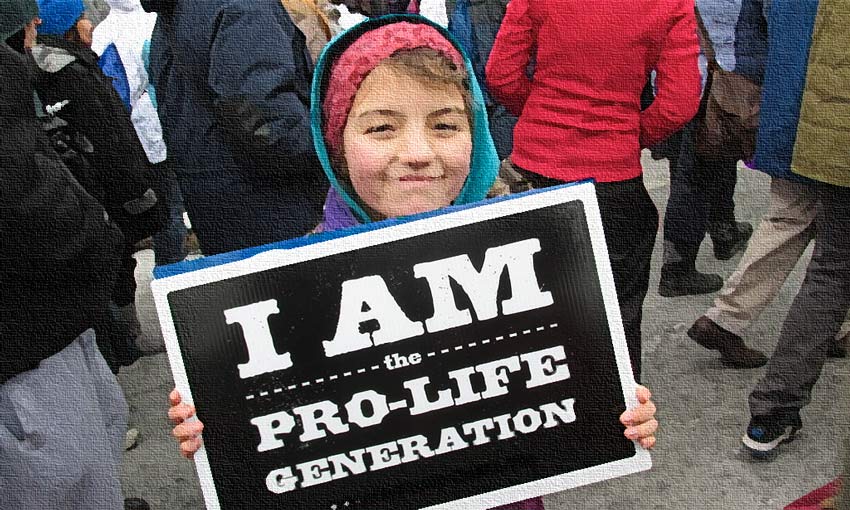
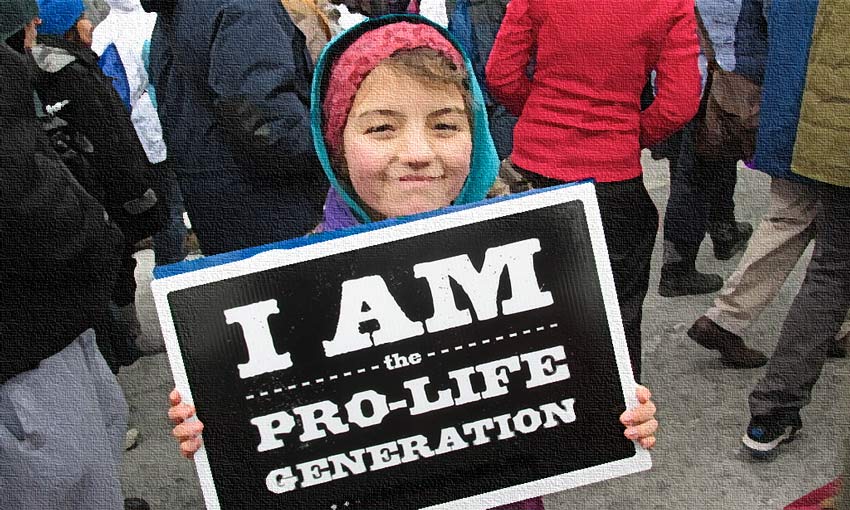
In its favor, the pro-life march, anti-celebrating the 44th year since the Roe v. Wade decision, had far more tasteful placards — despite the fact that pro-life protesters are often remembered for grisly signs picturing aborted fetuses. I particularly liked a sign held by a young women, reading:

“We are having a clump of cells.” — [said] No One Ever

Speaking of young people, Slate magazine reported that “the demographic outlook for the pro-life movement looks anything but bleak,” citing a 2015 poll wherein “52 percent of millennials said the label ‘pro-life’ describes them somewhat or very well.”

Remember, the pro-life movement has been marching all these years not to secure government benefits for themselves, but to protect others.

This is Common Sense. I’m Paul Jacob.


Printable PDF


Categories
Accountability responsibility too much government

Out of Our Misery

Obamacare may be on the way out.

According to The Atlantic, “the powers of the incoming Health and Human Services secretary are broad enough to cripple the [Affordable Care Act] so it has to be replaced.” Which is significant since the new President has just “signed an executive order empowering his administration’s agencies to do all they can — within the bounds of the Affordable Care Act — to undercut that law.”

The Atlantic’s Vann R. Newkirk II suggests this is . . . “ironic.” The executive leeway Trump is taking is not without precedent. “The irony of that component,” he writes, “is that it rests on precedent set by the Obama administration, which used executive and regulatory power liberally to make the law work in the face of Republican opposition.”

Irony? How about chickens returning to the home roost?

Obamacare itself undermined Obamacare. The plan, from the beginning, was so gimcrack with hidden redistribution that, to both opponents and proponents, it was designed to fail . . . to usher in the Glorious Era of socialized medicine.

Since Obamacare increased “insurance” costs for hundreds of thousands of previous insurance policy holders, and increased medical costs generally, too, it actually discouraged participation from the healthiest, many of whom would rather pay the exorbitant fines, er, “taxes.” Throwing the insurance industry into a death spiral.

So, putting the system out of our misery sooner seems sensible.

But Congress and Trump cannot stop there. Either they repeal more federal regulation and subsidy*, or keep parts of Obamacare, despite a lack of financial stability. A new bill in the Senate promises to do the latter.

We haven’t seen much hint of the former.

But can hope. Audaciously.

This is Common Sense. I’m Paul Jacob.

 

* To let markets work. Note that The Atlantic tends to miss the point of Obamacare critics. In describing more market-based options, the magazine characterizes the Medical Health Savings Account approach as “For people sick of high deductibles, Republicans offer high-deductible plans as replacements for Obamacare.” The idea is to incentivize people to pay for their own care, which would bring costs down generally.


Printable PDF