Why isn’t this a bigger story? Is there a “truth embargo”?
The reports do not suggest ball lightning or other natural phenomena, despite what debunkers tell us. Weird in every dimension:
Why isn’t this a bigger story? Is there a “truth embargo”?
The reports do not suggest ball lightning or other natural phenomena, despite what debunkers tell us. Weird in every dimension:

The United States was founded by the brightest people in the country — and we haven’t seen them since.
Gore Vidal, Matters of Fact and Fiction (1978)

Today is Estonia’s Victory Day, which has been celebrated on June 23 every year since 1934. The date recalls the victory in the 1919 Battle of Vonnu of the Estonian military forces (and Latvian North brigade) and their allies over German forces (Baltische Landeswehr) who sought to re-assert Baltic-German control over the region. The battle was part of the 1918-1920 Estonian War of Independence, where the main adversary of the newly independent Estonia was Communist Russia.
Today, Victory Day also marks the contributions of all Estonians in their fight to regain and retain their independence. Estonian celebration of June 23 is ceremonially tied to the following Midsummer Day celebrations on June 24.
According to Estonian laws, the state flags are not to be lowered during the night between days.

All truths are easy to understand once they are discovered; the point is to discover them.

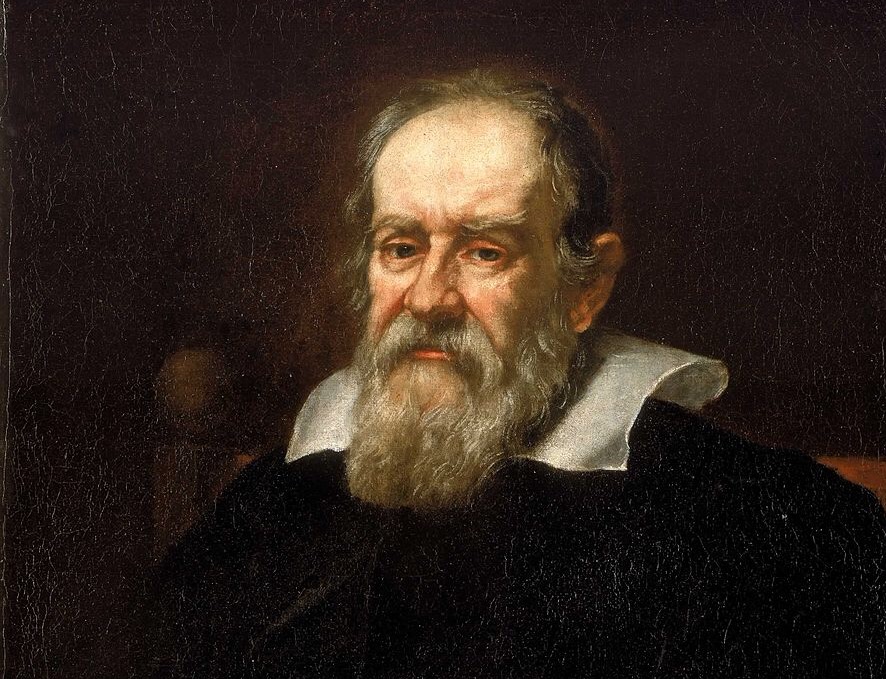
On June 22, 1633, astronomer Galileo Galilei recanted his belief in heliocentrism, the idea that the Earth revolves around the sun. He didn’t do this based on scientific research, but under pressure from the Holy Office in Rome.
Three hundred forty-five years later, to the date, American astronomer James W. Christy discovered Charon, a moon for what was then called “the ninth planet,” Pluto. This put Christy in an august company of satellite discovers, including Galileo, who had discovered four of Jupiter’s moons in 1610.
When Pluto was later “demoted” to “dwarf planet” status, in 2006, no one was put under house arrest for objecting, or for not changing his or her mind, as had Galileo been centuries before.
“President Trump warned Thursday that America ‘will not stand’ for Iran shooting down a U.S. drone over the Strait of Hormuz,” a Fox News report summarizes, “while at the same time leaving open the possibility that the attack was unintentional.”
This incident immediately follows the previous week’s apparent provocation, attacks on Japanese oil tankers in the same vicinity — also said by our government to have been caused by the Iranian military. Nearly everyone now regards these events as portending war,* which some see as a long time coming, since American relations with Iran have been antagonistic since the late 1970s, when Shia clerics raised a popular revolt to oust the American-installed thug, er, Shah.
While Mr. Trump was incredulous that the strike on the drone (opposite of a drone strike) could have been intentional, the rest of us can dare doubt even more: Can we really trust the “intelligence” that blames Iran’s military or paramilitary Revolutionary Guard for these puzzlingly dangerous provocations?
Not based on past performance.
The “intelligence” used to justify America’s several wars with Iran’s neighbor, Iraq, seems more disinformation than mere misinformation. And we now know that the Gulf of Tonkin incident enabling U.S. escalation into Vietnam was a lie.
We should even “remember the Maine!” — the questionable rationale for the Spanish-American War.
Lying to start wars is obviously not unheard-of in our history. Indeed, some insiders have itched for war so badly that they have plotted false flag ops against the American people.
The truth of what is happening now may not be known for years . . . by us . . . or even by President Trump.
This is Common Sense. I’m Paul Jacob.
* According to the New York Times, late yesterday President Trump authorized and then de-authorized a strike against Iran.
See all recent commentary
(simplified and organized)
See recent popular posts
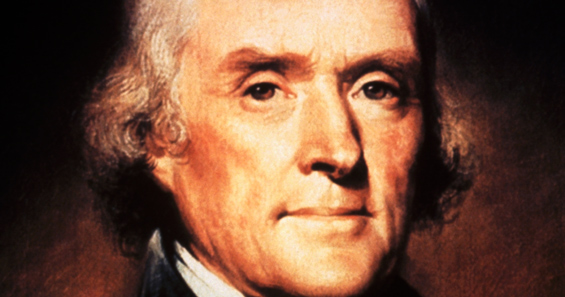
Of liberty I would say that, in the whole plenitude of its extent, it is unobstructed action according to our will. But rightful liberty is unobstructed action according to our will within limits drawn around us by the equal rights of others. I do not add “within the limits of the law” because law is often but the tyrant’s will, and always so when it violates the rights of the individual.
Thomas Jefferson, letter to Isaac H. Tiffany (April 4, 1819).
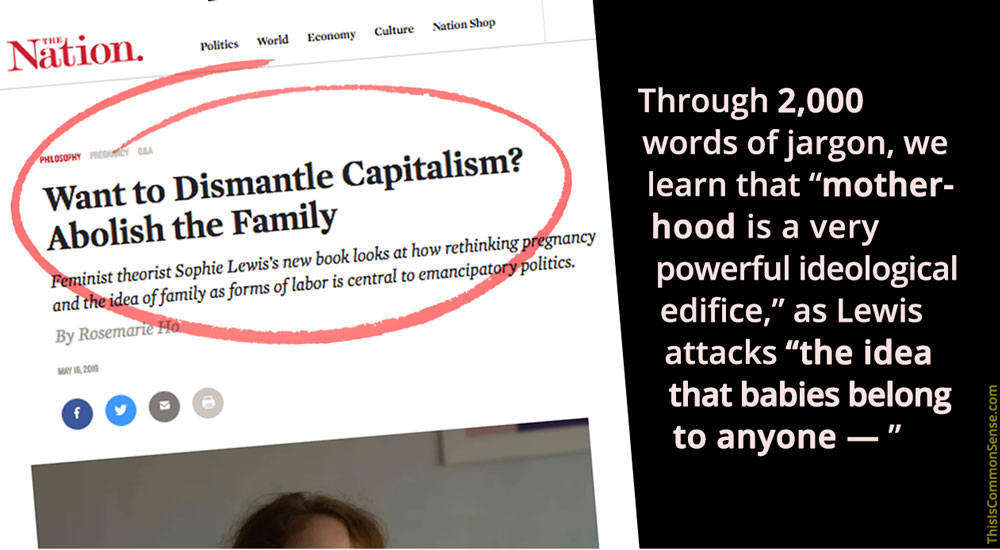
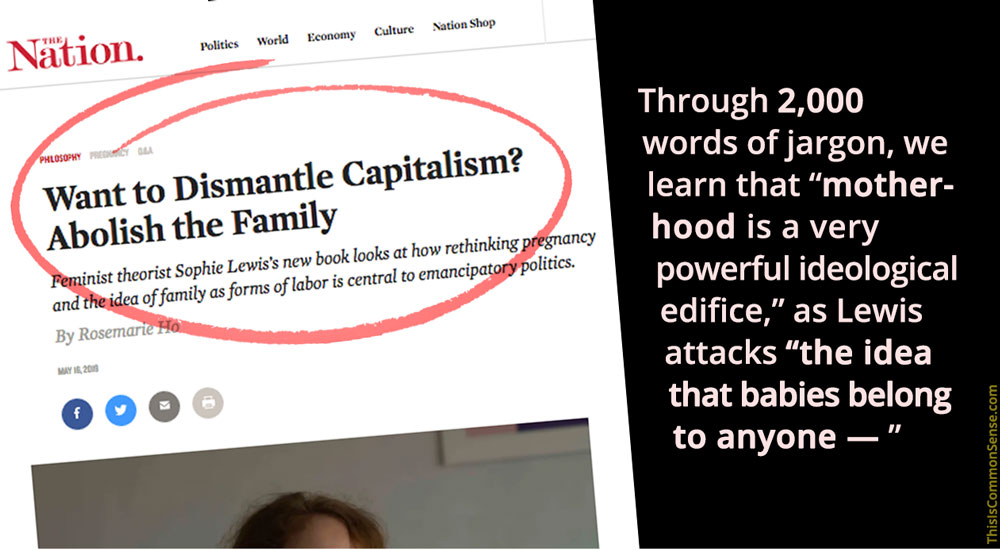
“Want to Dismantle Capitalism?” asks The Nation headline for a recent interview with feminist Sophie Lewis, immediately answering: “Abolish the Family.”
In a world of YouTube videos on how to do almost everything, apparently the progressive publication noticed something missing: There is no reliable guide for going full commie.
Rosemarie Ho prefaces her discussion with Ms. Lewis, author of “Full Surrogacy Now: Feminism Against Family,” by observing that “the most infamous demand of The Communist Manifesto is the ‘abolition of the family.’”
“The family, Marx and Engels noted, was where patriarchy and capitalism worked in tandem to produce willing, alienated workers,” writes Ho, “where women became little more than ‘instruments of production’ for the men who lorded over them.”
Ah, “little more” — how depressingly reductionist.
Ho applauds that Lewis “takes up this forgotten struggle” and “gives us an account of the material conditions — the biological and societal violence — that gestators, or people who are carrying fetuses, have to bear.”
“Mothers nurture,” acknowledges Lewis, “but they also kill and abuse their wards. That’s why it’s so valuable to denaturalize the mother-child bond. To do anything otherwise is to devalue that work. That’s the horizon that I think opens up the space for a revolutionary politics.”
Through 2,000 words of jargon, we learn that “motherhood is a very powerful ideological edifice,” as Lewis attacks “the idea that babies belong to anyone — the idea that the product of gestational labor gets transferred as property to a set of people.” After all, she informs that we should “think about babies as made by many people.”
Gestators of the world unite! We have nothing to lose but our sanity!
Oh . . . and the family.
This is Common Sense. I’m Paul Jacob.
See all recent commentary
(simplified and organized)
See recent popular posts
On the 20th of June in 1787, at the Constitutional Convention in Philadelphia, Oliver Ellsworth moved to confine legislative powers to two distinct branches, and to strike the word “national” from the document. Edmund Randolph of Virginia had previously moved successfully to call the government the National Government of United States. Ellsworth moved that the government should continue to be called the United States of America.
The final wording eventually became “All legislative powers herein granted shall be vested in a Congress of the United States, which shall consist of a Senate and House of Representatives.”
And, yes, the word “national” does not occur anywhere in the Constitution.
John F. Kennedy authored the Encyclopædia Britannica’s article on Ellsworth. This was Kennedy’s only contribution to the Encyclopedia.