Categories
Thought

Michael Badnarik

People are usually surprised to discover that I hate the phrase “constitutional rights.” I hate the phrase because it is terribly misleading. Most of the people who say it or hear it have the impression that the Constitution “grants” them their rights. Nothing could be further from the truth. Strictly speaking it is the Bill of Rights that enumerates our rights, but none of our founding documents bestow anything on you at all. . . . The government can burn the Constitution and shred the Bill of Rights, but those actions wouldn’t have the slightest effect on the rights you’ve always had.

Michael Badnarik, Good to be King (2004).
Categories
Today

Cornerstone & Anti-Corn Law

On September 18, 1793, George Washington laid the cornerstone of the Capitol building.


On September 18, 1838, Richard Cobden established the Anti-Corn Law League, which eventually brought free trade to Britain.

Categories
election law

Over-Regulated or Regulations Over?

Critiques of campaign finance regulations (CFR) often focus on particularly egregious applications or expansions of the regulations.

That’s fine. When somebody who is hammering us on the head starts hammering even harder, it’s okay to object. 

We should make clear, though, that we object to being head-bashed at all, not just the latest intensification.

In an amicus brief submitted to the Supreme Court National Republican Senatorial Committee v. FEC, the Institute for Free Speech and the Manhattan Institute are tackling CFR-rationalized repression of speech (CFRRS) as such.

“By conflating election campaign speech with the mechanics of running elections,” IFS says, “the Supreme Court has allowed the government to trample the First Amendment through campaign finance laws.”

This has been going on at least since the Supreme Court’s 1976 ruling in Buckley v. Valeo.

The current case, NRSC v. FEC, pertains to federal limits on coordinated spending by political parties, which is allowed in many states. IFS punches holes in the excuses for this instance of CFRRS but also stresses the bottom line.

“The brief argues that the federal government lacks the power to regulate this type of speech in the first place. . . . The Constitution grants Congress the power to regulate the times, places, and manner of electing federal officials. But . . . speech about candidates is not the same thing as the election itself, and the Elections Clause does not give Congress authority to regulate core political speech.”

Obviously. May at least five out of nine justices grasp this also.

This is Common Sense. I’m Paul Jacob.


PDF for printing

Illustration created with Krea and Firefly

See all recent commentary
(simplified and organized)
See recent popular posts

Categories
Thought

James Madison

This term in its particular application means “that dominion which one man claims and exercises over the external things of the world, in exclusion of every other individual.”

In its larger and juster meaning, it embraces every thing to which a man may attach a value and have a right; and which leaves to every one else the like advantage.

In the former sense, a man’s land, or merchandise, or money is called his property.

In the latter sense, a man has a property in his opinions and the free communication of them.

He has a property of peculiar value in his religious opinions, and in the profession and practice dictated by them.

He has a property very dear to him in the safety and liberty of his person.

He has an equal property in the free use of his faculties and free choice of the objects on which to employ them.

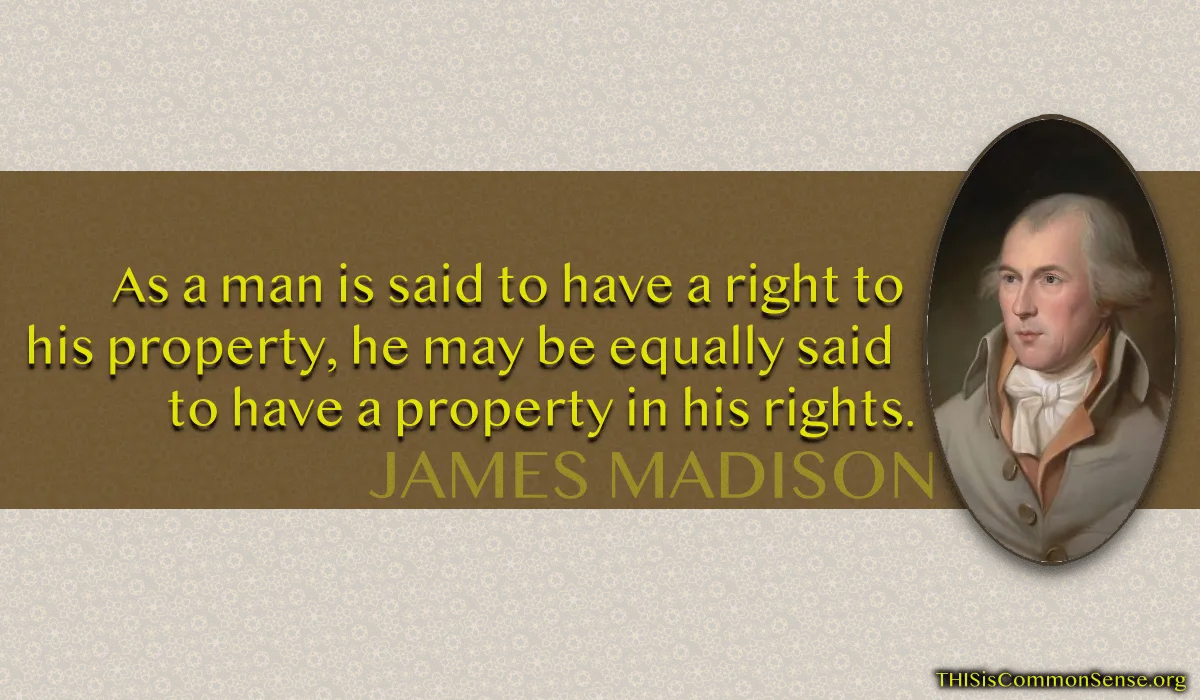
In a word, as a man is said to have a right to his property, he may be equally said to have a property in his rights.

Where an excess of power prevails, property of no sort is duly respected. No man is safe in his opinions, his person, his faculties, or his possessions.

Where there is an excess of liberty, the effect is the same, though from an opposite cause.

Government is instituted to protect property of every sort; as well that which lies in the various rights of individuals, as that which the term particularly expresses. This being the end of government, that alone is a just government, which impartially secures to every man, whatever is his own.

According to this standard of merit, the praise of affording a just securing to property, should be sparingly bestowed on a government which, however scrupulously guarding the possessions of individuals, does not protect them in the enjoyment and communication of their opinions, in which they have an equal, and in the estimation of some, a more valuable property.

More sparingly should this praise be allowed to a government, where a man’s religious rights are violated by penalties, or fettered by tests, or taxed by a hierarchy. Conscience is the most sacred of all property; other property depending in part on positive law, the exercise of that, being a natural and unalienable right. To guard a man’s house as his castle, to pay public and enforce private debts with the most exact faith, can give no title to invade a man’s conscience which is more sacred than his castle, or to withhold from it that debt of protection, for which the public faith is pledged, by the very nature and original conditions of the social pact.

That is not a just government, nor is property secure under it, where the property which a man has in his personal safety and personal liberty, is violated by arbitrary seizures of one class of citizens for the service of the rest. A magistrate issuing his warrants to a press gang, would be in his proper functions in Turkey or Indostan, under appellations proverbial of the most complete despotism.

That is not a just government, nor is property secure under it, where arbitrary restrictions, exemptions, and monopolies deny to part of its citizens that free use of their faculties, and free choice of their occupations, which not only constitute their property in the general sense of the word; but are the means of acquiring property strictly so called. What must be the spirit of legislation where a manufacturer of linen cloth is forbidden to bury his own child in a linen shroud, in order to favor his neighbour who manufactures woolen cloth; where the manufacturer and wearer of woolen cloth are again forbidden the economical use of buttons of that material, in favor of the manufacturer of buttons of other materials!

A just security to property is not afforded by that government, under which unequal taxes oppress one species of property and reward another species: where arbitrary taxes invade the domestic sanctuaries of the rich, and excessive taxes grind the faces of the poor; where the keenness and competitions of want are deemed an insufficient spur to labor, and taxes are again applied, by an unfeeling policy, as another spur; in violation of that sacred property, which Heaven, in decreeing man to earn his bread by the sweat of his brow, kindly reserved to him, in the small repose that could be spared from the supply of his necessities.

If there be a government then which prides itself in maintaining the inviolability of property; which provides that none shall be taken directly even for public use without indemnification to the owner, and yet directly violates the property which individuals have in their opinions, their religion, their persons, and their faculties; nay more, which indirectly violates their property, in their actual possessions, in the labor that acquires their daily subsistence, and in the hallowed remnant of time which ought to relieve their fatigues and soothe their cares, the influence will have been anticipated, that such a government is not a pattern for the United States.

If the United States mean to obtain or deserve the full praise due to wise and just governments, they will equally respect the rights of property, and the property in rights: they will rival the government that most sacredly guards the former; and by repelling its example in violating the latter, will make themselves a pattern to that and all other governments.

James Madison, “Property,” National Gazette (March 27, 1792).
Categories
Today

Protozoa

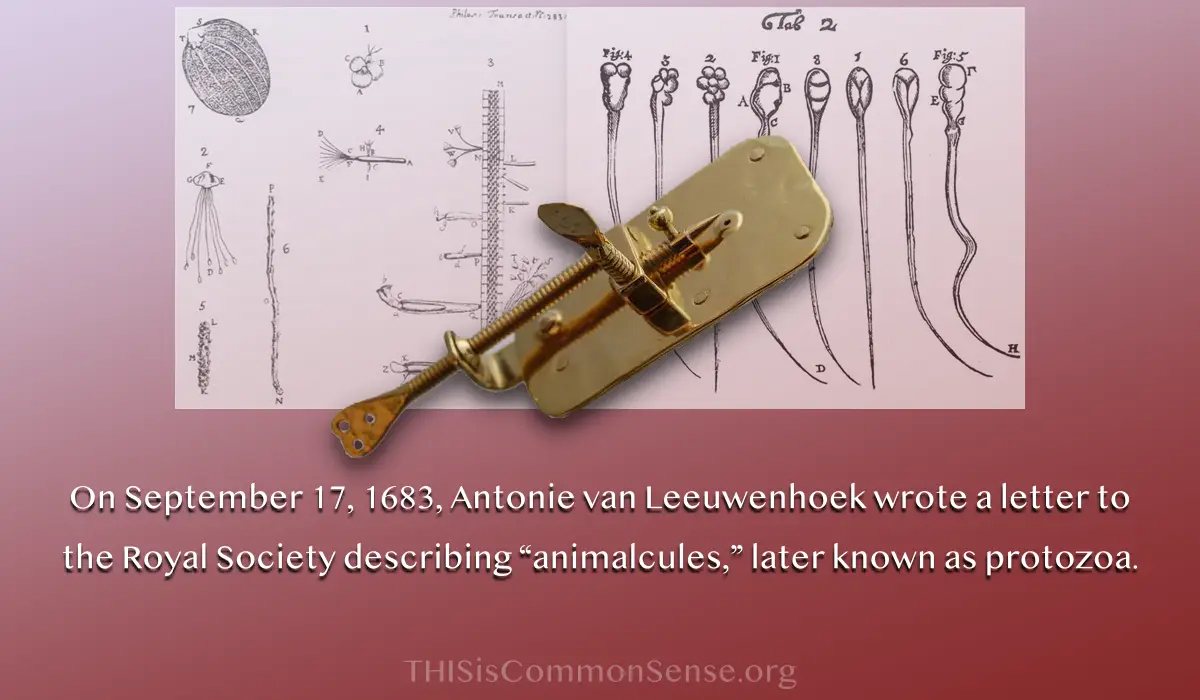
On September 17, 1683, Antonie van Leeuwenhoek wrote a letter to the Royal Society describing “animalcules,” later known as protozoa.

Categories
ideological culture national politics & policies

Timothy Tendentious

Democratic Senator Tim Kaine — most noted, till now, for being the first Timothy to run for the U.S. vice presidency — said something interesting last week.

And that may indeed be a significant first.

Sen. Kaine expressed his shock at something said by Riley Barnes, nominated to serve as Assistant Secretary of State for Democracy, Human Rights, and Labor. Mr. Barnes had confessed to the belief that “all men are created equal because our rights come from God, our Creator; not from our laws, not from our governments.”

Horrifying!

“The notion that rights don’t come from laws and don’t come from the government, but come from the Creator,” said the Virginia senator, aghast, “that’s what the Iranian government believes. It’s a theocratic regime that bases its rule on Shi’a law and targets Sunnis, Bahá’ís, Jews, Christians and other religious minorities. . . .”

Our First Failed Tim* is trying to advance an argument: the Iranians, believing “that they understand what natural rights are from their Creator” do bad things, so the idea must be wrong.

Presumably, however, Tim Kaine would not argue that Thomas Jefferson, when he wrote the famous words “We hold these truths to be self‑evident, that all Men are . . . endowed by their Creator with certain unalienable Rights,” was hell-bent on persecuting religious minorities. The senator surely knows that Jefferson was a daring proponent of religious freedom. 

Generally, the idea of natural rights was used in the West to extend religious freedom.

Kaine must also know that folks like him who hold to legal positivism — thinking that rights only come from governments — include some of the worst persecutors of religious people in human history.

This is Common Sense. I’m Paul Jacob.


* Our Second Failed Tim is of course Minnesota Governor Tim Walz, who unsuccessfully ran alongside Vice President Kamala Harris in the 2024 election. 

PDF for printing

Illustration created with Krea and Firefly

See all recent commentary
(simplified and organized)
See recent popular posts

Categories
Thought

John Donne

No man is an island,
Entire of itself.
Each is a piece of the continent,
A part of the main.
If a clod be washed away by the sea,
Europe is the less.
As well as if a promontory were.
As well as if a manor of thine own
Or of thine friend’s were.
Each man’s death diminishes me,
For I am involved in mankind.
Therefore, send not to know
For whom the bell tolls,
It tolls for thee.

John Donne, “No Man Is an Island,” Devotions upon Emergent Occasions (1624).

Categories
Today

Hong Kong Liberation

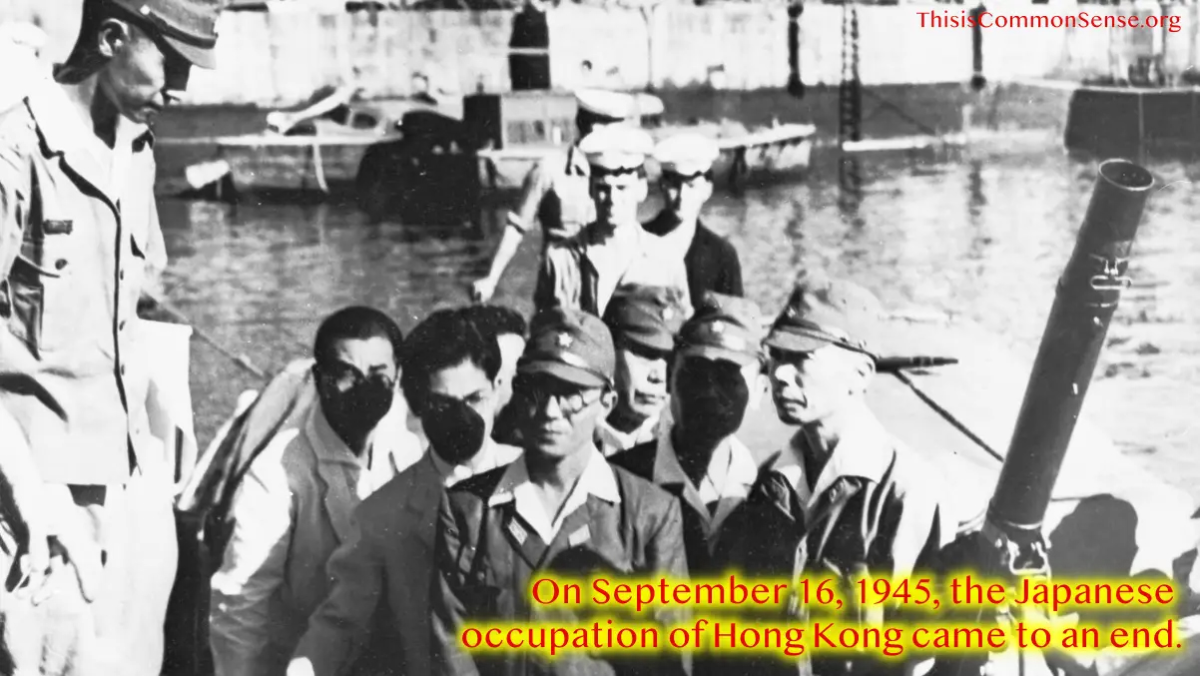
On September 16, 1945, the Japanese occupation of Hong Kong came to an end.

Categories
First Amendment rights international affairs social media

Germany Versus X

The question is freedom of speech. Many German officials are opposed. Twitter-X, or X, is in favor.

As Reclaim the Net summarizes the case, “German prosecutors are testing whether the reach of their censorship laws can outstrip the guardrails of international treaties.”

These prosecutors have been going after three X managers for alleged “obstruction of justice.” This obstruction consisted of refusing to immediately give prosecutors data on users who utter government-disapproved speech.

The X managers have been adhering to the provisions of a bilateral treaty, the Mutual Legal Assistance Treaty, under which the German requests are to be reviewed in U.S. legal channels before X can be forced to comply. Which increases the chances that X will not be forced to comply.

The prosecutors regard the managers’ refusals as a form of criminal interference. The legal and constitutional issues are now being battled over in German courts.

This is the German government which has been in the news for raiding the homes of people who post sentiments online of which the government disapproves.

That X is not meekly obeying orders to violate the trust of account holders and turn over their private information has upset German advocates of censorship. One MP, Anna Lührmann of the Green Party, says that X’s resistance to censorship is a “scandal” that “goes against fair competition and puts our democracy at risk.”

I don’t think, though, that democracies fail to be robust as they become more like dictatorships. Germany has it all inverted.

This is Common Sense. I’m Paul Jacob.


PDF for printing

Illustration created with Krea and Firefly

See all recent commentary
(simplified and organized)
See recent popular posts

Categories
Thought

Agatha Christie

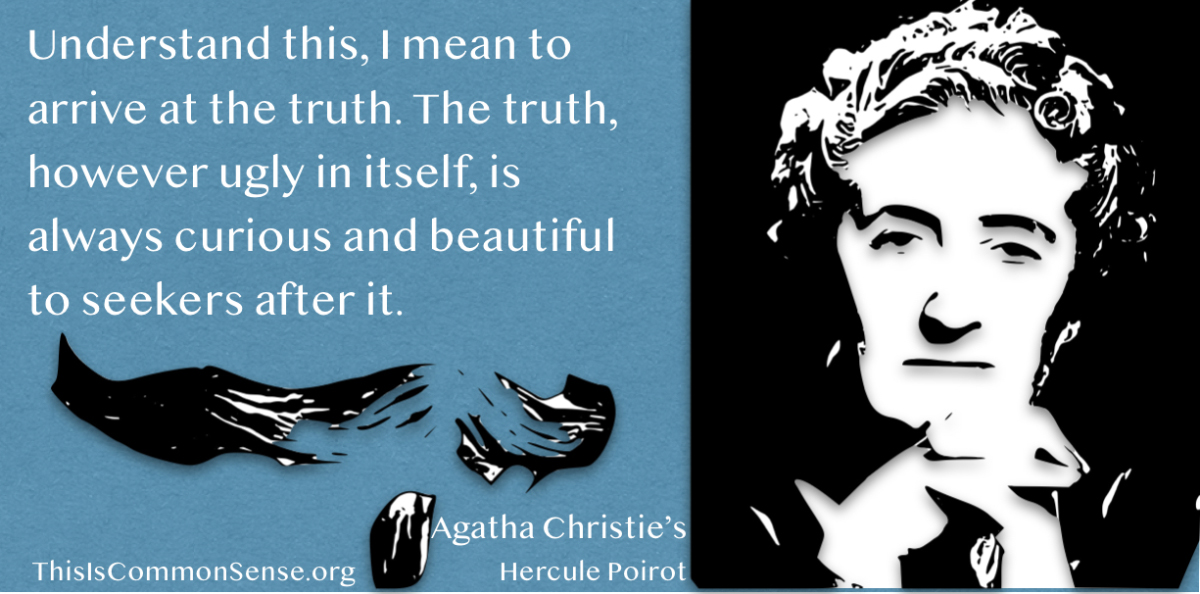
Understand this, I mean to arrive at the truth. The truth, however ugly in itself, is always curious and beautiful to seekers after it.

Hercule Poirot, the detective in Agatha Christie’s The Murder of Roger Ackroyd (1926).