Categories
Fifth Amendment rights First Amendment rights Fourth Amendment rights general freedom

Three Decades of Justice

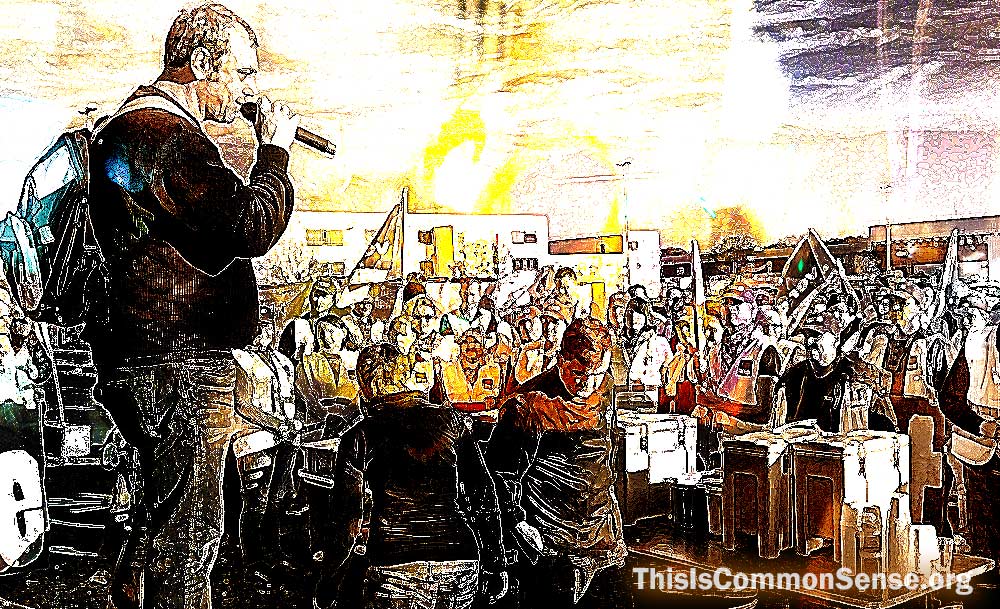
Since September 1991, the libertarian law firm founded by Chip Mellor and Clint Bolick has been fighting for the rights of its clients against governmental assault.

For no charge, Institute for Justice helps people stripped of options fight for:

● The right to keep one’s land (and what’s on it).

In 2001, the city of Mesa, Arizona launched eminent-domain proceedings against Bailey’s Brake Service, owned by Randy Bailey. The plan was to destroy the shop and give the land to a hardware store, not a constitutionally permitted “public use.” Bailey and IJ eventually prevailed in court.

● The right to make a living despite arbitrary professional licensing.

The Louisiana State Board of Cosmetology demands that aspiring hair braiders submit to hundreds of hours of training and pay for an expensive license to ply their trade. IJ is challenging the requirement on behalf of clients Ashley N’Dakpri, Lynn Schofield, and Michelle Robertson.

● The right to keep one’s cash despite arbitrary civil forfeiture — i.e., the power of police and prosecutors to grab your money or other belongings without charging you with a crime.

One recent victim is Marine Corps veteran Stephen Laura, whose $86,900 was looted by the Nevada Highway Patrol. The Institute has agreed to help him get it back.

And so on.

It doesn’t look like governments will stop interfering with our ability to live and work any time soon. 

“Eternal Vigilance”? Thy name is IJ.

This is Common Sense. I’m Paul Jacob.


PDF for printing

See all recent commentary
(simplified and organized)
See recent popular posts
Categories
Thought

Boethius

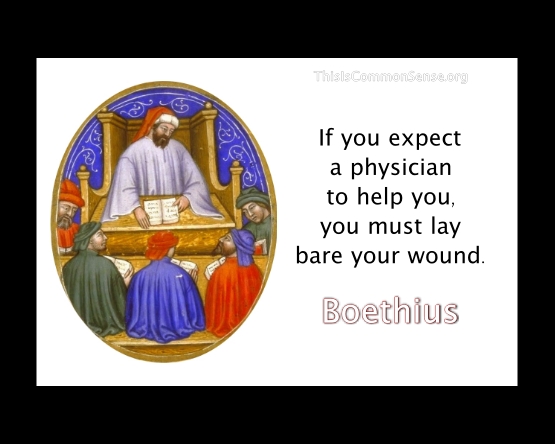
Si operam medicantis exspectas, oportet vulnus detegas.

If you expect a physician to help you, you must lay bare your wound.

Anicius Manlius Severinus Boethius, The Consolation of Philosophy (De consolatione philosophiae, c. 524 A.D.), Prose IV, line 1; translation by W.V. Cooper
Categories
Today

A Twentieth Anniversary

On September 10, 2001, Secretary of Defense Donald Rumsfeld gave a speech about an “adversary that poses a serious threat to the United States of America.” Describing it as “one of the last bastions of central planning, governs by dictating five year plans,” and that “with brutal consistency it stifles free thought and crushes new ideas.”

The adversary? “The Pentagon bureaucracy — not the people, but the processes.” And he went on to state that the Pentagon could not account for more than $2.3 trillion.

The next day, September 11, “some people did something,” in the immortal words of Rep. Ilhan Omar (D-Minn.),* and nearly everybody forgot about Rumsfeld’s alarm. The terrorist attacks on 9/11, in New York and at the Pentagon itself, along with a citizen-led resistance on United Flight 93, resulted in 2,977 fatalities, over 25,000 injuries, and substantial long-term health consequences.

The unaccounted-for spending and receipts of the Pentagon and the Department of Housing and Urban Development increased ten-fold in the next 19 years.


* Rep. Omar said these words on March 23, 2019. They were not a hit.

Categories
free trade & free markets property rights

Unions Must Stop

Golden State labor organizers want to be able to trespass on the property of companies to recruit new workers. But companies don’t want their operations periodically disrupted by trespassers.

Typical kind of political disagreement. One party wants its rights to be respected; the other wants to violate those rights.

That was pretty much where things stood in the Golden State until the California Supreme Court’s 6-3 decision last summer, which invalidated the relevant provision of the California law that had empowered unions to disrupt business for hours a day for up to a third of the year.

Let me repeat that: for hours a day for up to a third of the year.

The petitioners in the case were Cedar Point Nursery, which produces strawberries, and Fowler Packing Company, which produces grapes and oranges. Pacific Legal Foundation pursued the litigation on their behalf.

On September 1, a California district court followed up. In light of the high court’s decision, the district court ruled that the state can’t enforce union access without “just compensation” to property owners for temporarily taking their property.

This seems like an unnecessary and contradictory hedge, a misunderstanding of the context in which just compensation for government-authorized taking of a property for public use properly applies (if ever).

But, practically speaking, the rulings mean that California businesses have now escaped at least one of the many hassles that are encouraging so many to flee the state.

PLF attorney Wen Fa says that agricultural businesses in California can now function “without the threat of unions trespassing on their property and disrupting their workplaces.”

This is Common Sense. I’m Paul Jacob.


PDF for printing

See all recent commentary
(simplified and organized)
See recent popular posts

Categories
Thought

Zoroaster

A righteous government is of all the most to be wished for,
Bearing of blessing and good fortune in the highest.
Guided by the law of Truth, supported by dedication and zeal,
It blossoms into the Best of Order, a Kingdom of Heaven!
To effect this I shall work now and ever more.

Zoroaster, also called Zarathustra and Zartosht, Vohu-Khshathra Gatha; Yasna 51, 1.
Categories
Today

Leo Tolstoy

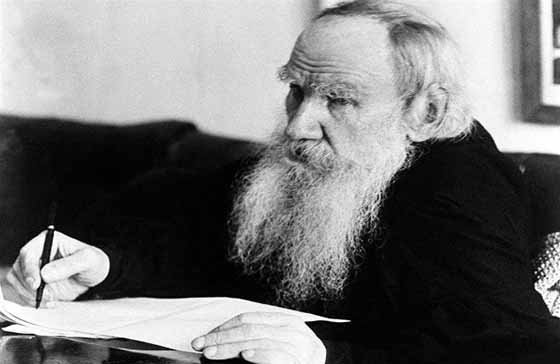
On September 9, 1828, Count Lev Nikolayevich Tolstoy was born. Known most commonly in the English-speaking world as Leo Tolstoy, he became the celebrated author of the novels Anna Karenina and War and Peace, as well as the novellas and short stories entitled “Family Happiness,” “The Death of Ivan Ilyich,” and “The Kreutzer Sonata.”

His political and religious ideas heavily influenced Gandhi and Martin Luther King, Jr.

Tolstoy died in 1910.

Categories
Thought

Herbert Spencer

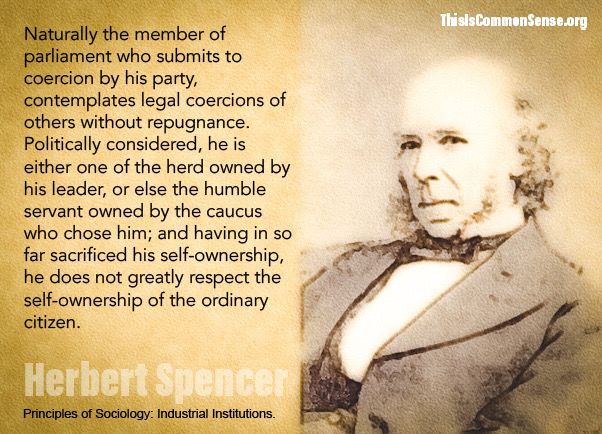
Naturally the member of parliament who submits to coercion by his party, contemplates legal coercions of others without repugnance. Politically considered, he is either one of the herd owned by his leader, or else the humble servant owned by the caucus who chose him; and having in so far sacrificed his self-ownership, he does not greatly respect the self-ownership of the ordinary citizen. If some influential body of his constituents urges a new interference, the fact that it will put upon the rest additional restraints, or appropriate further portions of their earnings, serves but little to deter him from giving the vote commanded. Indeed he feels that he has no alternative if he wishes to be returned at the next election. That he is adding another to the multitudinous strands of the network restraining men’s movements, is a matter of indifference. He considers only what he calls “the merits of the case,” and declines to ask what will result from always looking at the immediate and ignoring the remote. Every day he takes some new step towards the socialistic ideal, while refusing to think that he will ever arrive at it; and every day, to preserve his place, he seeks to outbid his political rival in taking such steps. . . . And thus, being the creature of his party and the creature of his constituents, he does not hesitate in making each citizen the creature of the community.

Herbert Spencer, Principles of Sociology (1898), Part VIII: Industrial Institutions; Chapter XXII, “Socialism.”

Categories
Today

Statute of Kalisz

On September 8, 1264, Boleslaus the Pious, Duke of Greater Poland, promulgated the Statute of Kalisz, guaranteeing Jews safety and personal liberties and giving battei din jurisdiction over Jewish matters.

On the same date in 1883, former U.S. President Ulysses S. Grant drove in the final “golden spike” completing the Northern Pacific Railway in a ceremony at Gold Creek, Montana.

Categories
initiative, referendum, and recall judiciary

The Ultimate Legislature

Proposition 22 was supported by 59 percent of California voters last November.

The statutory initiative partly reverses the destructive effects of AB5, a law that forced many California gig workers or freelancers to be treated as regular employees who must receive benefits — whether these gig workers like it or not.  

One notices at Ballotpedia that all the listed opponents of this measure were politicians, including our current Vice President (then Senator) Kamala Harris as well as socialist Bernie Sanders, while the diverse list of Prop 22’s supporters included: the California Chambers of Commerce along with the Black, CalAsian, and Hispanic Chamber of Commerce, Crime Victims United of California, California Farm Bureau Federation, California NAACP State Conference, California Small Business Association, and Mothers Against Drunk Driving.

The benefits of the so-called gig economy are politically opposed and diversely appreciated. 

Unions funded the opposition, though far outspent by the prosperous app companies: Uber, Lyft, Doordash, etc. Those same unions, having failed to win over voters, then filed suit to block implementation of Prop 22.

‘The Court finds,” reads Judge Frank Roesch’s opinion, “that Section 7431 is unconstitutional because it limits the power of a future legislature to define app-based drivers as workers subject to workers’ compensation law.”

Simply. Not. So.

A statutory California initiative can only be changed via a vote of the people, whether that vote happens because the legislature places the change on the ballot or citizens do so through the initiative petition process. 

The voters are the ultimate legislature. 

Therefore, nothing prevents the elected California Legislature from providing a change to ultimately be decided by the people of California, i.e. the whole legislature, at the ballot box.

For good reason, the judge’s decision is being appealed.

This is Common Sense. I’m Paul Jacob.


PDF for printing

See all recent commentary
(simplified and organized)
See recent popular posts

Categories
Today

Fannie and Freddie

On September 7, 2008, the U.S. Government “took control” of the two largest mortgage financing companies in the United States, Fannie Mae and Freddie Mac. Both of these had been created by Congress as part of a concerted plan to make home ownership easier, and both had gotten completely out of hand during the many years of their existence, especially under new rules established by politicians in the 1990s. The after-market that they helped create — the packaged mortgage market — was what imploded in 2007–2008, leading to the economic slump that Nicholas Nassim Taleb referred to as setting the U.S. government on President Obama’s economic policy course of “eight years of Novocain.”