The demand for money is regulated entirely by its value, and its value by its quantity.
Categories
David Ricardo

The demand for money is regulated entirely by its value, and its value by its quantity.
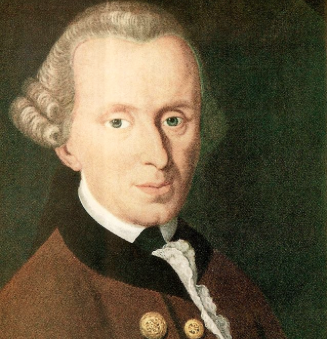
On April 22, 1724, philosopher Immanuel Kant was born.
Aside from being the pre-eminent modern philosopher and originator of transcendental idealism, Kant was also a major figure of Enlightenment thought, a classical liberal, and the originator of the notion of the Categorial Imperative. He was an early and important astronomical theorist in his early career, but produced his greatest works towards the end of his life, including The Critique of Pure Reason and The Groundwork for the Metaphysics of Morals. He was also author of the 1795 essay “Perpetual Peace: A Philosophical Sketch.”
Arthur Schopenhauer is widely known as an admiring and astute critic of Kant’s thought, while philosophical opponents include Friedrich Nietzsche and Ayn Rand. Kant’s approach to ethics continues to excite interest today, with some of the revival a result of the work of John Rawls.
Kant died on February 12, 1804, in Königsberg, Prussia (now Kaliningrad, Russia), where he had lived the bulk of his life.

That’s where I differ from Tennessee’s Republican-dominated state legislature.
My beef with the Metro Council (discussed in this Wall Street Journal op-ed) is the fact that, after term limits were passed back in 1994, the council has forced voters to say “No” to five different ballot measures referred by the council (1996, 1998, 2002, 2015, 2018) to weaken or abolish their own limits.
“No” is a tough concept for them to grasp.
One of those failed council-sponsored measures even offered to reduce the size of the council from 40 to 27 in hopes voters might see that provision as positive — “give the public something,” said one pol — to divert from the council’s self-servingly unpopular attack on term limits.
The GOP-controlled state legislature, on the other hand, is very angry at Nashville’s liberal Democratic politicians for blocking the Republican National Convention from being held next year in Music City. It sure seems a vindictively partisan move, costing people who own Nashville restaurants and hotels a sizeable bit of income.
So, back in March, the Tennessee Legislature passed a new law cutting Nashville’s council from 40 to 20 members.
That’ll teach ’em, eh?
Were only the tender feelings of Nashville’s dishonorable honorables in jeopardy, I wouldn’t complain. But the ratio of us citizens to our elected representatives is critical.
As Citizens Rising head Stephen Erickson aptly put it, “The state government of Tennessee recently decided that the people of Nashville should be less well represented.”
For the moment, thankfully, a three-judge panel in Tennessee has paused the legislature’s anti-representation scheme pending the outcome of a legal challenge.
But our representatives should be working to improve representation, not hobble it.
This is Common Sense. I’m Paul Jacob.
Illustration created with PicFinder.ai and DALL-E2
See all recent commentary
(simplified and organized)
See recent popular posts
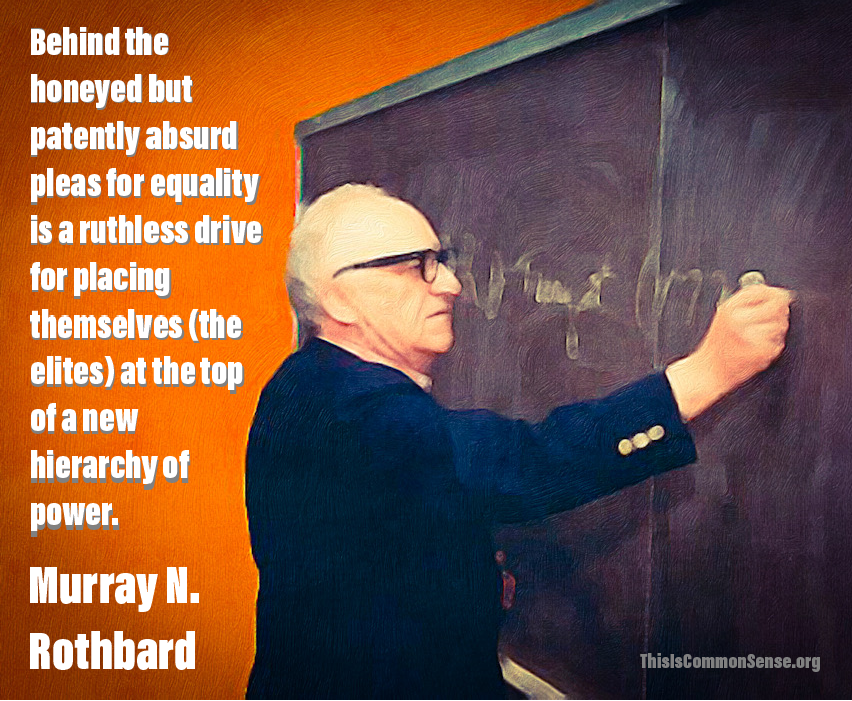
Behind the honeyed but patently absurd pleas for equality is a ruthless drive for placing themselves (the elites) at the top of a new hierarchy of power.
Murray N. Rothbard, “Egalitarianism and the Elites,” The Review of Austrian Economics, Volume 8, No. 2 (Summer 1995).
Nowadays, all sorts of people call their political opponents “fascist,” often on the shakiest of rationales. Well, The Manifesto of Fascist Intellectuals was first published in Il Mondo, then by most Italian newspapers on April 21, 1925 — the national, anniversary-day celebration of the Founding of Rome (ca. April 21, 753 BC).
It might be a good idea to consult this original document, for a good idea what politics’ “f-word” originally meant:
Fascism was . . . a political and moral movement at its origins. It understood and championed politics as a training ground for self-denial and self-sacrifice in the name of an idea, one which would provide the individual with his reason for being, his freedom, and all his rights. The idea in question is that of the fatherland. It is an ideal that is a continuous and inexhaustible process of historical actualization. It represents a distinct and singular embodiment of a civilization’s traditions which, far from withering as a dead memory of the past, assumes the form of a personality focussed on the end towards which it strives. The fatherland is, thus, a mission.
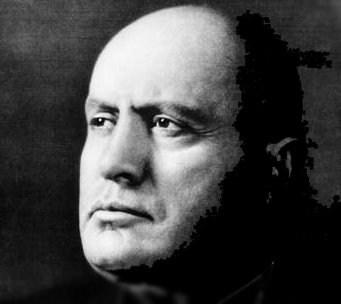
The manifesto was written by Giovanni Gentile, in support of the regime of Benito Mussolini (pictured above).
Less than two weeks later, on May 1, 1925, Il Mondo published philosopher Benedetto Croce’s The Manifesto of the Anti-Fascist Intellectuals.

Patti Peeples and Dawn Tiura want intruders to be treated this same way — as criminals to be thwarted immediately — if owners are away when intruders intrude.
The pair co-own a Jacksonville, Florida, house that they rent out. After the last tenant moved out, two squatters moved in. They were discovered by a handyman.
To evict the squatters, Peeples and Tiura had to go to court to start justice’s slow wheels turning. It took more than a month.
The squatters told police that they’d been conned by a rental scam. But they had recently told the same story to explain their occupancy of another home in the neighborhood.
Also, they threw a brick and feces at the owners’ car as the owners were driving past the house.
And after the squatters were finally evicted, the owners discovered massive damage: missing appliances, holes punched in walls.
So, not innocent. Much less sanitary.
“Squatters are nothing more than criminals who are breaking and entering into a house,” Peeples says. “They should not be handled in civil court. They should be treated within the criminal court system.”
There’s certainly no reason to let them linger and wreak revenge for having suffered the inconvenience of being caught.
This is Common Sense. I’m Paul Jacob.
Illustration created with PicFinder.ai and DALL-E2
See all recent commentary
(simplified and organized)
See recent popular posts
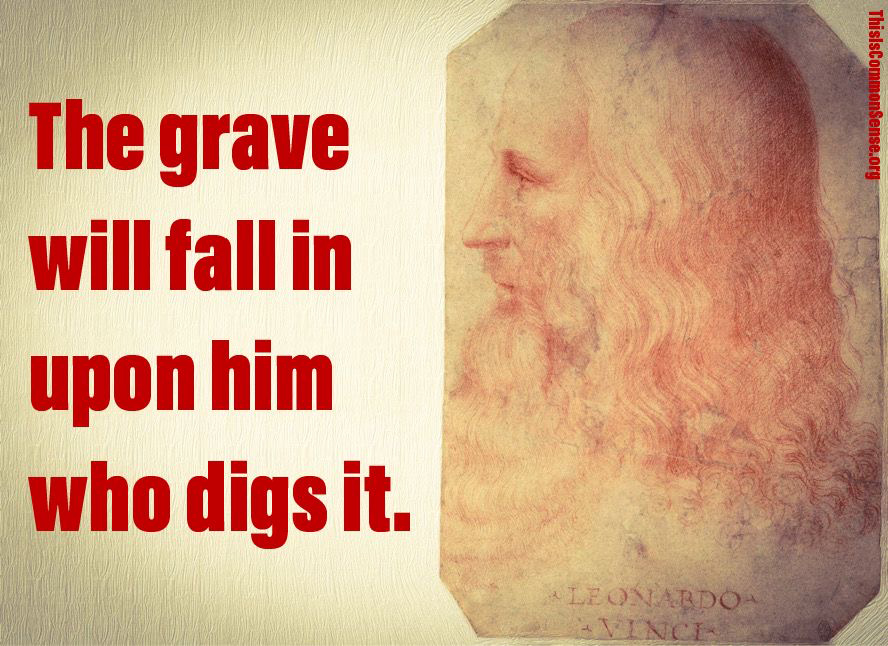
The grave will fall in upon him who digs it.
Leonardo da Vinci, The Notebooks of Leonardo da Vinci (1883), XIX Philosophical Maxims. Morals. Polemics and Speculations.
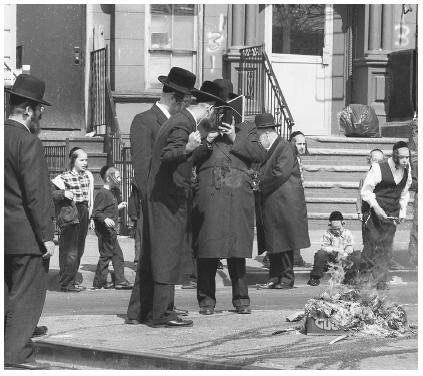
On April 20, 1657, freedom of religion was granted to the Jews of New Amsterdam (which was later renamed New York City).

She was, after all, a direct descendent of a Macedonian general — and pal of Alexander the Great — “Ptolemy the Savior.”
European, in other words. White.
Anthony Brian Logan, a conservative African-American YouTube commentator, notes Netflix’s woke race-swapping as habit, a trend — which he takes as a “meme” and a “joke” — with the most egregious recent example being Anne Bolyn being portrayed as a “sub-Saharan African woman.” Mr. Logan argues that this “is the equivalent of casting Tom Hanks to play Dr. Martin Luther King, Jr.”
Cannot we have movies “that make some kind of sense”?
The answer may be No; the reason, not at all mysterious.
After all, race hustlers and ideologues have been spewing out misinformation about ancient Africa for a long time, trying to get ignorant, public-school-educated Americans to think of “the dark continent” as a place of one race.
I’m sure many people, reading the above, might wonder if the Ptolemies might not have inter-married native Egyptians. Well, the Egyptians weren’t sub-Saharan blacks, either. They were basically lighter-skinned Mediterranean types.
But, as Anthony Brian Logan observes, previews of the upcoming series have darkened up some images, suggesting that the producers (one of whom is Will Smith’s notorious wife, Jada Pinkett Smith) may be messing with us. Nevertheless, the big issue remains the “underlying effort to try to change historical fact.”
“Who controls the past controls the future,” Orwell wrote. “Who controls the present controls the past.”
Race isn’t really the issue. It’s lying. For political reasons.
And yes, it matters.
This is Common Sense. I’m Paul Jacob.
Illustration created with PicFinder and DALL-E2
See all recent commentary
(simplified and organized)
See recent popular posts

There is one good thing about Marx: he was not a Keynesian.
“A Conversation with Murray N. Rothbard,” Austrian Economics Newsletter, Volume 11, Number 2 (Summer 1990).