Categories
Thought

A. James Gregor

In 1934, Mussolini reiterated that capitalism, as an economic system, was no longer viable. Fascist economy was to be based not on individual profit but on collective interest.

A. James Gregor, The Ideology of Fascism: The Rationale of Totalitarianism (1969), p. 299, showing that fascism has always been the very opposite of a free-trade, freedom-of-contract society.
Categories
Today

Royal Charter

On July 27, 1694, the Bank of England received a royal charter, beginning a long history of central banking in England. Subsequent inflationary booms and deflationary busts are usually considered “mysterious” by people connected with the bank.


July 27 births include that of Samuel Smith (1752), an American who served as a captain, major, and lieutenant colonel in the Continental Army, and later as a politician in several capacities in the state of Maryland; Hilaire Belloc (1870), author of a classic analysis of modern political governance, The Servile State; and American singer and songwriter Bobbie Gentry (1944).

Categories
judiciary local leaders

Arresting Speech Victory

I am happy that the U.S. Supreme Court ruled the way it did, letting Sylvia Gonzalez proceed with her litigation.

But why was there even a question?

The case is Gonzalez v. Trevino. It started in 2019 when Gonzalez was elected to the council of Castle Hills, Texas. After winning, she led a petition drive to remove the city manager from office for abusing employees and neglecting his duties.

Soon the mayor and the police chief were falsely accusing her of tampering with a government record. She was arrested and jailed. But the district attorney dropped the charges after a day.

After Gonzalez resigned from the council because of “ongoing intimidation,” the Institute for Justice helped her file a federal lawsuit against the town for selective prosecution.

A lower court had gone along with the city’s request to dismiss the case. The rationale was that Gonzalez had not shown that others who trivially “mishandled a government petition” in exactly the same way Gonzalez did were not then arrested.

In reversing this decision, the Supreme Court said that “the demand for virtually identical . . . comparators goes too far.” Plausible evidence that Gonzalez had been singled out for retaliation, thus violating her First Amendment rights, was enough to let the case proceed.

It’s an important issue for all of us, not only for Sylvia Gonzalez. As IJ stresses, this kind of retaliation “against citizens engaging in protected speech or activity” is more common than we may suspect.

This is Common Sense. I’m Paul Jacob.


PDF for printing

Photo provided by Institute for Justice

See all recent commentary
(simplified and organized)
See recent popular posts
Categories
Thought

William Leggett

A legislature is always badly set to work in manufacturing crime. To risk money in a wager is not a crime per se, whether the wager be on the result of a race, on the fate of a lottery ticket, on the turn of a dicebox, or on any other like contingency. It is folly, perhaps, in all cases, and it becomes crime and madness in some; but to draw the line between allowable folly and criminality, in a matter of this kind, is rather the office of publick opinion, than of the law.

William Leggett, in an editorial in the Plaindealer, January 28, 1837, republished in A Collection of the Political Writings of William Leggett (1840), and titled “Gambling Laws.”
Categories
Today

Atahualpa

On July 26, 1533, Francisco Pizarro’s Spanish conquistadors strangled to death Atahualpa, the 13th and last emperor of the Incas, thereby ending 300 years of Inca civilization. The conquistadors were greedy and murderous, but the Inca civilization, arguably, was worse: totalitarian and radically inegalitarian. But they made great high-mountain roads. (Arguments about infrastructure promoted by Big Government continue to this very day. And it is quite possible that an earlier civilization made the roadways, which the Inca merely renovated.)


On this day in 1948, U.S. President Harry S. Truman signed Executive Order 9981 desegregating the U.S. military.

Categories
free trade & free markets general freedom international affairs

Bombers Off the Coast

No wonder Taiwan is going ahead, despite a typhoon battering the island, with its annual war games

China threatens. And threatens. And threatens

As discussed yesterday, it is unclear just how committed a Trump 47 administration would be to protecting Taiwan. 

President Joe Biden, on the other hand, has repeatedly pledged to engage U.S. military forces in defense against China. But since he is physically and cognitively unable to run for the presidency, are we safe letting Joe hang out at the White House for the next six months performing the “lesser” job of being America’s commander-in-chief?

That position might suddenly take on a less sleepy character.

Just prior to Biden’s Oval Office address, NORAD disclosed that it had “scrambled fighter jets to intercept two Russian Tu-95 ‘Bear’ bombers and two Chinese H-6 bombers off the coast of Alaska.”

Lately, the Philippines has gotten most of the CCP’s bullying, enforcing their ridiculous claim to 90 percent of the South China Sea. The U.S. has an unambiguous treaty obligation to the Philippines. 

On the other hand, the U.S. position toward Taiwan, right there 80 miles off the Chinese coast, is friendly . . . but the U.S. doesn’t officially recognize Taiwan as a country and our policy toward its defense remains one of “strategic ambiguity.” 

Still, unless the U.S. plans to leave Asia, and maybe even then, we will have to stand up to China. Best to draw that line, to mount that defense at Taiwan.

Why? 

  • Because of the island’s worldwide dominance in producing vital computer chips, a New York Times headline declared, “Pound for Pound, Taiwan Is the Most Important Place in the World.” Kept free, that is.
  • But it’s more than that: without a free Taiwan uniting Japan and the Philippines in the “first island chain,” China can divide those two countries — both of which the U.S. is treaty-bound to defend — and conquer.
  • Taiwan is freedom and democracy’s success story of the last half-century, successfully throwing off four decades of martial law authoritarianism to become, arguably, Asia’s freest and most democratic nation. 

Making it in my interest and yours to disallow the snuffing out of freedom on the other side of the globe. 

We need a president who knows the world is a dangerous place, understands how critical Taiwan is, and levels with the American people about the challenges ahead.

This is Common Sense. I’m Paul Jacob.


PDF for printing

See all recent commentary
(simplified and organized)
See recent popular posts
Categories
Thought

Gordon Cooper

Nothing like I’d ever seen. . . . I knew that we didn’t have any vehicles of that kind, and I was 99 and nine tenths percent sure that the Russians didn’t have any of that type either. . . . At that point in time there was no doubt in my mind that this vehicle was made at some other place than here on Earth.

NASA astronaut Gordon Cooper, on one of his several encounters with UFOs in the 1950s.
Categories
defense & war general freedom international affairs

Breaking Taiwan?

“Would you defend Taiwan against China?” Bloomberg News recently inquired of former President Donald Trump.

After mentioning his great “respect” for the Taiwanese — though complaining that the nation “did take about 100% of our chip business” — the Republican nominee responded: “I think Taiwan should pay us for defense. You know, we’re no different than an insurance company. Taiwan doesn’t give us anything. Taiwan is 9,500 miles away. It’s 68 miles away from China. A slight advantage . . .”

Indeed. But the Nazis and Imperial Japan once flaunted the same geographicadvantage. And note that the Japanese island of Yonaguni is closest to the big island of Taiwan.

Taiwan is much freer than China. And, accordingly, richer per capita . . . because the Taiwanese do give us (and the world) something: computer chip manufacturing, especially high-end chips. An important commodity. The Chinese government encourages and facilitates the stealing of our intellectual property; Taiwan companies just kicked our butts in the marketplace. 

“Cool to the idea of the U.S. protecting Taiwan,” was how Nancy Cook, Bloomberg’s senior national political correspondent, not unreasonably characterized Mr. Trump’s comments. Still, Trump may have been simply negotiating up Taiwan’s military commitment, much as he did to NATO countries in his first term. 

Of course, “Taiwan has been paying for its own defense,” says the State Department.  

Taiwan has “consistently been one of the biggest buyers of U.S. weapons,” argues Michael McCaul (R-Texas), acknowledging that Trump “is right that U.S. allies should” pony up “in their own defense.”

Lastly, is the United States like an “insurance company”?

Well, it’s certainly a breakable world. But the idea is to prevent more breakage, not pay out after a disaster. 

This is Common Sense. I’m Paul Jacob.


PDF for printing

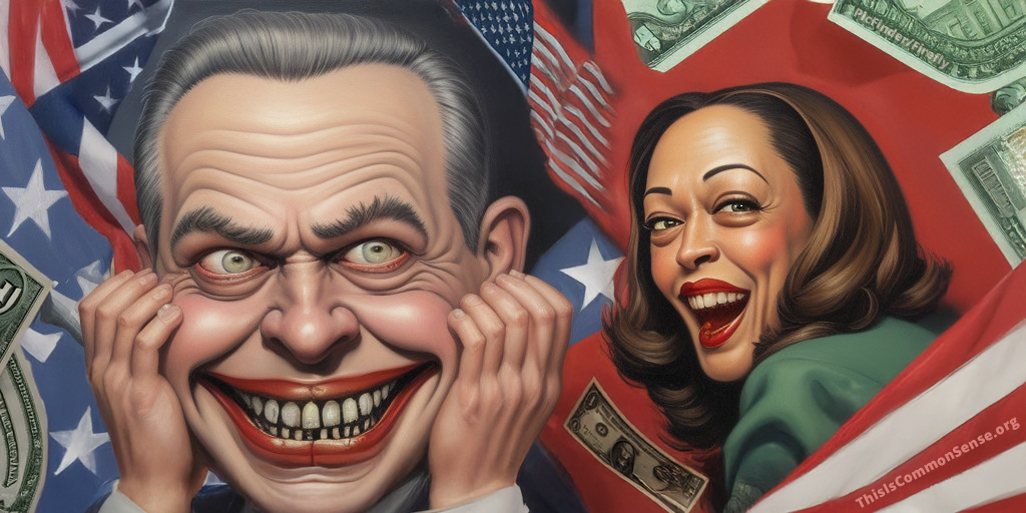
Illustration created with PicFinder and Firefly

See all recent commentary
(simplified and organized)
See recent popular posts
Categories
Thought

Herbert Gerjuoy

The illiterate of the 21st century will not be those who cannot read and write, but those who cannot learn, unlearn and relearn.

Herbert Gerjuoy, as quoted by Alvin Toffler in Future Shock (1970), Ch. 18, p. 414. Quotation from this psychologist is often misattributed to Toffler.
Categories
Today

A Liberation Day

On July 24, 1487, citizens in Leeuwarden, Netherlands, went on strike against a ban on foreign beer.

On the same day of 1823’s calendar, slavery was abolished in Chile.

July 24 serves as Pioneer Day in Utah and as Simón Bolívar Day in Bolivia, Ecuador, Colombia, and Venezuela.


On this day in 1974, the U.S. Supreme Court told President Richard Nixon that he lacked constitutional authority to withhold the infamous “Nixon Tapes” from Congress.