Categories
Thought

Bliss Perry

“To be an American,” it has been declared, “is to be a radical.” That statement needs qualification. Intellectually the American is inclined to radical views; he is willing to push certain social theories very far; he will found a new religion, a new philosophy, a new socialistic community, at the slightest notice or provocation; but he has at bottom a fund of moral and political conservatism. Thomas Jefferson, one of the greatest of our radical idealists, had a good deal of the English squire in him after all. Jeffersonianism endures, not merely because it is a radical theory of human nature, but because it expresses certain facts of human nature. The American mind looks forward, not back; but in practical details of land, taxes, and governmental machinery we are instinctively cautious of change. 

Bliss Perry, The American Mind (1912), p. 77.
Categories
Today

SpaceX

On September 28, 2008, SpaceX launched the Falcon 1, the first private spacecraft to go into orbit around planet Earth.

SpaceX has achieved many records since.

Categories
Fourth Amendment rights media and media people property rights

The Realism of ‘Rebel Ridge’

Some viewers of the popular Netflix film Rebel Ridge say that it’s unrealistic. But a certain crucial assumption of the story is very realistic indeed.

The movie assumes that some cops are bad cops. More specifically, it assumes that bad cops often have arbitrary legal authority to do bad things. In the movie, what gets the ball rolling is the arbitrary authority conferred by America’s civil forfeiture laws.

These laws permit officers to confiscate cash on your person if they merely have a suspicion, or pretend to, that the cash is ill-gotten. They needn’t have evidence that it’s drug money or bank-robbery proceeds. 

The suspicion is enough.

And even if you can show that the money was acquired by your own hard work and withdrawn from your bank account in pursuit of a legitimate end — buying a truck, bailing a cousin out of jail (the reason that the protagonist carries cash in Rebel Ridge) — that’s typically not the end of it. It’s rare that the law-empowered thugs who violated your property rights just say “Oops!” and hand your property right back.

J. Justin Wilson of the Institute for Justice observes another realistic portrayal of injustice in the movie, “over-detaining defendants to keep them quiet.” In real life, though, such over-detention may have as much to do with bureaucratic sloth as with malice directed toward a particular prisoner.

The solution, says Wilson, is not revenge, but the kinds of legal reform IJ fights for. The movie, on the other hand, leaned more on revenge.

This is Common Sense. I’m Paul Jacob.


PDF for printing

Illustration created with PicFinder and Firefly

See all recent commentary
(simplified and organized)
See recent popular posts

Categories
Thought

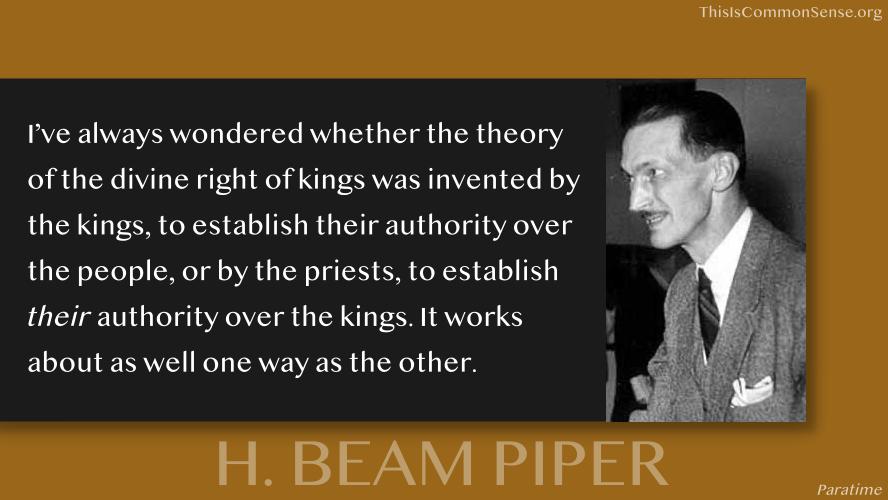
H. Beam Piper

I’ve always wondered whether the theory of the divine right of kings was invented by the kings, to establish their authority over the people, or by the priests, to establish their authority over the kings. It works about as well one way as the other.

H. Beam Piper, “Temple Trouble” (Astounding Science Fiction, April 1951), collected in Paratime (1981) and The Complete Paratime (2001).

Categories
Today

Congress on the Run

Lancaster, Pennsylvania — home to James Buchanan, Jr., the 15th president of the United States, and to congressman, abolitionist and “Radical Republican” Thaddeus Stevens — served, during the American Revolution, as the capital of the United States for one day, on September 27, 1777.

This occurred after the Continental Congress fled Philadelphia, which had been captured by the British. The revolutionary government then moved still further away, to York.

Categories
regulation too much government

Wait, What?

The Federal Aviation Administration wants to fine Elon Musk’s spacefaring firm SpaceX $633,000 for various alleged infractions of FAA regulations. In response, Musk says he’s suing the agency for “regulatory overreach.”

One set of fines pertains to using an “unapproved control room” and failure to “conduct the required T-2 hour poll” during a June 2023 launch: 350,000 smackers.

Another set, totaling $283,000, is for using an “unapproved rocket propellant farm,” i.e., tanks for storing fuel until it’s pumped into the ships, back in July 2023.

Meanwhile, the Justice Department has sued SpaceX for hiring “only U.S. citizens and lawful permanent residents” (wait, what?) and failing to take into account currently prevailing political winds. Perhaps the FAA should sue the Justice Department for expecting SpaceX to focus on anything but its missions.

The initial reporting doesn’t make clear whether there’s any merit to the FAA’s complaints — wrong specs for fuel tanks or whatever. The mere deviation from some regulation is meaningless if what SpaceX did instead is as safe or safer than what the bureaucrats stipulated.

Large enterprises must navigate an infinite number of regulations, and federal agencies are certainly selective enforcers. If you’re Boeing, it seems you can get away with shoddy practices for years, at least until the fit hits the shan.

I’ll wait to hear more, but I suspect that the FAA’s attempt to grab hundreds of thousands of dollars from Musk is indeed a symptom of regulatory overreach.

And just possibly motivated by . . . politics.

This is Common Sense. I’m Paul Jacob.


PDF for printing

Illustration created with PicFinder and Firefly

See all recent commentary
(simplified and organized)
See recent popular posts

Categories
Thought

Vernor Vinge

Within thirty years, we will have the technological means to create superhuman intelligence. Shortly after, the human era will be ended.

Computer scientist and science fiction author Vernor Vinge (1944–2024), “The Coming Technological Singularity” (presented at the VISION-21 Symposium sponsored by NASA Lewis Research Center and the Ohio Aerospace Institute, March 30–31, 1993.)
Categories
Today

Shays’ Constitution

On September 26, 1786, protestors shut down the court in Springfield, Massachusetts, beginning a military standoff and ushering in Shays’ Rebellion.

This anti-tax revolt spurred a dramatic reaction on the part of the day’s politicians, including their attempts to reform the Articles of Confederation and to figure out better ways than high state taxes to pay off Revolutionary War debts. These efforts directly led to the adoption of a new Constitution.

Categories
Fifth Amendment rights property rights

Blight Fight

The government destroyed the new fixer-upper of handyman Eric Arnold, migrant from New Jersey to Georgia, even as he was diligently renovating it. The rationale of Macon-Bibb County: fighting blight. 

Blight that Arnold was already fighting himself.

What happened to Arnold was not an isolated occurrence.

Institute for Justice reports that over the last few years, “Macon-Bibb County has demolished over 800 houses that it has designated as blighted through a fast-tracked, secret code enforcement process that completely avoids court proceedings and deprives property owners of a meaningful chance to protect their property.”

Sometimes, the county doesn’t even notify owners.

Arnold discovered what was about to happen only because a neighbor alerted him that a demolition crew was installing a dumpster on Arnold’s property. He provided officials with evidence of the improvements he was making. But it was like talking to a brick wall. The county’s only answer was to speed up the process.

“To spend all that time and money and sweat and end up with nothing but a bare piece of land, it’s devastating,” he says.

IJ attorney Dylan Moore says that Macon-Bibb “should welcome skilled home renovators like Eric with open arms. Instead, county officials made demolishing Eric’s house ‘high priority’ after Eric asked for help. . . .”

IJ and Arnold are suing the county to try to spare others from the loss that he has been made to suffer without any due process whatever. It’s the county’s unconstitutional system that needs demolishing.

This is Common Sense. I’m Paul Jacob.


PDF for printing

See all recent commentary
(simplified and organized)
See recent popular posts

Categories
Thought

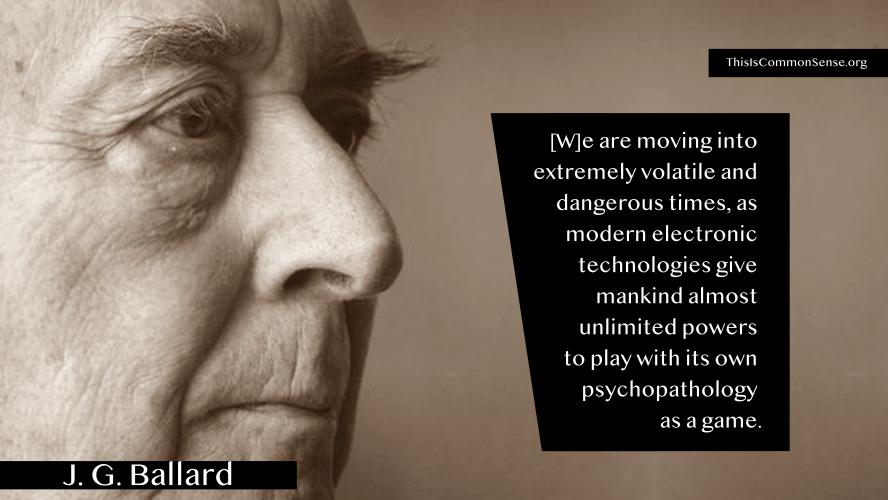
J. G. Ballard

For the sake of my children and grandchildren, I hope that the human talent for self-destruction can be successfully controlled, or at least channelled into productive forms, but I doubt it. I think we are moving into extremely volatile and dangerous times, as modern electronic technologies give mankind almost unlimited powers to play with its own psychopathology as a game.

J. G. Ballard, as interviewed by Jean-Paul Coillard, “JG Ballard: Theatre of Cruelty,” Disturb (1998).