On March 3, 1924, the 407-year-old Islamic caliphate collapsed when Caliph Abdülmecid II of the Ottoman Caliphate was deposed. The last remnant of the old regime gave way to the reformer Kemal Atatürk.
Protesters, caught up in the cause of continuing government waste, fraud and abuse, protest outside the Space X facility in Hawthorne, California. Cuz Elon Musk. Musk denies that DOGE is in any way radical. It is, he says, “common sense.”
“Trump has said the nation, facing $36 trillion in debt, must cut federal spending,” explains the Los Angeles Daily News today.
DOGE protests are also taking place at Tesla dealerships across the country.
“Cuts to the Department of Education are hitting the highly valued Nation’s Report Card,” writes Lexi Lonas Cochran, today, “even as sirens blare on student test scores.”
The 12th grade National Assessment of Educational Progress (NAEP) was recently canceled, and the top official in charge of it was put on leave, leading advocates to doubt a promise from the Department of Education that NAEP would not be affected by the cuts from Elon Musk’s Department of Government Efficiency (DOGE).
Educational experts like the testing system, but admit that in both reading and math, “the gaps between the lowest-performing and highest-performing students are still growing.”
Obviously government schooling is failing, bureaucrats are most concerned about testing, and DOGE’s cuts alarm them.
Meanwhile, CNBC has probably found an effective way to spread unease, maybe even panic: “Social Security has never missed a payment. DOGE actions threaten ‘interruption of benefits,’ ex-agency head says.” Or so says the headline.
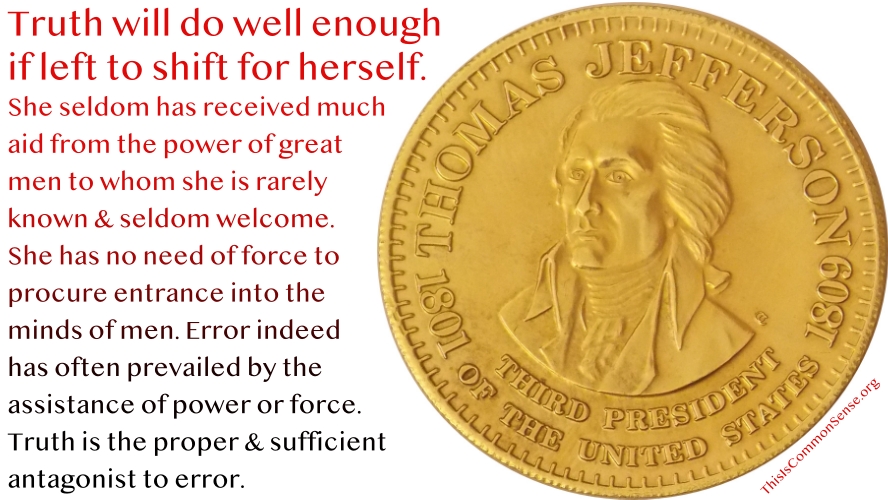
Truth will do well enough if left to shift for herself. She seldom has received much aid from the power of great men to whom she is rarely known & seldom welcome. She has no need of force to procure entrance into the minds of men. Error indeed has often prevailed by the assistance of power or force. Truth is the proper & sufficient antagonist to error.
Thomas Jefferson, Notes on Religion (October 1776), published in The Writings of Thomas Jefferson : 1816–1826(1899) edited by Paul Leicester Ford, v. 2, p. 102.
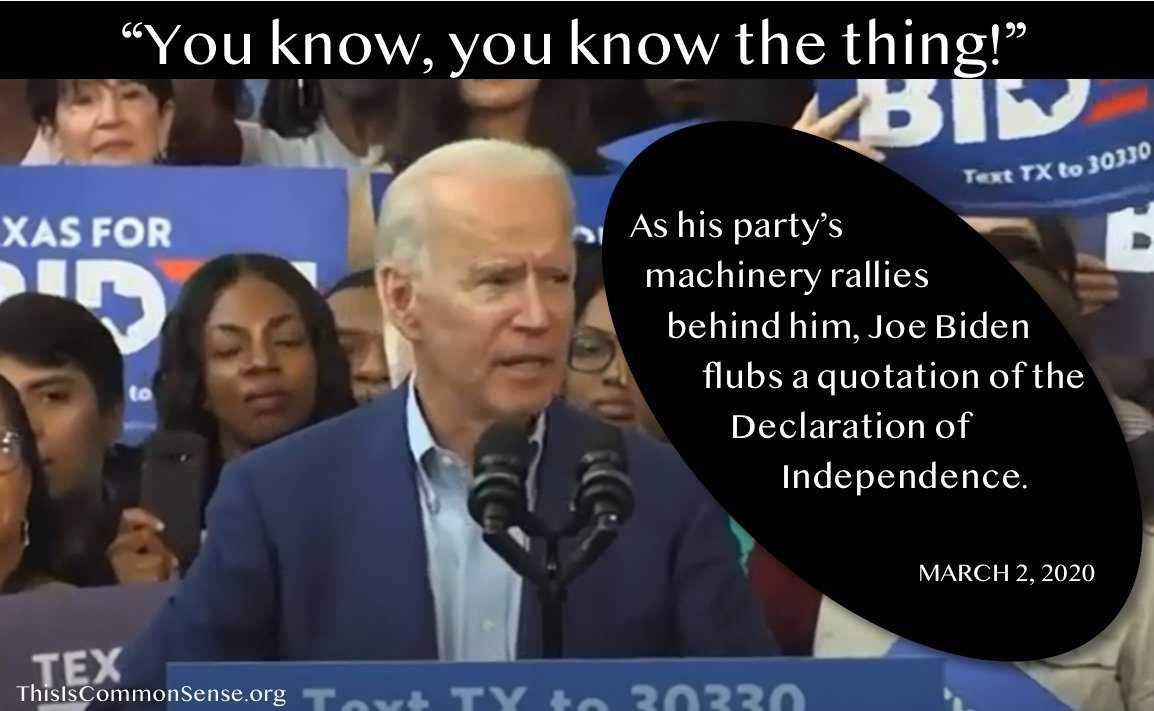
As the Democratic machine was consolidating its support around Joe Biden on March 2, 2020, in his (ultimately successful) bid for the presidency, the man himself was showing his level of eloquence with a speech in which he demonstrated some trouble regurgitating the most memorable words from the Declaration of Independence:
It’s time for America to get back up on its feet and once again fight for the proposition that “We hold these truths to be self-evident”! Sounds corny; not a joke: think about it. We hold these truths to be self[la]-evident. All men and women created, by the, go, you know, you know the thing! You know how we talk about it.
Americans revel in quadrennial presidential debates and arguments made by talking heads on TV, but many, many people were made deeply uncomfortable by the public tiff broadcast from the White House between Ukraine’s president, Volodymyr Zelensky, on one side, and the President and Vice President of the United States on the other:
We might wish to ask ourselves — why?
CNN’s characterization of it was interesting:
A remarkable shouting match broke out in the Oval Office on Friday between President Donald Trump and his Ukrainian counterpart Volodymyr Zelensky, who was hoping to appeal to the US for continued security assistance during his trip to Washington. Raising their voices, Trump and Zelensky — along with the Vice President JD Vance — engaged in a tense back-and-forth about the nature of US support, and whether Zelensky had demonstrated enough gratitude.
But the “shouting match” was figurative, not literal. No one shouted, exactly. But voices were raised as Zelensky and Trump talked over each other. Someone was being impolite in that.
People unused to conflict that is demonstrated politely, and then devolves into a debate about manners, tend to think that all public meetings should be “nice.”
Not when war is the subject matter, perhaps.
In this case, Zelensky made his appeal in public, in a “nice” public setting, and the American leaders, Donald Trump and J. D. Vance, rose, ahem, to the occasion.
They have been called bullies for this, on TV and in social media. Perhaps it is the repeatedyou should be more thankful line that really galls.
But is Trump right? Is Zelinsky “gambling with World War III”?
Or is it Mr. Trump who gambles with WWIII? The U.S. siding with Russia after invading Ukraine might embolden further aggression by Russia or other authoritarian regimes (read: China).
Whether shouting or not, it was a tad tense. Tellingly, Trump defended the fracas. “But you see, I think it’s good for the American people to see what’s going on.”
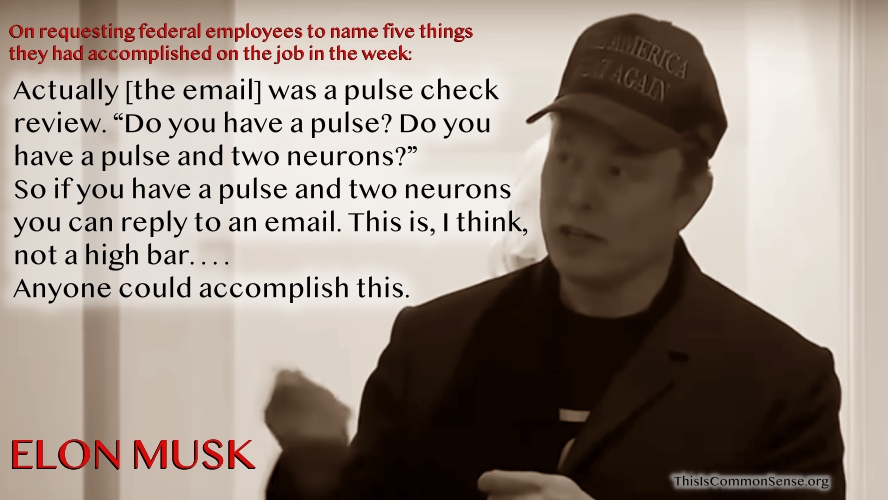
I think that email was best interpreted as a performance review — but actually it was a pulse check review. “Do you have a pulse? Do you have a pulse and two neurons?” So if you have a pulse and two neurons you can reply to an email. This is, I think, not a high bar, is what I’m saying.
Anyone could accomplish this.
But what we are trying to get to the bottom of is: we think there are a number of people on the government payroll who are dead, which is probably why the can’t respond. And some people who are not real people. Like they’re literally fictional individuals.
Elon Musk, about his DOGE request of all federal government employees to respond to the email with five things they accomplished during the week. Accessed on The Rubin Report, February 27, 2025.
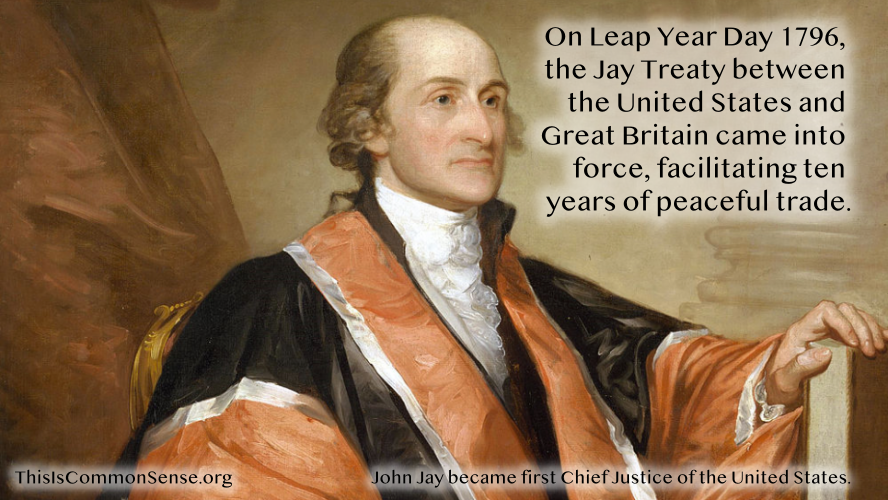
On Leap Year Day 1796, the Jay Treaty between the United States and Great Britain came into force, facilitating ten years of peaceful trade between the two nations.
Not everything worth fighting for, or against, is being taken up President Trump and Elon Musk. There are other battles. For a moment, at least, let us direct our attentions closer to home to consider the causes taken up by, say, the Institute for Justice and Pacific Legal Foundation.
Unlike a taxpayer-funded NGO, always on the march to push big government or social decay, these organizations go to bat for people around the country who are being abused by local governments.
As an example, take a current IJ case, Brooks Township in Michigan, which has been struggling to prevent Peter and Anna Quackenbush from opening a business: a cemetery.
This was to be a “green” burial forest that the township board blocked because it disliked the idea.
After losing a court fight over a proposed ban of all new cemeteries as a way to block Peter and Anna’s particular cemetery, the township is now seeking to impose an ordinance dictating that “No new cemetery shall be created, installed, constructed or instituted . . . unless a written cemetery permit has first been approved and issued by the Brooks Township Board under this Ordinance.”
In other words, a de facto ban by a Board that has made clear its determination to stop Peter and Anna from opening a cemetery on their own property. If this ordinance is allowed to stand, no permit will be issued to them. It’ll be the end of the cemetery.
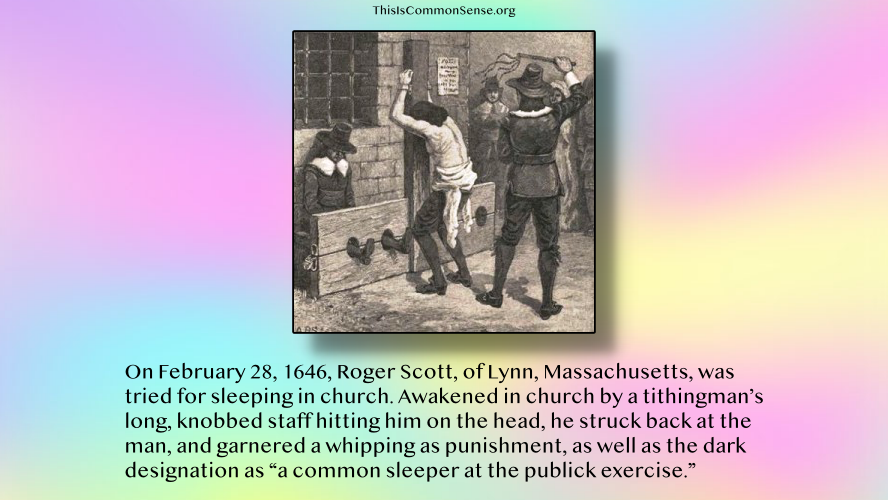
On February 28, 1646, Roger Scott, of Lynn, Massachusetts, was tried for sleeping in church. Awakened in church by a tithingman’s long, knobbed staff hitting him on the head, he struck back at the man, and garnered a whipping as punishment, as well as the dark designation as “a common sleeper at the publick exercise.”