On June 4, 1989, student protests at Beijing’s Tiananmen Square were brutally suppressed by the People’s Liberation Army.
See all recent commentary
(simplified and organized)
See recent popular posts
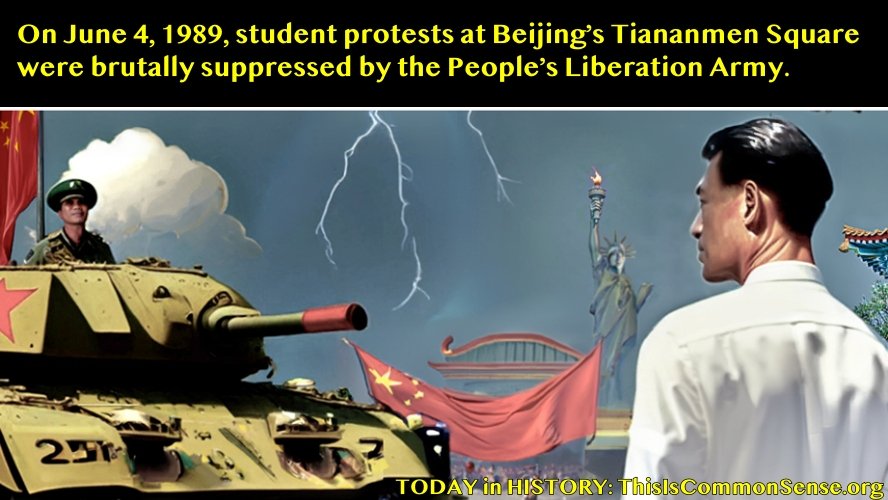
On June 4, 1989, student protests at Beijing’s Tiananmen Square were brutally suppressed by the People’s Liberation Army.
See all recent commentary
(simplified and organized)
See recent popular posts

They shouldn’t “issue or threaten arrest warrants on U.S. citizens or U.S. residents for social media posts on American platforms while physically present on U.S. soil. . . . [Or] demand that American tech platforms . . . engage in censorship activity that reaches beyond their authority and into the United States. We will not tolerate encroachments upon American sovereignty, especially when such encroachments undermine the exercise of our fundamental right to free speech.”
The policy is the least the U.S. can do to combat despots of even “friendly” countries who target speech in the U.S. or demand that U.S. firms abet local repression.
It would also be reasonable to tie trade agreements to willingness to abstain from censoring U.S. speech and bullying U.S. companies that protect speech and privacy. But a White House report on a recent agreement with the UK says nothing about these matters.
American companies have sometimes withdrawn from foreign markets or offered truncated products rather than cooperate with censorship or surveillance. When Britain demanded a global back door to iPhone encryption, Apple removed an encryption feature from iPhones for users in the UK. Better than rendering the feature useless everywhere in the world.
But it would be better still if a country like the United Kingdom simply agreed to leave us alone. Pretend we’re allies and so forth; pretend that they, too, think freedom is a good thing.
This is Common Sense. I’m Paul Jacob.
Illustration created with Krea and Firefly
See all recent commentary
(simplified and organized)
See recent popular posts
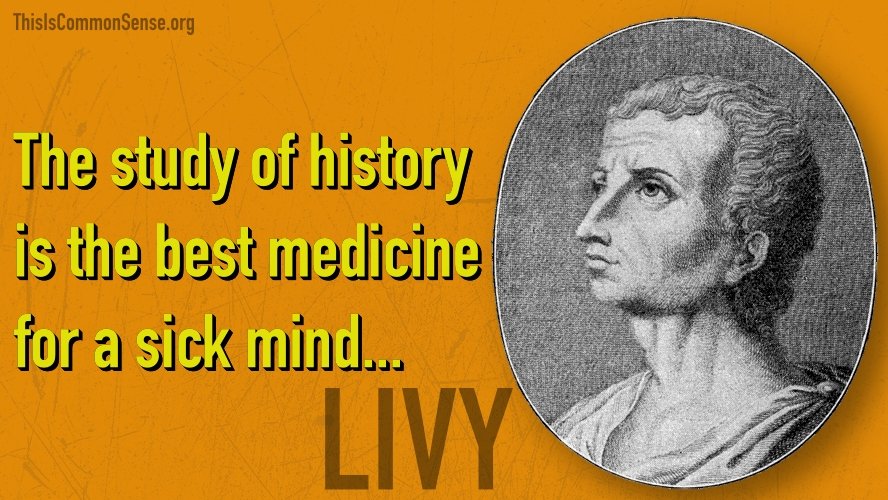
The study of history is the best medicine for a sick mind; for in history you have a record of the infinite variety of human experience plainly set out for all to see; and in that record you can find for yourself and your country both examples and warnings; fine things to take as models, base things, rotten through and through, to avoid.
Titus Livius (c. 59 BC – 17 AD), Ab urbe condita (History of Rome, trans. Aubrey de Sélincourt, 1960), Introduction.
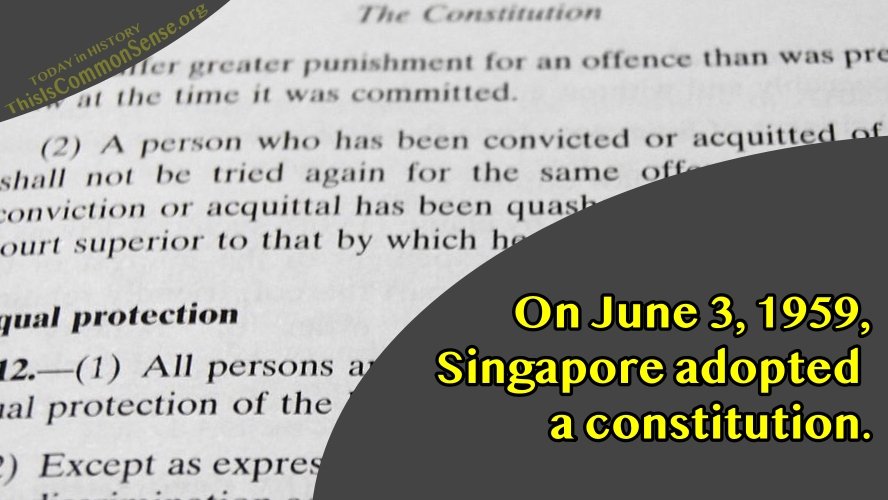
On June 3, 1959, Singapore adopted a constitution.

Mark Steyn and Rand Simberg accused him of manipulating data “in the service of politicized science.” Instead of answering the criticism, Mann treated it as actionably defamatory.
In 2012, Mann launched a lawsuit against Simberg (of the Competitive Enterprise) and Steyn (then writing for National Review).
National Review observes that the criticism which offended Mann “was obviously protected by the First Amendment,” so that his suit should have been scuttled immediately.
Instead, judges antagonistic to free speech when they find the speech uncongenial enabled Mann’s litigation to trundle on for years.
The story gets complicated, as touched upon a few months ago. In 2021, the tide seemed to be turning in favor of Steyn and Simberg, with a court issuing a favorable summary judgment. But in January 2024, a jury found Steyn and Simberg liable for defamation. The awards? Steyn was ordered to pay $1 in compensatory damages and $1 million in punitive damages, Simberg to pay $1 in compensatory damages and $1,000 in punitive damages.
That insane $1 million amount was later reduced to $5,000.
Now it is Mann taking the hit, with rulings that he must pay about a million bucks in legal fees to CEI and Rand Simberg ($477,350) and National Review ($530,820).
National Review urges Michael Mann to finally relinquish his authoritarian quest lest he lose even more.
Will he? It would be irrational to continue, but it was irrational at the start.
This is Common Sense. I’m Paul Jacob.
Illustration created with Krea and Firefly
See all recent commentary
(simplified and organized)
See recent popular posts
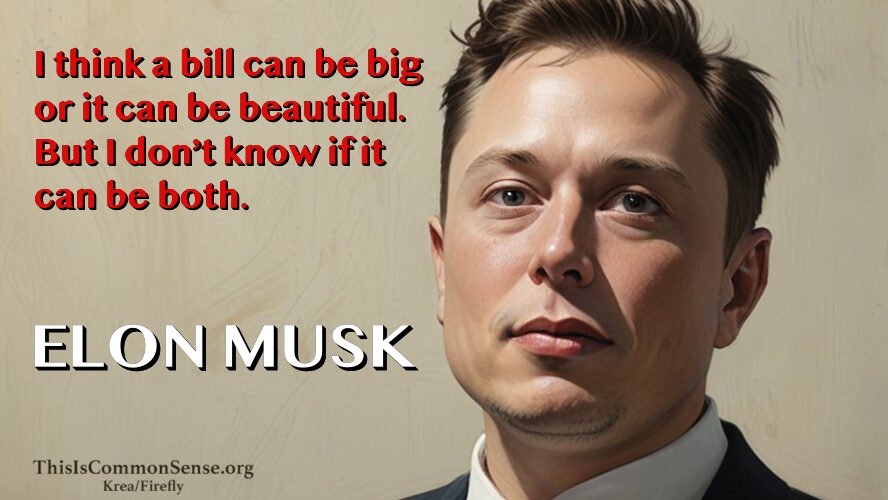
I think a bill can be big or it can be beautiful. But I don’t know if it can be both.
Elon Musk, referring to Donald Trump’s ballyhooed “Big Beautiful Bill,” to CBS Sunday Morning, aired June 1, 2025.

On June 2, 1924, President Calvin Coolidge signed the Indian Citizenship Act into law, granting citizenship to all Native Americans born within the territorial limits of the United States.

“The total number of excess deaths in 47 countries of the Western World was 3,098,456 from 1 January 2020 until 31 December 2022,” write the four authors of “Excess mortality across countries in the Western World since the COVID-19 pandemic: ‘Our World in Data’ estimates of January 2020 to December 2022.”
It’s an interesting journal article, well worth our attention.
“Excess mortality was documented in 41 countries (87%) in 2020, 42 countries (89%) in 2021 and 43 countries (91%) in 2022. In 2020, the year of the COVID-19 pandemic onset and implementation of containment measures, records present 1,033,122 excess deaths (P-score 11.4%). In 2021, the year in which both containment measures and COVID-19 vaccines were used to address virus spread and infection, the highest number of excess deaths was reported:
1,256,942 excess deaths (P-score 13.8%). In 2022, when most containment measures were lifted and COVID-19 vaccines were continued, preliminary data present 808,392 excess deaths (P-score 8.8%).”
Or, to put it in graphic terms:

Here we can compare excess death stats among the various countries:

Though we are already forgetting the enormity of mob-action, abuse of expert testimony, and unconstitutional government, our forgetfulness is not a result of the problem going away. “Excess mortality has remained high in the Western World for three consecutive years,” the authors summarize, “despite the implementation of containment measures and COVID-19 vaccines.”
Interestingly, in Eastern Europe and Russia, where vaccination with mRNA gene therapeutics was scant to none, the excess level has gone negative. That is a good thing.
Paul Jacob has written extensively about the pandemic in these pages. Feel free to use the search engine above.

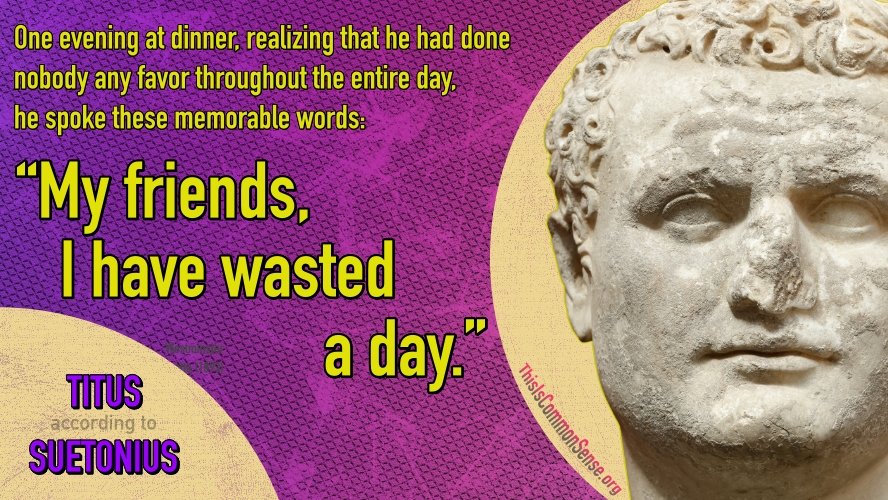
Atque etiam recordatus quondam super cenam, quod nihil cuiquam
toto die praestitisset, memorabilem illam meritoque
laudatam vocem edidit: “Amici, diem perdidi.”
One evening at dinner, realizing that he had done nobody any favour throughout the entire day, he spoke these memorable words: “My friends, I have wasted a day.”
Suetonius on Titus Flavius Vespasianus, in The Twelve Caesars, Robert Graves and Michael Grant, translators (Harmondsworth, 1979), Chapter 8.