Categories
Thought

Nathaniel Hawthorne

Amid the seeming confusion of our mysterious world, individuals are so nicely adjusted to a system, and systems to one another and to a whole, that, by stepping aside for a moment, a man exposes himself to a fearful risk of losing his place forever.

Nathaniel Hawthorne, “Wakefield” (1835) from Twice Told Tales (1837, 1851).
Categories
Today

Founders, Fathers

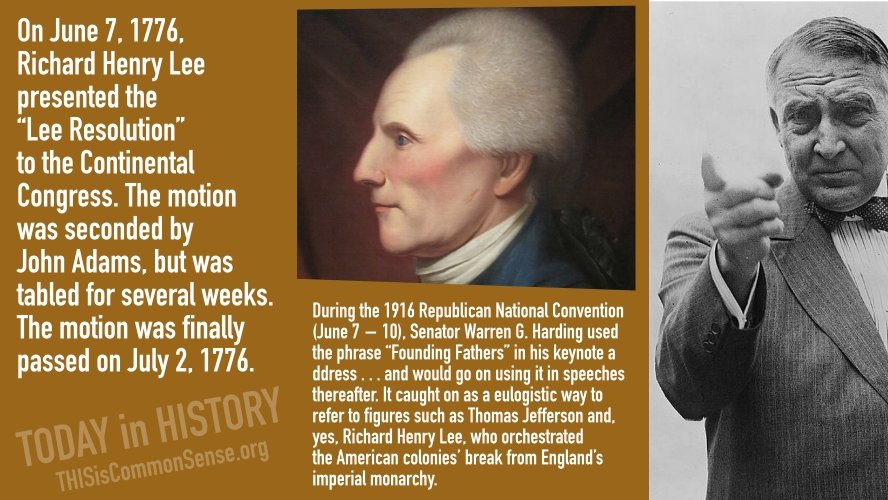
On June 7, 1776, Richard Henry Lee presented the “Lee Resolution” to the Continental Congress. The motion was seconded by John Adams, but was tabled for several weeks. The motion was finally passed on July 2, 1776.

During the 1916 Republican National Convention (June 7 – 10), Senator Warren G. Harding used the phrase “Founding Fathers” in his keynote address . . . and would go on using it in speeches thereafter. It caught on as a eulogistic way to refer to figures such as Thomas Jefferson and, yes, Richard Henry Lee, who orchestrated the American colonies’ break from England’s imperial monarchy.

Categories
general freedom ideological culture

Chinese Individualism

“You’re not the center of the story — at least not everywhere.”

That’s the tagline of a video featuring the late President Lee Kuan Yew, described as the “founding father of Singapore,” elsewhere affectionately referred to as LKY.

The social media account responsible runs under the moniker Office of the Director of Intelligence & Strategy, which sounds like a propaganda bureau. It’s an excerpt from a 25-year-old hour-long interview with Charlie Rose.

Entitled “Not Every Culture Believes Success Starts with One Person,” the clip goes on to say that LKY “shares his understanding of a key divide between the West and many Asian societies: Where the West centers the individual and leading your own path, many Asian systems prioritize the group — family, obligation, cohesion, survival together.”

The familial and communal aspects of traditional Chinese society are not in doubt. But LKY makes two crucial errors. 

“You believe in the individual as the creator of all things,” he says of Americans. 

That is not even close to how American individualism views the world. For starters, most Americans continue to believe in a capitalized Creator “of all things,” and it’s not the individual. Furthermore, even the most rugged individualist understands the role of families in raising children and communities in helping humans flourish.

American liberty, as imperfect and diluted as it is, can accommodate family-values traditions and communitarian folkways as well as free radicals. The point of individualism is not that The Individual creates success ex nihilo, but that government must make no exceptions for some individuals over others based on group membership.

Which is why Chinese-Americans do so well: they are helped by their family orientation as well as freedom. They do much better here than in China, but Chinese do even better in Singapore, which sports a lower tax burden. 

The kind of tax burden individualists prefer.

This is Common Sense. I’m Paul Jacob.


PDF for printing

Illustration created with Midjourney and Firefly

See all recent commentary
(simplified and organized)
See recent popular posts

Categories
Thought

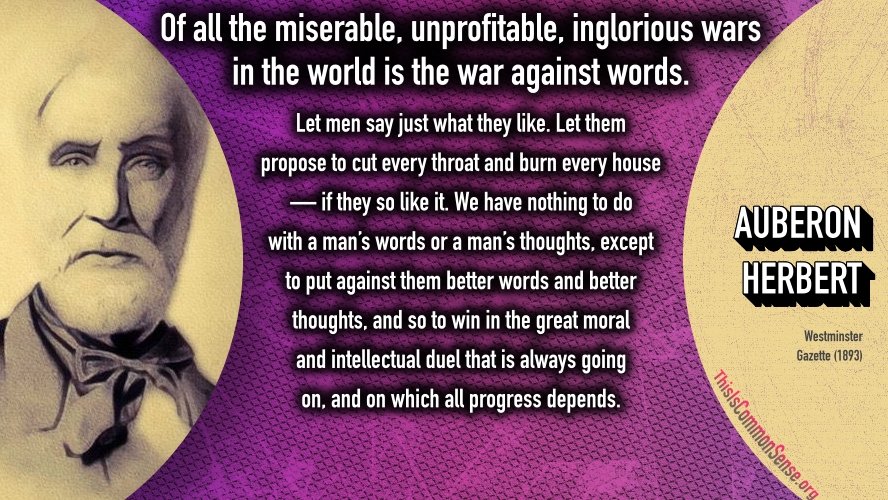
Auberon Herbert

Of all the miserable, unprofitable, inglorious wars in the world [the worst] is the war against words. Let men say just what they like. Let them propose to cut every throat and burn every house — if they so like it. We have nothing to do with a man’s words or a man’s thoughts, except to put against them better words and better thoughts, and so to win in the great moral and intellectual duel that is always going on, and on which all progress depends.

Auberon Herbert, Westminster Gazette (1893), as quoted in Theodore Schroeder, Free Speech for Radicals: Seven Essays (1912), p. 43.
Categories
Today

A Bolide

On June 6, 2002, a high-energy upper atmosphere explosion over the Mediterranean Sea (c. 34°N 21°E) occurred. Similar in power to a small atomic bomb, the cause of the fireball has been determined to be a small, undetected asteroid entering the Earth’s atmosphere and burning out without hitting the surface, though no meteorite fragments were recovered. One of the several meanings of the word “bolide” is this, an atmospheric explosion of a meteor.

General Simon Worden of the U.S. Air Force opined that, had the explosion occurred closer to Pakistan or India — which were at war at the time — it could have sparked a nuclear exchange.*


* “Near-Earth Objects Pose Threat, General Says,” Space Daily (2002-09-17).

Categories
media and media people partisanship

Rats A-Jumpin’

When the ship starts sinking, the rats start jumping.

In politics, when a party or movement is soundly demolished at the polls, you can expect to see stalwarts flake off and go the way of the opposition, or “their own way.”

But the honorable time to do that is before the insider position becomes untenable. Not after

Late timing smacks of opportunism.

Case in point: Karine Jean-Pierre, former Press Secretary to President Joe Biden.

Ms. Jean-Pierre was the African-American woman hired to obfuscate for the Democrat cabal who ran the federal government’s executive wing while the Man Sworn In was out — to lunch.

Now she’s formally left the Democratic Party and is shilling a book, Independent: A Look Inside a Broken White House, Outside the Party Lines, scheduled for publication this fall. It sports a great cover.

Like CNN’s Jake Tapper, Jean-Pierre focuses on a critical period in Joe Biden’s administration. “She takes us through the three weeks that led to Biden’s abandoning his bid for a second term and the betrayal by the Democratic Party that led to his decision,” her publisher blurbles.

Also like Tapper, she has no standing to preach any virtuous sermons on verity or clarity or even non-insularity. She was absolutely in the thick of Democratic insider corruption.

Her spin is in her title: she’s going independent, not switching sides

“I think we need to stop thinking in boxes and think outside of our boxes,” she posts on Instagram, “and not be so partisan.”

Now that her PR for her president’s party has been repudiated.

This is Common Sense. I’m Paul Jacob.


PDF for printing

Illustration created with Midjourney and Firefly

See all recent commentary
(simplified and organized)
See recent popular posts
Categories
Thought

Livy

Many things complicated by nature are restored by reason.

Titus Livius (c. 59 BC – 17 AD), History of Rome, Book XXVI, sec. 11.
Categories
Today

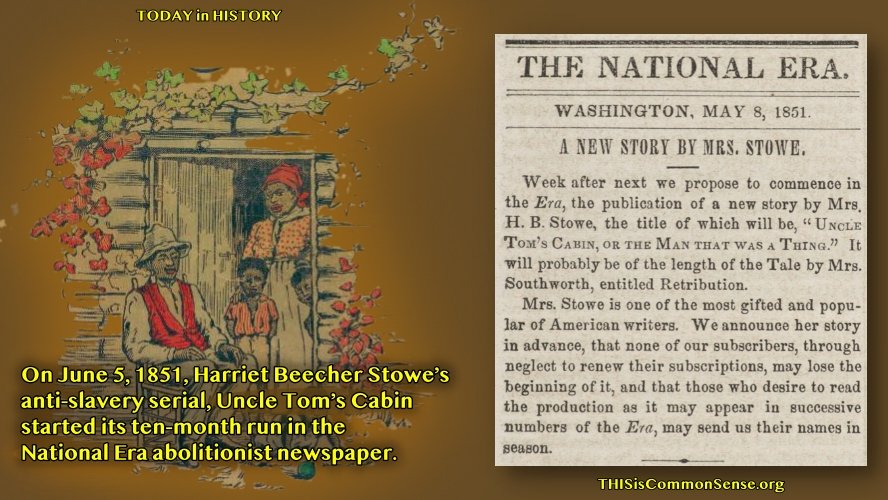
Uncle Tom’s Cabin

On June 5, 1851, Harriet Beecher Stowe’s anti-slavery serial, Uncle Tom’s Cabin, or Life Among the Lowly, started its ten-month run in the National Era abolitionist newspaper. It had been announced earlier, in the May 8th issue of the paper.

Categories
defense & war international affairs

China, No

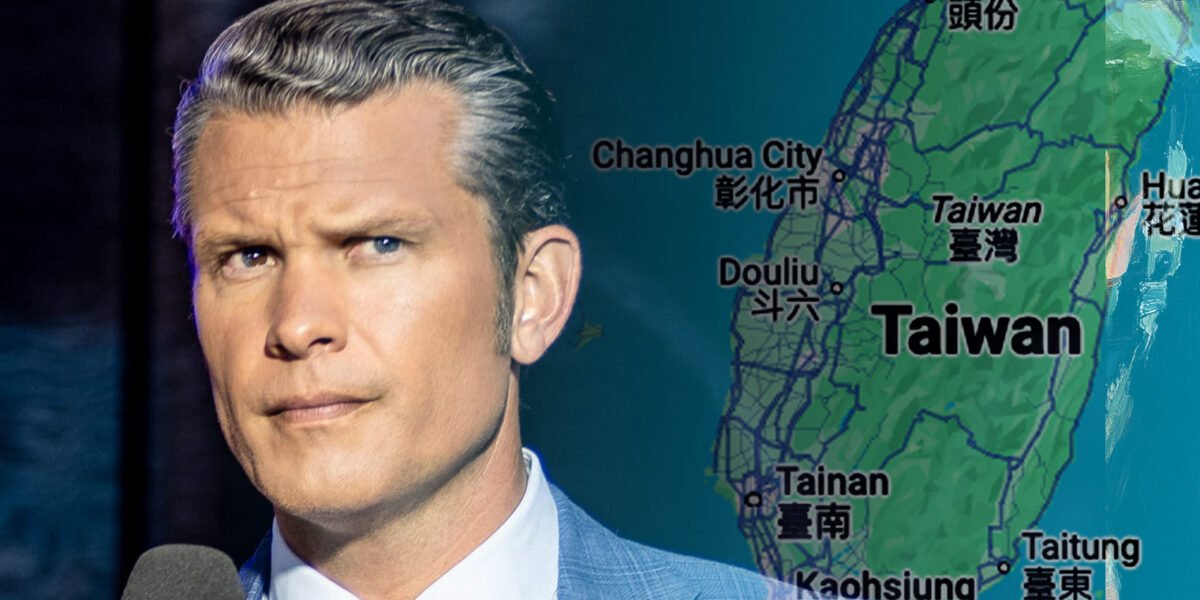
“China’s behavior towards its neighbors and the world is a wake-up call,” U.S. Secretary of Defense Pete Hegseth warned at last weekend’s Shangri-La Dialogue in Singapore. “We cannot look away, and we cannot ignore it.” 

“Hegseth throws down gauntlet to China” was how Newsweek headlined its story on the Defense Secretary’s “assertive policy address” at Asia’s “premier defense summit.”

“We will stand with you and work alongside you to deter Chinese aggression,” the Secretary pledged to Asian allies. Moreover, he declared that, as a first step, “the Department of Defense is prioritizing forward-postured, combat credible forces in the Western Pacific to deter by denial along the first and second island chains.”

“Hegseth described Chinese coercion and aggression against Taiwan and the South China Sea more clearly than any prior U.S. defense secretary,” offered Bonnie Glaser, managing director, of the German Marshall Fund’s Indo-Pacific Program. 

Today is June Fourth, 36 years to the day that the People’s Liberation Army rolled tanks into Tiananmen Square, firing on and killing students and other peaceful protesters. Had the George H.W. Bush administration delivered a stronger message to China back then, maybe Hegseth wouldn’t be required to restate President Trump’s insistence that China not be allowed “to invade Taiwan on his watch.”

Or talk openly of doing “what the Department of Defense does best — fight and win — decisively.”

“[B]arely a month after the bloodshed in Tiananmen Square,” Ted Galen Carpenter wrote five years ago, “the White House dispatched National Security Adviser Brent Scowcroft on a secret trip to Beijing to mend ties. That visit followed an impassioned personal letter that Bush sent to Chinese leader Deng Xiaoping” in which the president “came perilously close to kowtowing to a brutal, autocratic regime.”

Contributing to the clear and present danger we face today.

This is Common Sense. I’m Paul Jacob.


PDF for printing

See all recent commentary
(simplified and organized)
See recent popular posts

Categories
Thought

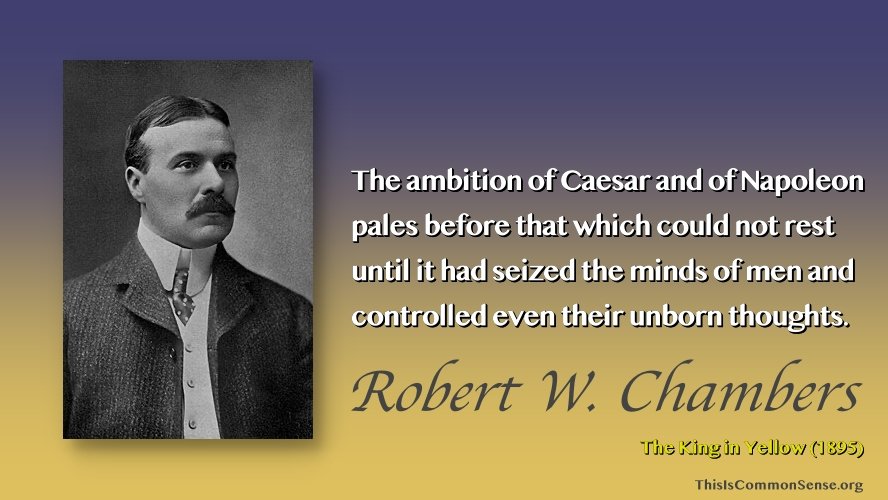
Robert W. Chambers

The ambition of Caesar and of Napoleon pales before that which could not rest until it had seized the minds of men and controlled even their unborn thoughts.

Robert W. Chambers, The King in Yellow (1895).