Categories
defense & war public opinion

Iran: What Next

The Iran Question dominates the news.

Most papers and programs have numerous takes at the top of the page or the hour devoted to Israel’s attack on Iran’s nuclear program; President Trump’s demand that Iran unconditionally surrender, and the government of Iran’s defiance; and Trump’s latest statements vaguing up “his decision” to bomb Iran.

And in a man-bites-dog angle, I’m going to agree with The New York Times.

Specifically, the editorial board’s “America Must Not Rush Into a War Against Iran,” run yesterday.

Where the Times is right regards not the disputed facts and theories about the conflict, but whether the United States military, under direction of its Commander-in-Chief, should bomb Iran.

That is not merely open to debate but must be debated.

Many in Trump’s base oppose any involvement: Trump was voted into office to stop the endless wars.

But it’s not just the matter of politics. It’s a constitutional issue: “An unprovoked American attack on Iran — one that could involve massive bombs known as bunker busters — would not be a police action or special military operation,” the Times declares. “It would be a war. To declare it is not the decision of Mr. Netanyahu or Mr. Trump. Under the Constitution, Congress alone has that power.”

And if we wince at the idea of our dysfunctional Congress grandstanding and bloviating about such a weighty matter, consider this: the congressional debate must occur in a context where Americans debate. We debate; the People.

After all, we end up playing lots of heavy roles in these things. 

This is Common Sense. I’m Paul Jacob.


PDF for printing

Illustration created with Krea and Firefly

See all recent commentary
(simplified and organized)
See recent popular posts

Categories
Thought

Martin Van Buren

All the lessons of history and experience must be lost upon us if we are content to trust alone to the peculiar advantages we happen to possess.

President Martin Van Buren’s Inaugural Address (March 4, 1837).

Categories
Today

Juneteenth

“Juneteenth” (a portmanteau of June and nineteenth) also known as Freedom Day, Jubilee Day, Liberation Day and Emancipation Day, is a holiday celebrating the emancipation of those held as chattel slaves in the United States. Originating in Galveston, Texas, it has been celebrated annually on June 19 throughout the United States, and on June 17, 2021, it was made into an official national holiday when President Joe Biden signed the Juneteenth National Independence Day Act into law. It is commemorated on the anniversary date of the June 19, 1865, announcement of General Order No. 3 by Union Army general Gordon Granger, proclaiming freedom from slavery in Texas.

Categories
crime and punishment insider corruption

The Quanta of Corruption

The first initiative petition drive I ever ran was the Tax Accountability Amendment in Illinois in 1990. I remember canvassing Speaker of the Illinois House of Representatives Michael Madigan’s district. 

He was a problem way back then. It was as if everything he worked for I worked against! The Democrat really knew how to wield power: going on to become the longest-serving leader of any state or federal legislative body in the history of the United States, holding the position for all but two years from 1983 to 2021. 

Well, he’s in the news again— and not for receiving a laurel of appreciation from a grateful state.

“Longest-serving legislative leader in US history given 7 1/2 years in federal corruption case,” reads the Associated Press headline.

In addition to the prison sentence following his February conviction for “trading legislation for the enrichment of his friends and allies,” Mike Madigan has alsobeen fined $2.5 million.

The “Velvet Hammer,” as Madigan was called, was, in the end, hammered, found guilty “on 10 of 23 counts in a remarkable corruption trial that lasted four months. The case churned through 60 witnesses and mountains of documents, photographs and taped conversations.”

At sentencing, U.S. District Judge John Robert Blakey demonstrated anger over Madigan’s perjury on the stand. “You lied. You did not have to. You had a right to sit there and exercise your right to silence,” the judge told the convict at sentencing. “But you took the stand and you took the law into your own hands.”

Just as the corrupt career politician did as Speaker for four miserable decades. 

Justice may have taken too long, but I applaud it. 

This is Common Sense. I’m Paul Jacob.


Common Sense: Clown Car of Felonies
December 18, 2018

Common Sense: Keystone Correlation
September 28, 2017

Common Sense: Most Messed Up
July 13, 2017

Townhall: Term Limits, Now More Than Ever
May 04, 2014


PDF for printing

Illustration created with Krea and Firefly

See all recent commentary
(simplified and organized)
See recent popular posts

Categories
Thought

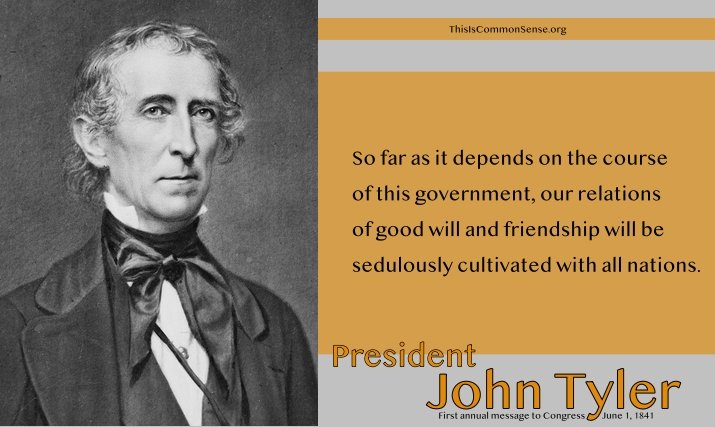
John Tyler

So far as it depends on the course of this government, our relations of good will and friendship will be sedulously cultivated with all nations.

President John Tyler, first annual message to Congress (June 1, 1841).

Categories
Today

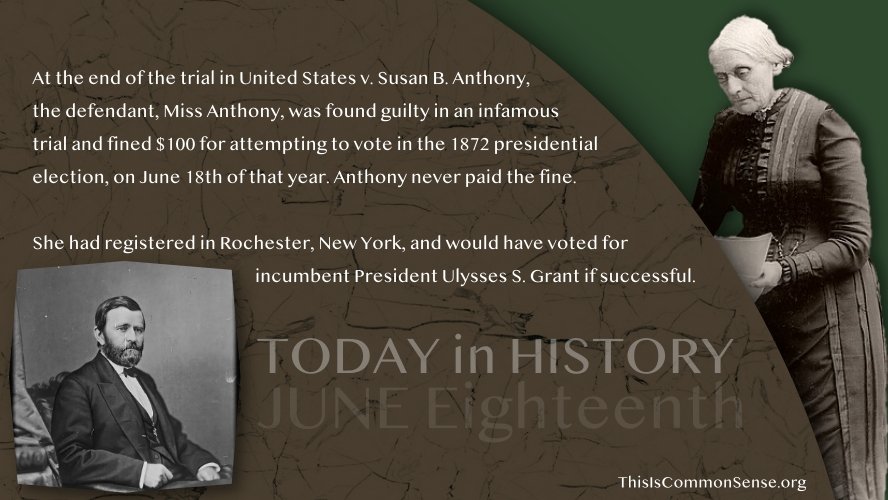
Susan B. Anthony

At the end of the trial in United States v. Susan B. Anthony, the defendant, Miss Anthony, was found guilty in an infamous trial and fined $100 for attempting to vote in the 1872 presidential election, on June 18 of that year. Anthony never paid the fine.

She had registered in Rochester, New York, and would have voted for incumbent President Ulysses S. Grant if successful.


Categories
national politics & policies political economy regulation

Ultra-Absurd?

Sen. Josh Hawley (R-Missouri) is oh-so-ultra.

USA Today dubs him a “conservative” in the title of a recent article on a proposed minimum wage hike, and then an “ultraconservative” (emphasis added) in the first word of the article itself

Why does this “ultraconservative” join a Democratic senator in raising the federal minimum wage to $15? They both seem to assume that minimum wage laws raise wages.

For hundreds of years, economists have argued they don’t. On the face of it, these laws merely prohibit jobs paid below a certain rate. They disemploy. 

When the government prohibits low-wage compensation, businesses shift productive processes to keep afloat; when a factor is suddenly made more expensive, they adjust. With more automation, for example.

At least, the USA Today article mentions, briefly, that the Congressional Budget Office forecasts that some individual workers and families would see their livelihoods diminished by the higher minimum — which is the only part of the coverage of the new, more restrictive (higher) minimum wage regulation that gets to the meat of the issue: what minimum wage laws actually do. 

A related article back home in the Springfield News Leader (a member of the “USA TODAY NETWORK”) explores the question of Missouri’s minimum wage and what activist economists call the state’s “minimum living wage” — and it is relevant at least to this extent: states have different economic climates, and wage rates differ region to region in the United States, so it’s very relevant to a senator from his state affecting his state’s economy with a regulation applying equally to all states.

Which is to say that the minimum wage issue should be a state issue.

If an issue at all.

“Ultraconservative” Hawley’s bill is ultra-misguided.

This is Common Sense. I’m Paul Jacob.


PDF for printing

Illustration created with Krea and Firefly

See all recent commentary
(simplified and organized)
See recent popular posts

Categories
Thought

William Henry Harrison

The strongest of all governments is that which is most free.

William Henry Harrison, letter to Simon Bolivar (September 27, 1829).
Categories
Today

The Statue of Liberty

The Statue of Liberty arrived in New York Harbor on June 17, 1885.


On the same day in 1930, progressive Republican President Herbert Hoover — eager to please agricultural states and confident that protectionism would yield greater wealth — signed the Smoot-Hawley Tariff. It did not help get the country out of the Great Depression.

Three years later, investment author and two-time Libertarian Party presidential candidate Harry Browne was born

On June 17, 1944, Iceland declared independence from Denmark.

On this day in 1971, President Richard Nixon declared a “War on Drugs,” which steadily decreased civil liberty and the rule of law in America.

Exactly one year later, five men were arrested for attempted burglary on the offices of the Democratic National Committee in the Watergate complex in Washington, D.C., igniting the Watergate scandal that ultimately led to the resignation of U.S. President Richard Nixon more than two years later.

Categories
incumbents term limits

The Mad-Libs Incumbency

In late April, Congresswoman Eleanor Holmes Norton, the District of Columbia’s delegate to the U.S. House for these last 35 years, “stumbled through a short speech in which she appeared to struggle with both reading and comprehension, unable to deliver more than a garbled, Mad Libs-style version of her intended remarks,” according to a report in Washingtonian magazine and confirmed by an audio recording.

Annie Karni’s story last week in the The New York Times discloses concerns among Norton’s “colleagues and friends” of “a notable decline . . . that has quieted her voice, leaving her vastly diminished and struggling to fulfill her congressional duties.”

Karni’s other tidbits?

  • “In hearings, she often sits quiet and alone, sometimes relying on staff aides to remind her where she is.”
  • “She sometimes does not seem to recognize people she has known for years.”
  • “Ms. Norton is unable to function independently.”

That means she is unable to function as an effective representative of the people of Washington, D.C. 

“In Ms. Norton’s case, the signs have been evident for years,” explains The Times article. Her activity on the House floor has dwindled precipitously.”

Still, when questioned earlier this week about possible retirement, Norton declared, “I’m going to run. I don’t know why anybody would even ask me.”

The 88-year-old non-voting delegate from our nation’s capital would be 90 if reelected next year and able to complete a 14th term. When of course she might yet run again.

“Ms. Norton’s story is a familiar one in Congress,” acknowledges The Times reporter, “an institution littered with towering figures who have stayed around well past the prime of their lives.”

Yet this is not really about age. It’s about incumbency. Politicians leveraging their positions for unlimited rule . . . resulting in rule by the old, the doddering, the feeble.

We all know — ’cept for incumbent politicians — that the answer is term limits.

This is Common Sense. I’m Paul Jacob.


PDF for printing

Illustration created with Krea and Firefly

See all recent commentary
(simplified and organized)
See recent popular posts