Categories
deficits and debt national politics & policies too much government

The Biggest

Trump’s riding high, in the first week of his second term — but not regarding the biggest problem he faces, inflation and economic instability.

“When bondholders don’t see a credible fiscal path to be repaid for current and future government debt,” writes Veronique de Rugy at Reason, “they expect that eventually the central bank will create new money to buy those government bonds, leading to higher inflation.

“Recent inflation wasn’t just about money supply; it reflected the market’s adjustment to unsustainable fiscal policy.”

Winning, for Trump, cannot equate to Spending.

While Ms. de Rugy tries to explain this all in terms of a big-picture economic analysis, she does not quite reach back in time far enough. We had stagflation way back when I was young. It was cured then not by decreased spending but by Paul Volcker of the Federal Reserve putting the brakes on money-and-credit expansion. He stopped inflation. 

A pure recession immediately followed, followed by recovery in the new administration, Ronald Reagan’s, who helped reduce the rate of growth of government (and not much else).

Inflation could, theoretically, be handled by the Fed alone, now, as then.

Except — the federal government can hardly now afford to service existing debt, which would skyrocket with the nitty-gritty of the Fed’s cure, higher interest rates. 

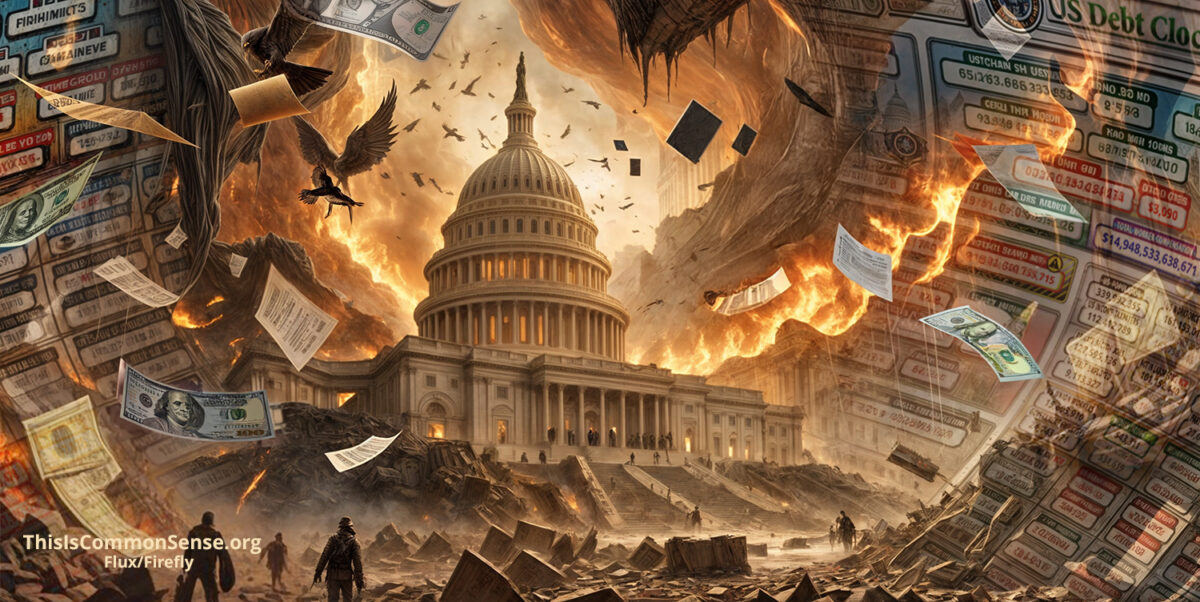
Today, debt service (paying just the interest) approaches One Trillion Per Annum. 

“A crucial tipping point was reached in 2024 when the interest expense on the federal debt exceeded the defense budget for the first time,” Nick Giambruno summarizes at The International Man. “It’s on track to exceed Social Security and become the BIGGEST item in the federal budget.” 

Increasing it yet more would cripple the government.

The only way out, if there is one, is a radical decrease in spending and deficits, as de Rugy advises. Trump’s path to success is somehow accomplishing that.

This is Common Sense. I’m Paul Jacob.


PDF for printing

Illustration created with Flux and Firefly

See all recent commentary
(simplified and organized)
See recent popular posts
Categories
Thought

Benjamin Franklin

Love your Enemies, for they tell you your Faults.

Poor Richard’s Almanack, 1756.
Categories
Today

Beaumarchais

On January 24, 1732, French playwright, watchmaker, inventor, musician, diplomat, fugitive, spy, publisher, horticulturalist, arms dealer, satirist, financier, and revolutionary (both French and American) Pierre-Augustin Caron de Beaumarchais was born. He proved instrumental in securing armaments for the America Revolution, but remains best known for his three “Figaro” plays, Le Barbier de Séville, Le Mariage de Figaro and La Mère coupable. The plays remain memorable today chiefly for their operatic settings by Mozart and Rossini.

Beaumarchais died May 18, 1799.

Categories
First Amendment rights national politics & policies

A Free Speech Order

“Will President Trump be a free speech president?”

On January 21, David Keating, president of Institute for Free Speech, asked this question. And he refers the reader to his Wall Street Journal op-ed published last month in which he offered suggestions about how to stop the federal government from censoring people via social media or in other ways.

The new president sure seemed to get off to a good start restoring the First Amendment. One of his thirty or so executive orders signed on the 20th, his first work day, is entitled “Restoring Freedom of Speech and Ending Federal Censorship.”

Section 2 says that it is U.S. policy to “secure the right of the American people to engage in constitutionally protected speech,” ensure that no federal employee or agent “engages in or facilitates” unconstitutional abridgement of speech, and “identify and take appropriate action to correct past misconduct by the Federal Government related to censorship of protected speech.”

Section 3 says no federal employee or department may act in a manner inconsistent with Section 2.

Maybe this broad order needs to be supplemented with many more specific orders that say: Really. Don’t engage in censorship here or there or anywhere.

This is where specific suggestions like Mr. Keating’s come in handy, such as preventing the IRS from penalizing taxpayers for criticizing political candidates, repealing SEC limits on political donations, and instituting specific regulations to “force disclosure of most government contacts with social-media organizations asking to take down third-party posts,” thereby scuttling most future such contacts.

It’s a start. Let’s keep going.

This is Common Sense. I’m Paul Jacob.


PDF for printing

Illustration created with Flux and Firefly

See all recent commentary
(simplified and organized)
See recent popular posts

Categories
Thought

Ambrose Bierce

Revolutions are usually accompanied by a considerable effusion of blood, but are accounted worth it — this appraisement being made by beneficiaries whose blood had not the mischance to be shed.

From The Devil’s Dictionary (1911).
Categories
Today

Stendhal, Cobden & Chevalier

On January 23, 1783, journalist and novelist Marie-Henri Beyle, known by his pen name Stendhal (pictured below), was born. Stendhal was a follower of Destutt de Tracy and an attendant at the count’s salons. His most famous works include the novel The Red and the Black and a treatise on romantic love.

Stendhal died March 22, 1842.

On January 23, 1860, the Cobden-Chevalier Treaty was signed between France and Great Britain. The treaty was named after the two main proponents of the agreement, Richard Cobden (in England) and economist Michel Chevalier (in France). The treaty had been suggested the year earlier, in British Parliament, by Cobden’s colleague John Bright, who looked upon the policy as a peace measure, an alternate to a military build-up.

Categories
crime and punishment national politics & policies

“The Same Lunatics”

Yesterday, President Donald J. Trump characterized a subset of federal government employees as “scum.”

While some pearls will no doubt be clutched out there among the Big Government fan base, he’s not wrong.

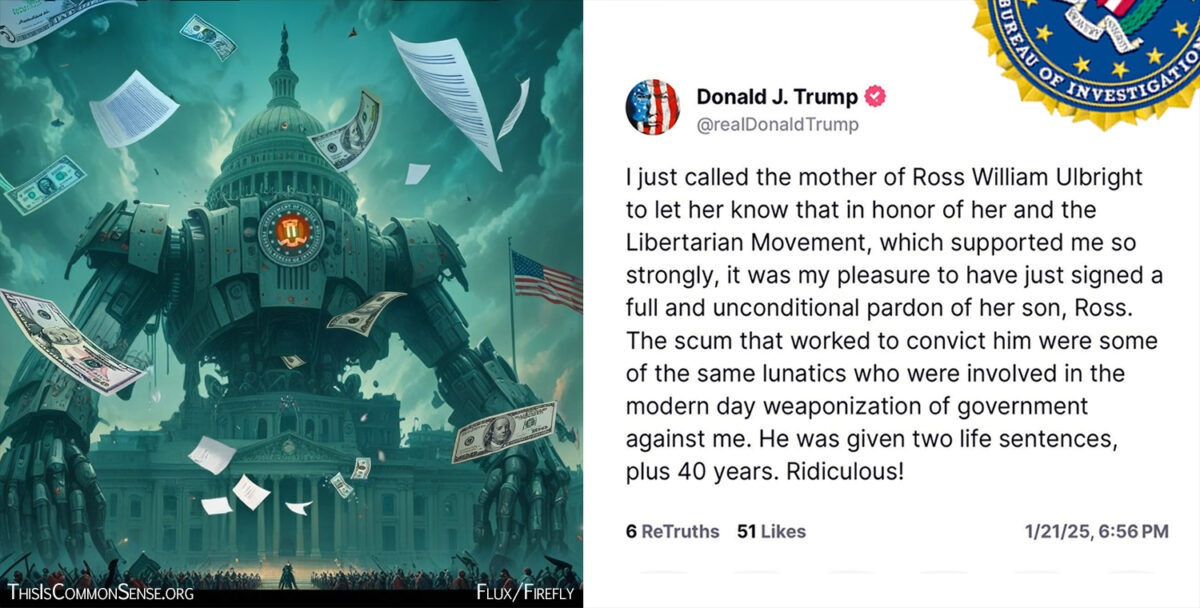
On Truth Social the president wrote: “I just called the mother of Ross William Ulbright to let her know that in honor of her and the Libertarian Movement, which supported me so strongly, it was my pleasure to have just signed a full and unconditional pardon of her son, Ross.”

This pardon, which readers of This Is Common Sense have certainly heard about before, was a long time coming. Ross Ulbricht had been sentenced for establishing and running The Silk Road, a Dark Web marketplace, way back in 2015.

Interestingly, Trump pardoned Ross, as he put it, in honor of Ross’s mother and friends — chiefly libertarians, specifically in the Libertarian Party. This may be the most significant thing the Libertarian Party has accomplished in years: a man is free.

Then we read the killer sentence: “The scum that worked to convict him were some of the same lunatics who were involved in the modern day weaponization of government against me.” While Trump defined the pardon as a matter of honor, the most important point may be who he is dishonoring.

But of Ross’s plight, Trump wrote, “He was given two life sentences, plus 40 years. Ridiculous!”

Yes, ridiculous. Overkill. The inhabitants of permanent government were trying to send a message: they would not allow commerce outside the scope of their moderation and oversight.

Trump now sends a different message. He knows what his enemies are.

This is Common Sense. I’m Paul Jacob.


PDF for printing

Illustration created with Flux and Firefly

See all recent commentary
(simplified and organized)
See recent popular posts

Categories
Thought

Benjamin Franklin

Let me add, that only a virtuous people are capable of freedom. As nations become corrupt and vicious, they have more need of masters.

Ben Franklin, letter to the Abbés Chalut and Arnaud (April 17, 1787).
Categories
Today

Irving Kristol

On January 22, 1920, American neoconservative pundit and author Irving Kristol was born. He died in 2009, survived by his wife, the historian Gertrude Himmelfarb, and two children, one of them well known today. His most famous book is undoubtedly 1978’s Two Cheers for Capitalism: A Penetrating Assessment of Free Enterprise and the Corporate System.

Categories
national politics & policies

Trump Fact-Checked

“Over the past eight years I have been tested and challenged more than any president in our 250 year history,” said Donald Trump in his second inaugural address. “And I’ve learned a lot along the way.”

This section of his speech, yesterday, is probably the best.

Because true.

While known for hyperbolic statements, extravagant figures of speech and whoppers and colorful b.s., Donald John Trump’s not exaggerating to claim a special status of having endured more than other presidents and presidential candidates. The prosecutions, the impeachments, the lies, the elaborate psychological operations carried on by mass media and Deep State operatives, and more, give weight to his claim. 

Now, this doesn’t make any of his proposals and positions and other opinions correct

But it does help us receive his next sentence: “The journey to reclaim our republic has not been an easy one, that I can tell you.” In the second half of the speech Trump framed his approach as a nationalism in the McKinley-Roosevelt tradition. Theirs is the kind of politics and republic he seeks to revive.

Also not untrue? “Those who wish to stop our cause have tried to take my freedom, and, indeed, to take my life.” 

The mobbing of multiple prosecutions was piled onto by two would-be assassins. Their story, Tucker Carlson noted last week — has dropped out of the conversation. 

Trump dropped it back in: “Just a few months ago, in a beautiful Pennsylvania field, an assassin’s bullet ripped through my ear — but I felt then, and believe even more so now, that my life was saved for a reason. I was saved by God to make America great again.”

Whatever else you may say about Trump, and whatever credence you give to his theological spin on the shots fired on July 13, 2024, his take is, if a stretch, a traditional one; many who first witnessed the shooting in Butler, Pennsylvania, leapt to a simple conclusion: he would become president again.

And he did. 

No joke — as another, very different president liked to say.

This is Common Sense. I’m Paul Jacob.


PDF for printing

Illustration created with Flux and Firefly

See all recent commentary
(simplified and organized)
See recent popular posts