Categories
Today

Heroes Executed

On February 22, 1943, brother and sister Hans and Sophie Scholl, and their colleague in the White Rose resistance organization, Christoph Probst, stood trial before the Volksgericht — the People’s Court that tried political offenses against the Nazi German state. Found guilty of treason by Roland Freisler, head judge of the court, the three were executed that same day.

The method of capital punishment was beheading by guillotine.

Their six pamphlets had spread throughout German-held territory before the war ended.

Categories
ideological culture Voting

Blood in the Streets?

“When you think about how dangerous it is to raise an issue like this,” Davis Hammet, president of Loud Light Civic Action, explained to a Kansas State House committee, “whenever something doesn’t need to be addressed — because you’re going to create a lot of public attention, a lot of debate on this, and very likely — not to say that anyone here, this is their intention — but there’s [sic] almost three million people in the state, some folks will have very xenophobic and potentially violent outlooks on immigration.”

Hammet then asked legislators to “consider the Garden City bombing plot,” a 2016 case in which three Kansas men were arrested and convicted of conspiring to bomb a housing complex with many Somali immigrants.

Wait . . . what issue — “like this” — is he talking about? 

Mr. Hammet testified against House Concurrent Resolution 5004, a constitutional amendment introduced by Rep. Pat Procter, clarifying that only U.S. citizens are eligible voters in all Kansas elections, state and local.

“This legally and practically won’t do anything,” asserted Hammet.

Far from the truth, legally. 

Kansas has the same language in its constitution’s suffrage provision as California and Vermont, where courts have upheld the constitutionality of noncitizen voting at the local level. Plus, by placing citizen-only voting in the state constitution, Kansans can guarantee their power to vote yes or no before any future state legislature or city council could legalize non-citizen voting.

Twenty-one cities across the U.S. now give the vote to noncitizens, most also allow those here illegally to vote. Meanwhile,in recent years nearly 30 million Americans in 14 states have voted by whopping margins to enact Citizen Only Voting Amendments like HCR 5004, eight of those states last November

“But it could create fuel on the fire for some radical groups,” speculates Hammet, “to feel like they’re motivated to take improper actions.”

Yet so far without a single fatality! No fisticuffs or riots or bombings attributed to the debate or the public vote. Not one incident. 

Hammet may sound high-minded, throwing around words like “xenophobic,” but note his paranoia about his fellow citizens handling political issues. Moreover, he fails to recognize that the policy he sees as “anti-immigrant” is, in actual fact, overwhelmingly supported by immigrants.

So, who’s the xenophobe?

This is Common Sense. I’m Paul Jacob.


Note: HCR 5004 passed that committee and then passed the House on a vote of 98 to 20. The amendment now awaits action in the Kansas State Senate in order to be referred to the voters.

PDF for printing

Illustration created with Flux and Firefly

See all recent commentary
(simplified and organized)
See recent popular posts

Categories
Thought

Montaigne

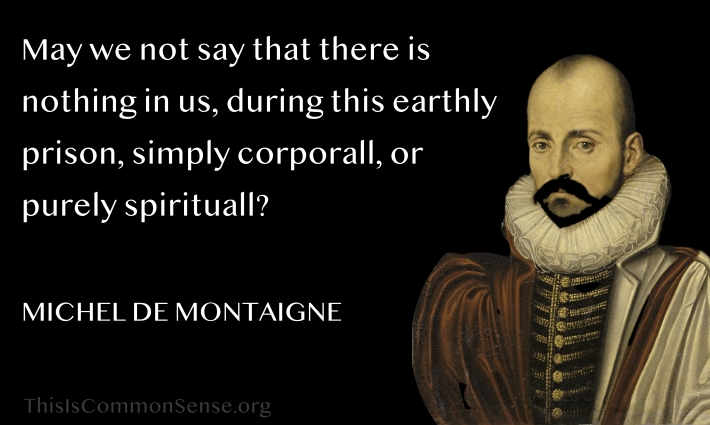
May we not say that there is nothing in us, during this earthly prison, simply corporall, or purely spirituall?

Michel de Montaigne, as quoted in Why We Should Read ——, by S. P. B. Mais (1921).

Categories
Today

Enver Hoxha

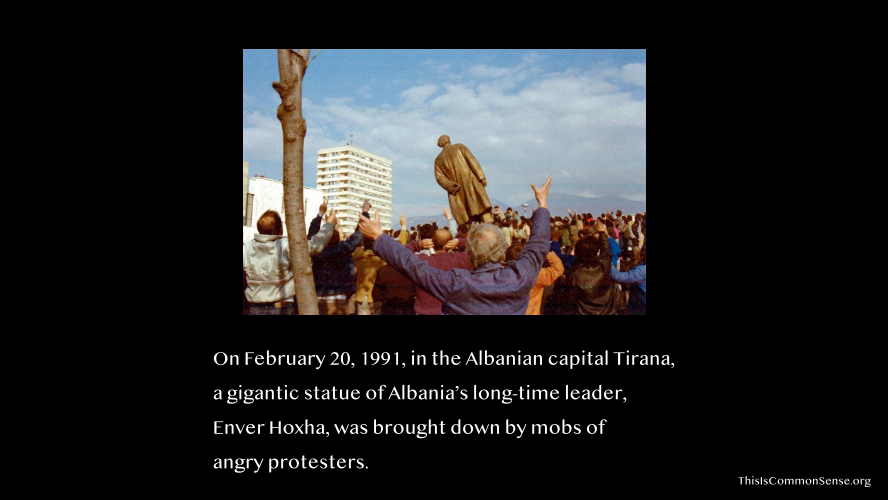
On February 20, 1991, in the Albanian capital Tirana, a gigantic statue of Albania’s long-time leader, Enver Hoxha, was brought down by mobs of angry protesters.

Categories
ideological culture

The Libertarian Path?

Donald Trump is launching so many initiatives to curtail government power and its abuse that even students of policy find it hard to keep up. I don’t always agree with what he’s doing, but I often do. Sometimes, a hundred percent.

In his second term, President Trump is following what Glenn Reynolds calls a libertarian path. 

Say, what?

There has long been a libertarian streak in the Republican Party — from even before Goldwater’s 1964 presidential run — but once in power, Republican politicians rarely did any streaking.

Trump was different at the start, more immune to many of the left’s vicious tactics. But Trump 2 (2025- ) is still different from Trump 1 (2017-2021).

One difference between 2017 and now is that in the intervening years, Trump’s ideological enemies have slugged him with impeachments, every possible kind of bogus investigation and lawsuit, rigged various parts of the 2020 election, robbed him of many millions of dollars, and threatened him with imprisonment.

“Trump saw firsthand, to a degree greater than probably any American citizen ever, just how far the resources and lack of principles or moral fiber of the federal government go,” writes Reynolds. “It would be very difficult to remain a believer in Big Government . . . after that.” 

Reynolds echoes Trump’s declaration at the Libertarian Party convention last May about the consequence of his persecution: “If I wasn’t a libertarian before, I sure as hell am a libertarian now.”

One Trump foe complains that his second term “is all about curtailing government’s power and reach.”

Yes. We know. Feature, not a bug.

This is Common Sense. I’m Paul Jacob.


PDF for printing

Illustration created with Krea-Realtime and Firefly

See all recent commentary
(simplified and organized)
See recent popular posts

Categories
Thought

Henry Adams

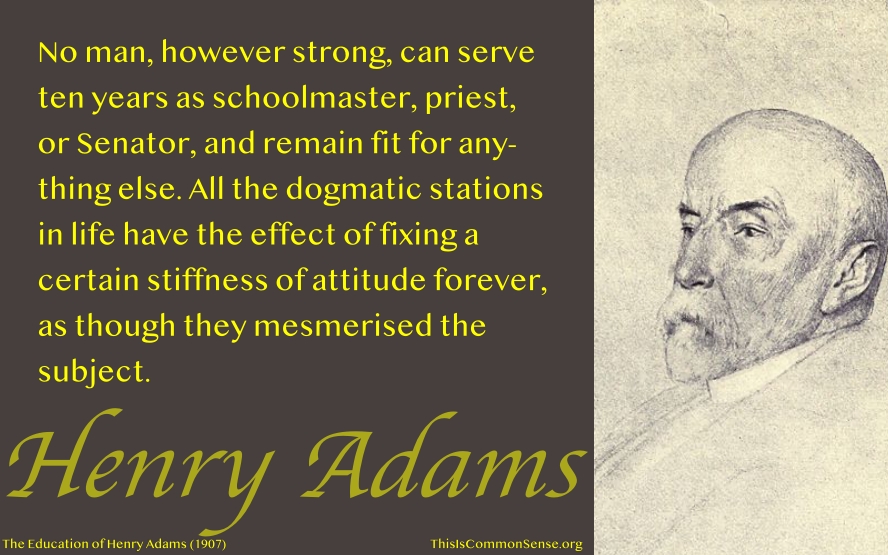
No man, however strong, can serve ten years as schoolmaster, priest, or Senator, and remain fit for anything else. All the dogmatic stations in life have the effect of fixing a certain stiffness of attitude forever, as though they mesmerised the subject.

Henry Adams, The Education of Henry Adams (1907), Vol. VII, “Treason.”

Categories
Today

U. S. Military Zones

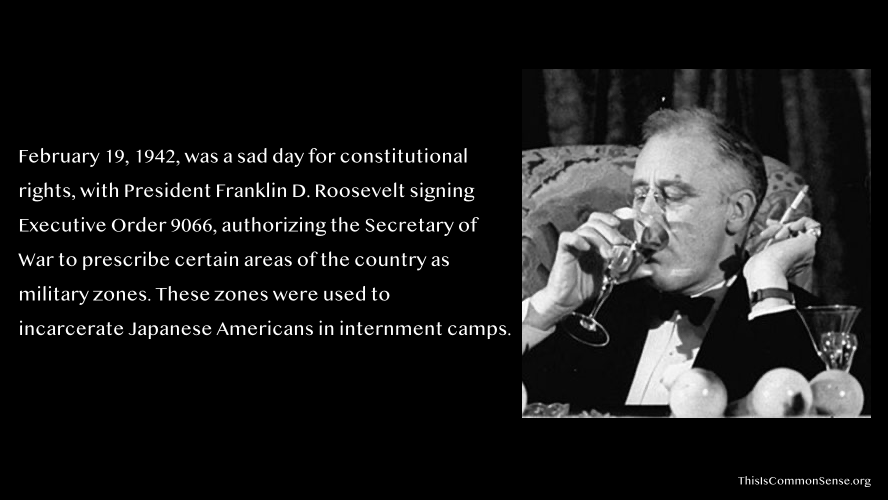
February 19, 1942, was a sad day for constitutional rights, with President Franklin D. Roosevelt signing Executive Order 9066, authorizing the Secretary of War to prescribe certain areas of the country as military zones. These zones were used to incarcerate Japanese Americans in internment camps.

Categories
First Amendment rights media and media people too much government

The Chirping Mockingbird

We are told that “there’s nothing to see” in the recent revelations about how USAID was subsidizing Politico

At Reason, Robby Soave pooh-poohed the story: “some critics of USAID have seized on a misleading claim: Namely, that the organization was funneling millions of dollars to Politico. In reality, it appears that government agents were paying for subscriptions to Politico‘s premium product. That may or may not be a worthwhile use of government funds (more on this in a moment), but at any rate, it does not represent some kind of direct subsidy to the news outlet.”

It could be, however, a subsidy with plausible deniability. 

The keyword may be: Mockingbird.

Remember the Church Committee investigations into the intel community, post-Nixon? One of the revelations was of Operation Mockingbird, which was (“allegedly”) the CIA training and subsidizing of — and coordinating stories to — scores (perhaps hundreds) of individual journalists. 

One of the many things we don’t know about Mockingbird is if it ever ended. But one thing we do know is that programs begun by one agency not irregularly get taken up by others.

And speaking of multiple agencies — with more than a dozen dedicated to intelligence, why is government paying the private sector for information?

For all their massive appropriations, the basic job of intel agencies to inform (not lie to) representatives, government executives, and functionaries appears to be one they’ve skimped on.

Meanwhile, USAID’s massive subsidies to New Zealand news outfits has somehow received little interest. “Last week, Wikileaks reported that 25 NZ mainstream media outlets were given funding from USAID,” explains The Daily Blog. “We need an immediate explanation from our Mainstream Media Owners if they changed any editorial stance that aligned us with America while taking this money.”

Inquiring minds should be skeptical of underplaying of these revelations. Don’t we need a wall of separation between press and state?

This is Common Sense. I’m Paul Jacob.


PDF for printing

Illustration created with Flux and Firefly

See all recent commentary
(simplified and organized)
See recent popular posts

Categories
Thought

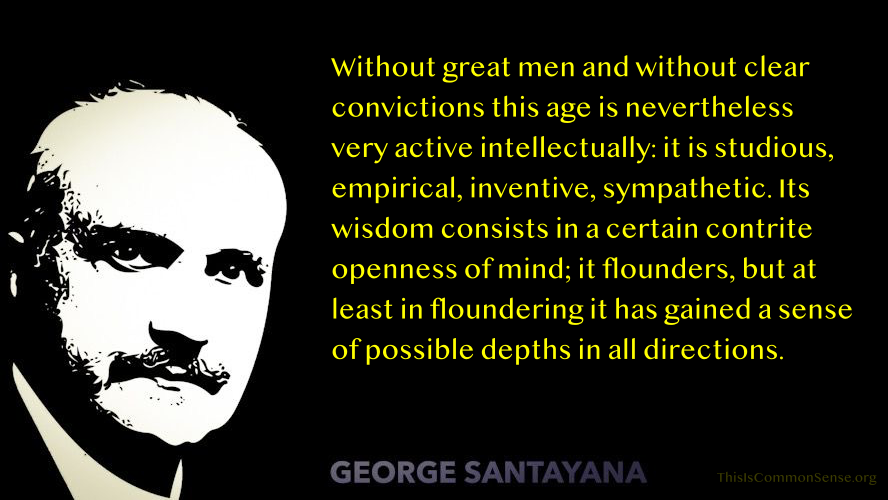
George Santayana

Without great men and without clear convictions this age is nevertheless very active intellectually: it is studious, empirical, inventive, sympathetic. Its wisdom consists in a certain contrite openness of mind; it flounders, but at least in floundering it has gained a sense of possible depths in all directions.

George Santayana, as quoted in Why We Should Read ——, by S. P. B. Mais (1921).
Categories
Today White Rose

White Rose

On February 18, 1943, Hans and Sophie Scholl, a brother and sister, were arrested at the University of Munich for secretly (or not so secretly) putting out leaflets calling on Germans to revolt against Adolf Hitler and the Nazi regime.

In the previous year Hans had founded a group of students, who called themselves “The White Rose.” The group wrote and distributed six leaflets aimed at educated Germans. The leaflets made their way across Germany and to several other occupied countries. The Allies later dropped them all over the Third Reich.