On November 15, 1777, after 16 months of debate, the Continental Congress approved the Articles of Confederation.
Categories
The Articles
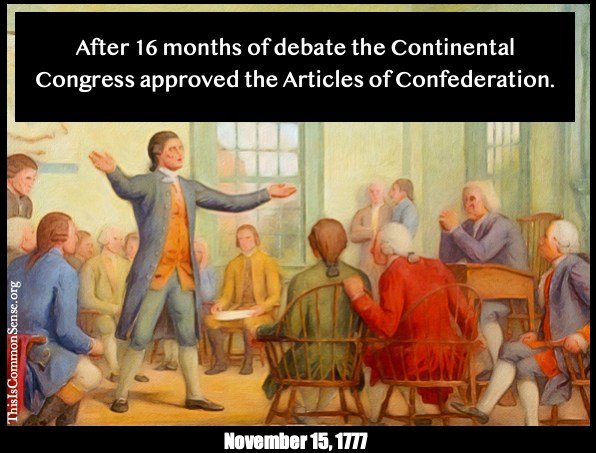
On November 15, 1777, after 16 months of debate, the Continental Congress approved the Articles of Confederation.

The wit and wisdom of
and others, all serving as grist for Paul Jacob’s commonsense mill — er, view — of the world. And a lot more, too, on Rumble, the latest podcast from Paul Jacob.
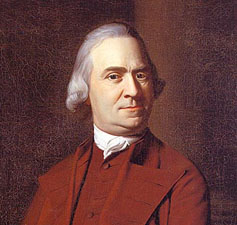
On November 2, 1772, Samuel Adams (pictured) and Joseph Warren formed the first Committee of Correspondence, which were instrumental in preparing the colonies from their 1776 breakaway from the British Empire of George III.
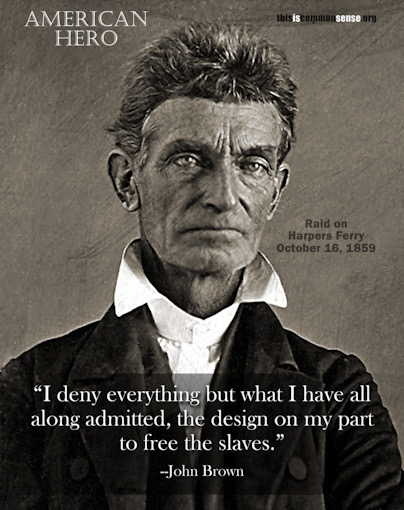
On this day in 1859, abolitionist John Brown led a group of 21 men — 14 white, seven black — on a raid of the federal armory at Harpers Ferry, Virginia (then; since 1863, West Virginia), to capture weapons and initiate a slave revolt in southern states.
Brown’s forces initially captured the armory, which had only one guard on duty that night, but the expected uprising did not occur. Soon the raiders were blocked from any escape by townspeople and local militiamen and then overwhelmed by federal troops sent into the town (commanded by Colonel Robert E. Lee, who would later lead the Confederate armies).
Ten of Brown’s men were killed during the incident; seven were captured, tried, convicted and executed, including John Brown; and five escaped. Two enslaved African-Americans joined Brown’s cause and also died in the fighting. Battling against Brown’s raiders, a Marine and four townspeople lost their lives, including the town’s mayor and a free African-American.
Though the raid on Harpers Ferry was a failure, it set the union on the road to disunion, war, and the end of slavery.
“John Brown began the war that ended American slavery and made this a free Republic,” Frederick Douglass would write in remembrance of this event. “Until this blow was struck, the prospect for freedom was dim, shadowy and uncertain. The irrepressible conflict was one of words, votes and compromises. When John Brown stretched forth his arm the sky was cleared. The time for compromises was gone — the armed hosts of freedom stood face to face over the chasm of a broken Union — and the clash of arms was at hand.”
Print out a commemorative poster:

Congressman Jim Banks is rebuking Microsoft for censoring its LinkedIn account holders who criticize the Chinese government.
This includes users in the United States.
“LinkedIn is pressuring U.S. citizens to remove posts critical of China’s dictatorship because, apparently, ‘regional laws’ compel them to do Xi’s bidding,” Banks tells the Washington Examiner. “That’s a lie. LinkedIn is simply selling out America’s values and national security in order to boost its bottom line.”
The congressman has written to the company, which connects job seekers to job providers.
He demands answers about how LinkedIn cooperates with Chinese censorship.
His allies include Carl Szabo, VP of a trade group called NetChoice. Szabo says that American tech firms “should actively push back on such [censorship] demands. China suppressing the profiles of American users should not be happening.”
Microsoft has a history of aiding and abetting the Chinese Communist Party, Chinazi Party for short.
Although Google withdrew its search engine from China in 2010 rather than (continue to) help China censor search results, the Bing search engine currently operates in China. And you can’t be a search engine in China without helping the CCP to censor.
Microsoft has even provided facial recognition resources used to track the Uyghurs, a Muslim population that the Chinese government has subjected to mass incarceration and torture.
A few years ago Microsoft apparently retreated on that facial-recognition front. But it shouldn’t be doing anything to help the Chinazi government to censor and repress.
Nobody should.
This is Common Sense. I’m Paul Jacob.
See all recent commentary
(simplified and organized)
See recent popular posts
“This will light up the right.”
So Rollcall, the Capitol Hill newspaper, quoted an unnamed Republican aide.
At issue? Last week’s Senate Armed Services Committee vote to force young women to register for the military draft. That provision is contained in the gargantuan National Defense Authorization Act (NDAA).
Only five senators voted against mandating draft registration for women — all Republicans.
Two hawks, Senators Tom Cotton (R-Ark.) and Josh Hawley (R-Mo.), so opposed the change that they joined the beer-swilling Sen. Elizabeth Warren (D-Mass.) in voting against the overall NDAA.
“Our military has welcomed women for decades and are stronger for it,” Cotton explained on Friday. “But America’s daughters shouldn’t be drafted against their will.”
“It’s one thing to allow American women to choose this service, but it’s quite another to force it upon our daughters, sisters, and wives,” said Sen. Hawley, adding “compelling women to fight our wars is wrong.”
As is conscripting men.
This Wednesday, the issue will come before the House Armed Services Military Personnel Subcommittee, chaired by Rep. Jackie Speier (D-Calif.). “I actually think if we want equality in this country . . .” Speier has argued, “we should be willing to support a universal conscription.”
Speier’s empty homage to “equality” does nothing for women, of course . . . or national defense.
“It’s time to end military draft registration altogether,” tweeted Rep. Peter DeFazio (D-Ore.), “not extend it.” He joined a bipartisan group — Rep. Rodney Davis (R-Ill.) and Sens. Rand Paul (R-Ky.) and Ron Wyden (D-Ore.) — in a letter calling draft registration “expensive, wasteful, outdated, punitive, and unnecessary” and urging support for their legislation to end it.
Finally, some common sense.
I’m Paul Jacob.
See all recent commentary
(simplified and organized)
See recent popular posts
1 — Draft the Congress and Leave My Kids Alone (December 28, 2003)
2 — Americans Gung-Ho to Draft Congress (January 4, 2004)
3 — Public Comment at the National Commission on Military, National, and Public Service (April 25, 2019)
Overview — https://thisiscommonsense.org/2019/01/01/paul-jacob-on-the-draft/

Sometimes the only way to make your point is to keep repeating yourself. So it is when explaining why the law requires educational institutions that receive federal funding, like Ward Melville High School, to allow clubs such as the one formed by17-year-old student John Raney in 2013.
 Students United in Faith meets to discuss faith and to plan charitable endeavors. Last year, Ward Melville officials sought to ban the club because of its religious character, but retreated after getting a letter from the Liberty Institute (dedicated to “restoring religious liberty in America”).
Near the beginning of this academic year, the school again moved to ban the club. Again, Liberty Institute intervened, threatening a lawsuit. Again, the school backed off.
If it were a private school, say, Atheist High, the school would well be within its rights to say “don’t come here unless you are willing to forgo any religious club.” Those hypothetical school officials wouldn’t be violating anyone’s rights.
But a public school funded by taxpayer dollars? Well, if it provides for extracurricular activities like clubs, it is acting as a part of the government to violate the right of freedom of association when it arbitrarily bans a club.
So what’s next? Either the administrators at Ward Melville High will keep trying the ban until they can get away with it; or, having finally learned their lesson, they’ll leave the group alone.
Thank goodness students and parents have the Liberty Institute in their corner.
This is Common Sense. I’m Paul Jacob.
Sen. Mark Pryor (D-Ark.) faces a tough re-election contest. Following his campaign, MSNBC’s Kasie Hunt inquired: “Do you think the Obama Administration has done an appropriate job handling the Ebola crisis?”
The senator responded with the universal politician distress call: “Uuuhhhhmmmmmm.”

Then Pryor stumbled ahead: “I would say that . . . it’s hard to know, ah, because, um . . . I haven’t heard the latest briefing on that to know all . . . [inaudible] can somehow read the paper and all. My impression is that we have people over there both from CDC and other medical-type people and even some engineers to try to build . . . um, you know, medical facilities. That’s what they need over there; they need the medical infrastructure.”
When Hunt asked whether the Administration had been “aggressive enough,” the senator returned to: “Uuhhhmmmmm. Again, I’d have to see the latest numbers.”
“Oh my god,” uber-liberal host Mika Brzezinski reacted to Pryor’s stumbling. “She asked a gentle question . . . and the guy just collapsed.”
“What was that, Kasie?” laughed Joe Scarborough. “Why were those questions so hard for the senator to answer?”
“I was a little surprised . . .” Kasie chuckled, noting that Sen. Pryor had earlier run a ludicrous TV spot accusing his Republican opponent, U.S. Rep. Tom Cotton, of voting “against preparing America for pandemics like Ebola.”
One might think the incumbent senator actually followed and cared about the effort to combat a horrible disease that could kill untold people. Instead, it appears he knows Ebola only as a brickbat with which to slug a political opponent in hopes of staying in power.
This is Common Sense. I’m Paul Jacob.
A man at a forum asks the operative question.
Michigan’s ban on racial and gender preferences, upheld this week by the SCOTUS, was passed by voters in 2006 through a citizen initiative led by Jennifer Gratz, now leading the XIV Foundation, and Leon Drolet, a former state legislator and activist. Ten years before that, Ward Connerly led a similar initiative petition effort in California, which is specifically addressed in the video.