Categories
general freedom Voting

Dis Democracy?

Starting the new year and awaiting a new administration, do we deserve to ‘get it good and hard’?

In the winter issue of Cato Institute’s Regulation, economist Pierre Lemieux acknowledges H.L. Mencken’s famous line — “Democracy is the theory that the common people know what they want, and deserve to get it good and hard” — and sympathizes with “disappointed voters” following last November’s election.

“The common person does know what he wants,” argues Lemieux, explaining that “he succeeds so well in his private life.”

Of course, our economic marketplace and our political marketplace are markedly different.

“The electoral choices presented to voters are typically a confused mix of unreliable promises and obscure policies,” Lemieux writes. “Contrast that with the clarity and variety of market choices.”

He notes the ways regular folks are being politically disempowered: “The value of lying as an electoral asset seems to be on the rise. The public education system appears to have not had much success in encouraging the quest for truth. And the common people have been infantilized by their own governments …”

Lemieux worries that “when the common person is given the power to decide what his fellow humans should want … things can go very wrong.” 

He’s correct, of course. But it isn’t a problem unique to democracy or the participation of regular folks. When any government has such enormous power over “fellow humans,” yes, things go wrong. Enormously wrong. 

Yet, in democracies, the problem of political tyranny is far less pronounced than in anti-​democratic regimes, and more effectively remedied. Democratic government is messy, woefully imperfect and can lead to awful policies and real tyranny. Still, it lacks a superior alternative.

Until then, give me democracy. 

Good and hard? Preferably good.

This is Common Sense. I’m Paul Jacob.


PDF for printing

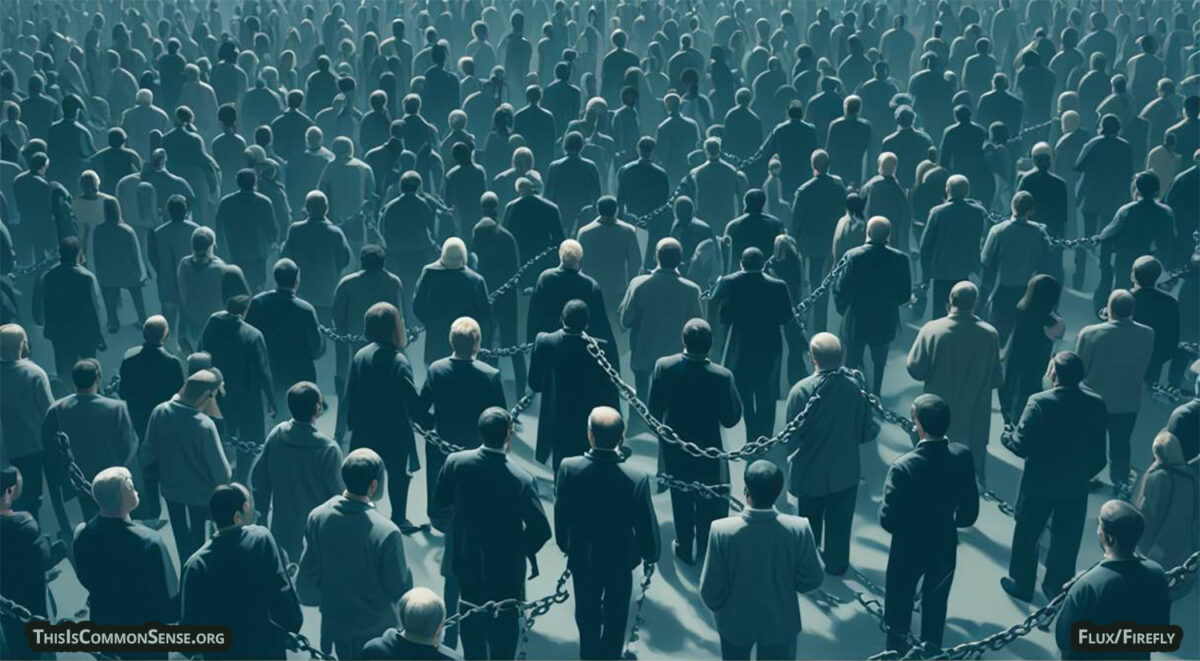
Illustration created with Flux and Firefly

See all recent commentary
(simplified and organized)
See recent popular posts

Categories
Common Sense general freedom

Happy New Year — 2025

“We have it in our power to begin the world over again. A situation, similar to the present, hath not happened since the days of Noah until now. The birthday of a new world is at hand, and a race of men, perhaps as numerous as all Europe contains, are to receive their portion of freedom from the events of a few months. The reflection is awful, and in this point of view, how trifling, how ridiculous, do the little paltry cavilings of a few weak or interested men appear, when weighed against the business of a world.”

—Thomas Paine

Categories
Thought

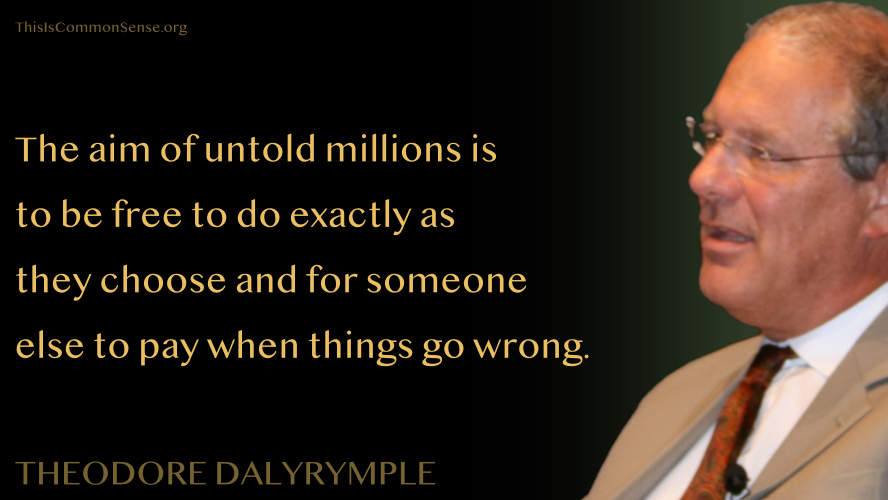
Anthony Daniels

The aim of untold millions is to be free to do exactly as they choose and for someone else to pay when things go wrong.

Anthony Daniels writing as Theodore Dalrymple, Life at the Bottom: The Worldview That Makes the Underclass (2001).
Categories
Today

Blue Marble

On December 7, 1972, Apollo 17 launched, the last of the Apollo Moon missions. Later that day, one of the astronauts — either Ron Evans or Harrison Schmitt — snapped the photo that would later become famous as “The Blue Marble.”

Categories
Today

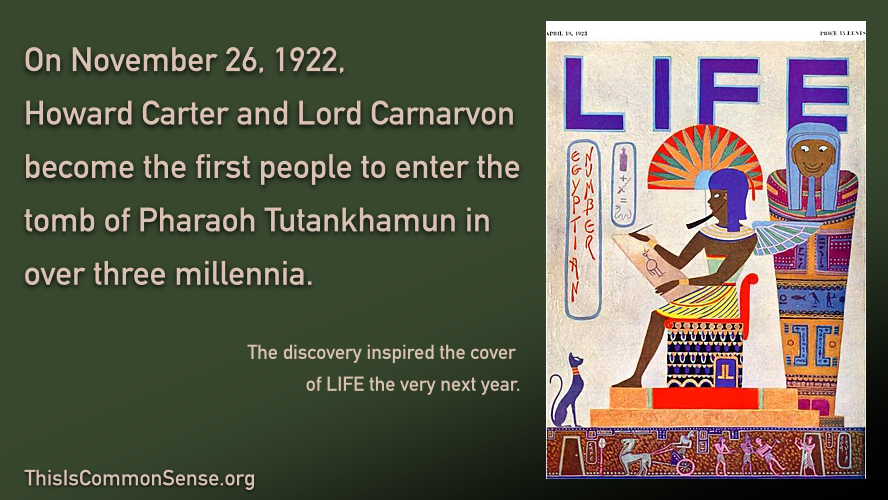
Tut Tut

On November 26, 1922, Howard Carter and Lord Carnarvon become the first people to enter the tomb of Pharaoh Tutankhamun in over 3,000 years.

King Tut, as he is now popularly known, started life as “Tutankhaten.” The future pharaoh’s name references the 18th Dynasty conception of a deity as represented in the sun disk, the monotheistic worship of which was the point of the Atenism of Akhenaten (Amenhotep IV), who reigned when he was a boy. During the reign of Tut, the religious revolution instigated by Akhenaten was overthrown, and the Amenist cult and its priesthood restored to preëminence. Thus the name change referencing another conception of a sun god, Amun.

Tutankhamun (c. 1341 BC – c. 1323 BC) died before age 20 and his burial appears to have been hastily made in the Valley of the Kings. He was succeeded by Ay, and then a general, Horemheb, who tried to erase from the records the “Amarna Period” pharaohs and any mention of the Atenist monotheistic revolution associated with pharaohs Akhenaten, Smenkhkare, Tutankhamun, and Ay. The tomb designated KV62 had been left intact, its grave good astounding the world, hence the April 19, 1923, issue of Life, reproduced in the image above.

Categories
Thought

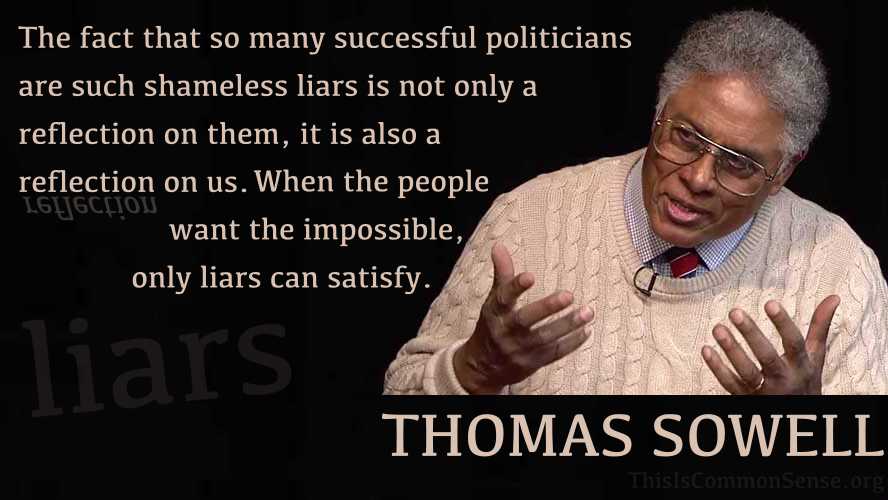
Thomas Sowell

The fact that so many successful politicians are such shameless liars is not only a reflection on them, it is also a reflection on us. When the people want the impossible, only liars can satisfy. 

Thomas Sowell, “Big Lies in Politics” (Townhall, July 31, 2012).

Categories
Today

Ruby Shoots Oswald

On November 24, 1963, Lee Harvey Oswald, the alleged assassin of President John F. Kennedy, was shot and killed by Jack Ruby while in custody. 

Categories
initiative, referendum, and recall

Exemplary Rejections

Lately, Americans have been distracted by a federal-​level election. But we’ve also had important state-​level matters to attend to during the recent election cycle, including some legislatively referred questions about citizen initiative rights.

In my experience, whenever many politicians push for a ballot measure in order to supposedly “fix” an already-​established right of citizen initiative, the goal is usually to make it harder for people to get a question onto the ballot.

Three questions on state ballots this November exemplify the pattern. Fortunately, voters have rejected the sly politicians’ gambit in each case.

In Arizona, Proposition 136 would have let opponents of a ballot question force a doubt about its constitutionality to be adjudicated before the measure can be placed on the ballot. (Nothing prevents a measure from being challenged in court after passage.) Of course, sometimes litigation, whether sincere or not, can’t be entirely resolved before proposed urgent deadlines, like the deadline for submitting signatures to place a question on the ballot.

Arizona voters clobbered Prop 136 with about 64 percent of the vote.

In North Dakota, voters had to again defeat a lawmaker-​referred measure to weaken citizen initiative rights. Among other arbitrary burdens, Measure 2 would have increased the number of signatures required to send a question to ballot.

Voters killed it by about 56 to 44 percent.

Lastly, Colorado’s Amendment K sought to impose an earlier deadline for submitting initiative signatures. This, too, voters declined by about a ten point margin.

Good results. Voters tend to see the elite’s designs and react appropriately.

This is Common Sense. I’m Paul Jacob.


PDF for printing

Illustration created with Midjourney and Firefly

See all recent commentary
(simplified and organized)
See recent popular posts
Categories
ideological culture Voting

Don’t Kill Yourself

As Donald Trump appeared to be winning last night, the number of Twitterers who proclaimed a hankering or a design to kill themselves rose dramatically. Michael Malice and others found humor in it, but it’s a super-​saddening development, if you ask me.

These Kamala Harris voters are not really going to kill themselves. It is just something to say on Twitter.

I really hope I’m not wrong about this.

I’ll leave to others the counsel of life. That is the job of friends and family and emergency hotline dispatchers. My counsel is different: talking about suicide because your candidate lost is undemocratic. If the authoritarian pronouncements of both major candidates alarmed you about the danger of anti-​democratic trend, this fad should raise the alarm several decibels.

The whole point of democracy is to allow a transition of power sans bloodshed. And that requires both contenders and supporters not to shed each other’s blood … or their own. When they fail.

It’s a requirement. Not to over-react.

The losers have to accept the loss, and the winners have to refrain from using the state to punish the losers further. 

It’s sort of that simple.

Resignation is key, as scientist Lawrence M. Krauss (@LKrauss1) indicated: “Going to bed, reasonably resigned to Trump win at this point as it seemed to me from a distance for some time. He may be a nut, a liar, and a crook, but the bright side is a likely boost free speech and due process at unis and bump in tech sector, if we survive the rest.”

We will survive. If Trump wins the Electoral Vote (I’m going to bed, too, before a final determination), or if Harris does.

This is Common Sense. I’m Paul Jacob.


PDF for printing

Illustration created with Midjourney

See all recent commentary
(simplified and organized)
See recent popular posts

Categories
defense & war international affairs

The Beam in Microsoft’s Eye

Microsoft has just published a pretty good update on the cyber-​threat landscape, Digital Defense Report 2024

The report comprehensively describes the recent prolific activity of state-​affiliated hackers all over the world, primarily those affiliated with China, Iran, North Korea, and Russia.

In the case of China, we have a series of “Typhoon”-named cyberattacks: Raspberry Typhoon, Flax Typhoon, and Granite Typhoon, to name a few, that “have intensively targeted entities associated with IT, military, and government interests around the South China Sea.”

The toll of cyberattacks in the U.S. — all kinds from all sources — has been extensive. In the recent year, “389 healthcare institutions were successfully hit by ransomware,” resulting in closures and medical delays.

The report is also about what we’ve been doing to defend ourselves: not enough. The authors say that although better cybersecurity is important, we also need “government action” that makes it costlier for states to launch these attacks.

We need something else, too. We need companies like Microsoft to abstain from helping adversary states to cyberattack us.

At Breitbart, Lucas Nolan reports that Microsoft has been maintaining close ties with the Chinese Academy of Sciences for over a decade. Among the details of a lengthy indictment, Nolan offers a list of publications coauthored by Microsoft and CAS researchers “in the fields of artificial intelligence, machine learning, data mining, computer vision, and even cybersecurity.”

Why help China gain knowledge that can be used to hurt us?

This is Common Sense. I’m Paul Jacob.


PDF for printing

Illustration created with Midjourney and Firefly

See all recent commentary
(simplified and organized)
See recent popular posts