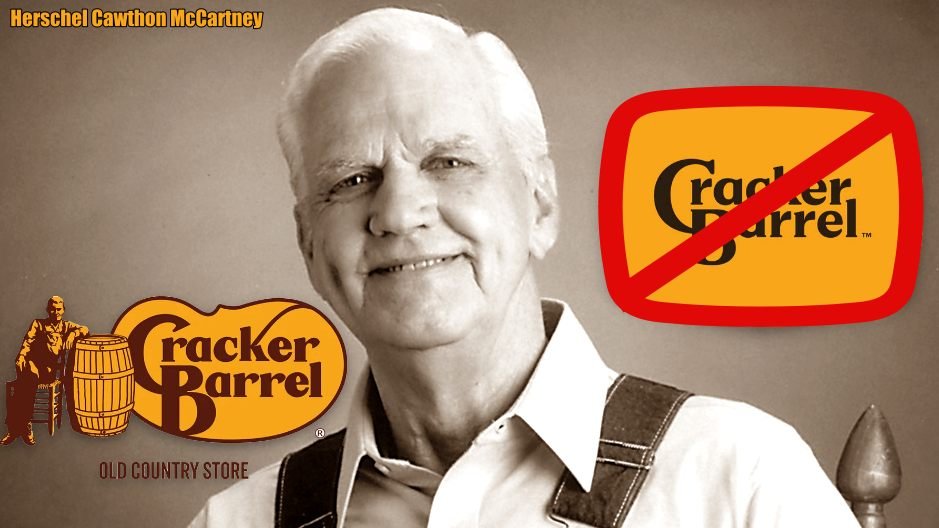
On Wednesday, Paul Jacob discussed the cultural erasure involved in the Cracker Barrel re-branding effort. One of the curious elements to the story is that previous icon branding erasures all focused on what might be called “icons of color,” Paul mentioning Aunt Jemima, Uncle Ben, and Mia the Land O’Lakes maiden. All gone now. They were “stereotypical” and thus somehow “racist.”
It is pretty obvious, however, that icons must be stereotypical — that is how they succeed as icons!
But this time a white — not to say “cracker” — icon was slated for erasure.
First they came for the icons of color (IoCs) and then for white icons. Why?
Paul suggested that cultural erasure may be the real point. A people without history or shared culture are easier to rule. Orwell was not alone to teach us that.
Thankfully, the issue was explored humorously by The Babylon Bee:
And even more thankfully, Uncle Herschel was spared, remaining on the logo.
“Define woke as erasure in the name of non-erasure,” Paul suggested. The Cracker Barrel erasure attempt wasn’t woke, obviously. It was a misguided erasure for the sake of modernization, of trying to … what?
The general trend in corporate (and perhaps the general) culture is to dispense with the past and its associations. As if that is the way to make money.
The announcement of the new logo on August 19, 2025, led to a significant drop in Cracker Barrel’s stock, shares falling over 12 percent in two days, and an additional 7 points by the 26th. After the reversal, the stock recovered quickly — the title at The Street was “Cracker Barrel Hasn’t Gone Woke Nor Has It Gone Broke.”
Branding experts were generally negative on the whole fiasco.
Cultural critics were all over the map. The Atlantic’s critique argued that Cracker Barrel’s brand has always been a “simulacrum of rural life” rather than authentic Americana — obvious enough. The backlash was misguided, the piece went on, because the corporate chain was founded to sell gas along highways, contributing to the erosion of genuine local culture by replacing it with a homogenized, nostalgic aesthetic; the new logo’s blandness was not “woke” but a continuation of this corporate sanding-down of regional identity. That doesn’t seem quite right, though. The earlier corporate branding served to entice rural Americans away from authenticity, sure, but with an appeal to traditional Americana style. The rebranding betrayed that, and if Americans objected, in a culture war way, they had a point.
But it wasn’t woke, true. It was too cynical and stupid for that.
Most of the critiques from the intelligentsia, including Paul’s foil David French, regarded the “political” reactions as “overdone” and “exaggerated.” But that is hardly up for them to decide. If consumers feel betrayed, their outrage is surely more sincere than the critics’ sniping.
Meanwhile, it might surprise most readers to learn that “Uncle Herschel” was an actual person with an actual connection to the company: Herschel Cawthon McCartney, uncle of Cracker Barrel’s founder, Dan Evins.