Categories
crime and punishment defense & war U.S. Constitution

Gunboat Anti-Diplomacy

A boat in international waters off the coast of Venezuela was blown up by the U.S. military, on President Donald Trump’s proud authorization. 

It was not universally praised.

“The controversy erupted on Saturday when Vance wrote on the social platform X,” Sabina Eaton reports, quoting the vice president: “’Killing cartel members who poison our fellow citizens is the highest and best use of our military,’ referencing the September 2 military strike.”

The idea that the “best use” of our armed forces is to destroy — without arrest or declaration of war or even a serious legal case set before world opinion or, for that matter, U.S. opinion — sounds all too modern but not very American.

Does it matter that they were, or merely might have been, “narco-terrorists,” as the president called the eleven people wiped out on the fast-moving boat? Or that Mr. Trump asserted their service to Venezuela’s strongman Maduro — against whom the U.S. has not declared war?

“Sen. Rand Paul all but accused the vice president of celebrating war crimes,” Eli Stokols and Dasha Burns wrote yesterday at Politico. “The Kentucky Republican ripped Vance over the weekend in a social media fight that could offer a preview of future skirmishes between President Donald Trump’s heir apparent and another Republican with 2028 ambitions.”

The Kentucky senator asked, rhetorically, if the vice president had “ever read To Kill a Mockingbird?

“Did he ever wonder what might happen if the accused were immediately executed without trial or representation??

“What a despicable and thoughtless sentiment it is to glorify killing someone without a trial.”

Rand is right. The use of unlawful or unaccountable power can never advance American interests. Because one of our interests is holding power to account, to the rule of law. 

Thank you for your attention to this matter.

This is Common Sense. I’m Paul Jacob.


PDF for printing

Illustration created with Krea and Firefly

See all recent commentary
(simplified and organized)
See recent popular posts
Categories
general freedom national politics & policies political challengers too much government U.S. Constitution

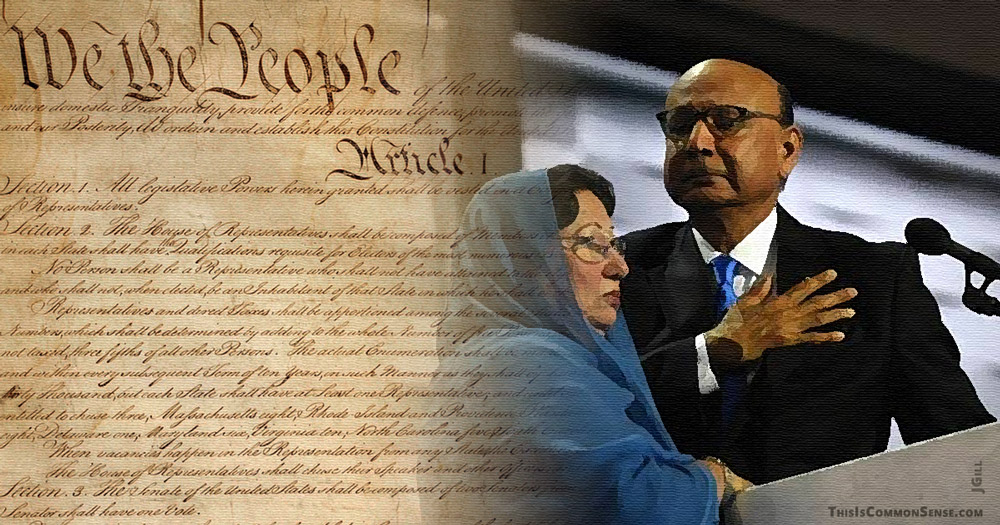
Is That a Constitution in Your Pocket?

“We were blessed to raise our three sons in a nation where they were free to be themselves and follow their dreams.”

Those eloquent words came from the lips of Khizr Khan, the Pakistani immigrant who spoke at the Democratic National Convention last week about losing his son, Capt. Humayun Khan, to a suicide bomber in Iraq.

Describing his family “as patriotic American Muslims with undivided loyalty to our country,” and charging that, “Trump consistently smears the character of Muslims.” Khan asked Donald J. Trump a great question: “Have you even read the U.S. Constitution?”

Then, reaching into his suit pocket, Khan pulled out a copy, adding, “I will gladly lend you my copy.”

Yesterday at Townhall, I declared Khan my Person of the Week. Not just because Mr. Khan is fond of handing out pocket-sized copies of the U.S. Constitution and told the New York Times that his “real hero” is Thomas Jefferson, but because he asked a great question.

Let’s ask all the candidates. That question, for sure, and three additional ones:

  1. Do you favor repealing parts of the First Amendment to allow incumbent congressmen to regulate their own campaigns and their opponents’ in regard to raising and spending money?
  2. In the Heller case, the Supreme Court ruled that the Second Amendment provides individuals a “right to bear arms” — will you appoint justices who agree or disagree with Heller?
  3. As president, will you issue an executive order instructing all federal agencies and police agents to cease any use of civil asset forfeiture?

I’ve got more questions. I bet you do, too.

This is Common Sense. I’m Paul Jacob.


Printable PDF

Khizr Khan, Pakistan, Democrat, convention, Democratic, Donald Trump, illustration


Categories
U.S. Constitution

Meet the Moots

The meaning of institutions, like words, changes over time.

Take Congress. The Constitution hands legislative power to the two houses of Congress. With the growth of government Congress has delegated more and more of its powers to the executive branch.

In a recent column, George F. Will identified the most recent “development” of this trend. Will’s example is the automaker bailout. Congress did not authorize it: The package failed in the Senate. But President Bush simply took money from another bailout bill and dumped it at the failing automobile manufacturers.

Even if you think the bailout is good policy, the president should be censured. “With the automakers,” Will writes, “executive branch overreaching now extends to the essence of domestic policy — spending. . . .

George Will’s Washington Post column is titled “Making Congress Moot.” Droll, that. “Moot” is an ancient term for a deliberative body. Philologist and fantasist J.R.R. Tolkien used it to designate his congress of “treeherders.” Remember “entmoot”?

The phrase “moot point” used to mean “open to debate.” It now usually means “an issue raised whose determination cannot have any practical effect.”

Congress has gone from an august, important deliberative body — a moot — to a mere debating society. As the meaning of the word “moot” has decayed, so too has Congress.

Think of 535 moot points.

This is Common Sense. I’m Paul Jacob.