Categories
Common Sense free trade & free markets general freedom initiative, referendum, and recall U.S. Constitution

Compatriots, We — For Liberty!

Thank you. It’s Thanksgiving, a good day to say so.

What a great idea for a holiday — a thoroughly American one, unpretentious and unspoiled. Centered on family and friends, the day may be the most important of the year, something we all share, in no small part because it is when we count (and publicly acknowledge) our blessings.

First on the list?

The blessing of liberty, of course. The freedom to work and produce and to keep the fruits of your labor. In order to put food on the table (a LOT of GOOD food.)

And, because man does not live by bread alone, to do it your way, independently, by the sweat of your own brow and the work of your wits — not as any man’s slave, nor riding anyone’s back . . . including the taxpayer.

Thanksgiving thus serves to celebrate that quintessential American Dream: standing on one’s own two feet . . . with friends, family, and freedom.

I have a further reason to thank you, though, other than this date on the calendar.
And no, it’s not simply for reading Common Sense and allowing me to bring you heaping helpings of honest outrage, and resolve, stories of perseverance, commitment to principle, tales of “doing something about it,” offering a bit of humor, hopefully providing some good information and argumentative ammunition, a perspective on smart grassroots politics in this state or that, a lens on corrupt politicians and their latest schemes in a city or town all the way across the country.

I’m thanking you for something even more important.

Don’t get me wrong. Common Sense is important. I love riffing on the latest insanity, or success — especially presenting stories that can spur copy-cat campaigns, initiatives, legal actions and, in a word, ACTION.

Imitation is the sincerest form of flattery, after all.

You and I: we’re the folks taking responsibility for the future of freedom. We’re committed to doing the hard work of political reform.

Right?

It ain’t easy. We need to support each other, learn from one another, and work together — even when we are many miles apart. We have to build a smarter, more united pro-liberty community.

That’s why I write Common Sense.

To communicate with you . . . and other important individuals. All of us hanging together — and not “hanging separately,” as old Ben Franklin once quipped — because our efforts are absolutely essential to protecting the values of freedom, responsibility and independence.

Friend, we pay our dues (and more) — for otherwise your children and grandchildren, and mine, will face a world without what we hold so dear.

I started Liberty Initiative Fund to help citizen activists place tax limits, term limits, criminal justice reforms, and other pro-liberty and anti-crony measures on state and local ballots. I also serve as president of Citizens in Charge Foundation, which protects our crucial ability to use the citizen initiative and referendum process to hold government accountable.

Thankfully, Citizens in Charge Foundation financially supports Common Sense, allowing my compatriots to make tax-deductible contributions to keep this communication network alive and kicking.

Of course, it all comes down to you. This program, this Common Sense network doesn’t exist without your caring and support.

You know, I adore the Constitution and the Bill of Rights. As I know you do, too. But words on paper don’t keep us free unless there are people, like you and me, standing up for those words.

Stand with me again today and support Common Sense by joining Team 1776.

What’s “Team 1776”? It’s a group of folks like you who believe in the values of liberty and in building a network around those values through this communication vehicle. Members of Team 1776 care enough to provide our financial foundation by making a one-time gift of $1,776. Or they donate more. Or less. Whatever they can afford to give.

Many join Team 1776 with a monthly pledge of $17.76, which doesn’t hit the checkbook so hard (less than 60-cents a day), but adds up big-time for Common Sense — especially with more people stepping up to make that commitment.

Between today and the end of the year, I need to raise $30,000 to keep the Common Sense coming. I hope you have a great Thanksgiving Day and that you’ll claim this Common Sense program as one of your blessings.

Thanks for all you do and for your consideration now.

This is Common Sense. You make it possible. I’m Paul Jacob . . . and mighty grateful.


P.S. Your gift to Citizens in Charge Foundation for Common Sense is fully tax-deductible and 100 percent will go to the support and expansion of this program. Be part of Team 1776 by making a contribution or a monthly pledge today. Click here to make a donation by credit card. If you prefer to mail a check, please write “Team 1776” in the memo line.

P.P.S. My rough draft of this letter was titled, “Hey Comrades — Send Money!” I chuckled. My Web guy chuckled. But “comrades” is a commie word. We’re not even socialists, right? Sociable individualists, I like to think of us. Patriotic Americans. Compatriots. The word “compatriot” means both fellow countryman and colleague. And most of my readers (though certainly not all) are Americans like me, and almost all of you are colleagues (“comrades” without the bad connotations) in an important cause, a cause that must triumph. So this may be a better way to think of us: Compatriots for Freedom! Let’s make an impact . . . by saving civilization.

P.P.P.S. Thanks again. Happy Turkey Day!

Printable PDF


Categories
Common Sense general freedom

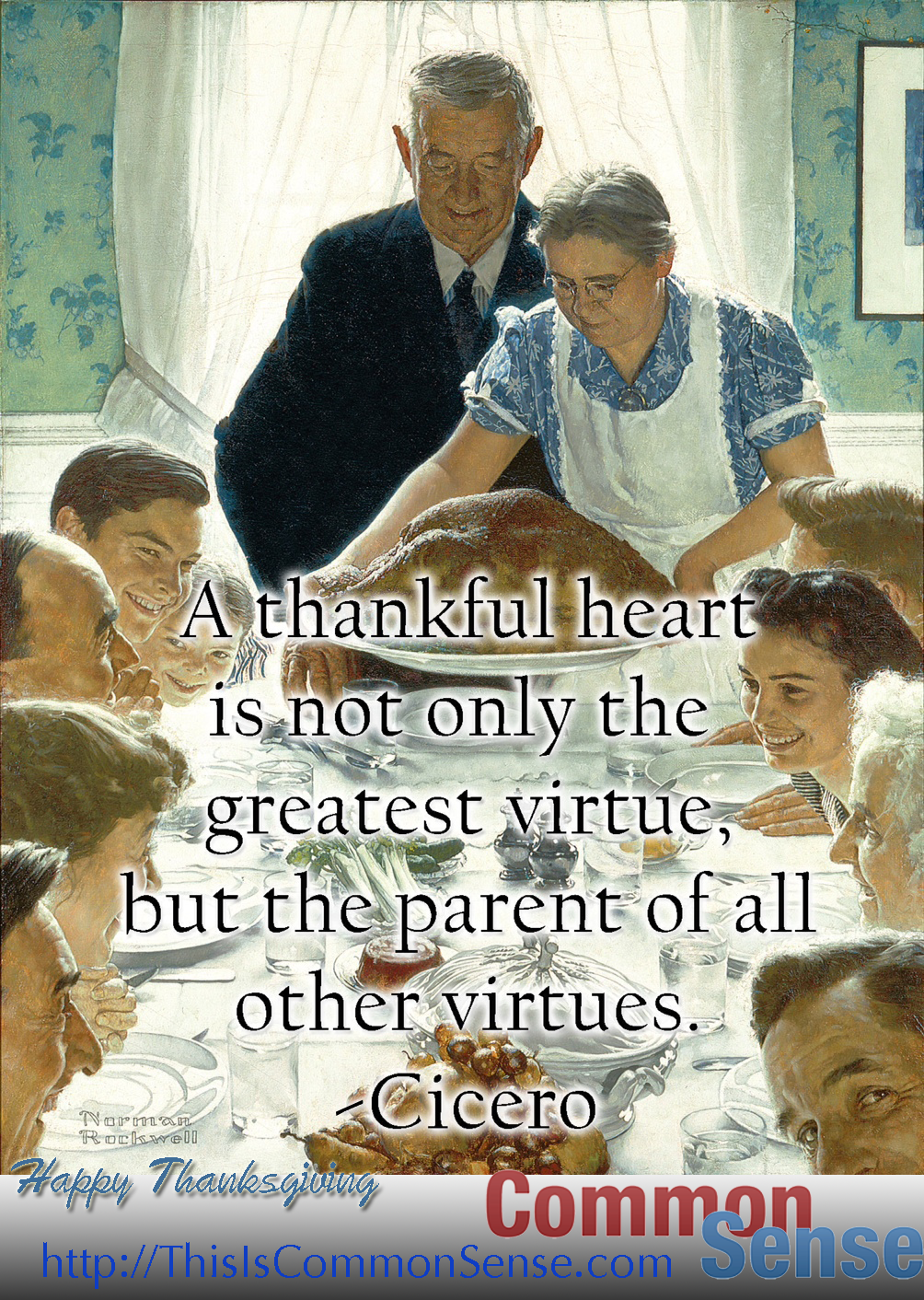
Happy Thanksgiving, 2014

Norman Rockwell and Cicero on Thanksgiving

And thank you for your continuing interest and support.

This is Common Sense. I’m Paul Jacob.

Categories
Common Sense general freedom ideological culture

Thankful for Tomorrow

Tomorrow will be a day of Thanksgiving, a wonderfully unpretentious holiday in a terribly pretentious time.

Thanksgiving is a national celebration about simply having enough food to eat and about eating it together . . . and recognizing, at least for a moment, how great that is.

The “dining together” part is so important that enormous controversy has erupted in recent years as retailers jump the next day’s usual start of the Christmas season, “Black Friday,” by daring to open up on Thanksgiving Day itself. Many complain that stores are frustrating the feast by “forcing” their workers to work.

Last year, I made the point that families truly committed to eating a meal together could find a way to do so, and that workers are not “forced to work,” but actually enjoy a meaningful degree of freedom in when they work. And I remember being very grateful for the opportunity to earn a living by working on a holiday.

In fact, the abundance on our Thanksgiving tables every year is only possible through the freedom to work and produce and trade with each other. This American holiday is also about giving thanks for that freedom.

Freedom has, like it or not, led to long lines of eager customers waiting for those retail doors to open. I’m no big fan of shopping, but more power to those who are.

Still, freedom has also led to a full-throated public discussion — and backlash. A New York Post article credits social media with mobilizing public sentiment against stores opening on the holiday and causing some stores to roll back their hours.

Brian Rich runs Boycott Black Thursday, a Facebook page with over 100,000 likes. “We are not anti-capitalism,” says the Idahoan, who suggests shoppers spend to their hearts’ content on Friday, but celebrate “a good old-fashioned holiday at home” on Thursday.

I’m thankful stores can open if they wish and that customers have money to trade for products they want. And I’m mighty glad that we don’t have to shop if we don’t want to and that we can speak out freely against stores opening and in favor of folks spending more time with loved ones.

On Thursday, I’m grateful for all those in my family and my wife’s with whom I’ll get to break bread. On Friday, well, my youngest daughter will get me up way too early to take her shopping.

And, doggone it, as painful as it is: I’m thankful for that, too.

This is Common Sense. I’m Paul Jacob.


Categories
ideological culture

Give Thanks for First-World Problems

Thanksgiving is my favorite holiday. It’s simple and unpretentious — a good meal and time spent with loved ones, remembering to count our blessings.

This Thanksgiving, however, has spurred a social media maelstrom over stores opening for business on what George Washington declared in 1789 to be “a DAY OF PUBLIC THANKSGIVING and PRAYER.”

Stores have been open on Thanksgiving for years, of course, without any tear in the space-time continuum, but they’re opening even earlier this year.

Much of the “controversy” is being ginned up by professional Walmart haters, who incessantly complain that the world’s largest private employer pays wages and provides benefits so low that . . . well, arguably only these same complainers offer workers less.

A post at the Daily Kos argues that, “workers shouldn’t have to rely on having an especially good boss to get to spend Thanksgiving with their families.”

Matt Walsh writes on his blog that “a holiday created by our ancestors as an occasion to give thanks for what they had, now morphs into a frenzied consumerist ritual where we descend upon shopping malls to accumulate more things we don’t need.”

New York Post columnist Nicole Gelinas sounds alarm bells that workers required to make time-and-a-half or double-time for clocking in today are being “cut off from fully celebrating America’s all-race, all-religion family holiday.”

But she adds, “It’s shoppers, not the government, who should force stores to close.”

She’s right there. Everyone has a right to boycott stores for opening on Thanksgiving. But the government should butt out entirely.

Still, since this day is all about giving thanks, wouldn’t having a job be something for which to be thankful? In fact, someone needing extra money to fund their family’s needs might even see working today as an opportunity.

It is possible to give thanks on a day other than Thanksgiving. Some might say that every day in America provides an occasion for offering thanks.

This is Common Sense. I’m Paul Jacob.

Categories
general freedom property rights too much government

Plymouth’s Great Reform

Times too tough for much thanksgiving? Some of my readers, surely, are feeling the bracing effects (to put it mildly) of a severe economic slump — a so-called “recession” that I’ve been calling, more simply (and I think more honestly) a “depression” — and all I can say is I have some glimmering of such troubles. Things could definitely be better.

But at Thanksgiving, it might do us good to consult William Bradford’s account of the History of “Plimoth Plantation,” a document that recounts how his fellow Pilgrim settlers established, endured, barely survived, recovered, and eventually thrived in Massachusetts.

By the spring of 1623 — a little over three years after first settlement in Plymouth — things were going badly. Bradford writes of the tragic situation:

[M]any sould away their cloathes and bed coverings; others (so base were they) became servants to [the] Indeans, and would cutt them woode & fetch them water, for a cap full of corne; others fell to plaine stealing, both night & day, from [the] Indeans, of which they greevosly complained. In [the] end, they came to that misery, that some starved & dyed with could & hunger.

The problem? The colony had been engaging in something very like communism.

The experience that was had in this comone course and condition, tried sundrie years, and that amongst godly and sober men, may well evince the vanitie of that conceite of Platos & other ancients, applauded by some of later times; — that [the] taking away of propertie, and bringing in comunitie into a comone wealth, would make them happy and florishing; as if they were wiser then God.

Bradford relates the consequences of common property:

For this comunitie (so farr as it was) was found to breed much confusion & discontent, and retard much imploymet that would have been to their benefite and comforte. For [the] yong-men that were most able and fitte for labour & service did repine that they should spend their time & streingth to worke for other mens wives and children, with out any recompence. The strong, or man of parts, had no more in devission of victails & cloaths, then he that was weake and not able to doe a quarter [the] other could; this was thought injuestice. The aged and graver men to be ranked and equalised in labours, and victails, cloaths, &c., with [the] meaner & yonger sorte, thought it some indignite & disrespect unto them. And for mens wives to be commanded to doe servise for other men, as dresing their meate, washing their cloaths, &c., they deemd it a kind of slaverie, neither could many husbands well brooke it.

Yes, the s-word: Slavery. Common property was mutual slavery.

The solution? The plan for society that Bradford attributed to God. He brooked no pleading that common property didn’t work because of corruption, sin. As he put it, “seeing all men have this corruption in them, God in his wisdome saw another course fiter for them.” The course? I’ll use a word of coined by Robert Poole, one of the founders of Reason magazine: Privatization.

Basically, what the Pilgrims privatized was land, and the fruits thereof, assigning to

every family a parcell of land, according to the proportion of their number for that end, only for present use (but made no devission for inheritance), and ranged all boys & youth under some familie. This had very good success; for it made all hands very industrious, so as much more corne was planted then other waise would have bene by any means [the] Govror any other could use, and saved him a great deall of trouble, and gave farr better contente. The women now wente willingly into [the] feild, and tooke their litle-ons with them to set corne, which before would aledg weaknes, and inabilitie; whom to have compelled would have bene thought great tiranie and oppression.

Thus began the years of bounty in Massachusetts. There’s much more in Bradford’s account worth reading, including the increasingly tragic relations with the native Americans. And, indeed, one learns from reading such first-hand accounts how imperfect a creature is man.

But it is obvious that some systems of property and governance work better than others, and, on the day that our government has set forth as a day of Thanksgiving, it is worth being thankful for living in a land that has upheld — to at least some degree — the system of private property that America’s Pilgrim’s learned to see as God’s “fitter course” for corruptible man.

Times may be tough today. On the bright side, they’ve been tougher. One reason for the progress we have seen — even as we endure a major setback, and perhaps a bigger one to come, as the international financial system implodes — is the system of private property that underlies our personal and economic liberties.

Let’s hope we can recover the best in this tradition.

This is Common Sense. I’m Paul Jacob.

Categories
general freedom

Thank You, Joe Blow

Psychological research has unearthed a completely unsensational truth: Expressing gratitude makes you happier.

What the research shows, I’m told, is that it doesn’t matter to whom one gives thanks. Just expressing it does the trick.

Of course, offering thanks to people you really care about, or who helped you in some extraordinary way, must make some other kind of difference. Still, there’s more than a little sense in being thankful for the people you walk by on the street — and expressing it here:

  • That fellow, the other day? He didn’t mug me. Ah, indifference! It’s better than malevolence.
  • That nice woman with the odd hair, some time back? She gave an encouraging smile when I dropped something. She didn’t have to say anything. I understood: “We all drop things, now and then.” No biggie. A little kindness goes a long way.
  • All the people who took my money and gave me what I wanted in return. Without you, my life would be impoverished. Whether you are selling me fruits or nuts or lattes or bread, I live because you work. And I work, too, to help you live.

In one of my favorite movies, Brazil, the Robert De Niro character encourages our embattled hero with a simple “We’re all in this together.” Actually, much of the time we’re all in this separately. But the connections we make are vitally important, and work remarkably well — for more than our feelings.

Even in tough times.

This is Common Sense. I’m Paul Jacob.

Categories
Common Sense

Thanksgiving 2009

Paul Jacob says “Thank You”

What a difference a year makes. As I sit down to my Thanksgiving Day feast, that’s what I’m thinking.

And I certainly know I have a whole lot to be thankful for.

Let me start by thanking you. For caring about freedom and justice. For your critical support for this Common Sense program and for the Citizens in Charge Foundation — the nation’s only organization with the express purpose of defending the initiative and referendum rights of Americans.

Last year at this time, I still faced Oklahoma Attorney General Drew Edmondson’s politically-motivated persecution. I’ll never forget seeing the fear in the face of my then 9-year old daughter as I left for a trip to Oklahoma. That certainly wasn’t the America we know and love.

This year, as we enjoy Thanksgiving and prepare for the Christmas season, Lillie is wondering which Nintendo DS game she might score from Santa — not about her father being imprisoned 1,000 miles away from home.

As you know, the charges — that had threatened me with ten years in prison and a $25,000 fine —were dismissed many months ago. We won. The court even ordered that the indictment itself be expunged from the record.

Yet, without the good work of so many people, from across the country and across the political spectrum, folks who helped me pay for my legal defense and who roared their disapproval online, on the airwaves, in print and in person to raise public awareness to the story of the Oklahoma-3, the ugly cloud of an indictment would likely still be hanging over our heads.

Oh, sure, we would have ultimately prevailed in court. We were innocent. But with Oklahoma’s Attorney General delaying at every turn, it might have taken several more years to ever get our day in court.

What made the difference? The AG had felt the sting of public attention. Oklahomans — and Americans everywhere — successfully focused their revulsion on him, and against his attack on us and on initiative rights.

Thank you for coming to the rescue. Thanks for helping protect my rights, as well as the rights of Oklahomans — and yours.

This year saw more than freedom and vindication for the Oklahoma-3. We gained a bigger victory, too: Dramatic reform for Oklahoma’s petition process. First, the state’s residency law was struck down in federal court as a violation of the First Amendment. Then, three important bills were passed through the state legislature to open up the nation’s toughest petition process.

For the first time in decades, a legislature enacted real reforms to enable citizens to use the initiative process, instead of passing restrictions designed to cripple its use.

How did it happen?

The prosecution of the Oklahoma 3 certainly galvanized a number of activists. But had there not been aggressive efforts to organize and mobilize supporters, the energy and urgency created by such an outrageous prosecution would have dissipated.

In November of last year, Citizens in Charge Foundation helped Oklahomans for Initiative Rights put on a Saturday forum in Oklahoma City to discuss Oklahoma’s initiative process and ways to reform it. Hoping to fill a meeting room for 35 to 40 people, over 100 people overflowed the room.

We then worked with two legislators, Sen. Randy Brogdon (now running for governor) and Rep. Randy Terrill, to help them propose legislation to (a) increase the time citizens have to gather petitions, (b) reform the process so that challenges to petition language come before and not after all the signatures are collected, and (c) lower the state’s onerous petition requirement.

A number of great Oklahomans and super organizations, most notably Oklahomans for Responsible Government and Oklahomans for Initiative Rights, came together to push these bills. They lobbied day after day in the capitol as well as launching a 70-city tour of the state to mobilize grassroots support.

Not surprising, hard work leads to success. But best of all, our Citizens in Charge campaign has spread far beyond Oklahoma — it’s all across the country.

We helped pass legislation in Virginia to protect petitioners from arbitrary judicial abuse, we worked to form broad-based coalitions in 14 states that in turn were able to stop a number of anti-initiative bills and, just weeks ago, I traveled throughout California to begin organizing groups there. Across the country, we face concerted attacks against the right of citizens to be heard.

The old saying is true: All that is necessary for evil to triumph is for good people to do nothing. Thank you for being a good person doing so much to help put citizens in charge. Where we get organized, when we stand up to fight, we citizens are able to battle back and win against entrenched special interests and power politics.

At Citizens in Charge Foundation, we’re re-doubling our national efforts to organize and mobilize grassroots Americans to protect initiative rights and insure that citizens are in charge. To continue to protect and defend the freedom for which we are so thankful today.

Your support — your contributions and your activism — made this year’s victories possible. On behalf of my family and myself, please accept my deepest appreciation. Have a great Thanksgiving.

Sincerely,

Paul Jacob

PAUL JACOB
President, Citizens in Charge Foundation

P.S. I can’t wait until next year. Let us at ’em! Citizens in Charge Foundation has an aggressive campaign to defend the initiative process across the country and to turn the tide on the politicians and special interests in 2010. They seek to block us from checking government power. But we shall block them — through ballot initiatives and referendums and recalls.  With your continued support, we’ll take names and . . . put citizens back in charge.