Categories
Accountability folly free trade & free markets general freedom initiative, referendum, and recall nannyism national politics & policies property rights responsibility too much government

Minimum Shock

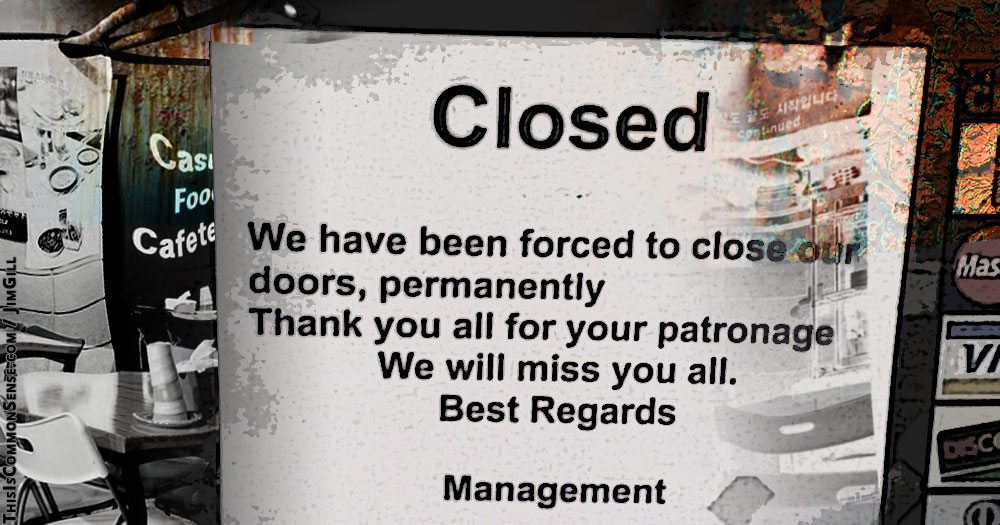
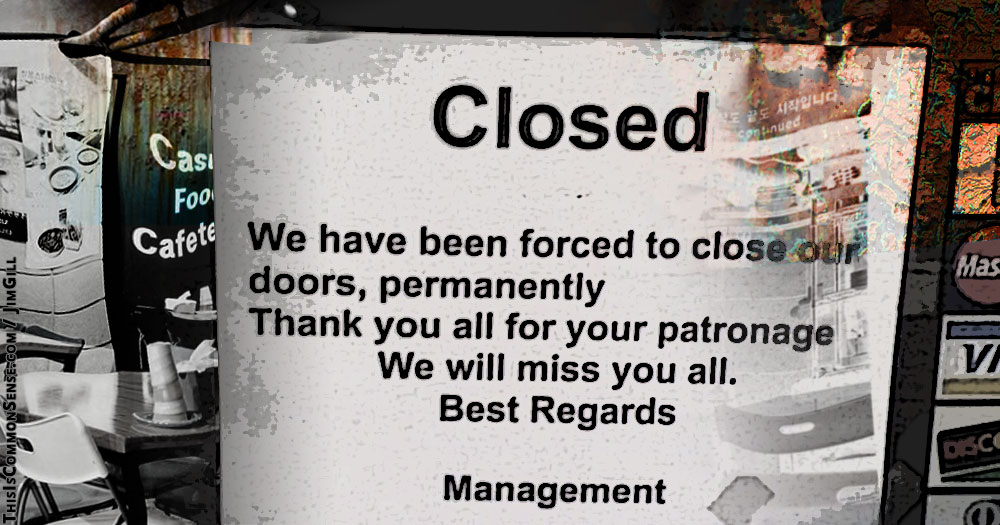
“Three restaurants vacated the Bay this week, with Berkeley’s Bistro Liaison getting the most attention,” the San Francisco edition of Eater informs us. “It’s a bittersweet exit for the owners, who plan to start new careers.”

The week in question was in February. But this was not an isolated event. Sixty-four Bay-area restaurants and fast food joints closed their doors this last winter.

That is a lot of closures.

Why?

Every eatery has a different story, but the entry December 17* provides a big clue: minimum wage hikes.

Citizens should hardly be surprised. They got what they asked for. The minimum wage went up to $13.00 per hour last July, and will go up another two bucks next year. And this was the result of a citizen initiative. “On November 4, 2014, San Francisco voters passed Proposition J, raising the minimum wage to $15.00 by 2018,” the City Office of Labor Standards and Enforcement tells us.

And the thing about minimum wage laws is that they do not — either by magic or by law — directly raise any wages. They, by law and quite directly, prohibit wage contracts below the minimum established.

Businesses then react, struggling to accommodate the newly imposed costs. Sometimes they keep all their employees and economize on other inputs, but often they must re-arrange hours and workers and whole production schemes.

If hemmed in elsewhere, they just go out of business.

Just as one should expect, according to the law of supply and demand.**

Citizens might wish to reconsider. That is, initiate a measure to repeal a previously successful initiative . . . that gave us this unsuccessful policy.

This is Common Sense. I’m Paul Jacob.


* The entry reads thusly: “OAKLAND — alaMar Kitchen and Bar as you know it is shuttering on December 17, but will reopen in the new year with a fast casual format. The owner points to minimum wage raises and the cost of doing business in the Bay Area as the reasons cited for the closure/change.”

** It is often said that businesses just “raise prices” and “pass along the costs” to consumers in general, but, for reasons of supply and demand, they cannot do this without decreasing sales and thus revenue.


Printable PDF


Categories
Common Sense crime and punishment free trade & free markets general freedom judiciary nannyism national politics & policies too much government

Legalize, But Prohibit?

Last week, I warned of marijuana legalization.

Not that I’m against it. But how much will actual freedom be increased?

Note: I’m not bemoaning, as one activist friend argued, that “if you can’t toke up and celebrate in public when it passes, it’s not legalization.”

One cannot now legally smoke tobacco in most public buildings (meaning those open for business as well as government-owned structures) or drink a beer in most public parks or while navigating sidewalks. But you can smoke and drink at home or on certain types of private property.

Ending the drug war and treating newly legalized marijuana pretty much as we treat alcohol and tobacco seems like a long overdo common sense approach.

There’s also the freedom of home cultivation. I have friends who make wine at home, for private consumption. It’s legal; it’s proper. It should also be legal to grow cannabis at home. Yet, many a politician thinks otherwise.

And they are inspired, in a sense, by the popular legalization mantra, “legalize, tax and regulate.” That sends an ominous signal: in order to maximize revenues, politicians see the revenue advantage in forbidding hard-to-tax home cultivation — cultivation that is, let’s face it, a traditional freedom, a right “retained by the people.”

The excuse for this continued prohibition could be “think of the children.” But it’s probably just greed for revenue . . . and the even more hidden enticements of “crony capitalism,” which plagues almost all industry.

You should be able to grow a plant. And self-medicate. These are basic human rights, and the state should work around those.

This is Common Sense. I’m Paul Jacob.


Printable PDF

Pot Pot, legalization, collage, photo-montage, Paul Jacob, Jim Gill


Categories
crime and punishment

Let Jeff Mizanskey Go

Commuting unjust sentences is the least that should be done for convicted non-criminals like Jeff Mizanskey, guilty of peaceful offenses in the War on Drugs. The man’s heinous crime? Abetting a friend’s purchase of marijuana. For this, Mizanskey was sentenced to life without parole — more than 20 years ago.

Because Mizanskey had been caught with pot before, prosecutors designated him a “prior and persistent offender,” and sought the most draconian penalty possible. For not doing anything to anybody.

Repeated appeals of his sentence have availed him naught.

His son Chris and his attorney Tony Nenninger have been asking Missouri Governor Jay Nixon for clemency. In his letter to the governor, Nenninger observes that his client seems to be alone in Missouri in serving a life sentence “for non-violent cannabis-only offenses.”

Nenninger’s appeal for donations is accessible via the website of Show-Me Cannabis, an organization that fights to legalize marijuana in Missouri and elsewhere, and which has been helping to publicize the cause. Show-Me Cannibis explains on its justice-for-Jeff page: “Many prisoners make these applications, and it is rare that a case gets enough of a governor’s attention to be seriously considered. This is why it’s so important you speak out!”

Since I disagree with 1,111 out of every 1,112 Obama policies, perhaps I should note here that one good thing the president has been doing, recently, is using his power more often to commute outrageous sentences. It’s a start.

This is Common Sense. I’m Paul Jacob.

Categories
ideological culture too much government

What’re They Smokin’?

We live in strange times. The “nanny state” mentality is ramping up into overdrive just as the War on Drugs hits the rock of enlightened public opinion.

And nothing shows this to stranger effect than the contrast between the continuing success of the anti-tobacco movement while marijuana liberalization proceeds apace.

As “medical marijuana” and even decriminalized recreational marijuana use seem to be gaining ground, the whole “smoking in public” thing has become more draconian.

For years now, state legislatures and town councils and even voting populations have been cracking down on smoking tobacco in public, despite the very shaky science regarding second-hand smoke.

And now the city council of San Rafael, California, has voted — unanimously — to ban residents of apartments, condos, duplexes, and multi-family houses from smoking cigarettes and other “tobacco products” inside their homes.

This American Cancer Association-approved legislation is quite intrusive. And one of the writers of the law boasted how little it matters to her who owns what property: “It doesn’t matter if its owner-occupied or renter-occupied,” she said. “We didn’t want to discriminate.”

And yet, contrasted with the cannabis liberalization movement — with medical marijuana legal (in some sense) statewide — there is discrimination here: in favor of the “weed” and against the “leaf.”

Perhaps history repeats itself. The war against cannabis began as the war on alcohol ended, with the repeal of the 18th Amendment. We could be we witnessing, now, another weird and inconsistent trade-off of paranoid prohibitions.

This is Common Sense. I’m Paul Jacob.