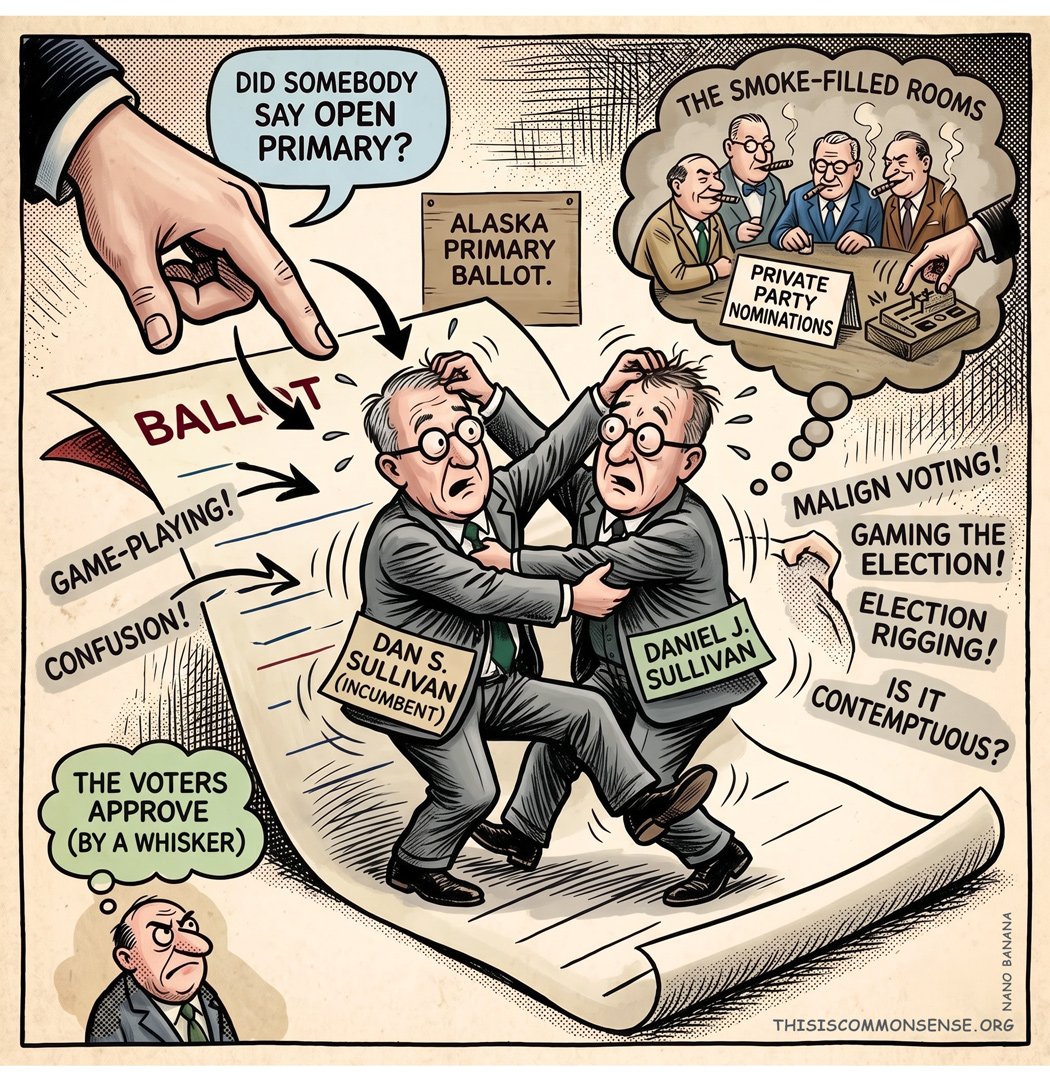
On today’s Alaska primary ballot, U.S. Senator Dan Sullivan, the Republican incumbent, faces an inconvenient challenger in the person of . . . Dan Sullivan.
The president of the United States is not pleased.
“Because of the trickery in the Voting, the Crooked, Radical Left Dumocrats have put up another man named ‘Dan Sullivan,’ and they did this to take Votes away from our Great Senator of the same name,” Donald Trump wrote on Truth.social. “Democrats are trying to ‘trick’ Alaskans, and treat Alaskan Voters with contempt.”
Is it contemptuous of Alaska voters?
“His primary purpose is not to win an election,” contends the Senator, “it’s to confuse Alaskans and rig the vote for my opponent, the Democrat.”
Challenger Dan J. Sullivan’s run against the incumbent with the near-identical name, one Dan S. Sullivan, doesn’t quite pass the smell test. He sure appears to be gaming the election. Still, the rigging occurred when the state went to an open primary where anyone — regardless of party membership — can vote for anyone on the ballot.
Regardless of party.
Many people think this sort of thing is a great advance, and voters did approve it (by a whisker) in 2020 and voted to keep it (by an even slimmer margin) in 2024. But this “Nonpartisan Top Four Primary” (sending four candidates to the General Election) is open to malign voting and, yes, candidacies. When former Independent Party member and current Republican Party member Daniel J. Sullivan of Petersburg, Alaska, threw his hat into the ring, confusion was a natural (and likely intended) result.
Election officials cooked up a halfway reasonable response: they list on the ballot “Sullivan, Dan S. (Registered Republican) Incumbent” and his possible vote-splitting challenger as “Sullivan, Daniel J. Jr.” unadorned.
To prevent sneaky campaigning and voting, however, Alaskans should go the opposite direction, allowing — no, requiring — political parties to privately select their candidates. And at their party’s expense, not the taxpayers’.
Hold the General Election after political parties have freely chosen their nominees . . . confining all game-playing and election-rigging to the smoke-filled rooms. Which voters can then judge accordingly.
This is Common Sense. I’m Paul Jacob.
Illustration created with Nano Banana
See all recent commentary
(simplified and organized)
See recent popular posts