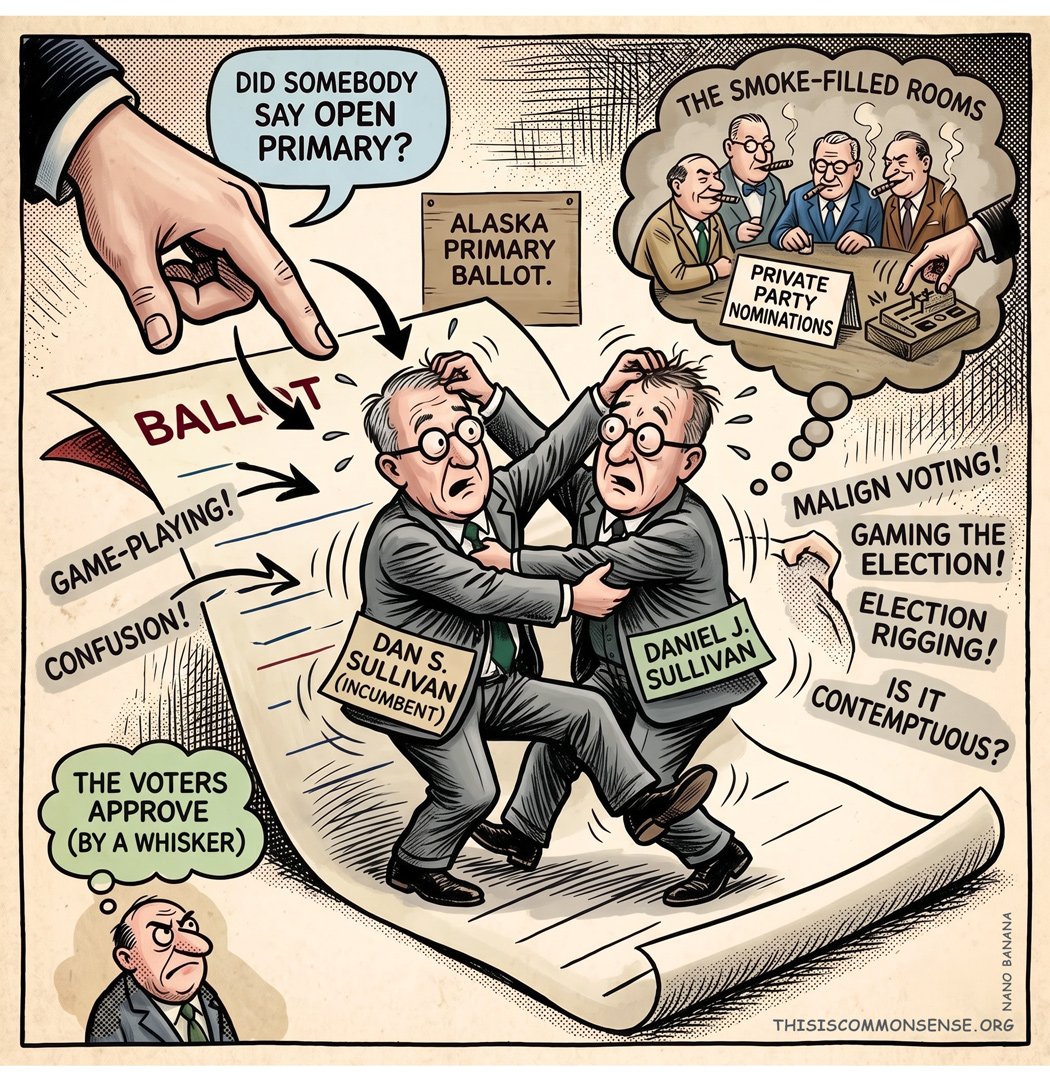
On today’s Alaska primary ballot, U.S. Senator Dan Sullivan, the Republican incumbent, faces an inconvenient challenger in the person of . . . Dan Sullivan.
The president of the United States is not pleased.
“Because of the trickery in the Voting, the Crooked, Radical Left Dumocrats have put up another man named ‘Dan Sullivan,’ and they did this to take Votes away from our Great Senator of the same name,” Donald Trump wrote on Truth.social. “Democrats are trying to ‘trick’ Alaskans, and treat Alaskan Voters with contempt.”
Is it contemptuous of Alaska voters?
“His primary purpose is not to win an election,” contends the Senator, “it’s to confuse Alaskans and rig the vote for my opponent, the Democrat.”
Challenger Dan J. Sullivan’s run against the incumbent with the near-identical name, one Dan S. Sullivan, doesn’t quite pass the smell test. He sure appears to be gaming the election. Still, the rigging occurred when the state went to an open primary where anyone — regardless of party membership — can vote for anyone on the ballot.
Regardless of party.
Many people think this sort of thing is a great advance, and voters did approve it (by a whisker) in 2020 and voted to keep it (by an even slimmer margin) in 2024. But this “Nonpartisan Top Four Primary” (sending four candidates to the General Election) is open to malign voting and, yes, candidacies. When former Independent Party member and current Republican Party member Daniel J. Sullivan of Petersburg, Alaska, threw his hat into the ring, confusion was a natural (and likely intended) result.
Election officials cooked up a halfway reasonable response: they list on the ballot “Sullivan, Dan S. (Registered Republican) Incumbent” and his possible vote-splitting challenger as “Sullivan, Daniel J. Jr.” unadorned.
To prevent sneaky campaigning and voting, however, Alaskans should go the opposite direction, allowing — no, requiring — political parties to privately select their candidates. And at their party’s expense, not the taxpayers’.
Hold the General Election after political parties have freely chosen their nominees . . . confining all game-playing and election-rigging to the smoke-filled rooms. Which voters can then judge accordingly.
This is Common Sense. I’m Paul Jacob.
Illustration created with Nano Banana
See all recent commentary
(simplified and organized)
See recent popular posts
4 replies on “Who Rigged Alaska’s Senate Race?”
The label “primary” was adapted by Americans in 1835 from a similar use of “primaire” by the French. Referring to a caucus or meeting as “primary” wasn’t too bad; but, in 1842, it was applied to an internal election by which Democrats selected a candidate; and thereafter this use continued. The adjective “primary” began then to mask the internality, and the public could then be guided to acquiesce to the use of the state to manage and to fund the balloting. After that, the public could be guided — by a somewhat different coälition — to insist that this state-managed process should be made more “democratic” by introducing open primaries. (An important part, in 2016, of making Trump the Republican Presidential nominee!) And, finally, in some places the primary election has been reworked into a unified contest in which all candidates compete, with a run-off to follow if no candidate gets a simple majority.
The problem of similarly-named candidates is not new. When I lived in Ohio, Democrat Anthony Orlando Calabrese got votes from people who mistook him for a member of the Democratic Celebrezze family. And Republican Dana Gillman Rinehart once lost an election apparently because a Libertarian with the last name “Miller” was mistaken by some voters for a member of a Republican Miller family.
Few if any in the Libertarian Party were imagining such a mistake, and certainly Rinehart didn’t either. But even if some Democrats hadn’t plainly admitted what they’re doing in Alaska, the deliberate pursuit of confusion would still be clear.
Hasn’t this happened before in a recent election? Two candidates with almost identical names? RCV invites such frauds.
Ranked Choice Voting was not a factor in the Alaska election. Top Four primary is not RCV. Voters select only one candidate. It is an open primary with a runoff election to finish it.
Condillac, Pat did not say or insinuate that ranked-choice voting was a factor in Akaska. She said that ranked-choice voting invites the deployment of candidates with similar names to split support for opponents.
The tactic is more powerful in a system with run-off elections and with RCV than in a system with ordinary first-past-the-post elections or with approval voting.
Advocates of RCV have long pretended that it provides “instant run-off elections”; that claim plainly isn’t true when voters have incomplete preferences amongst candidates, but RCV does exhibit some of the same behavior, including this same vulnerability to confusions about similarly-named candidates.