Categories
Common Sense folly media and media people responsibility

Who Are the Bigots Now?

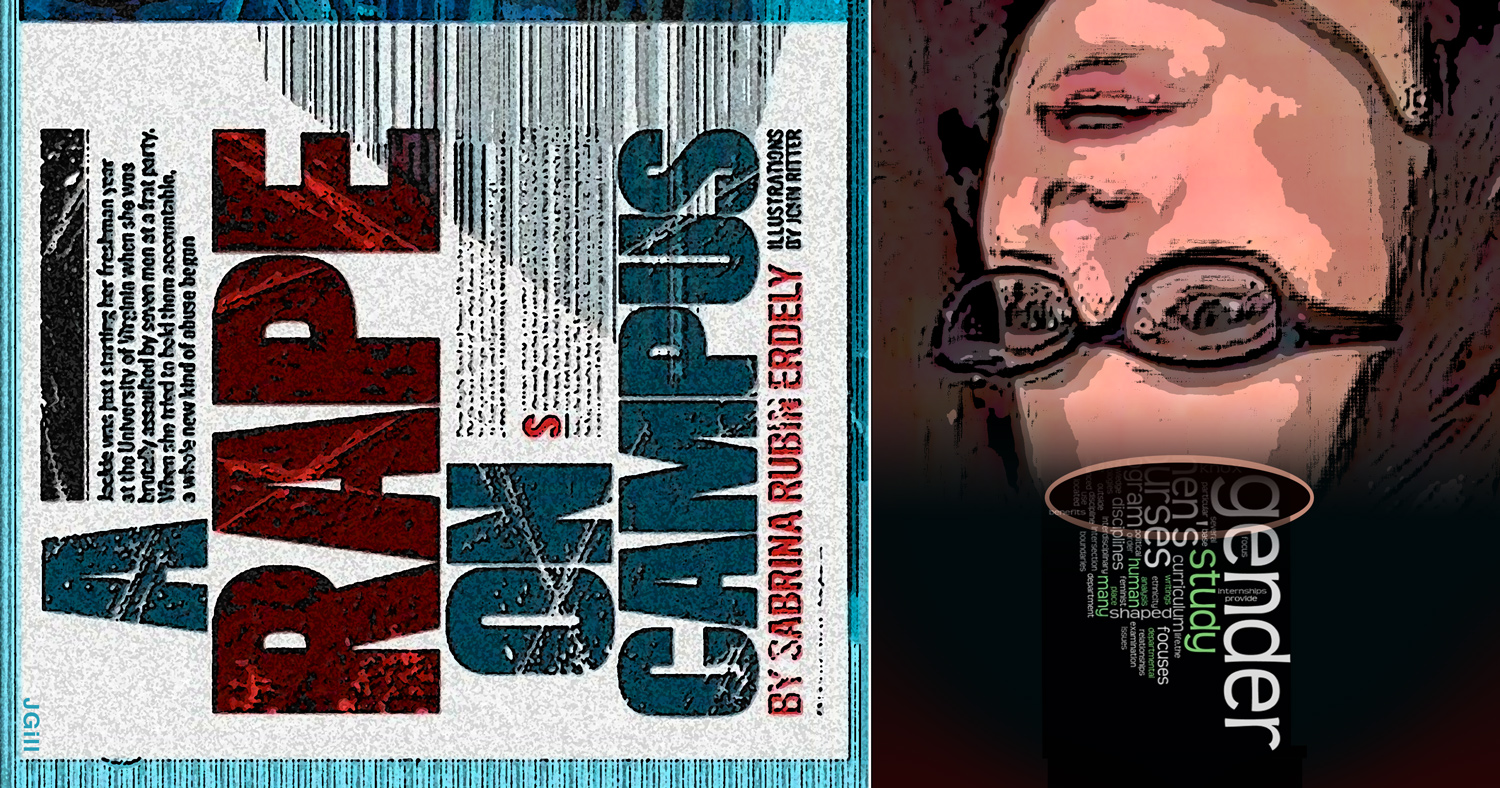
“Why did Rolling Stone … so massively screw up” in “falsely accusing a University of Virginia frat of gang-​raping a freshman girl?” asks Alex Griswold of The Daily Caller. “[I]f you work for liberal magazine The New Republic, the answer is that they were too right-wing.”

Most of my online friends are with Griswold, excoriating and ridiculing TNR’s Elizabeth Stoker Bruenig’s questionable analysis of the piece in question. Before I pile on, let me just say what is right about her analysis in “Rolling Stone’s Rape Article Failed Because It Used Rightwing Tactics to Make a Leftist Point…”

She ably summarizes a world view. 

“The left tends to view oppression as something that operates within systems, sometimes in clearly identifiable structural biases” while the “right,” she insists, “tends to understand politics on the individual level,” which she imputes to “a general obsession with the capital‑i Individual.”

That, she thinks, is why “the right” pokes at “specific details of high-​profile cases like those of Trayvon Martin and Michael Brown.” If the leftist critique doesn’t apply there, she thinks “rightwingers” hope, they thereby disprove the left’s systemic oppression thesis.

Note how she just assumes the accuracy of the left’s approach; she just ignores how often lefty journalists get actual “big-​picture” stats wrong. For example, on the subject of “rape culture,” they routinely suppress discussion of accurate stats on false rape charges by women against men.

Worse yet, she honestly does not see how her “leftwing” media comrades have prejudged coverage of recent race-​based and rape-​involved cases, doing injustice to individuals.

Is this mere media bias?

No. It’s the very definition of prejudice. It’s bigotry.

This is Common Sense. I’m Paul Jacob.

Printable PDF

Upside Down World View


Categories
First Amendment rights media and media people

Journalism Codified

The great revolutionary idea at the time of our nation’s independence rubs against the grain of politics and “statecraft,” as practiced by khans, kaisers, and kleptocrats: divide and conquer, divide and rule. It is no wonder that the art of making legal distinctions is so often based not on human rights but governmental convenience.

Take the right of a free press.

The notion of open government has it that the right to participate in the dissemination of knowledge (particularly information about government) is to be an individual right. Modern Freedom of Information Act (FOIA) laws are a great example of government accommodation of this right.

But the Michigan House is now attempting to restrict access to state information by trying to set up a definition of journalist, making it easier for journalists to finagle data from government, harder for lone individuals. The state’s House Judiciary Committee just approved HB 4770, which does a number of things, including setting very particular definitions of terms like “newspaper” and “journalist.”

All the better to make the practice of publishing information about government more of a privilege than a right.

This was made even clearer at the federal level, by Senator Diane Feinstein, whose support for a new “shield law” to protect journalists is best understood by its limitations: bloggers, you don’t count. And she actually referred to a “special privilege” to publish. Not a right guaranteed by the Constitution.

Politicians like it when they have credentialed, easy-​to-​identify (and easier-​to-​manipulate) professional journalists to contend with.

Citizens with those rights? Why, it drives them crazy.

Crazy enough to try to codify what a “journalist” is, anyway.

This is Common Sense. I’m Paul Jacob.

Categories
First Amendment rights media and media people national politics & policies U.S. Constitution

Dick Durbin’s Dangerous Idea

Politicians think in terms of institutions. If you identify yourself as an individual, a mere citizen, pfft: you’re nothing. But say you are from a lobbying group, or a government bureau, or a news organization — suddenly you matter.

That’s even how they interpret the Constitution.

They are wrong.

Back in May, Illinois Sen. Dick Durbin expressed doubt whether “bloggers, or ‘someone who is Tweeting,’ should be given media shield rights.” He believes a big unanswered question looms:

What is a journalist today in 2013? We know it’s someone that works for Fox or AP, but does it include a blogger? Does it include someone who is tweeting? Are these people journalists and entitled to constitutional protection?

Durbin thinks he’s both clever and profound to ask “21st century questions about a provision in our Constitution that was written over 200 years ago.”

But he is actually missing the whole enchilada, the point of the Constitution.

First, our two-​century old freedoms don’t have an expiration date. Second, individuals have rights, not “institutions.” And not because we belong to a group. Either everyone has a basic right, or no one does.

Glenn Harlan Reynolds countered Durbin’s institutional prejudice with a fine piece in the New York Post, where he takes a common sense position: “a journalist is someone who’s doing journalism, whether they get paid for it or not.”

Reynolds reminds us that, in James Madison’s time, “it was easy to be a pamphleteer … and there was real influence in being such.”

Just so for today’s Tweeters and bloggers.

Hey: as far as I’m concerned, you’re being a journalist just for commenting on this at ThisIsCommonSense​.com.

I’m Paul Jacob.

Categories
ideological culture individual achievement

Commemorating Alan Bock

Journalist Alan Bock died in May after a long struggle with cancer. 

In addition to many articles penned as an editorial writer for the Orange County Register as well as for various magazines, Bock also wrote four books: Ecology Action Guide, The Gospel Life of Hank Williams, Ambush at Ruby Ridge: How Government Agents Set Randy Weaver Up and Took His Family Down, and Waiting to Inhale: The Politics of Medical Marijuana. The last two deal trenchantly with government assaults on our liberty — assaults as foolish as they are destructive.

In his obituary for the Orange County Register, Greg Hardesty reports that Bock “cultivated a loyal following as a passionate defender of individual liberty and freedom.” He “cut a figure as a bookish intellect — yet one whose friendly, easygoing nature endeared him to family, friends and colleagues.”

Representative Dana Rohrabacher recalls that Bock “smiled every time he made a point that furthered his basic beliefs in freedom.”

His 25-​year-​old son Stephen Bock says that his father always had a smile on his face. 

Decades ago, Alan met with me when I was facing prosecution for draft resistance, and subsequently wrote a great editorial defending me. We kept in touch in the years since. My own acquaintance confirms the consensus that he was a very learned, effective and happy warrior for freedom. 

We talked politics many times, but I wish we’d found the time to talk about Hank Williams.

Alan Bock will be missed.

This is Common Sense. I’m Paul Jacob.

Categories
First Amendment rights media and media people too much government

Liberty and Licenses

Oh, no. We’re being drowned — in alternatives.

Remember the good old days, with three choices for national broadcast news, Walter Cronkite and whoever the other guys were? Plus the local paper and the New York Times? Sure, there were other avenues. But if the big boys happened to have a unitary government-​approved perspective on something, you could battle uphill for years with hardly anyone noticing your particular flag.

Then cable arrived. The Internet. Zillions of webzines and blogs. If you want an alternative to whatever the Official View is, you don’t have to look very far or for very long. It’s harder for the powers that be to burble baloney unchallenged.

Big, big problem, all this competition, right?

It is according to Michigan State Senator Bruce Patterson. He wants to license journalists the way Michigan licenses plumbers and hair dressers.

From what I can tell, the state can’t be trusted with protecting us from bad hair cuts, let alone tell us who’s best suited to toot out the news. But Patterson says we’re being overwhelmed by all the media outlets. Poor us! So we need guvmint — which always puts the truth first, of course — to tell us good reporting from bad. 

Think about this: The traditional job of journalism is to provide a check on lying politicians. Now politicians will vet those who get the privilege to criticize them?

Puh-​leeze.

Patterson, we’ll take a pass.

This is Common Sense. I’m Paul Jacob.