Categories
First Amendment rights insider corruption local leaders

Vindictiveness vs. the First Amendment

Finally, the city council of Castle Hills, Texas, is doing the right thing by Sylvia Gonzalez, accepting a settlement to resolve years of litigation against the city for violating her First Amendment rights.

In 2024, the U.S. Supreme Court ruled in her favor, agreeing that courts may properly consider evidence that an arrest is retaliatory.

According to Gonzalez’s lawsuit, in 2019 city leaders had lashed out against the councilwoman for her support of a nonbinding petition to remove a city manager. The city’s weapon? A rarely used law that it wielded against her for “briefly and inadvertently having the petition among her papers” during a heated council meeting; she allegedly tried to “steal” her own petition.

Gonzalez was arrested and spent a day in jail — the real reason, according to her lawsuit, being her criticism of local leaders.

The settlement means that statewide training on “First Amendment retaliation” (presumably, how to avoid engaging in it) will be offered throughout Texas and, for Castle Hill officials, will be mandatory.

The city must also pay $500,000 in damages to Gonzalez.

Anya Bidwell, an attorney for the Institute of Justice, which represented Gonzalez in the suit, observes that the First Amendment “doesn’t come with handcuffs. This outcome sends a message to officials everywhere: if you retaliate against critics, you can be held to account.”

Let’s hope that not a whole lot of training is needed to safeguard local freedom of speech. The issue is not that complicated.

This is Common Sense. I’m Paul Jacob.


PDF for printing

Illustration created with Krea and Firefly

See all recent commentary
(simplified and organized)
See recent popular posts
Categories
Fifth Amendment rights property rights

Property Rights for Competitors

New Year’s Resolution for the U.S. Supreme Court: follow the Constitution.

That’s not what happened in 2005 when, by a 5 – 4 majority, the court determined that governments in this country could enjoy an almost unlimited power of eminent domain. The mere prospect of a more taxable commercial entity or mere desire to appease some constituency would suffice to legally justify violating the rights of innocent property owners.

This Kelo v. New London decision was applauded by abusers of power, derided by defenders of property rights. The latter leapt into action, fighting for legislation in 47 states to give property owners firmer protection.

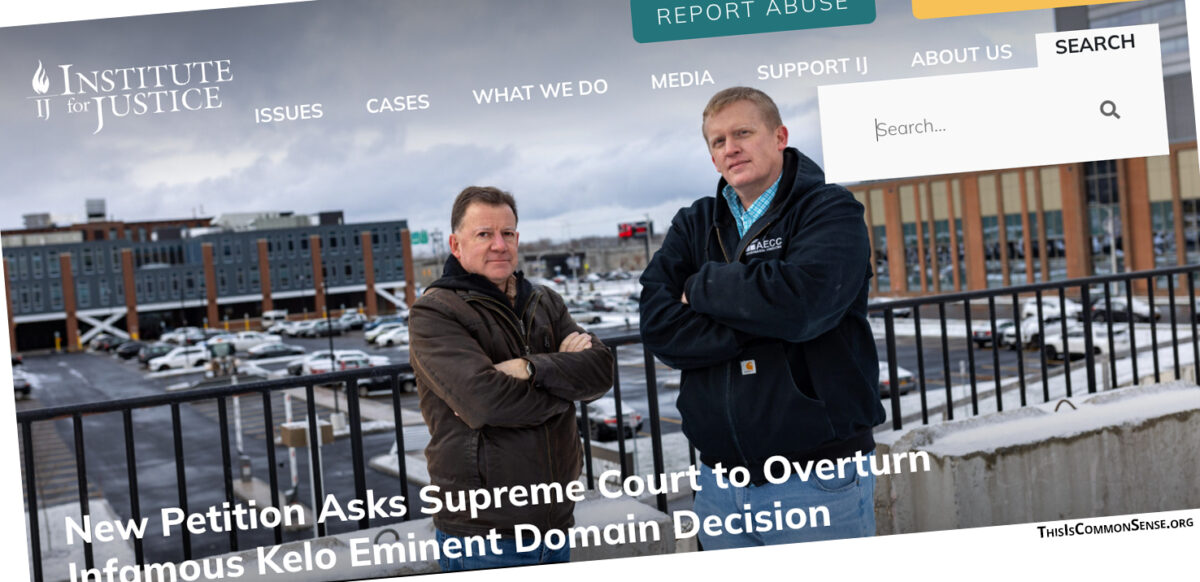
One exception was New York State, where the town of Utica recently used the power of eminent domain against Bryan Bowers and Mike Licata.

These business partners had established a cardiology service to compete with that of CNY Cardiology group, right next door. CNY begged the city to let it turn the Bowers Development building into a parking lot. We need a parking lot there, said CNY; right where our lower-​priced competitor is sitting.

The city said okay.

Enough, says Institute for Justice, which is representing Bowers Development and all of us by petitioning the U.S. Supreme Court to revisit Kelo.

IJ President Scott Bullock believes that it’s “high time for the Supreme Court itself to … remove this blot on its jurisprudence and restore constitutional guardrails to the use of eminent domain.”

Please resolve to give America a favorable outcome, justices.

This is Common Sense. I’m Paul Jacob.


PDF for printing

See all recent commentary
(simplified and organized)
See recent popular posts