Categories
Accountability ballot access First Amendment rights general freedom government transparency initiative, referendum, and recall media and media people moral hazard nannyism Regulating Protest too much government U.S. Constitution

Four Measures for Rogue Government

Rule of thumb: don’t enact today laws that, had they been obeyed by folks in the original 13 states of our union, would have prevented independence.

Voters in Missouri, South Dakota, and Washington have the “opportunity” to enact such laws this November.

In “Beware of Anti-Speech Ballot Measures,” Tracy Sharp and Darcy Olsen, presidents of the State Policy Center and the Goldwater Institute, respectively, offer a warning. Focusing on Measure 22, the South Dakota Government Accountability and Anti-Corruption Act, they show how dangerous notions like forcing “nonprofit organizations to report the names and addresses of their donors to the state government” can be.

Such disclosure would subject non-profits “to possible investigation by an unelected ethics board that is given the power to subpoena private documents and overrule decisions made by the state attorney general. . . .” Rogue, star-chamber government.

Fever dream?

No. Sharp and Olsen highlight a famous U.S. Supreme Court case that protected the NAACP from the state’s demand for the group’s funding sources. Both women also offer personal tales of how nasty the opposition (in government and out) can become when big issues are on the line.

I can personally attest.

These measures fly in the face of what really matters — encouraging robust public debate. Democracy doesn’t work when people dread participation. As our authors challenge, “[d]o we want America to be a country where government keeps public lists of law-abiding citizens because they dare to support causes they believe in?”

Especially when, without the secret (unreported!) activities of the Committees of Correspondence, the USA would not have become united states in the first place.

This is Common Sense. I’m Paul Jacob.


Printable PDF

speech, anti-speech, NAACP, Supreme Court, First Amendment, Free Speech,


Original (cc) photo by Michael Tracey on Flickr


Categories
Common Sense free trade & free markets general freedom ideological culture initiative, referendum, and recall responsibility tax policy term limits U.S. Constitution

Trying Our Souls

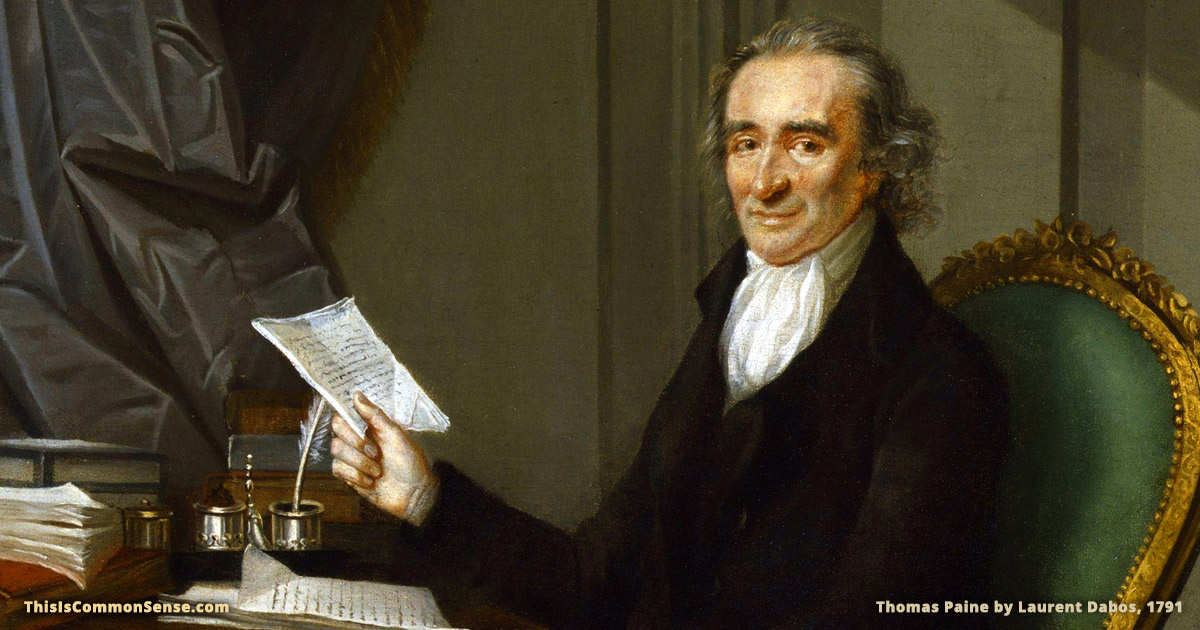
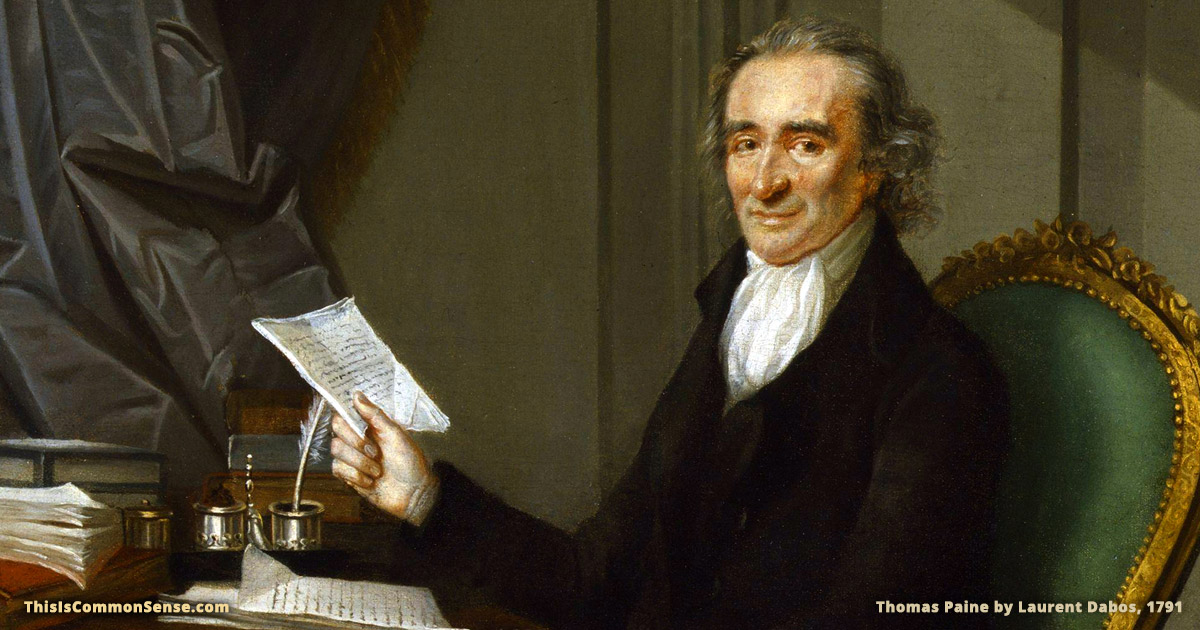
In Common Sense, his incredible hit pamphlet of 1776, Tom Paine appealed to “the inhabitants of America”:

O ye that love mankind! . . . Every spot of the old world is overrun with oppression. Freedom hath been hunted round the globe. Asia, and Africa, have long expelled her. Europe regards her like a stranger,and England hath given her warning to depart. O! receive the fugitive, and prepare in time an asylum for mankind.

Today . . . well, our country might be mistaken for an asylum. Just not the type envisioned by Mr. Paine

Worse still, freedom in America is under consistent attack.

Following the Orlando terrorist massacre (and don’t forget, “hate crime”), who could be surprised at yet another rush to infringe on Second Amendment rights by legislation? But I must admit I was still naïve enough to be shocked that not a thought was given to making our Fifth Amendment rights to due process so much collateral damage.

Secretly writing names on a classified list, whether you call it a “no-fly list” or the “terrorist watch list,” and using merely that to bureaucratically deny citizens fundamental rights (“top ten” rights, as in No. 2 and No. 5 in the Bill of) is no process of law at all.

Who could so cavalierly toss away the very bedrock of our freedom? It’s as if our so-called representatives don’t give a hoot about our rights.

Common Sense readers are well aware that two years ago every Democrat in the U.S. Senate voted to repeal the key freedom of speech provision of the First Amendment. The goal was to completely reverse the current wording of “Congress shall make no law” with new wording that incumbent legislators in “Congress and the States may regulate . . . the raising and spending of money by candidates and others to influence elections.”

The amendment didn’t pass. Thankfully. But, frighteningly, it continues to be promoted. Presidential candidate Hillary Clinton has endorsed it. Most folks are ignorant about the extremism of the approach, because the media reports mainly that the amendment reverses Citizens United, something the amendment actually doesn’t do.

The amendment simply awards Congress so much power that the highly-disapproved body could do almost anything.

Most people also don’t realize that the Citizens United case was about the Federal Election Commission (FEC) censoring advertising for a movie about Hillary Clinton, produced by a non-profit corporation.

Speaking of government censorship of the press, the FEC had been threatening Fox News with major fines for making corporate contributions to 17 GOP presidential candidates. What happened? The cable news channel decided to expand from a single debate featuring 10 candidates to two debates with the earlier “undercard” debate featuring an additional 7 candidates. A candidate not chosen to be one of the 17 candidates filed a complaint against Fox, alleging it amounted to an illegal contribution to all 17 candidates.

The FEC recently closed the case without beating up the disfavored news channel only because three Republican commissioners blocked three Democrats. The case should not only be closed, it should never have been brought in the first place. We don’t want our government dictating to the media about political debate coverage.

Or anything else.

And how can major federal agencies provide equal protection to all citizens, when they are staffed according to political party to provide protection for Republicans and Democrats? More of us are independents than either Rs or Ds.

The war against political participation isn’t confined to Washington. I know from my ordeal in Oklahoma nearly a decade ago, when for assisting initiative petition campaigns for a spending cap and eminent domain reform, I was charged with conspiracy to defraud the state and threatened with ten years in prison . . . until a year and a half later when, without ever completing even a preliminary court hearing, the charge was dismissed.

I’ve seen Eric O’Keefe and other brave citizens in Wisconsin endure dawn SWAT-style police raids for the awful crime of campaigning in favor of government policies they support.

And, of course, how can we forget that no one has been held in any way accountable for the years that the IRS blocked the formation of Tea Party and conservative and libertarian groups?

This country is in trouble.

In addition to the assaults on our rights, especially the right to participate politically, there is the dysfunction at all levels of government. Among the big national problems of massive debt and constant war, we find smaller local issues that signal a deeper, bigger problem.

Common Sense has long covered the school kid suspended for drawing a gun or eating one’s PB&J sandwich into a pistol or the school that photo-shopped out the musket from their Minuteman mascot. This last year we followed many of the twists and turns to the story of the Meitivs, the Maryland family that dared allow their two children, ten and six years of age, to walk home from a public park. The children were obviously well cared for, but nonetheless they were picked up and held by police several times and the parents were long threatened with losing their kids.

It took over a year for the authoritarians with Child Protective Services to agree that kids walking home from a park in broad daylight did not constitute prima facie evidence of child abuse or neglect. And to agree to leave the poor Meitiv family alone.

Common Sense has also highlighted the racketeering being done by police forces federal, state and local through what’s known as civil asset forfeiture — again, a complete denial of basic rights. Under current law — or more correctly, lawlessness — police can take people’s property and money when detaining them and then keep it, even if the person is never convicted of a crime, or even charged.

This suspension of the fundamental concept of “innocent until proven guilty” must not stand.

But who is going to stop it? Not just this one outrageous rip-off, but the whole societal slide to a system where individuals have no rights, especially if they lost the last election, and government makes more and more of our decisions for us.

Hillary Clinton?

Donald Trump?

Your state’s legislators? Your city council? Your congressman?

You and I must stop the erosion of our liberties. We have the tools — especially with state and local ballot initiatives available to most of us, allowing us to seize the agenda at the time and on the issue(s) of our choosing.

Liberty Initiative Fund works with Liberty Initiators across the country to hold government accountable, fight crony capitalism and protect our liberties through state and local ballot initiatives. Contributions are not tax deductible, but pack a powerful punch for liberty.

Citizens in Charge and Citizens in Charge Foundation protect the critical initiative and referendum process, so citizen activists can reform government and limit power. Donations to Citizens in Charge Foundation are fully tax-deductible.

The Foundation also supports Common Sense, which I offer the modern inhabitants of America to help keep us focused on the most important problems we face, with intermittent seriousness and humor, as well as uniting active allies from across the country, each pursuing their own issues in their own communities.

Today, I’ll enjoy being with the people I love and I’ll take some time to celebrate the birthright of freedom forged for you and me 240 years ago.

But I won’t pretend that freedom will be there for me or for mine unless together we forge our future freedom anew.

This is Common Sense. I’m Paul Jacob.


Printable PDF

Tom Paine, Thomas Paine, Laurent Dabos


Categories
ideological culture media and media people nannyism national politics & policies Regulating Protest too much government U.S. Constitution

The Long Road to Citizens United

Everybody is familiar with the standard theory regarding the Citizens United decision. Former comedian and current earnest socialist Sarah Silverman puts it this way: “Every politician takes money from Big Money, ever since it was made legal with Citizens United.”

Like most folks who talk this way, she doesn’t give a squeak of context. She barely even indicates that it was a Supreme Court case, 2010’s Citizens United v. Federal Election Commission. She does not mention at all that the ruling overturned the FEC’s act of suppressing a political movie.

But there is a much wider context than such bare facts — and if you want a good synopsis, you could hardly do better than read my friend Krist Novoselic’s calm, reasoned “look at the history of attempts to regulate independent campaign expenditures.”

This “modern history” started with what the New York Times called Richard Nixon’s “revolution in political financing.” The Federal Election Campaign Act of 1971 “required detailed disclosure of campaign contributions; set campaign contribution limits to candidates, parties and committees; set expenditure limits on campaigns, independent groups and individuals and created the first public financing of presidential campaigns and national conventions.”

And almost immediately the law began suppressing political speech and advertising. And led to a long series of court cases.

And decisions.

And revisions.

That define our times.

Krist (with whom I serve on the board of FairVote.org) provides the context you need to see through what he aptly calls “the hype” about “Citizens United,” as well as how the decision correctly removed the license given to the FEC’s role as “state censorship board.”

This is Common Sense. I’m Paul Jacob.


Printable PDF
Krist Novoselic, Citizens United, free speech, fairvote.org


Categories
crime and punishment First Amendment rights general freedom moral hazard national politics & policies Snowden

Structurally Opinionated B. S.

Edward Snowden, the infamous American whistleblower now exiled in Russia, says the FBI’s claim that it cannot decode the infamous San Bernardino terrorist’s iPhone is, and I quote, “Bernie Sanders.”

Oops.

He used another word-set, also sporting the initials B. S.

I got confused because, though the press has been fretting endlessly about the B.S. coming from Donald Trump, the real corkers of late have come from Bernie Sanders, who seems to think that white people cannot be poor or oppressed* and that the successes of free markets elsewhere serve perfectly as excuses for Big Government interference here in America.**

Mr. Snowden, who knows a lot more about encryption and decryption than I do, has given more weight to my suspicion that the whole FBI case against Apple — demanding that Apple create software to decrypt the company’s customers’ iPhones, and supply (on an allegedly case-by-case basis) the decrypted private information to the government — is a sham.

Snowden insists that there are multiple ways to do the job.

“Other technologists have explained how the FBI could have easily accessed the phone’s latest iCloud backup,” a report on Snowden’s judgment elaborated, “if agents working with San Bernardino County had not reset the iCloud password.”

Once again, a government failure leads to another push by government to correct for its failure, burdening citizens.

In this case: folks at Apple.

Interestingly, Apple’s legal defense appears to rest heavily on the First Amendment’s free speech guarantees, arguing that the demanded software is value-laden speech, is literally made up of such.

The exact term is “structurally opinionated,” which I nominate for the jargon phrase of the year.

This is Common Sense. I’m Paul Jacob.


* Sanders has recently said, in one of those interminable debates that I can no longer watch in full, “When you are white, you don’t know what it’s like to be living in a ghetto, you don’t know what it’s like to be poor, you don’t know what it’s like to be hassled when you are walking down a street or dragged out of a car.” As if “white privilege” amounts to immunity from poverty or oppression.

** Sanders, whose Tweets are as insane as his spoken pronouncements, recently lamented how Romanians in Bucharest have faster Internet speeds than Americans — without realizing they’d achieved these levels of access by wide-open, unrelenting, and wild competition. That is, Laissez Faire capitalism.


Printable PDF

Edward Snowden, iPhone, First Amendment, privacy, Apple, illustration


Common Sense Needs Your Help!

Please consider showing your appreciation by dropping something in our tip jar  (this link will take you to the Citizens in Charge donation page… and your contribution will go to the support of the Common Sense website). Maintaining this site takes time and money. Your help in spreading the message of common sense and liberty is very much appreciated!


Categories
video

Video: How Today’s Fascists Do It

Squelching the speech of those you disagree with, how it is done — a cultural artifact of the present age:


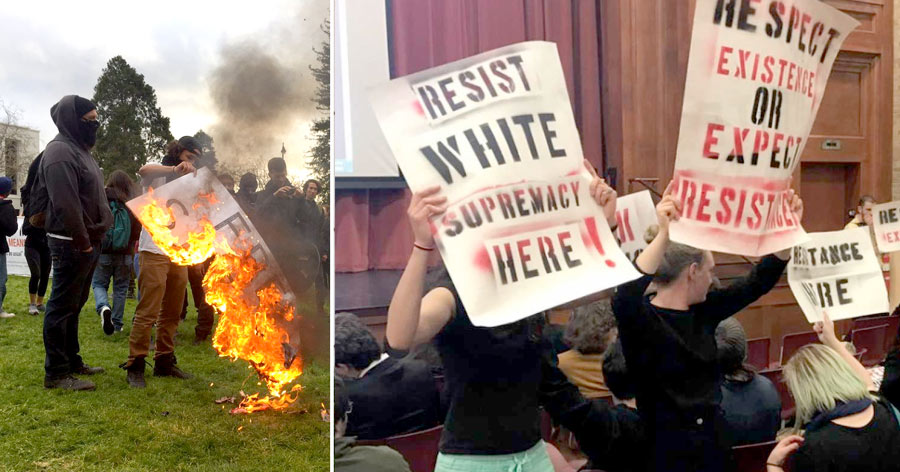
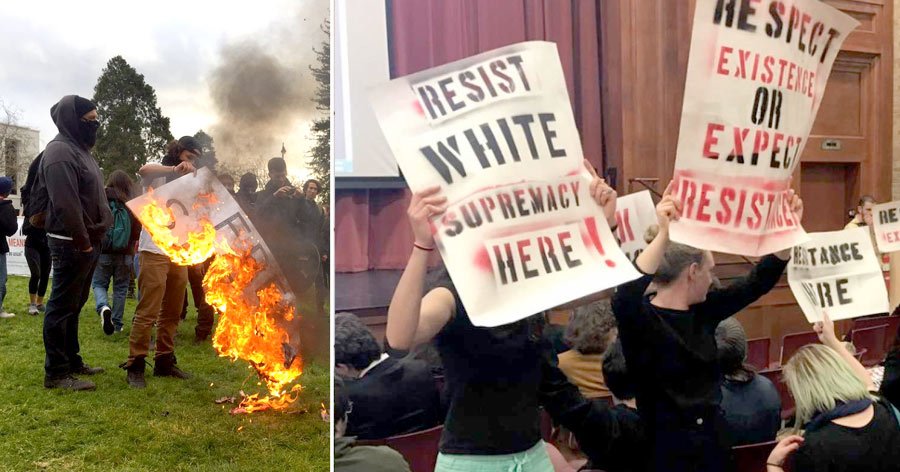
In this video, the valiant Ben Shapiro gives a scheduled talk, but is harassed by protestors and his talk sabotaged by those seeking to “no-platform” him.

Categories
Common Sense First Amendment rights folly general freedom initiative, referendum, and recall Regulating Protest too much government

Citizen Registration Fee

It’s not about the ten bucks — or the thousand. An important principle is involved.

Professional lobbyists in Missouri are legally required to submit reports about the corporations, local governments, industries, associations, and special interests for whom they lobby, how much they are paid, and the goodies they bestow upon the politicians they seek to influence. The registration fee is $10.

Problem is, as I revealed at Townhall yesterday, Ron Calzone isnt a lobbyist. So, naturally enough, he didn’t file.

Calzone is president of Missouri First, a group advocating constitutional governance and mobilizing fellow citizens for an enormous impact on Show-Me State government. He regularly treks to the capitol, while Missouri First helps folks who can’t get to Jefferson City submit testimony online . . . all to weigh in on issues like the Second Amendment, property rights, initiative petition rules, and cronyism.

It’s true that Calzone lobbies every time he speaks to a legislator. But hey: he’s not a lobbyist under the legal definition. Why? Because he earns not a penny. Missouri First doesn’t even have a bank account. And Calzone doesn’t represent various clients as a professional lobbyist would; he represents himself — and those citizens who agree with him.

Despite the letter of the law, last week the Missouri Ethics Commission fined Mr. Calzone $1,000 for not registering as a lobbyist. It also ordered him not to speak to any state legislator until he registers.

Ron Calzone — with the help of the Freedom Center of Missouri and the Center for Competitive Politics — is appealing the case.

And will win in court.

Yet, that an “ethics” agency is harassing a citizen volunteer speaking truth to power . . . speaks volumes.

This is Common Sense. I’m Paul Jacob.


Printable PDF
Ron Calzone, Missouri, citizenship, freedom, lobbyists


Categories
Common Sense folly ideological culture media and media people national politics & policies

Iconoclasm Spasms

As America stands upon a precipice of insolvency, as southern European nations undergo the spasms of sovereign debt catastrophe, as many of our citizens call the Chinese devaluations of their money “currency wars,” obsessing about political symbolism seems . . . a tad . . . trivial.

First it was the Confederate Flag. Now it’s Jefferson Davis.

He’s dead. And as a result of his 126 years in the “post-living” state, he quite literally doesn’t matter for the future of the United States.

And yet the Confederacy’s president (1861-1865) is in the news again. As Charles Paul Freund relates at Reason, the dead rebel prez has been having a figurative “bad summer.” How? The University of Texas has decided to move his statue into a museum, away from public eyes; some Georgians want to obliterate the Stone Mountain tableau that features Davis along with Stonewall Jackson and Robert E. Lee; there’s talk of renaming Virginia’s “Jefferson Davis Highway”; etc.

Davis died unrepentant, refusing to ask Congress for a pardon for his part in the Confederacy after the secessions of 1860 and ’61. And yet he was pardoned in 1978, posthumously, by the Democratic Congress and President Jimmy Carter, who yammered on in a Fordian “long national nightmare is over” fashion, saying the pardon would, at long last, “clear away the guilts and enmities and recriminations of the past.”

I’m not convinced it did a thing.

And about the current proposals? I don’t think any highway should be named after any politician. Of the other ideas, I don’t really care. Much.

Nevertheless, fights over political symbols have long been important. Why? My guess: to deflect our attention — away from the future, and to the past.

This is Common Sense. I’m Paul Jacob.


Printable PDF
Jefferson Davis


Categories
Common Sense general freedom ideological culture national politics & policies responsibility

Supremacist Progressives?

“Thank you, Seattle, for being one of the most progressive cities in the United States of America,” socialist-cum-Democratic presidential candidate Bernie Sanders shouted to the large crowd in the City of Goodwill.

Seconds later, two women with a local Black Lives Matter group jumped the stage, threatening to shut down the event. Quickly, they were rewarded for their extortion-by-tantrum. Sen. Sanders and company relinquished the microphone, podium and stage.

The kidnapped crowd booed the violation, only to be screamed at by Marissa Johnson, one of the protesters, as “a bunch of screaming white racists,” who practice “white supremacist liberalism.”

“I was going to tell Bernie how racist this city is, filled with its progressives, but you did it for me,” Johnson added.

Angry audience members yelled, “How dare you?!” and “How dare she call me a racist.”

“You guys are full of bull-$@%# with your ‘black lives matter,’” she chided, acknowledging that the event had already recognized the anniversary of Michael Brown’s shooting in Ferguson, Missouri.

What a fascinating marriage of outrage and entitlement!

And yet . . . real grievances abound.

“Welcome to Seattle,” Johnson told Bernie, “where our Seattle Police Department has been under federal consent decree for the past three years, and yet has been riddled by use of force, racial profiling, and scandals throughout the year.”

Sen. Sanders doesn’t even stand up for his own speech rights, much less ours. Apparently fearing the loudmouths, he proved unwilling to confront them or address their complaints.

Sanders and his “progressive” Democrat comrades (governing cities like Baltimore and Seattle) must take responsibility for the results of their policies, and admit that the black voices shouting against racism are shouting at them.

This is Common Sense. I’m Paul Jacob.


Printable PDF
Bernie Sanders and Black Lives


Categories
First Amendment rights general freedom

Reason Requires Freedom

For two weeks, Reason magazine was stopped by court order from talking about two government actions.

It started with online comments.

Everyone who samples the Internet knows that although some un-moderated remarks are judicious and thoughtful, others are intemperate and un-thoughtful. Freedom of speech subsumes the latter just as much as the former — unless and until a published comment can be honestly construed as a genuine threat of violence, as opposed to mere venting.

Reason was first hit with a subpoena that “demanded the records of six people who left hyperbolic comments at the website about the federal judge who oversaw the controversial conviction of Silk Road founder Ross Ulbricht.”

The subpoena is itself debatable, the Supreme Court having recently noted that context is relevant to determining whether an online “threat” is a genuine one.

Not debatable? The gag order that soon followed, prohibiting discussion of both the subpoena and the gag order after Reason notified the affected commenters so that they would have a chance to defend their right to anonymity.

Reporting at the magazine’s “Hit and Run” blog, Reason editors Nick Gillespie and Matt Welch explain why the prior restraint represented by the order is unconstitutional and a bad idea.

For Reason, the situation was unprecedented; but similarly wrongful gag orders have become commonplace.

If we lose freedom of speech in this country, it won’t be all at once but bit by ugly bit.

This episode? One of the ugly bits.

This is Common Sense. I’m Paul Jacob.


Printable PDF

Reason and Freedom


Categories
education and schooling folly

Learning Zone or War Zone

Given the stated purposes of the university — discovering, learning, teaching, engaging in open intellectual discourse — you might suppose that the pitched battles on campus would be primarily intellectual in nature. Persons set forth a view, others criticize it or elaborate a positive alternative, etc.

Open intellectual change, however heated, is indeed often what transpires.

But on many campuses, we also witness efforts to muzzle opponents of ideas or policies. The censors contend that disagreement as such constitutes a kind of assault on them, one from which their delicate selves must be forcibly and un-delicately protected.

Thus, campus activists at Northwestern University have reported Professor Laura Kipnis for “sexual harassment” for arguing, in The Chronicle of Higher Education, that “Sexual Paranoia [Is Striking] Academe,” as exemplified by prissy new rules about dating, jokes, the simplest of standard human interactions. According to her accusers, her article somehow creates a “hostile environment” for students eager to impose not only a Victorian screen on dating and talking, but also a screen, or lid, on any discussion of the Victorian screen. It’s just one example of a syndrome that could be multiplied ad infinitum.

What to do?

One thing, if you’re applying to college: omit as a prospect any school rife with the politics of repression. Boycott the anti-academic academy.

The second, larger solution: bypass the modern university altogether.

Modern technology can help with that. There are more and more ways to learn, and teach, with every day that passes.

This is Common Sense. I’m Paul Jacob.


Printable PDF

College Safe Zones