
Categories
initiative, referendum, and recall national politics & policies term limits

The Next Election

“If Tuesday’s vote sparks unrest,” a weekend Washington Post feature informed, “customers at Fortitude Ranch will be secure behind walls patrolled by armed guards.”

The Post highlighted a pricey survivalist “get away” in West Virginia and hyped for the rest of us “that violence could erupt, especially if the vote count drags on for days without a clear winner.”

Just as an aside, doesn’t it seem like we are getting less information about what happened yesterday and a lot more “news” about what is going to happen tomorrow? 

Anyway, I think we can trust each other. We’ve got to. Not on TV, but in real life. 

Part of that trust is believing that one election loss won’t alter all previous societal norms [cough: court-packing]. Yes, elections have consequences, but in a free country, losing an election should not be a scary event. Look at me, I have only voted for one winning candidate in my entire life!!!*

Whatever happens tomorrow . . . or days or weeks later . . . don’t worry. You have rights and there shall be another election before too long. Right? 

Rights?

“Eternal vigilance” being the rule about defending basic things like rights, the next election will always be the most important.

Ballot measures in Arkansas, Florida and North Dakota are about the next election. 

Sadly, dangerously, they seek to make it much harder and more expensive for citizens to petition issues onto the state ballot and gain an up or down decision from the voters. That’s why Citizens in Charge is fighting to defeat all three.

Proponents shriek that wealthy out-of-state interests must be stopped from changing the state constitution, but not a single word in any of the three amendments even touches on out-of-state funding. Instead, each makes the process more cumbersome and expensive, undercutting grassroots groups while having little effect on moneyed interests.

In North Dakota, voters passed a reform measure in 2018 creating a state ethics commission. The ballot issue was funded by an out-of-state group, and thoroughly despised by state legislators . . . who referred Measure 2 to the ballot.

Measure 2 allows the legislature to veto a vote of the people for a constitutional amendment and require the vote to be held a second time. Beyond the ugly optics of politicians vetoing the people, it will make passing an initiative amendment much more costly — again empowering wealthier interests at the expense of the less well-heeled.

In Florida, a constitutional amendment already requires a 60-percent supermajority vote. Amendment 4 would require the measure win a second time by that supermajority. In the nation’s third largest state, the expense of a second campaign weighs in favor of long-term established political interests and against grassroots reform.

In Arkansas, Issue 2 seeks to further weaken the already weakened term limits and Issue 3 endeavors to wreck the petition process to block a future term limits initiative. Previously, I’ve explained the duo of amendments as the “Lifetime Politicians Ruin Christmas Amendments.” Today, a “Trojan” Horse travels Arkansas telling the tale

Which is critical because Arkansas legislators refused to clue-in voters. The ballot titles that legislators placed on both measures tell voters precisely zero about the actual constitutional changes being voted upon. 

That our own representatives are attempting to knock out an important democratic check on themselves is not “the small stuff.”

We had better sweat it. 

And you can help Citizens in Charge fight back. It’s too late to do more toward tomorrow’s votes in Arkansas, Florida and North Dakota. With earned (free) media work and a shoestring budget of Facebook ads, we got our message out in all three states and have a shot to defeat each one.

Help us fight the new bills we know are coming as legislative sessions begin in January. Support our work with activists in Arkansas and North Dakota fighting Issue 3 and Measure 2, respectively, as they go on offense to demand change — perhaps by initiative.

Good luck to America tomorrow, but the campaign to prevent critical grassroots democratic checks from being hobbled and chopped and blocked continues. Because there is another election in 2022.

This is Common Sense. I’m Paul Jacob.


* And I still regret it. Who was it? Well, ours are secret ballots, but I will fully disclose the sordid details in the first three minutes of my podcast this weekend.

PDF for printing

See all recent commentary
(simplified and organized)
See recent popular posts

Categories
judiciary national politics & policies

Biden’s Court-Packing Scheme

Hold on! What scheme am I talking about?

Joe Biden hasn’t said that he agrees with other Democrats (including former Democratic presidential candidates) who propose that the U.S. Congress act to dramatically expand the number of U.S. Supreme Court justices.

Joe Biden hasn’t said that at all. 

In his first and so-far-only debate with President Trump he refused to say, because if he did then that would become the issue.

“The issue is the American people should speak,” he said, and then turned to the camera. “You should go out and vote. . . . Vote and let your senators know how strongly you feel. Vote now. Make sure you in fact let people know.”

Know what, precisely? To vote to allow a Democratic administration to seize control of the Court, overcoming any constitutional objections to his (or her) socialist schemes?

But then Biden turned against the voters, when asked on Friday, whether voters deserve to know where he stands on court-packing: “No, they don’t deserve” to know. “I’m not going to play his [Trump’s] game. . . .”

So, officially, we “don’t know” whether Biden supports packing the High Court the way FDR tried in 1937.

Do voters deserve better from Biden? 

They do not! 

O, those voters — always demanding to know positions and agendas and things. Playing right into the hands of the opposition. 

Come on, man! Ya gotta vote for the guy to know what’s in him.

I know what’s on your mind. You’re asking, “Are you saying that Joe Biden’s coy covertness toward the imposition of one-party authoritarian government exemplifies a crude disdain for voters’ legitimate desire to know what their vote will get them and is even more disqualifying than his stealth court-packing scheme?”

Please. Don’t put words in my mouth.

This is Common Sense. I’m Paul Jacob.


PDF for printing

See all recent commentary
(simplified and organized)
See recent popular posts
Categories
ballot access crime and punishment

Harvest Season

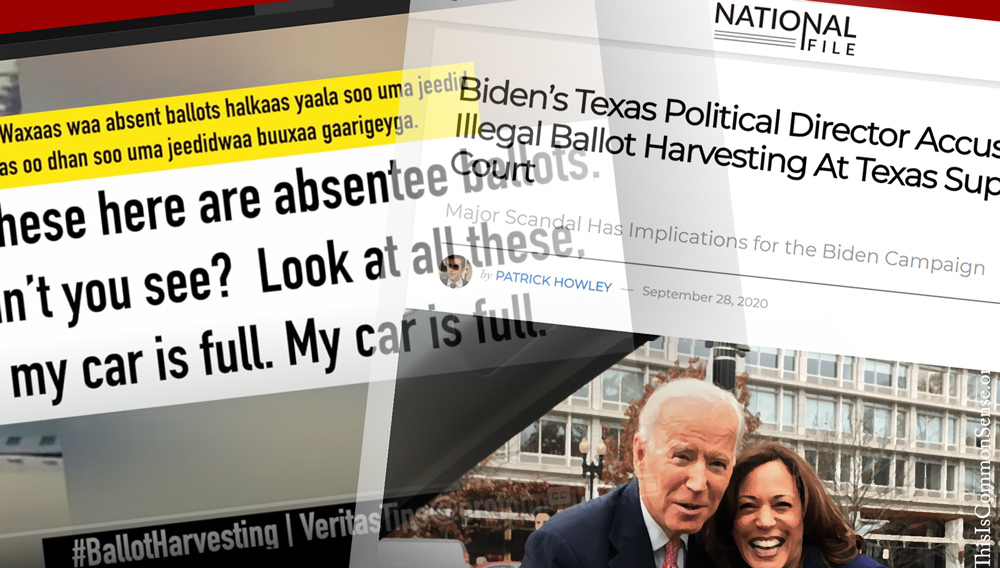
Democrats say Trump is going to steal the election. But what if they are “projecting”? Politics has gotten so nasty that you wouldn’t be a cynic to express no surprise at stories like these: 

  1. Project Veritas uncovered a “ballot harvesting” scam in Representative Ilhan Omar’s Minneapolis district, implicating, it seems, Omar (D-Minn.) herself; and 
  2. Formal accusations against a Biden campaign official, and others, for a similar scheme in Texas.

The Minnesota story is juicy; the Project Veritas video speaks for itself.

But in Texas? “Two private investigators, including a former FBI agent and former police officer, testify under oath that they have video evidence, documentation and witnesses to prove that Biden’s Texas Political Director Dallas Jones and his cohorts are currently hoarding mail-in and absentee ballots and ordering operatives to fill the ballots out for people illegally, including for dead people, homeless people, and nursing home residents in the 2020 presidential election.” That, courtesy of the industrious Patrick Howley, in the thick of the investigation.

“Witnesses have shown me,” the former FBI agent testifies, “how the ballot harvesters take absentee ballots from the elderly in nursing homes, from the homeless, and from unsuspecting residences’ mailboxes. The ballot harvesters then complete the ballots for their preferred candidate and forge the signature of the ‘voter.’” 

Several Biden campaign workers and two Harris County bureaucrats are implicated. It will be interesting to see if these accusations lead to charges.

And how many similar stories will emerge elsewhere.

Folks can argue about how much voter fraud happens, but when we find it, let’s act.

This is Common Sense. I’m Paul Jacob.


PDF for printing

See all recent commentary
(simplified and organized)
See recent popular posts

Categories
media and media people national politics & policies

Insincerely Simulated Insanity

“What’s the worst that could happen?” 

That question, splashed across the lead opinion offering in Sunday’s Outlook section of The Washington Post, was answered by the sub-heading: “The election will likely spark violence — and a constitutional crisis.”

Happy Labor Day!

Rosa Brooks, a Georgetown University law professor and co-founder of the Transition Integrity Project, authored the commentary about a group of political insiders — “some of the most accomplished Republicans, Democrats, civil servants, media experts, pollsters and strategists around” — she assembled for “a series of war games” about “a range of election and transition scenarios.”

The group “explored” four different simulations: “a narrow Biden win; a big Biden win . . .; a Trump win with an electoral college lead but a large popular-vote loss, as in 2016; and finally, a period of extended uncertainty” as the country witnessed following the 2000 election.*

“Over and over, Team Biden urged calm, national unity and a fair vote count,” explained Brooks, “while Team Trump issued barely disguised calls for violence and intimidation against ballot-counting officials and Biden electors.”

Team Biden participants included John Podesta, Hillary Clinton’s 2016 campaign chair; Donna Brazile, Al Gore’s 2000 presidential the campaign chair; and former Michigan Gov. Jennifer Granholm.

“Team Biden repeatedly called for peaceful protests, while Team Trump encouraged provocateurs to incite violence,” she added, “then used the resulting chaos to justify sending federalized Guard units or active-duty military personnel into American cities to ‘restore order,’ leading to still more violence.”

“In each scenario, Team Trump — the players assigned to simulate the Trump campaign and its elected and appointed allies — was ruthless and unconstrained right out of the gate,” informed the professor.  

Wait . . . who were these Team Trump “players”? 

Conservative Bill Kristol, a longtime #NeverTrumper and “one of President Trump’s most vocal opponents,” was one. Another was former RNC chairman Michael Steele, who has not only endorsed Biden, but serves as a senior advisor to The Lincoln Project, now spending millions on attack ads against the president.

Shamefully unfair and intellectually dishonest by Professor Brooks — and the ‘dying in partisan darkness’ Washington Post

But here’s the rest of the story . . . 

Even with Bidenites played as angels and Trumpians as devils, both Biden victory scenarios nonetheless resulted in peace by Inauguration Day. 

Not so for a Trump win . . . which “the Left” is not projected to peacefully accept.  

This is Common Sense. I’m Paul Jacob.


* Obviously not considered was Trump winning a solid majority of the vote. Not likely according to today’s polls, but if polls had been accurate in 2016, Trump wouldn’t be president.

PDF for printing

See all recent commentary
(simplified and organized)
See recent popular posts
Categories
general freedom initiative, referendum, and recall

Today’s Trifecta

Three measures on ballots today are particularly worth watching.

Two issues in Washington State represent the only citizen-initiated measures out of 32 propositions voters will see in eight states: Washington Referendum 88 allows voters to re-decide the issue of racial and gender preferences, so-called “affirmative action,” while Washington Initiative 976 offers voters a chance to cap their vehicle taxes.

More than two decades ago, in 1998, Washingtonians passed Initiative 200 to end racial and gender preferences in state employment and education. This year, the state legislature enacted a virtual repeal of I-200, by allowing the state to employ such a preference provided it was not the “only factor” used. 

Washington’s vibrant Asian-American community, which stands to be discriminated against should affirmative action return, rose up to petition Referendum 88 onto the ballot. A “yes” vote upholds the legislature’s new pro-preference policy; a “no” vote restores the prior voter-enacted policy prohibiting such preferences.  

Initiative 976 is yet another effort from Tim Eyman, the state’s most prolific initiative practitioner. “This measure,” as the official summary states, “would repeal or remove authority to impose certain vehicle taxes and fees; limit state and local license fees to $30 for motor vehicles weighing 10,000 pounds or less, except charges approved by voters . . .”

Like virtually every Eyman initiative, powerful opponents have dramatically outspent supporters — by greater than a 6-to-1 margin — funding ads that have been less than truthful. Additionally, government officials have broken campaign laws in pushing a “no” vote.

Nonetheless, a mid-October poll showed 48 percent of voters support I-976 against 37 percent who oppose it. Could Eyman again thwart the state’s behemoth Blue Establishment?

Lastly, New York City voters will decide a ballot question on whether to use ranked choice voting in future primary and special elections for mayor, city council and other offices. It would mark a major victory for a reform growing in popularity.

This is Common Sense. I’m Paul Jacob.


PDF for printing

vote, election, initiative, referendum, Washington, New York,

See all recent commentary
(simplified and organized)
See recent popular posts

Categories
political challengers too much government

Recognizing a Problem

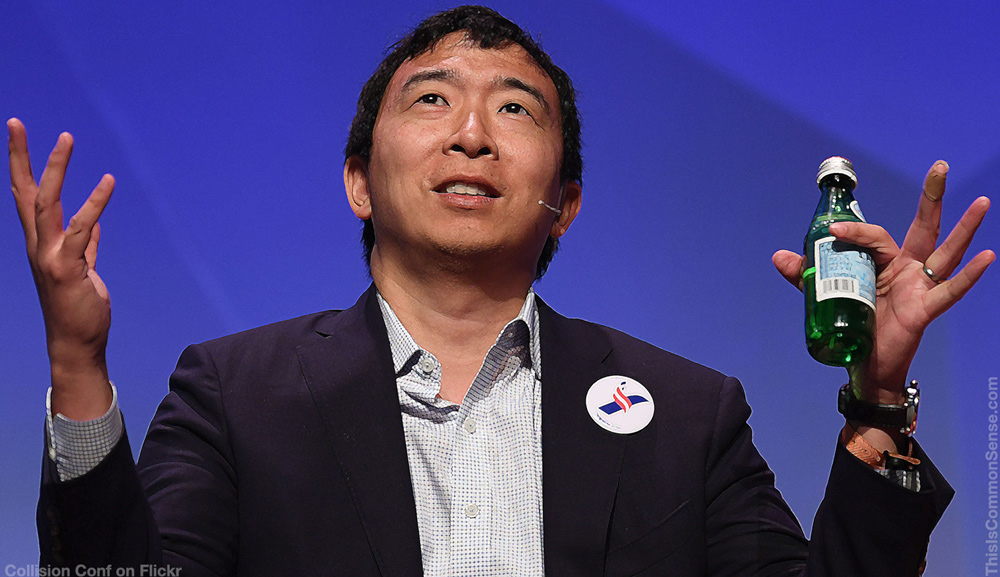
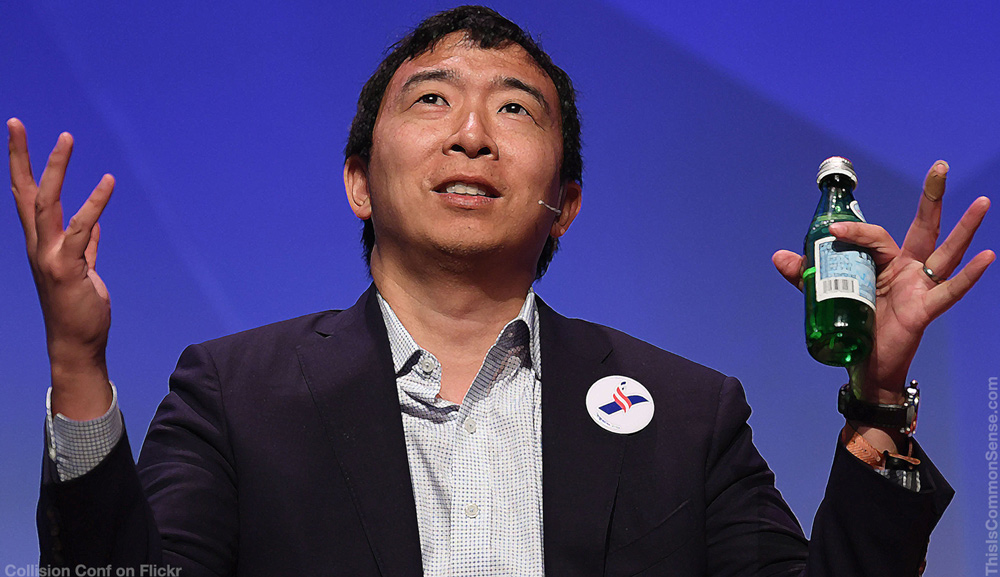
Democratic Presidential candidate Andrew Yang has at least one good policy preference: he opposes tough land use and zoning regimes.

And he is not alone. 

“Yang’s criticism of zoning is pretty close to what other Democratic primary candidates have said on the subject,” writes Chistian Britschgi at Reason. “Sens. Cory Booker (D–N.J.), Elizabeth Warren (D–Mass.), and Amy Klobuchar (D–Minn.), and former Housing and Urban Development Secretary Julian Castro have all targeted restrictive local land use regulations as a cause of high housing costs.”

Mr. Yang’s website clarifies the problem: “Those who already own homes have made it significantly harder for those who don’t to recognize that dream. Through NIMBY (not in my backyard) and zoning laws, the ability of new housing to be built in certain areas has been impeded to the point where the vast majority of Americans can’t afford to live in the largest cities.”

But while Yang recognizes that zoning is best dealt with on a local and state level, his more famous competitors offer fixes, Britschgi notes, that “require the federal government to either spend more money or attach more regulations to the money it already spends.”

Here’s the bottom line: Several Democrats competing for the highest office in the land recognize government interference as the leading cause of the housing crunch and its high prices.

Yet, instead of fighting bad policies at the state and local source, they advocate more federal spending. And they most decidedly do not apply their housing regulation realism to other problems we face.

This is Common Sense. I’m Paul Jacob.


Andrew Yang, zoning, land use, visionary, presidential, election,

Photo by Collision Conf

See all recent commentary
(simplified and organized)
See recent popular posts

Categories
national politics & policies too much government

The New New Dealer

Reason magazine’s Nick Gillespie finds “a lot” to like about Pete Buttigieg. He sees a candidate “who at his best represents a new generation in American politics and a principled unwillingness to go along with the most free-spending plans of his rivals for the Democratic presidential nomination.” 

I have so far resisted the charms of the Mayor of South Bend, Indiana.

He seems dangerous to me, in part because he cuts quite a figure while appearing so calm and reasonable.

But Mr. Gillespie is not making a case for Buttigieg. The Reason editor has noticed a growing set of downsides to the pol, writing that as Buttigieg “starts to unveil more and more plans — to pack the Supreme Court, say, and to call for national service — he becomes less appealing,” which, if anything, understates the situation.

You see, Buttigieg “wants to destroy the gig economy in order to save it.”

Gillespie provides that “takeaway” from the campaign’s proposal, “A New Rising Tide: Empowering Workers in a Changing Economy.” Gillespie explains that the plan’s “focus is to force more regulations on employers and increase unionization among workers, neither of which is likely to make it easier for the economy to grow or the workplace to ‘more easily adapt’ to the needs of suppliers, workers, or consumers.”

There is a lot about the current labor markets (at record all-time highs, says the President) that definitely would not be helped by a plan to “organize” labor using the old idea of the strike-threat system.

Like a lot of Buttigieg’s positions, they seem warmed-over yesteryear progressivism.

FDR, but modernly packaged.

Making Big Government even bigger.

This is Common Sense. I’m Paul Jacob.


PDF for printing

Pete Buttigieg, president, election, labor, gig economy, candidate,

Photo by Lorie Shaull

See all recent commentary
(simplified and organized)
See recent popular posts

Categories
initiative, referendum, and recall political challengers term limits

A Different Conversation

“Here’s the difference between me and the other candidates,” says billionaire investor-turned-presidential aspirant Tom Steyer. “I don’t think we can fix our democracy from the inside. I don’t believe Washington politicians and big corporations will let that happen.”

Of course, if this Democrat becomes president of these United States, that’s hardly the outside.

“For me,” Steyer continues, “this comes down to whether you trust the politicians or the people.”

Well, I certainly trust the people a whole lot more than I trust the politicians.* 

“If you say you trust the people, are you willing to stand up to the insiders and the big corporations and give the people the tools they need to fix our democracy?” Steyer asks. 

Which tools? “A national referendum, term limits, eliminating corporate money in politics, making it easy to vote.”

The toolkit’s a mixed bag.

Eliminating corporate money means repealing part of the First Amendment, and silencing non-profit corporations such as U.S. Term Limits, MoveOn.org, the NRA, Planned Parenthood, National Right to Life, etc., etc. 

Mr. Steyer also worries that, without reform, “We won’t be able to . . . pass any of the great plans proposed by the Democratic candidates running for president.”

We should be so lucky.

Still, here is another Democratic presidential candidate endorsing congressional term limits. And we do need a direct democratic check on Washington, the ability for citizens to initiate reforms such as term limits and take unpopular legislation to a referendum. 

I’m not sanguine that Steyer will get the policy details right, but as fellow Democratic candidate Sen. Kamala Harris is fond of saying, “Let’s have that conversation.”

This is Common Sense. I’m Paul Jacob.


* Constitutional protections for our basic rights, as in The Bill of Rights, mean we do not have to trust government, directly democratic or representative.

PDF or printing

billionaire, Tom Steyer, candidate, president, election, campaign,

See all recent commentary
(simplified and organized)
See recent popular posts


Categories
ideological culture national politics & policies

Inslee, AOC, and the Watermelon

Washington State Governor Jay Inslee is running to lead the Democratic Party in the next presidential election to take back the imperial capital, Washington, D.C. His chief issue? Fighting “man-made climate change.” But he also dares to say goofy things, apparently on the theory that It Works For Trump.

Seeking to promote “more unity across the world and more love rather than hate,” he has said, in an apparent attempt at impish if instructive irony, that his “first act will be to ask Megan Rapinoe to be my secretary of state.”

Inslee is not referring to Ms. Rapinoe’s best-known statement, her infamous scream, upon a sports win last week, “I deserve this!” 

Inslee is referring, instead, to her admonishment for everyone “to be better. We have to love more, hate less. We got to listen more, and talk less. . . .” And so on.

With this sort of inanity awarded by a major Democratic pol, you might wonder, is his primary policy plank equally hollow?

Not according to Saikat Chakrabarti, chief of staff to Rep. Alexandria Ocasio-Cortez (D-N.Y.). 

Talking off the cuff with the climate director for Inslee’s campaign, Chakrabarti praised the Democrat’s “comprehensive plan” for fitting together disparate parts.

As I noted several months ago, AOC’s Green New Deal suffers from an over-abundance of extraneous-to-climate change elements. But Chakrabarti insists that the “interesting thing about the Green New Deal is it wasn’t originally a climate thing at all.” 

It was “a how-do-you-change-the-entire-economy thing.”

Which brings us back to the old Watermelon Theory of environmentalism: “green on the outside but red in the middle.”

This “green” agenda isn’t hollow. It is dangerous.

This is Common Sense. I’m Paul Jacob.


PDF for printing

Jay Inslee, Washington, president, election, socialism, watermelon, green on the outside, red on the inside,

See all recent commentary
(simplified and organized)
See recent popular posts


Categories
initiative, referendum, and recall national politics & policies term limits

Electing a Better Way

For the seventh time in the last 22 years, the Metro Nashville Council put a measure on the ballot to weaken or abolish their own term limits. And for the seventh time voters said no. 

Term limits were under attack elsewhere in Tennessee — along with Ranked Choice Voting. The Memphis City Council foisted three dubiously worded ballot questions on voters. The measure to weaken the council’s limits, neglected to explain that to voters. The other two misleading measures sought to repeal or block Ranked Choice Voting from going to effect.

Voters put down all three. 

Speaking of Ranked Choice Voting (RCV), after several squeaker U.S. Senate races, perhaps Republicans and Democrats will reconsider the reform. 

The Arizona race is still too close to call. Republican Martha McSally leads with 49.3 percent of the vote against Democrat Kyrsten Sinema with 48.4 percent. But Angela Green, the Green Party candidate, took 2.2 percent of the vote. Sinema used to be a Green Party activist, so it’s not unreasonable to think those folks would have preferred her to the Republican.

In Montana, incumbent Democrat Jon Tester has won. He garnered 49.6 percent of the vote, while Republican challenger Matt Rosendale received 47.5 percent and Libertarian Rick Breckenridge racked up 2.9 percent, more than the margin of difference. 

Last week, the Libertarian seemingly endorsed Rosendale. “I am here today to support Matt and his candidacy,” Breckenridge told reporters. “And endorse him in his continuing effort to be the front man in the cause of liberty.”

Using RCV, voters can rank their choices and, were their first choice eliminated, their votes would go to their second choice until some candidate achieves an actual majority.

Thus ending “spoilers” — and giving voters more say-so.

This is Common Sense. I’m Paul Jacob.


PDF for printing