
Categories
crime and punishment partisanship

Caveat Preemptive

Were Donald J. Trump an exemplar of strict Kantian honesty; had he a reputation for exactitude about his achievements and acumen; if hyperbole had not become his own very public modus — then, and only then, would the near half a billion judgment against him make even a modicum of sense.

But the former U.S. president and infamous branding entrepreneur is and has always been known to be something of a b.s. artist. No one has excuse to take what he says literally. Business partners and all who make deals with Trump should do their own diligence. Their watchword should be: caveat emptor.

Yet, last week, New York State regulators and prosecutors bent over backwards to find Trump guilty. “On Friday, New York County Supreme Court Justice Arthur Engoron ordered Donald Trump to pay a staggering $355 million for repeatedly inflating asset values in statements of financial condition submitted to lenders and insurers,” explains Jacob Sullum of Reason. “When the interest that Engoron also approved is considered, the total penalty rises to $450 million. All told, Trump and his co-defendants, including three of his children and former Trump Organization CFO Allen Weisselberg, are on the hook for $364 million, or about $464 million with interest.”

That is a lot of money to protect other businesses from Trump’s characteristic exaggerations, which so appalled the court. But not any of the banks Trump did business with.

No one has been harmed, for Trump repaid all the loans.

There is no victim — making Trump the biggest-name victim of victimless crime prosecution of all time.

We, the people, know that “honesty is the best policy” is not standard business practice, and that Trump doesn’t always follow it. But we are also not demanding that our governments insert themselves into every successful transaction looking for fibs and fakery.

That would be a recipe for selective prosecution.

Which is just what this case is: selective prosecution of a political opponent.

This is Common Sense. I’m Paul Jacob.


PDF for printing

Illustration created with PicFinder and Firefly

See all recent commentary
(simplified and organized)
See recent popular posts
Categories
crime and punishment sports subsidy

A Big Step Over the Vomit

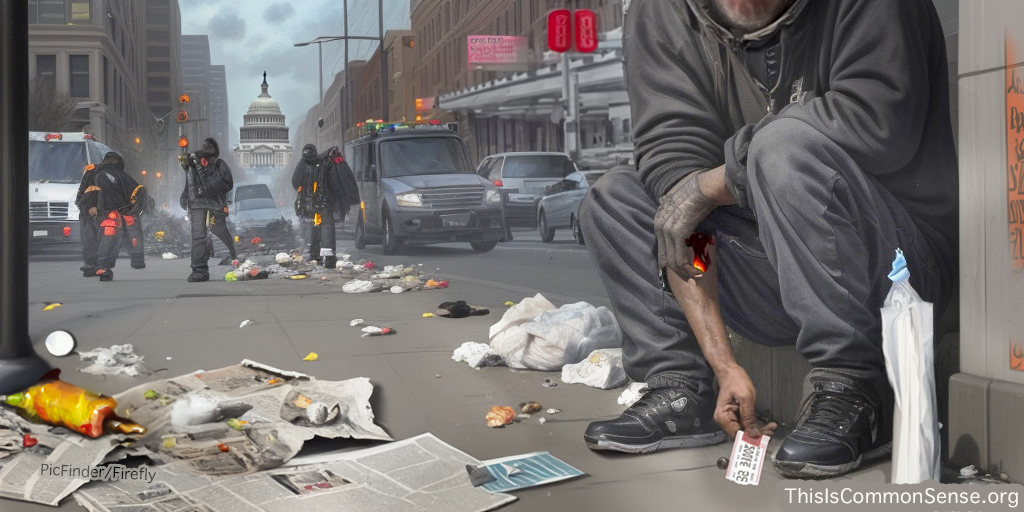
“Two hours before the Washington Capitals play in Chinatown on a crisp November evening,” Candace Buckner wrote recently in The Washington Post, “a man stretches out on the pavement near Sixth and F streets NW, wrapped beneath a gray hoodie that he’s using as a blanket. Around the corner, a woman rolls a blunt outside the arena’s sportsbook entrance, and soon the waft of marijuana will perfume the area. There’s a spillage of vomit, green, near the tree on the sidewalk. Another man, this one cradling his arms behind his back and mumbling, doesn’t seem to notice the mess as he walks over it and bends over to pick up old cigarette butts.”

Might there be some connection between the state of downtown Washington, D.C., and the decision by the owner of both the Washington Capitals hockey team and the Washington Wizards NBA team to relocate them outside the city to Virginia?

“The District faced competition from Virginia,” explained a separate news story, “only because Leonsis had begun quietly exploring a new home for his teams in 2022, after years of complaining about crime and the noise of buskers outside his arena.”

There was not only less vomit but more room to be had in Virginia. For an even more expensive “public-private partnership” project. 

My fellow Virginia taxpayers and I are not crowing — Washington’s loss is our loss. We will no doubt pay for the privilege of experiencing even worse traffic and pricier tickets to hockey and basketball games . . . with higher taxes. 

Politicians can make names for themselves with these big sports franchise grabs. That’s what happened 30 years ago in the District of Columbia’s Chinatown. 

But the names have moved on, and now so have the games.

This is Common Sense. I’m Paul Jacob. 


PDF for printing

Illustration created with PicFinder and Firefly

See all recent commentary
(simplified and organized)
See recent popular posts
Categories
crime and punishment ideological culture

Crime: Police or Re-define?

Can crime be defined out of existence?

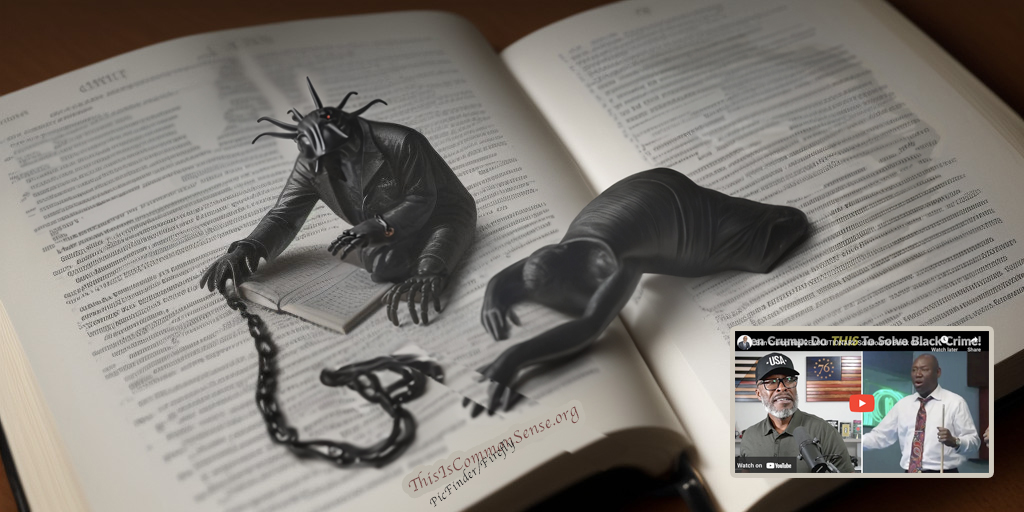
“Attorney Ben Crump proposed a solution to the issue of high crime that is plaguing the black community,” YouTube commentator Anthony Brian Logan reports on a story that an aging white fellow like myself was not apt to spot. “He said it is easy to identify criminals if laws that target specific groups of people are created. Crump brought up Eric Garner, who lost his life after struggling with police outside of a store when he was accused of selling loose cigarettes.”

Crump says crimes have been defined into existence targeting black communities.

Mr. Logan urges us to understand the context for Crump’s theorizing: the African-American lawyer “was speaking to a group of black men for an MSNBC special called ‘Black Men in America, Road To 2024.’ The purpose of the special is to rein black men back in and stop them from straying away from the Democratic Party.”

Logan is skeptical that this sort of half-cleverness is going to cut it with black men, who in increasing numbers are bolting from the ranks of the party created by Martin Van Buren. 

Many of us, of all colors, were extremely sympathetic to Eric Garner, who died at the hands of New York City police trying to block Garner’s unlicensed entrepreneurial effort enabled by high taxes on cigarettes. Yet, the real problem with Crump’s notion is that the worst crime in black neighborhoods is rampant theft and violence, the kind of activity that common sense dictates as criminal no matter who legislates, or why.

Defining crime into existence is not the current cause of increased black crime, Logan says, it’s decreased policing and punishment.

Crump’s argument, counters Anthony Brian Logan point blank, “is stupid.”

This is Common Sense. I’m Paul Jacob.


PDF for printing

Illustration created with PicFinder and Firefly

See all recent commentary
(simplified and organized)
See recent popular posts
Categories
crime and punishment

Theft Thwarts Thieves

It happens plenty in fiction.

Thieves or ex-thieves like John Robie (“To Catch a Thief”), Alexander Mundy (“It Takes a Thief”), and Slippery Jim DiGriz (The Stainless Steel Rat) are among the many beloved reformed or semi-reformed criminals who thwart the criminality of others.

It happens in real life too. Con artist Frank Abagnale eventually taught people how to spot fraud (though apparently still committing it in his memoir Catch Me If You Can). Former black-hat hacker Kevin Mitnick taught people how to protect themselves from hacking and social engineering.

The role of criminals stopping criminals can also be played entirely accidentally.

Last Saturday, three armed men robbed a business called Hi Lo Check Cashing out in Commerce City, Colorado.

“In an unexpected and ironic twist,” says a Facebook post by the Commerce Police Department, “as the trio was robbing the business . . . a fourth criminal stole their getaway vehicle . . . which may have already been stolen.

Police are seeking the third robber and the car thief. I guess they may offer a curt “Thanks” to the latter bad guy just before jailing him.

The Goddess Fortuity won’t always intervene thus. And we don’t want to people to start stealing cars on the off chance that one of their thefts will foil some other theft.

On the other hand, it would be criminal to decline any strokes of crime-stopping luck that come our way, since the politicians and prosecutors aren’t really doing it for us these days.

This is Common Sense. I’m Paul Jacob.


PDF for printing

Illustration created with PicFinder and Firefly

See all recent commentary
(simplified and organized)
See recent popular posts
Categories
crime and punishment

Justice & Consequences

Crime has gotten so bad in our nation’s capital that it’s even becoming too dangerous for the criminals.

“An off-duty federal security officer on his way into work Saturday night,” reports The Washington Post, “fatally shot a 13-year-old boy who the officer said was one of two youths who tried to carjack him in the District’s Penn Quarter neighborhood, near public safety buildings and an entertainment complex, according to D.C. police.”

My heart goes out to this man who was forced to defend himself. But also to this foolish 13-year-old boy, who is gone. 

Carjackings in the city have more than doubled this year over last, 821 and counting. According to the newspaper, those “involving juveniles are also up this year.”

The death of this perpetrator follows a recent incident in which “a 16-year-old girl driving a carjacked vehicle crashed into a utility pole in Northeast Washington and was killed.” The deceased girl’s 15-year-old partner in crime, now in police custody, had been released from “the city’s Department of Youth Rehabilitation Services” after “robbery and theft charges” only “because the agency had no available housing for her.”

“Violent crime in D.C. is up 41 percent this year,” The Post adds, pointing out that this recent shooting was just “several blocks north of where . . . the Washington Wizards played a home game . . . about three hours before.”

Good and evil have their own inertia. If crime pays, we will see more of it. And in more places. And if such acts are perceived to be easy to get away with . . .  

The consequences of no consequences are proving all too consequential.

This is Common Sense. I’m Paul Jacob.


PDF for printing

Illustration created with Firefly

See all recent commentary
(simplified and organized)
See recent popular posts
Categories
crime and punishment ideological culture media and media people

Why Criminals Commit Crimes

Is it a mystery?

“I really think if we can identify the ‘why,’ especially amongst the juveniles, we might be able to change our approach on how to slow this down,” says Carlos Heraud, an assistant chief at the DC police department.

Along with other crime in Washington. D.C., carjackings are up. Why?

Some people choose to be criminals. And some policymakers choose to aid and abet them.

It’s a matter of incentives and disincentives, but also choices and character. 

Since different people react differently to being born into poverty — or being disrespected, being peer-pressured, being bored, being fired — we cannot simply say that criminals are created by difficult circumstances.

Most do not become thugs and hoodlums.

Some who make criminal choices pull back and determine to do better. Others commit offenses forever. Chief Heraud and D.C. mayors and lawmakers should heed the insights of Stanton Samenow’s Inside the Criminal Mind. Although criminals make excuses for themselves and latch onto the excuses made for them by others, they know they’re responsible for their actions.

But while circumstances don’t create the criminal mind, circumstances can abet crime. For example, if you make it easier for criminals to get away with assault and theft, they’ll likely commit more assaults and thefts.

The government of our imperial capital makes it hard for potential victims to arm themselves, easy for criminals who are “caught” to walk away. If you’re a criminal operating in a town like that, it’d have to be encouraging to receive by this kind of encouragement?

After all, it’s not a question of bad incentives incentivizing all to be wicked. The effects can be seen on the margin, among those most likely to be induced by corrupt incentives, or to not be dissuaded from criminal action by reduced disincentives.

No great mystery.

This is Common Sense. I’m Paul Jacob.


PDF for printing

Illustration created with PicFinder.ai

See all recent commentary
(simplified and organized)
See recent popular posts

Categories
crime and punishment property rights

The Tide of Theft

There’s a black market for Tide laundry detergent. Who knew?

Giant Food, a Washington, D.C., area grocer, can’t seem to keep national brands such as Tide or Colgate or Advil on store shelves. Not because customers are buying these products, but because they’re stealing them.

Last week, we discussed the revelation by Dick’s Sporting Goods that thievery was a key cause of falling profits. The National Retail Federation believes that $95 billion is lost each year to public pilfering — something other retailers, including Target, Dollar Tree, and Ulta, are acknowledging is a very serious problem.

“Growing losses have spurred giants such as Walmart to shutter locations,” The Washington Post informs.

If we cannot police our own neighborhoods, and police can’t seem to do it, then we rely on . . . big corporations. With 165 supermarkets, Giant has yet to close any stores. Instead, the chain is “hiring more security guards, closing down secondary entrances, limiting the number of items permitted through self-checkout areas, removing high-theft items from shelves and locking up more products.” 

Most vulnerable is “the unprofitable store on Alabama Avenue SE — the only major grocer east of the Anacostia River in Ward 8,” a poor, largely black area of the city.

“We want to continue to be able to serve the community,” explains Giant’s president, “but we can’t do so at the level of significant loss or risk to our associates . . .

“During the first five months of this year,” Target’s chief executive recently leveled with investors, “our stores saw a 120 percent increase in theft incidents involving violence or threats of violence.”

Apparently, folks who pocket other people’s stuff are more likely to also be violent. 

Who saw that coming?

This is Common Sense. I’m Paul Jacob. 


PDF for printing

Illustration created with PicFinder.ai

See all recent commentary
(simplified and organized)
See recent popular posts

Categories
crime and punishment ideological culture property rights

Shrink Shrank Shrunk

“Shrinkage.” A big problem.

I’m not talking about the delicate issue identified in the classic Seinfeld episode, “The Hamptons.” I refer, instead, to the business lingo for theft.

It’s rampant and taking a sad toll. 

Dick’s Sporting Goods is the first major retailer to blame declining profits on the “shrink” of its inventory because of mass theft. “The sporting goods and athletic clothing seller reported second-quarter results Tuesday morning that included a 23% drop in profit, despite sales that rose 3.6% in the period,” CNN explains. 

But it’s not just a Dick’s problem. “Retailers large and small say they are struggling to contain an escalation in store crimes — from petty shoplifting to organized sprees of large-scale theft that clear entire shelves of products. Target warned earlier this year that it was bracing to lose half a billion dollars because of rising theft.”

The cause?

No mystery.

Leftists have long been uncomfortable with private property. Their socialism seeks to replace private property with public property and private control over the means of production with governmental control. No wonder they often excuse private thievery as something like a revolutionary act.

When Pierre-Joseph Proudhon put the idea boldly onto paper in 1840, that private property is itself theft, he really meant landed property, not personal property. Today’s leftists, unburdened by subtlety, keep coming back to opposing what is the core institution of civilization: respect for other people’s things.

Which allows for everything from privacy to progress.

Encouraging petty theft, as the left has knowingly, and organized theft, as the left has unwittingly (I hope) is not without consequences.

Our wealth, our liberties, our peace — they shrink.

This is Common Sense. I’m Paul Jacob.


PDF for printing

Illustration created with Midjourney

See all recent commentary
(simplified and organized)
See recent popular posts

Categories
insider corruption national politics & policies partisanship

A Very Special Prosecutor

You don’t send a salamander to put out a fire or a leech to drain a swamp. Similarly, you don’t appoint David Weiss as a special counsel to “investigate” the Hunter Biden case. 

Not if you want justice.

Weiss, who has been on the case since 2017, was responsible for the cushy plea deal that fell apart last month, in court. It was a novel, first-of-its-kind offering of immunity to all future prosecutions for unspecified charges. When pressed in court, the prosecutors had to admit it was “unprecedented.”

And the judge had to throw it out.

Now, with U.S. Attorney General Merrick Garland appointing Weiss as special counsel, the questions mount:

  • Why Weiss — considering his track record?
  • What additional powers does he have — considering the AG’s past assurances that Weiss had everything he needed?
  • And why now?

To answer that last query, Rep. Jamie Raskin (D-Md.) admitted on ABC’s This Week — amidst many accusations against former President Donald Trump — that Hunter Biden “did a lot of really unlawful and wrong things” and that Mr. Weiss, “with the collapse of the plea agreement that he had apparently worked out with Hunter Biden,” now “wants to be certain that he’s got the authority to go bring charges wherever he wants.”

Which only further begs the question. Weiss says he didn’t ask for it. And if he in fact lacked what was needed, why didn’t Garland give it before?

What’s really going on?

“The Biden Justice Department is trying to stonewall congressional oversight,” explains House Oversight Committee Chairman James Comer (R-Ky.), “as we have presented evidence to the American people about the Biden family’s corruption.”

And as Jonathan Turley, the renowned George Washington University law professor, adds, “The initial impact is to insulate Weiss from calls for testimony before Congress.”

Republicans are looking this Democrat gift horse in the mouth. 

This is Common Sense. I’m Paul Jacob.


PDF for printing

Illustration created with PicFinder.ai and DALL-E2

See all recent commentary
(simplified and organized)
See recent popular posts
Categories
Fifth Amendment rights Fourth Amendment rights national politics & policies

Time to Slap Grabby Hands

Is the House of Representatives readying itself to do something to limit civil asset forfeiture initiated by federal agencies?

The legislation has emerged from the Judiciary Committee, so there is hope.

The Fifth Amendment Integrity Restoration Act (FAIR) would impose substantial limits on federal civil asset forfeiture — on the power of officers to grab someone’s cash or other belongings on the unsupported suspicion that it was involved in a crime.

Currently, this power to steal based on zero evidence and zero due process remains untrammeled. And forfeited funds thus grabbed can then be spent by the agencies that did the asset-grabbing. 

Victims must spend years in the courts to get their stuff back, if they ever do.

FAIR would require “clear and convincing evidence” of wrongdoing. It would also prohibit law-enforcement agencies from being able to spend forfeited funds, eliminating a perverse incentive to rob people naïve enough to be carrying “too much” cash for whatever reason.

At National Review Online, Jill Jacobson says that the bill is “a step in the right direction” but doesn’t go far enough. Arguing on the premise of innocent until proven guilty, she insists “there is no reason why federal law enforcement should be seizing personal property from everyday citizens on tenuous suspicion.” 

Or even non-tenuous suspicion, I would add, for not everyone strongly suspected of doing wrong can be proven to have done wrong. And citizens caught on the wrong end of a government official’s steely gaze should not be regarded as a public resource. 

The reform isn’t finished until civil asset forfeiture is abolished altogether.

This is Common Sense. I’m Paul Jacob.


PDF for printing

Illustration created with PicFinder.ai and DALL-E

See all recent commentary
(simplified and organized)
See recent popular posts