Caution: Do Not Over-Feed Government!
Get a high-resolution screensaver of this image. Click on the image below to open large version that you can download.
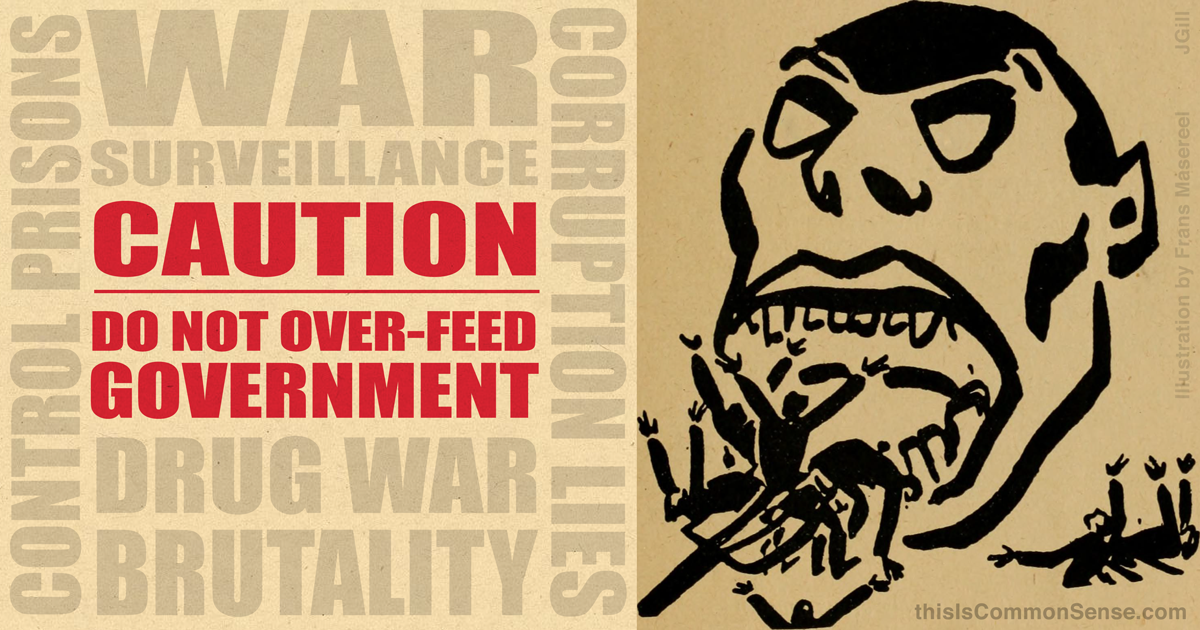
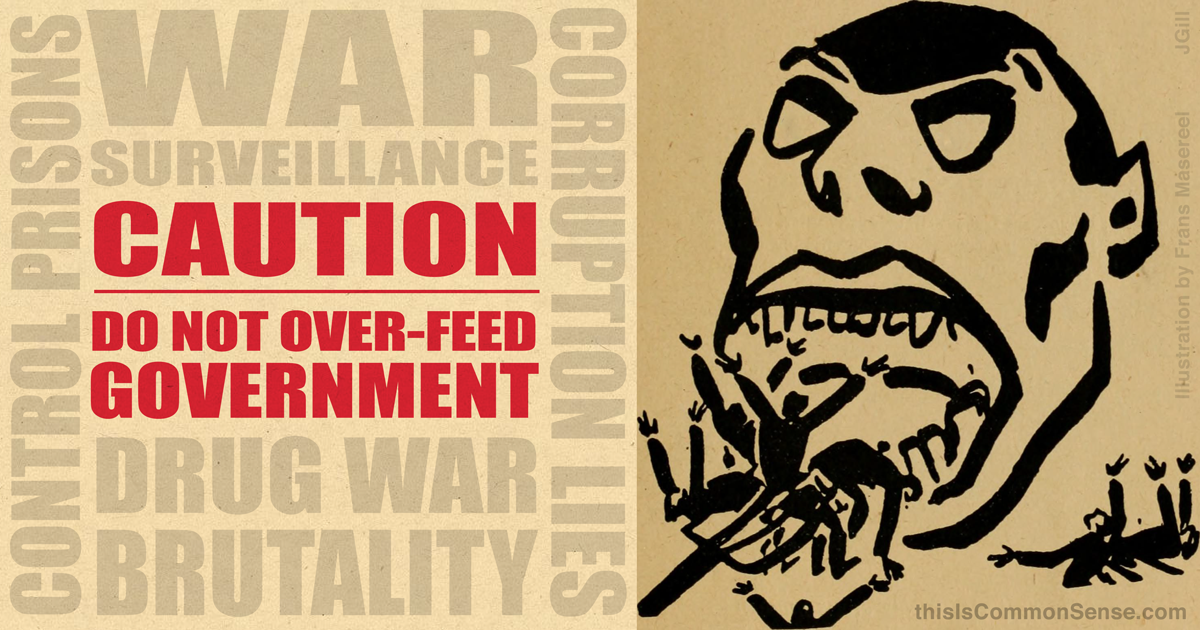
Caution: Do Not Over-Feed Government!
Get a high-resolution screensaver of this image. Click on the image below to open large version that you can download.

I have friends who call themselves anarchists. Their theory? Government is always merely an open conspiracy of some to live at the expense of others.
Republicanism, on the other hand, proposes that if we limit government, we can hone it down to the level where there is no conspiracy, and everything the government does can plausibly help everybody.
Not just a few insiders.
Socialism is the opposite notion. Socialists seek to grow government so far that it “naturally” serves everybody, not only the few. It’s all about “equality,” you see.
Here’s what we know for sure: socialism, when really tried, is so awful that it makes anarchy-as-chaos sound good.
The latest socialist horror is Venezuela, which is getting worse every day. Now hospitals place newborns in cardboard boxes. There are no other supplies.
But that’s not all. The special program for feeding everybody? It’s now mainly for feeding just those close to the government — precisely as my anarchist friends say all government is:
Six months after the creation of the Local Committees of Supply and Production (Clap) that is designed to “distribute food directly to the people,” the government has decided to change its approach by threatening those using the program.
The Venezuelan government announced that it will suspend delivery of food packages to those who criticize its policies.
Are socialist out to prove anarchists right?
I bet most of my readers still put some hope in limiting government to serve all. Venezuelan socialism demonstrates how badly the opposite idea is, showing us that serving everybody by total government just decays into the folks allied closely with government warring against everybody else . . . who starve in plain sight.
This is Common Sense. I’m Paul Jacob.

Questions Answered:
What is the difference between a republic and a socialist state?
What do anarchists think of government?
What happens when government tries to do everything for everybody?
The Next Question:
How do we convince well-meaning socialists that total government cannot work for the benefit of everybody? (Since the examples of the USSR, Communist China, and Venezuela haven’t worked so far.)

The “unexpected” Donald Trump presidential victory has put the folks at The Gray Lady a bit out of sorts.
Heather Wilhelm at the National Review pokes and prods at the absurdities of the New York Times’s cultural cluelessness. And ably enough. So I’ll stick to The Times’s recent “six views” of America’s ideological divide:
Julie Turkewitz recognizes two well-insulated informational bubbles at play. Nothing too controversial — or very deep.
Campbell Robertson muses upon the dominance of the “elites” against which Trump’s insurgents rebel, noting that “the elites are the still the ones who get to decide who gets to be elite.”
Laurie Goodstein takes on religious culture, making much of divergent spiritual outlooks, left and right.
Julia Preston peers at immigration and the prospect of sending a message by building a “wall.”
In the manner of the other five, Sheryl Gay Stolberg digs up real-world people — as does our speechifier-in-chief, Barack Obama — to lightly probe questions of assimilation versus multiculturalism.
Manny Fernandez concludes with a (yawn) discussion of giving and taking offense.
They all miss the underlying structural basis for the divide.
On one side: folks working in the private sector — or local governments and charities, or at home — who have seen the world pass them by in terms of income and security.
On the other: government workers and consultants (and other college grads) who make more, on average, than their “real world” counterparts.
The latter has advanced as a class; the former remain in stasis . . . at best.
A mystery?
No — it’s the predictable result of what Thomas Jefferson called “the parasite institutions now consuming us.”
This is Common Sense. I’m Paul Jacob.

Original (cc) photo by diana MĂRGĂRIT at Flickr

“If Libertarian Gary Johnson doesn’t win the presidency,” I posted to Facebook last Monday, “I’m leaving the country.”
Well, Johnson didn’t win. And I wasn’t kidding. I’m writing this from a Parisian café.
Of course, I was also tongue-in-cheek, since — spoiler alert! — I am coming home next week.
This week, I’m speaking at the Global Forum on Modern Direct Democracy in San Sebastián, Spain — a gathering of pro-initiative folks from all over the world. We want people’s votes to count, even if we disagree with their candidate or issue.
Which brings us back to Donald J. Trump’s surprise victory. Protests have broken out in several cities — some violent. And some folks say they’re scared of what Trump may do as president. Sure, one can snicker at these fearful responses as liberal whining. And to the extent they’re talking about university professors canceling tests and coddling “traumatized” students . . . well, no argument here.
Still, I don’t just sympathize when I hear people fear a politician with power, I empathize.
For a long time, I’ve been worried by out-of-control presidential power — from unconstitutionally making laws through executive orders to making war without any real check on that power. Scary. Whether that president is George W or Obama or Hillary or Trump.
Government is a monopoly on force. Therefore, by definition, government is frightening.
Democracy is often an antidote to tyranny, a check on power, but not always. That’s why folks who truly appreciate democracy believe in individual rights that transcend any vote-getting public decision mechanism.
Scared by President-Elect Donald Trump? Protect yourself: enact greater limits on government.
This is Common Sense. I’m Paul Jacob.
Questions Answered:
Is fear a natural byproduct of government?
Which presidential powers lack sufficient checks and balances?
What is more important: individual freedom or democratic decision-making?
Is democracy a check on power or an enhancement?
The Next Question:
How do we go about creating greater limits on political power?


The answer to what ails us is . . . us.
Oh, we can say it is the fault of politicians — and we’re not wrong — but turning to the cause of a problem for its solution is . . . problematic at best.
Our politics is a tug-of-war, in part, between those wanting government to do ever more for us (by taking more from someone else) and those skeptical that such “solutions” supply much more than ever-more problems.
The Big Government crowd sports the opposite skepticism: Where’s the guarantee that “the private sector” will take care of folks? They assume government does provide a guarantee . . . like No Child Left Behind.
Meanwhile, advances do get made.
Throughout my life I’ve had the privilege to work with political activists whom I deeply respect. These “liberty initiators” work tirelessly to make government better, to right wrongs, to institute justice and the sort of transparent, ethical and limited government that’s consistent with a free and decent society.
Just as adults nurture their children, these citizens nurture their communities, their states, their country — as well as taking care of their children, their parents, their businesses.
Last week, an Arkansas woman took a day off work to join hundreds of fellow citizens in gathering petition signatures for term limits at the primary in Arkansas. I have a lot more faith in her and other responsible individuals than I do in far-off federal bureaucracies.
“The character inherent in the American people has done all that has been accomplished,” wrote Thoreau in Civil Disobedience, “and it would have done somewhat more, if the government had not sometimes got in its way.”
This is Common Sense. I’m Paul Jacob.

Please consider showing your appreciation by dropping something in our tip jar (this link will take you to the Citizens in Charge donation page… and your contribution will go to the support of the Common Sense website). Maintaining this site takes time and money. Your help in spreading the message of common sense and liberty is very much appreciated!
Photo credit: Cary Bass-Deschenes on Flickr

Progressives are becoming increasingly defensive about nearly all forms of Big Government, relentlessly telling us that we need government for everything from money and roads to food inspection and subsidies and . . . well, the list is endless.
Food safety is one of their favorite subjects, but I’m increasingly skeptical. Do we really need to be protected from our neighbors’ produce and cooked goods, as can be found in community bake sales and potlucks?
In Arizona, legislators had long carved out an exemption from commercial food safety regulations for potluck and similar “noncommercial social events.” Great. But there was an unfortunate limitation to the exemption: it applied only to such events that took place at a workplace.
Home or church? Potlucks there are still against the law.
So of course officials took the occasion of said “loophole” to crack down on some neighborly events in an Apache Junction mobile home park, in Pinal County.
I’m sure hundreds, perhaps thousands of these events are routinely ignored by Arizona’s police. Indeed, I bet half of the state’s better cops engage in such activities themselves — just because potlucks are part of everyday life all over the country.
But the idiotic regulation allowed public servants (loosely so called) discretionary powers to attack a few people for reasons tangential to community safety. Thankfully, Rep. Kelly Townsend has introduced HB 2341, which would extend potluck freedom beyond the office or warehouse workplace.
Let us be clear: this was not a problem waiting to be solved by Big Government. It is a Big Government problem to be solved by new legislation to de-regulate home and community potlucks.
This is Common Sense. I’m Paul Jacob.


Building a mega-state to fight corporate power…
…is like giving yourself AIDS to fight the flu.
Click below for a high resolution version of this image:


The modern age sports an amazing feature that used to be hard to detect, because so drawn out: a shorter-than-ever-before lag between the proposal of some popular inanity and its complete debunking.
It used to take seemingly forever for a bad idea to be shown up, either in argument or evidence. Now it can be a matter of days or even hours. Call it the Buncombe/Debunking Lagtime.
Take the Flint, Michigan, water fiasco.
When the story hit the news cycle, almost immediately the progressive meme machinery began cranking out slogans imposed upon visuals — jpegs and gifs — to the effect that the poisoned water was the result of Republican “austerity” or (even) “libertarian” policy.
Somehow a Democratic mayor was less to blame than a more distant Republican governor, but in the minds of knee-jerk partisans, common sense is not as important as an in-your-face accusation.
But now, days and scant weeks into the story, it turns out that the story behind the story is not merely wrong, but entirely, upside-down wrong. The Flint water fiasco was caused by a stimulus project, and the switch from bad to worse water sources was made to promote “jobs”!
In the words of Reason’s Shikha Dalmia, “the Flint water crisis is the result of a Keynesian stimulus project gone wrong.”
Yes, another failed Big Government policy — just like progressives are always pushing.
And it didn’t take years for the truth to seep out.
Hooray for today’s accelerated history! Now, if we could only decrease the lagtime between lesson given and lesson learned.
This is Common Sense. I’m Paul Jacob.


When I was a kid, both Democrats and Republicans sported “conservative” and “liberal” wings as well as “moderate” leaders and representatives.
Now, conservatives have pretty much corralled themselves into the GOP, and liberals into the Democratic Party.
Why? Birds of a feather?
Ezra Klein offers some interesting observations in “This is what makes Republicans and Democrats so different”:
Klein also draws on research by political scientists Matthew Grossmann and David Hopkins, who in their paper, “Policymaking in Red and Blue,” conclude that “the Republican Party is dominated by ideologues who are committed to small-government principles, while Democrats represent a coalition of social groups seeking public policies that favor their particular interests.”
Interest groups demanding that their “particular interests” be addressed with more “deliverables” from government would certainly explain a strong Democratic Party bias in favor of more government. Klein seems to be saying that Democrats are led, as if by an invisible hand, in the socialistic direction.
But why does a Republican Party supposedly “dominated” by those with “small-government principles” also advance policies that grow big government? “New policies usually expand the scope of government responsibility, funding, or regulation,” Grossmann and Hopkins point out.
Perhaps Republican politicians are more influenced by their own position in government than by the views of their base voters.
This is Common Sense. I’m Paul Jacob.


The biggest problem facing Americans? According to a Gallup poll, for the second year in a row, it’s our government.
Maybe I should say “the government.” Few think it represents us. Which is sort of a big problem for a representative government.
Presidential candidate Donald Trump says our leaders are “stupid.” Were that the case, it’d be easier to correct. The reality is worse.
We have an ethical problem in government. Those entrusted to represent us represent, instead, themselves. And their cronies. And special interests.
Charged with creating a level playing field where we can all succeed through hard work, our elected officialdom have tilted that field. Oh, they’re doing just swell. The rest of us? Not so well.
Elected officials from Washington to state capitols have hiked up their pay, finagled perks, per diems and other bennies, and rewarded themselves with lavish pensions. Meanwhile, most Americans lack even a 401K to help save for retirement, much less a pension beyond a meager (and politician-imperiled) Social Security safety net.
Transparency? Well, it’s not just Hillary Clinton who has conducted public business privately. Even with her scandal looming in the headlines, Defense Secretary Ash Carter confidently did likewise.
Let’s end pensions for politicians, nudging them to return to our world. And let’s change the rules so they work serving the public, not for private gain.
Can we count on our elected representatives to rectify their ethical lapses? Not on your life. We need to do it ourselves, using ballot initiatives to put ethics first.
This is Common Sense. I’m Paul Jacob.