Categories
national politics & policies Second Amendment rights

It’s Not About Responsibility

“It’s not about me,” insisted the President of these United States, before crowds in Hartford, Connecticut.

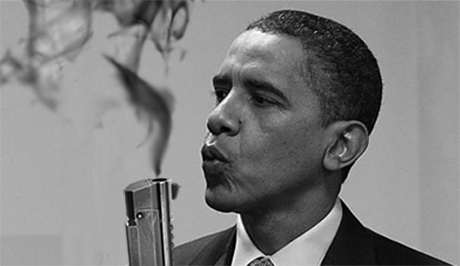
Barack Obama, in expert oratorical mode, elaborated: “Some in the Washington press suggest that what happens to gun violence legislation in Congress this week will either be a political victory or defeat for me.” After a long and impressive facial pause, he went on. “Connecticut, this is not about me; it’s not about politics. This is about doing the right thing. . . .” but he didn’t stop there. He listed the beneficiaries of “gun violence legislation”:

  • “for all the families who are here who have been torn apart by gun violence”;
  • “and all the families going forward . . . so we can prevent this from happening again”;
  • “it’s about the law enforcement professionals putting their lives at risk. . . .”

Not about politics? Sounds exactly like politics.

No discussion of the efficacy or practicality of what’s on the line, universal background checks on all gun sales. (Private trades in legal armaments now constitute a “loophole,” you see.)  What evidence is there that universal background checks would have stopped the murderous Adam Lanza — or most such hard-to-predict murderers?

The Orator-in-Chief’s earlier emphasis on the ostensible fact of 90 percent American support for this rule is also political. You can bet that the pollsters did not probe very deeply into the nitty gritty of the issue by asking about increases in bureaucracy, paperwork, the regulation of law-abiding folk.

Or how to get criminals to comply.

None of that.

It is all politics. The feel-good politics of politicians claiming they are “doing something.”

That is not principle. Not philosophy. And certainly not responsible policy making.

This is Common Sense. I’m Paul Jacob.

Categories
free trade & free markets national politics & policies too much government

A Teachable Wage

The U.S. President wants to up the national minimum wage to $9 per hour.

Republicans tend to lose at such policy debates, sometimes by daring to tell the truth: That minimum wage laws tend to raise unemployment. But that doesn’t impress politicians, who can’t be bothered to look beyond the surface of such issues.

They present the minimum wage hike as a guarantee that higher wages get paid all around, that wages only go up, rather than what actually happens: some wages go up to meet the law, and others evaporate, as people are let go, jobs downsized, and new jobs go uncreated.

So why would congressional Republicans use the same old rhetoric to balk at the president’s plan?

Sometimes irony works. Republicans should take all the Democrats’ premises — we want higher wages, more wealth, etc., etc. — and up the ante:

“Yes, raising wages would be great! But why are you all such tightwads? Raise the minimum to $49 an hour! Or make the lowest rate comparable with congressional pay: $85 per hour!”

Then compromise and say they will only vote for the raise if the rate hike is a serious amount, not the president’s paltry $1.75 increase.

At that point, a more honest conversation will start up.

For the ugly truth is that the harmful effects of the current and rather low minimum wage laws rest mainly on folks who aren’t very likely to vote, or to notice why it is they are unemployed. But raise the rate to $49 per hour, or even $19, and the scam becomes obvious to all but the most dense.

Even Democrats would insist on a lower rate.

And then Republicans should demand that Democrats explain why. And reveal the perverse logic behind minimum wages for all to see.

This is Common Sense. I’m Paul Jacob.

Categories
too much government

Oh, For a Smarter Obama

There are some things that can be endured only with irony, or a lot of drink (and I don’t drink).

Last night, as I listened to Barack Hussein Obama’s fifth “State of the Union” Address, I chose irony:

Obama just said he wants a smarter government, not a bigger one. So, surely, the new slogan will be: FREEZE GOVERNMENT SPENDING! Washington Will Simply Work Smarter for the Same Money! Now we’re united. Go Obama!

Live-blogging on Facebook in this manner allowed me to breeze through the rest of the tedium pretty well: my blood pressure didn’t rise one bit.

But this “smarter government” theme is actually a serious issue.

The problem with current government is not the IQs of the folks in our bureaucracies or running for office. The problem is the systemic effects of the incentives and disincentives that modern, barely limited government present to us all. We don’t need smarter government to improve conditions, we need wiser governance. And the wise person knows when to leave well enough alone.

Actually, there’s a lot of intelligence out there. And knowledge. But these are dispersed amongst “We, the People.” Government concentrates power, but it cannot concentrate knowledge or IQ in any multiplicative way. When people live under the right incentives — as provided by liberty and the rule of law — they become more responsible, they learn from their mistakes, and they even achieve some great things.

Government must learn to back off to allow this — or at least freeze spending!

I wonder if President Obama is smart enough, wise enough, to learn that.

Probably not as long as enough people laud him for saying inane things about “smart government.”

This is Common Sense. I’m Paul Jacob.

Categories
Accountability free trade & free markets

Standing By, Standing For

While President Barack Obama, Intoner-in-Chief, reads his “State of the Union” Address this evening, in front of a Congress of Over-Clappers, seated next to his wife will be Apple CEO Tim Cook.

Gene Sperling, White House economic advisor, enthused about the symbolism:

Apple is a great American company, and it stands for our sense of innovation, invention, entrepreneurship, and risk taking and I think that’s quite an appropriate person to be in the First Lady’s box when the president is talking about our economic future, the importance of job creation, manufacturing, innovation and how we create strong middle-class jobs.

Apple is, indeed, a great American business — one of the few that people who typically disdain business can’t stop loving. But it might be worth remembering that Apple’s success doesn’t so much “stand for our sense of innovation, invention, entrepreneurship and risk taking” as exemplify all of those things . . . “our sense of” those qualities is secondhand at best.

But politicians like to soak up secondhand qualities. They eat symbolism for lunch and dinner.

I wonder if the president, in stating the union’s state, will dare compare the qualities of America’s best companies and folks like Tim Cook (corporate heir of Steve Jobs; master of the supply chain) with that of America’s government.

A huge chasm separates them. Having won the election, President Obama enjoys a captive customer base over the next four years. Mr. Cook does not. Obama seeks to raise his revenue by taking more from a tiny minority. Cook has to persuade people to willingly buy his product.

This is Common Sense. I’m Paul Jacob.
Categories
ideological culture responsibility

If You Build It, They Will Come

During the presidential campaign, Barack Obama was criticized for telling business folks “You didn’t get there on your own. . . . You didn’t build that.”

He meant something more than the truism that a successful businessperson functions not in splendid isolation but in cooperation with others, like employees and vendors (presumably compensated). He meant that successful people shouldn’t be so proud of their virtues. Also they must pay more taxes.

Surrogates yipped that Obama’s denigration of individual achievement wasn’t what it sounded like. But his inaugural address was more of the same. Charles Krauthammer calls the speech “an ode to collectivity,” with its stress not on voluntary associations but on coercive orchestration by the state. According to Obama, for example, “No single person can” do all the good things like build research labs and train teachers that we supposedly must do “as one people.”

Sounds like a glaring false alternative. David Boaz observes that “property rights, limited government and the rule of law”—under assault by Obama—are what we need to safeguard the voluntary cooperation critical to our progress and individual flourishing. I would add that we necessarily pay our own way as we engage in voluntary trade. We do “build that,” and so does the other guy.

Government can confine itself to protecting our rights in trade and otherwise leave us alone, or it can actively plunder our achievements. If the latter, we have less of what we built. Even though we did build that.

This is Common Sense. I’m Paul Jacob.

Categories
crime and punishment folly national politics & policies

Shooting from the Hip

Wearing his I’m-Not-Partisan-No-Not-Me hat, President Obama has again declared war on partisanship, telling congressional Republicans to “peel off the partisan war paint.”

To be partisan in a bad way is not merely to belong to a political party and more or less support its program. It is to cling to party at the expense of Doing the Right Thing.

Unless, that is, it’s about opposing the program of a president determined to be partisan at the expense of Doing the Right Thing.

I often disagree with both parties. But let’s say that a representative of one party is marginally more reluctant to destroy our wealth and freedom than a representative of another party. Then I prefer the slightly more responsible stance of the former — and wish it were tougher and more consistent — even when the latter engages in name-calling and abuse of the former.

Demanding “perspective,” President Obama declares that he and the Congress should “not put ourselves through some sort of self-inflicted crisis every six months.” And I wholeheartedly agree. These crises happen because their spending programs always go up and up and up, even when a few “cuts” get made.

But the president doesn’t stop there. He explains they must “allow ourselves time to focus on things like preventing the tragedy in Newtown from happening again, focus on issues like energy and immigration reform. . . .”

Um, sir, please do not suggest that an unimpeded path to fiscal ruin is the only way to prevent fiscal ruin, or can somehow enable policymakers to prevent crazy gunmen from killing people. Please.

This is Common Sense. I’m Paul Jacob.

Categories
government transparency

Lights, Cameras, Action

“It’s the president who is threatening to raise taxes on the middle class if he doesn’t stamp his feet and get his way,” Grover Norquist charged on NBC’s Meet the Press. “He should get into a room with C-SPAN cameras there and negotiate. So instead of hearing rhetoric like this — because that was all show and no economics — let’s have it in front of C-SPAN cameras. And if the Republicans are being reasonable, we’ll see that. If they’re not, we’ll see that. Got to have cameras in that room.”

Norquist has a great idea. Why allow our so-called leaders do their stuff — their thing, their deliberation and negotiation or what-have-you — behind closed doors? Let’s have it in living color, out in the open, with the audio turned way up, for the American people to witness first-hand.

But, of course, the C-SPAN idea isn’t really Grover Norquist’s — any more than it is his pledge not to raise taxes. The power of the mass of voters, who truly want to hold down taxes, entices candidates to sign the tax pledge and enforces their compliance.

After all, it was candidate Barack Obama who promised repeatedly during the 2008 campaign that if he were elected president “we’re going to do all these [healthcare] negotiations on C-SPAN so that the American people will be able to watch.”

Then, President Obama tossed out that transparency pledge and turned off the public. Just like some want Republican congressman to toss aside their commitment not to raise taxes.

Keep your word. And let us see our government in action. How damning could it be?

This is Common Sense. I’m Paul Jacob.

Categories
ideological culture

Alfred Nobel Rolls Over

The Nobel Committee, having whetted its appetite for absurdity with a long string of goofy Peace Prize Awards, especially but not limited to the 2009 award for Barack Obama (who had done nothing but get elected to earn it), went all the way by giving the 2012 award to the European Union.

Barack Obama went on to become a “war president,” even regularly picking targets for assassination by drone. So, could Europe continue the trend and head straight towards war?

Maybe. Last year, former French Prime Minister Alain Juppe warned that the unions debt crisis could lead to “the explosion of the European Union itself,” and warned of growing nationalism. And violent unrest.

Dire warnings from former heads of state are one thing. Actual military movements are another. And Switzerland seems to be preparing for the worst:

The Swiss defense ministry told CNBC that it doesn’t rule out having to deploy troops in the coming years.

“It’s not excluded that the consequences of the financial crisis in Switzerland can lead to protests and violence,” a spokesperson told CNBC.com. “The army must be ready when the police in such cases requests for subsidiary help.”

Talk about financial contagion!

Cooler heads may prevail, of course. Matthew Feeney, writing at reason.com, notes that the “most obvious argument against the possibility of war is that there are no likely candidates for the part of aggressor.” And Europe hasn’t exactly been engaging in a massive military build-up, unlike before the two world wars.

Alas, that doesn’t preclude massive rioting and uprisings.

Sovereign financial bankruptcy usually follows war, rather than preceding it. I guess that provides something like hope.

This is Common Sense. Im Paul Jacob.

Categories
ideological culture tax policy

Curvewise, Gainswise

The so-called “Laffer Curve” — the graphic representation of the varying relationship between tax rates and tax revenues — really bugs people left of center.

The curve maps an economic reality, showing that not all increases in tax rates can increase tax revenues. Why object to reality?

Perhaps because, on the left, taxes are seen less as a practical means to raise government revenue than as an expression of one’s values. The more “leftist” one is, the more equality matters, which too often boils down to: the more one wants to punish the rich. Higher rates stifle the economy and garner less revenue? Big deal. Consequences be damned. One’s values must be expressed.

This came out in Barack Obama’s first presidential campaign. He famously didn’t care whether a capital gains tax rate increase would decrease revenues, as has happened in the past. For him, “fairness” was more important.

Interestingly, it appears that capital gains tax rates tend to top out Laffer-Curve-wise much lower than income taxes. The reason? One seeks a return on capital from invested savings, but one also fears the possibility of loss.  Risk. Pile higher tax rates onto the already palpable negative of uncertainty, and the investor will be tempted to consume his capital rather than engage further in risking his wealth for less reward.

But I confess: I sort of sympathize with the left’s attitude towards taxation. I don’t really want the government to maximize revenue, either. Government misspends most everything it takes in, so I’d prefer lower rates for reasons maximizing quality, not equality.

I bet that the poor, though, would be far better off were the rich not targeted for extra penalties. But that’s not an egalitarian concern, for me. It’s a humanitarian concern.

This is Common Sense. I’m Paul Jacob.

Categories
ideological culture national politics & policies political challengers

Polled American!

More people view Mitt Romney unfavorably (49 percent) than view Barack Obama unfavorably (45 percent), according to the most recent Reason-Rupe Poll. This, despite Romney being the challenger, while President Obama must live down his sorry record.

By this measure, and others in the poll, Obama’s re-election seems ever more likely. And if you think that’s depressing, wait till you read about the general views of taxing the rich more. The “soak the rich” mentality remains quite strong. But some of this “the rich don’t pay their fair share” notion is based on misinformation. Get a load of this:

Last year, the government collected about $1.8 trillion dollars in income tax revenue. If you were to estimate, about what PERCENTAGE of this total tax revenue do you think the top 5 percent of households probably contributed? Would you say…

<1% . . . . . . . . . . . . . . . . . . .  3%

1% to less than 20% . . . . . . . 29%

20% to less than 40% . . . . . . 19%

40% to less than 60% . . . . . . 15%

60% to less than 80% . . . . . . 11%

80% or more . . . . . . . . . . . . . 8%

Don’t Know/Refused . . . . . . . 16%

The truth is that America’s Top 5 percenters pay more than 60 percent of income taxes collected. The vast majority of those polled (66 percent) thought the Top 5 should pay less than they currently do.

I’m not going out on a limb, here, to infer a lesson: Were Americans to learn a few more truths about their government, about taxes, and (hey, why not?) real life, they might change their minds on a few crucial political notions.

Education — and by this I don’t mean schooling — is obviously important to political betterment.

This is Common Sense. I’m Paul Jacob.