Categories
Accountability government transparency incumbents initiative, referendum, and recall local leaders nannyism political challengers Regulating Protest term limits too much government

Strange It Is

Strange for the Arlington, Texas, City Council to hold a meeting on a Sunday evening, much less one to “consider suspending the city charter.”

That is how the Fort Worth Star-Telegram reported “the latest twist in the term limit controversy that has engulfed the city with a lawsuit and competing ballot proposals.”

Led by Zack Maxwell, citizens in this Fort Worth adjacent community of 400,000 gathered 11,000 voter signatures to place a term limits charter amendment on the November ballot. It would limit councilmembers to three two-year terms. It also figures in past service, so five of the eight current councilmembers would be blocked from seeking re-election in the coming two years.

With swift legislative prowess, the council responded, passing its own competing “term limits” measure, which incidentally allows them to stay 50 percent longer in office.

But there’s one problem: the council did not follow the law, which requires multiple readings, with one at a regular meeting. 

Actually, there’s a second problem: Mr. Maxwell challenged the council’s unlawful action in court. 

The court blocked the council’s measure. 

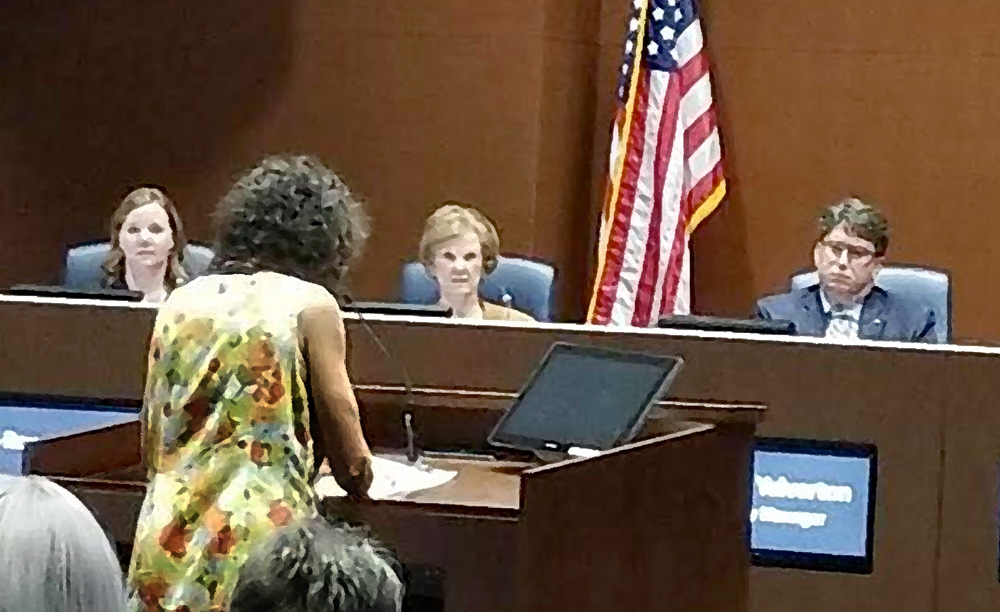
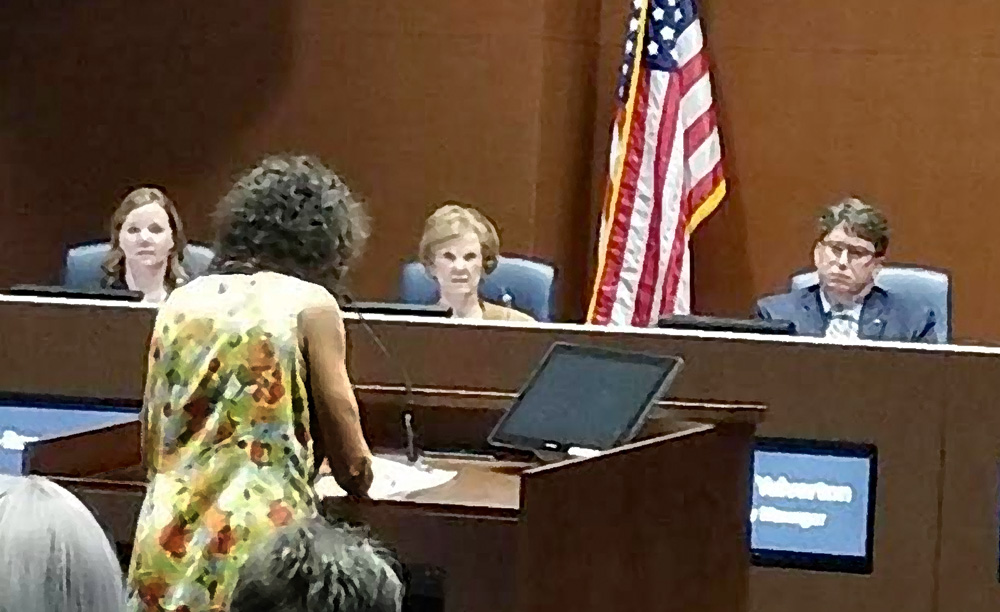
That left the council holding an unusual weekend meeting to suspend the rules and re-pass their fumbled alternative to the term limits voters really want. But news travels fast and city hall was “packed.” 

“You’re suspending the rules because your jobs are in jeopardy,” charged one man.

A woman told the council, “You guys should be absolutely embarrassed about this.”

“After hearing from dozens of angry residents,” the paper explained, “[t]he council voted unanimously to not suspend the rules, finally killing its own term limit proposal.”

Politicians doing the right thing . . . having exhausted every other possibility.

This is Common Sense. I’m Paul Jacob. 


PDF for printing


Photo from the Fort Worth Star-Telegram

 

Categories
Today

Singing Revolution

On August 23, 1989, two million people from Estonia, Latvia and Lithuania stood on the Vilnius-Tallinn road, holding hands, as part of the “Singing Revolution” that helped set the Soviet Union to its implosion.

Categories
Thought

Confucius

If you see what is right and fail to act on it, you lack courage.

Categories
Common Sense free trade & free markets government transparency insider corruption local leaders media and media people national politics & policies too much government

Never Trust a Politician

One of my more persistent critics on this site asked, last week, why I might believe anything the current president says — considering all the lies.

For reasons of decorum I won’t repeat his exact wording.

The odd thing about the comment was not the vulgarity, though (unfortunately). It was the idea that I was relying upon belief in Donald Trump’s veracity. The whole point of my commentary regarding Trump’s handling of trade and foreign policy was to read between some lines.

I try never to believe anything . . . er, everything . . . any politician says.

In Donald Trump’s case, though, there are lies and there are fictions and there are exaggerations. And corkers . . . and “negotiating gambits.” Separating the wheat from the chaff from the grindstone is not always easy.

Based not only on some of what he says, but also on results-thus-far from the EU negotiations, Trump’s idea of “fair trade” appears to be multilateral free trade. But he has chosen a bizarre method to get there: the threat of high-tariff protectionism — which in the past has led to multilateral protectionism, not free trade.

Trump sees everything as a contest. Trade isn’t a contest as such. It’s win-win. But trade negotiations are contests. And Trump’s game of chicken is dangerous.

Regarding foreign policy generally, though, he seems to be playing a more familiar game: we can outspend everybody. The recent increase in Pentagon spending is bigger than Russia’s annual military budget!

So, who pays? Americans in

  1. higher taxes and 
  2. the consequences of massive debt, as well as in
  3. the higher prices from his tariffs.

That’s awfully daring of him. For us.

This is Common Sense. I’m Paul Jacob.


PDF for printing


Photo from Max Pixel


Categories
Today

Devil’s Island

On August 22, 1952, France closed its penal colony on Devil’s Island.

At first a leper colony, it had been transformed by the end of the 19th century into a prison tasked primarily with housing enemies of the French state.

Categories
Thought

Epictetus

It is unlikely that the good of a snail should reside in its shell: so is it likely that the good of a man should?

Categories
Accountability incumbents initiative, referendum, and recall insider corruption local leaders political challengers term limits

Sneaky Lobbyists Prefer Sneakiness

The Arkansas Chamber of Commerce’s CEO and chief lobbyist, Randy Zook and Kenneth Wall, have formed Arkansans for Common-Sense Term Limits. 

The Chamber has a burning hatred for term limits — Common-Sense or otherwise — just like every other lobbyist and special interest. But Zook and Hall are fibbing in their name because they realize that voters love term limits. 

The ballot committee’s stated purpose? To “advocate for the disqualification or defeat” of the Arkansas Term Limits Amendment, which citizens just petitioned onto the ballot, collecting 129,000 signatures.

Defeating such a popular ballot measure isn’t likely. Instead, these politically-experienced lobbyists are preparing to sue, hoping to disqualify valid voters’ signatures on some ginned-up technicality, feigning confusion over the clear ballot language — anything that might keep democracy from coming this November.*

At issue? The difference between real term limits and ridiculous ones.

That is, between term limits set by citizens and those set by legislators themselves. 

Currently, legislators can serve for 16 years in a single seat under the state’s “limits.” And because two-year Senate terms aren’t counted at all, senators can stay as long as 22 years. 

Legislators snuck this past voters in 2014 with a ballot title claiming only to “establish” term limits . . . amidst other lies. Politicians thereby turned Arkansas’s toughest-in-the-nation term-limit law into the nation’s very weakest — a significant 50 percent longer than limits in any other state.**

Unfazed by all the corruption in the Arkansas Legislature, Chamber lobbyists are focused on putting politicians in their pocket for as long as possible. 

But those pesky Arkansas voters are once again in the way.

This is Common Sense. I’m Paul Jacob.


* After recently threatening to challenge the signatures of another initiative petition, Zook had to admit that he was not aware of a single problem or deficiency in the petition. But he quickly added, “It’s a very complicated process.”

** Arkansas’s term limits were the same as Michigan’s until 2014, three terms, six years in the House and two-terms, eight-years in the Senate.

PDF for printing


Original photo by Jeff Kubina


Categories
Today

Nat Turner

On August 21, 1831, Nat Turner led slaves and freed black Americans in a rebellion that was quickly suppressed.

Categories
Thought

Benjamin Constant

Where there are no rights, there are no duties.

Categories
education and schooling ideological culture moral hazard responsibility too much government

An Expert Explains Failure

The failures of the public high schools in the District of Columbia go on an on. It is quite a scandal, as I explained this weekend at Townhall.

And yet some “charter schools that serve large populations of children from low-income families,” notes the Washington Post, after providing much detail about the massive failures, “recorded big increases in scores.”

What hint about improving education does that fact give?

Well, Kevin Welner, a professor who heads the National Education Policy Center at the University of Colorado, has an interesting thought: “People want to read into these test scores lessons about what the schools are doing. But these scores, even the growth scores, depend a great deal on students’ opportunities to learn outside of school. If we address the poverty and racism, then we will see these test scores increase.”

Hmmm. Let’s review: (a) the problem is at home and (b) it cannot be overcome by the schools. Moreover, the esteemed professor perceives the cause of these detrimental home environments to be “racism and poverty.” 

Once upon a time, public education was proclaimed to be the great equalizer, allowing the disadvantaged to climb the economic ladder, and, if not wipe out poverty completely, to certainly dramatically reduce it. 

Now, we discover from a certified education expert that we had it backwards.

So maybe it is time to chuck the whole experiment and just try to educate kids.

Not “save” them, or society.

This is Common Sense. I’m Paul Jacob.


PDF for printing