This weekend’s podcast is set around the big day this weekend, Independence Day. Paul Jacob has a lot to say. And he says it here:

This weekend’s podcast is set around the big day this weekend, Independence Day. Paul Jacob has a lot to say. And he says it here:
On July 2, 1776, the Continental Congress approved the Lee Resolution:
Resolved, That these United Colonies are, and of right ought to be, free and independent States, that they are absolved from all allegiance to the British Crown, and that all political connection between them and the State of Great Britain is, and ought to be, totally dissolved.
That it is expedient forthwith to take the most effectual measures for forming foreign Alliances.
That a plan of confederation be prepared and transmitted to the respective Colonies for their consideration and approbation.
The Lee Resolution, July 2, 1776, as adopted by the Continental Congress.
That evening the news hit the papers:
This day the Continental Congress declared the United Colonies Free and Independent States.
Pennsylvania Evening Post, July 2, 1776.
John Adams wrote to his wife Abigail:
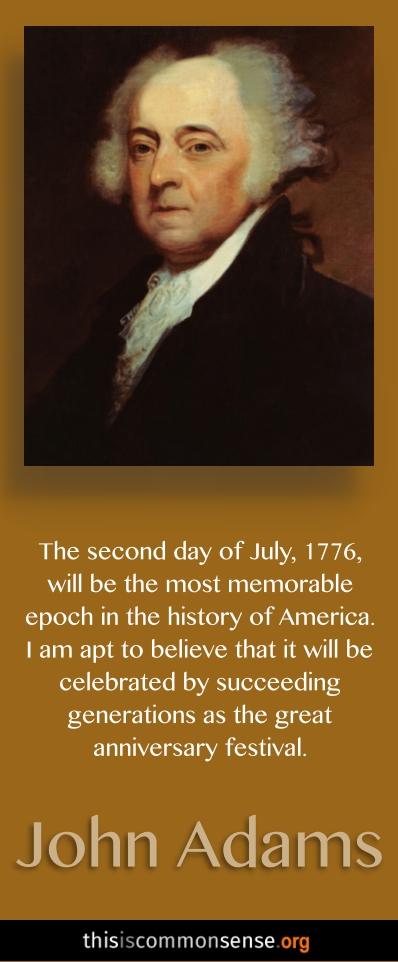
The second day of July, 1776, will be the most memorable epoch in the history of America. I am apt to believe that it will be celebrated by succeeding generations as the great anniversary festival. It ought to be commemorated as the day of deliverance, by solemn acts of devotion to God Almighty. It ought to be solemnized with pomp and parade, with shows, games, sports, guns, bells, bonfires, and illuminations, from one end of this continent to the other, from this time forward forever more.
John Adams to Abigail Adams, personal correspondence, July 3, 1776.
John Adams was almost immediately proven wrong: July 4, 1776, when the Declaration of Independence was approved by Congress, was the day Americans chose to celebrate the dissolution of ties with Great Britain.
July Fourth events include:
1054 – A supernova was spotted by Chinese, Arab, and possibly Amerindian observers near the star Zeta Tauri, remaining, for several months, bright enough to be seen during the day. Its remnants form the Crab Nebula.
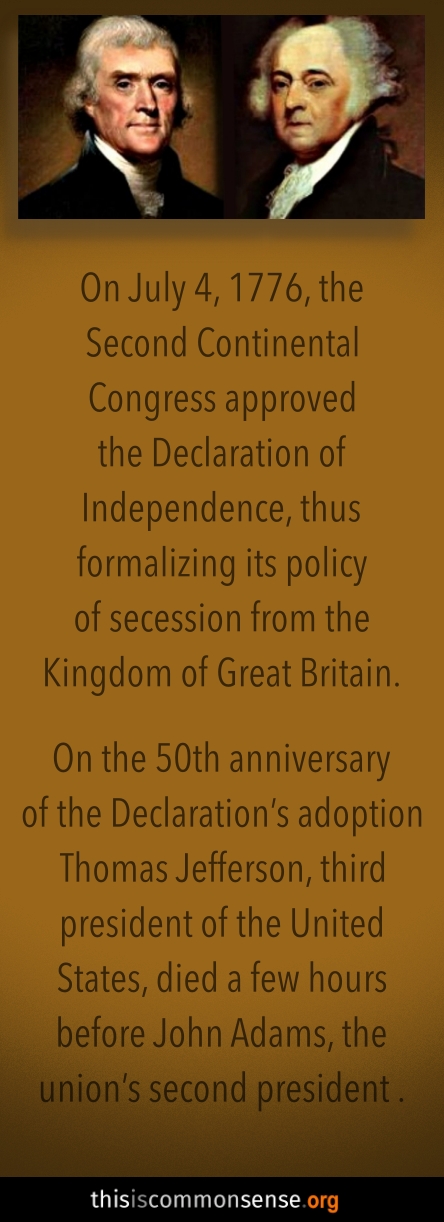
1776 — The Second Continental Congress approved the Declaration of Independence, thus formalizing its policy of secession from the rule of the Kingdom of Great Britain.
1803 — The Louisiana Purchase was announced to the American people.
1804 – Nathaniel Hawthorne, American author of The Scarlet Letter, House of Seven Gables, The Blithesdale Romance, and other classics, was born. Hawthorne became part of the Young America literary movement spawned by Loco-Foco political activism in New England.
1826 – Thomas Jefferson, third president of the United States, died a few hours before John Adams, second president of the United States, on the fiftieth anniversary of the adoption of the United States’ Declaration of Independence.
1826 – Stephen Foster, composer of “Old Black Joe,” “Beautiful Dreamer,” and many other classic American songs, was born.
1827 – Slavery was abolished in New York State.
1831 – Samuel Francis Smith wrote “My Country, ’Tis of Thee” for Boston’s July 4th festivities, set to the tune of Great Britain’s national anthem, “God Save the King/Queen.”
2009 – The Statue of Liberty’s crown re-opened to the public after eight years of closure that resulted from security concerns following the September 11, 2001, attacks.

. . . and to the refrigerator for which it stands, one cooling unit, under electric power, indivisible from the side by side freezer, with cold drinks and frozen TV dinners for all.
Silly to pledge allegiance to a refrigerator or its warranty? Perhaps no more so than to pledge allegiance to our nation’s flag or our beloved Republic, for which that flag stands.
Wait a second: Doesn’t our Republic deserve our allegiance?
Well, what is meant by “allegiance”? The first dictionary definition reads: “the obligation of a feudal vassal to his liege lord.”
The word “allegiance” does indeed derive from feudal times. Even further variations of the definition — “the fidelity owed by a subject or citizen to a sovereign or government” or “the obligation of an alien to the government under which the alien resides” — are tied to a relationship whereby “We, the People” are inferior to our nation-state.
But not in America. We are not “subjects” nor “aliens.” We are the sovereigns.
That wonderful frost-free icebox is ours; it works for us. This Republic is also ours and it was designed to work for us. In clear and deliberate language. In fact, language not dissimilar from an appliance warranty — though written more accessibly for the common person.
We are the government. So, do we really need to pledge our allegiance to ourselves?
As Judge Andrew Napolitano asked on his Freedom Watch show several years ago — before Fox mysteriously cancelled the show — “Does the government work for us or do we work for the government? Are true patriots guided by symbolism such as flag waving and pledges or by their commitment to personal freedoms?”
Perhaps it doesn’t matter. Most folks reciting the Pledge surely do not view themselves as feudal serfs.
Still, words matter. And actions and rituals matter as well. Tomorrow we celebrate Independence Day — not simply as a method to get out of work, but as a way to remind ourselves and our children that this country was conceived in liberty, in the hope we can continue to expand on and live in freedom. (That’s why I say “Independence Day” rather than the “Fourth of July,” since what happened is much more important than the date it happened.)
The Founders who signed the Declaration of Independence — pledging their lives, fortunes and sacred honor — didn’t see fit to establish a pledge for citizens to recite. Their pledge was to each other and to the country.
The Pledge of Allegiance, on the other hand, was written by an admitted socialist, Francis Bellamy, in 1892. In addition to the Pledge, Mr. Bellamy also came up with a salute for school children and others to make toward the flag. To prove that truth is stranger than fiction, what came to be known as the Bellamy Salute was very similar to the salute adopted by Mussolini and the Italian fascists . . . as well as the Nazis, for use in tandem with their exclamation of “Heil Hitler!”
In 1942, after U.S. entry into World War II, Congress amended the Flag Code to advise folks to place their hand over their heart, instead of giving the Nazi — er, Bellamy Salute.
Don’t go off the deep-end here: I’m not suggesting that reciting the Pledge of Allegiance makes one a Nazi, or even a far milder brand of socialist. When Americans recite the Pledge, they do so for love of country and to affirm the freedoms our Republic is designed to protect and defend.
What I am declaring is that we Americans must understand our history, our government, and our exceptional place in the world well enough to stop defining patriotism as the repetition of someone else’s words about an alien concept of allegiance. Instead, let’s celebrate the words that are quintessentially ours: the Declaration of Independence, the Constitution and the Bill of Rights.
As we celebrate our Independence Day, our break from the monarchy of the Old World, we ought to appreciate that this break threw out any allegiance to rulers as if they wielded divine power over us and substituted for that corrupt rule a constitutional republic, where the citizens had protection against government encroachment on their freedoms, written down in black and white and fully enforceable.
The Constitution is a warranty of sorts. And the more we think of government in practical terms, like a refrigerator or an agreement for services, rather than some mystical force that tells us what to do, the better for actually maintaining our freedom and keeping our Republic.
As Tom Paine wrote: “It is the duty of the patriot to protect his country from his government.”
We cannot protect our freedom by repeatedly declaring allegiance to the Republic, much less its three-color stand-in.
Instead, saving our Republic requires citizens to stand up and demand that our government adhere to the contract.
This is Common Sense. I’m Paul Jacob.
See all recent commentary
(simplified and organized)
See recent popular posts
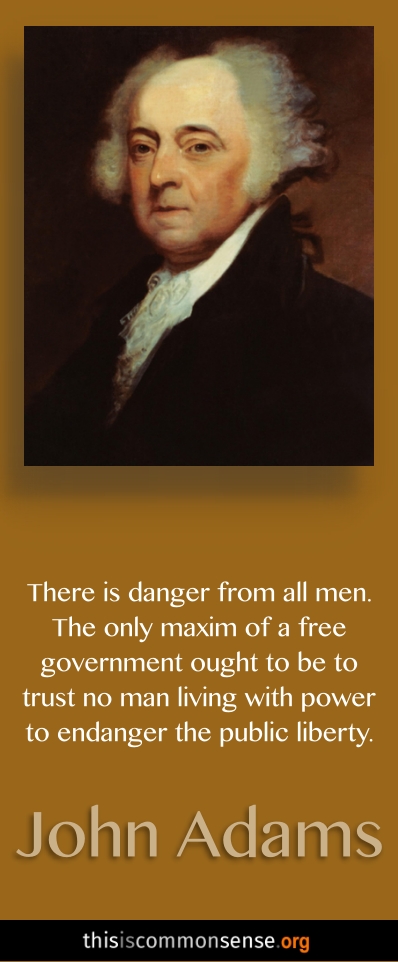
There is danger from all men. The only maxim of a free government ought to be to trust no man living with power to endanger the public liberty.
John Adams, in notes for an oration at Braintree (Spring 1772).

July 3 marks the 1947 birthday of Dave Barry (pictured), American columnist and author.
Five years later on the same date, Puerto Rico’s Constitution was approved by the Congress of the United States.

Yesterday, on the 23rd anniversary of Britain’s 1997 handover of Hong Kong to China, the Chinese Communist Party (CCP) imposed a draconian national security measure on the previously semi-autonomous territory.
“The law effectively ends the long-cherished freedom of speech that Hong Kong residents have had,” reported The Washington Post, “putting them under the same threat of life imprisonment if they criticize Beijing’s government, as other Chinese nationals face.”
Supersizing police powers to “intercept communications and covertly surveil people” are also part of the CCP clampdown.
“In the past,” a pro-Beijing council member explained, “Hong Kong has been too free.”
In keeping with that sentiment, protests planned for yesterday were banned.
“They still came out,” however, noted a reporter with UK’s Sky News, “even though the cost of protest had been raised significantly on the first full day of the new law.”
“We are on street,” tweeted Joshua Wong, the young pro-democracy activist, “against national security law. We shall never surrender. Now is not the time to give up.”
“China is Hong Kong, Hong Kong is China, as of today, the first of July. It’s a sad day, but that’s what it is,” offered a woman protester. “I’ll still take to the streets. I’ll still say what I think. Because it is my right as a human being.”
More than 300 protesters were arrested yesterday.
Wong called on the “international community” to “continue to speak up for Hong Kong” and help protect its “last bit of freedom.”
This is Common Sense. I’m Paul Jacob.
See all recent commentary
(simplified and organized)
See recent popular posts
Remota itaque iustitia quid sunt regna nisi magna latrocinia? quia et latrocinia quid sunt nisi parua regna? Manus et ipsa hominum est, imperio principis regitur, pacto societatis astringitur, placiti lege praeda diuiditur. Hoc malum si in tantum perditorum hominum accessibus crescit, ut et loca teneat sedes constituat, ciuitates occupet populos subiuget, euidentius regni nomen adsumit, quod ei iam in manifesto confert non dempta cupiditas, sed addita inpunitas. Eleganter enim et ueraciter Alexandro illi Magno quidam comprehensus pirata respondit. Nam cum idem rex hominem interrogaret, quid ei uideretur, ut mare haberet infestum, ille libera contumacia: Quod tibi, inquit, ut orbem terrarum; sed quia ego exiguo nauigio facio, latro uocor; quia tu magna classe, imperator.
Augustine of Hippo, De Civitate Dei (c. 400 AD), IV, 4
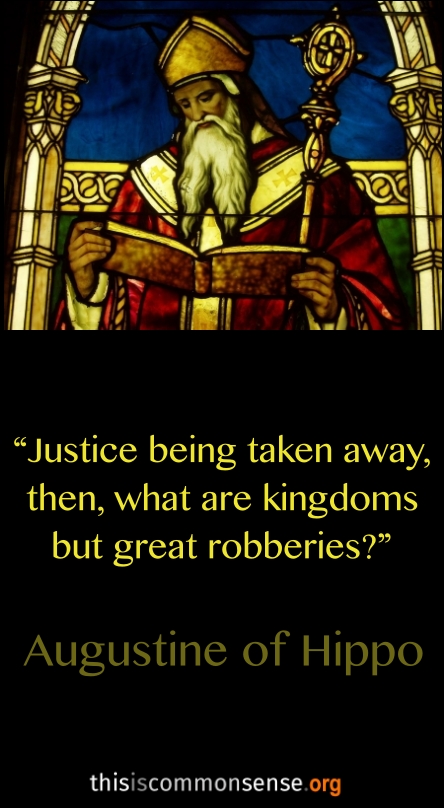
Justice being taken away, then, what are kingdoms but great robberies? For what are robberies themselves, but little kingdoms? The band itself is made up of men; it is ruled by the authority of a prince, it is knit together by the pact of the confederacy; the booty is divided by the law agreed on. If, by the admittance of abandoned men, this evil increases to such a degree that it holds places, fixes abodes, takes possession of cities, and subdues peoples, it assumes the more plainly the name of a kingdom, because the reality is now manifestly conferred on it, not by the removal of covetousness, but by the addition of impunity. Indeed, that was an apt and true reply which was given to Alexander the Great by a pirate who had been seized. For when that king had asked the man what he meant by keeping hostile possession of the sea, he answered with bold pride, “What thou meanest by seizing the whole earth; but because I do it with a petty ship, I am called a robber, whilst thou who dost it with a great fleet art styled emperor.” St. Augustine, The City of God (c.400), IV, 4, Rev. George Wilson and Rev. J. J. Smith, translators.
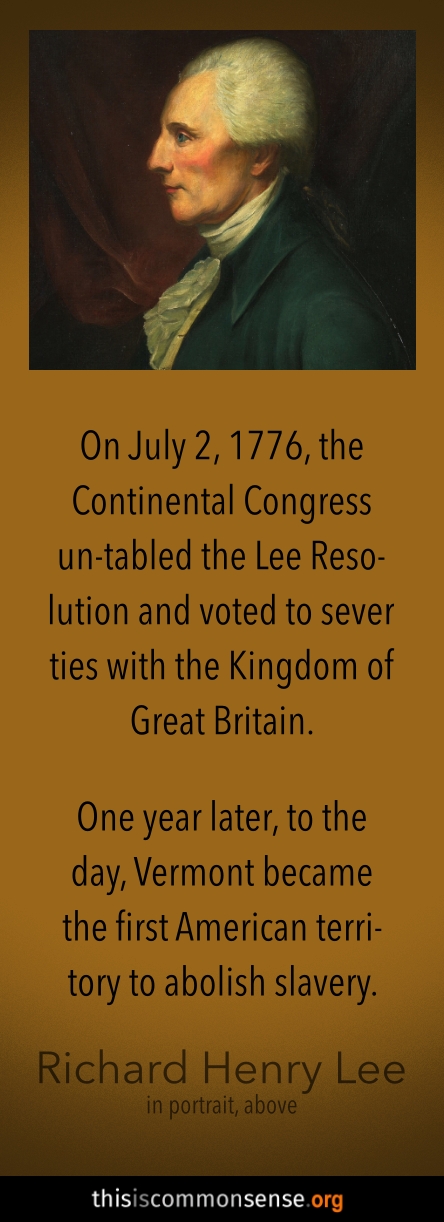
On July 2, 1776, the Continental Congress un-tabled the Lee Resolution and voted to sever ties with the Kingdom of Great Britain.
One year later, to the day, Vermont became the first American territory to abolish slavery.
On Monday, we considered how to get better representation in Congress for the 700,000 folks residing in our nation’s capital city, Washington, D.C.
Today, let’s tackle how the rest of us get any semblance of representation. We are sliced up into 435 congressional districts, each comprised of roughly 700,000 people electing a “representative” supposedly doing our business in Washington.
Are they doing our business?
The nearly universal and long-standing public disapproval of Congress answers that question.*
As the framers of the Constitution saw it, Congress would be the first and most powerful branch of government, as it would be closest to the people. The original idea was to create in members of Congress a “fidelity to their constituents,” James Madison wrote in Federalist No. 57, which “would be found very insufficient without the restraint of frequent elections. Hence . . . the House of Representatives is so constituted as to support in the members an habitual recollection of their dependence on the people.”
Madison goes on to say that congresspeople “will be compelled to anticipate the moment when their power is to cease.”
Yet well-funded congressional incumbents sporting 90 percent-plus re-election rates cycle after cycle, decade after decade — serving 20 and 30 and 50-plus years — cannot plausibly feel either compelled or dependent.
Looming large over the problem? Huge population districts.
The more voters in a district, the more expansive and expensive campaigns must be . . . and the bigger the need for help from special interests . . . and the more powerful those groups’ influence.
Conversely, the smaller a district is, the more influence constituents individually have on their representative.
It may seem paradoxical, but it isn’t: citizens will wield more power when there are more representatives in Congress.
This is Common Sense. I’m Paul Jacob.
* In April, after sending stimulus checks to the entire country, Congress did more than double its approval rating, though it is still seen unfavorably by a lopsided two-to-one margin.
See all recent commentary
(simplified and organized)
See recent popular posts