Categories
Thought

Senator Sam Ervin

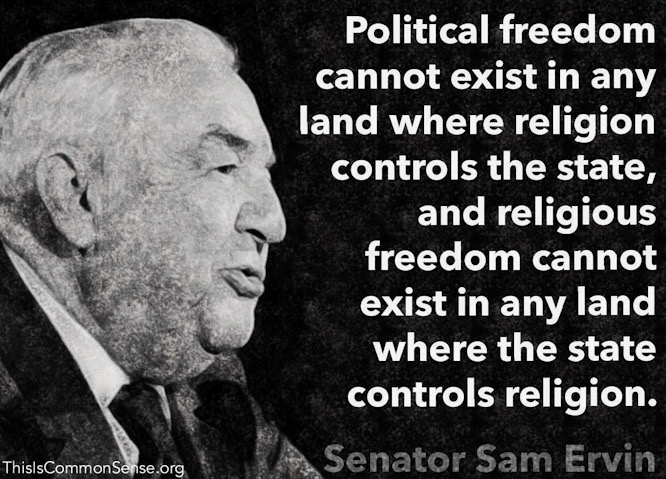
Political freedom cannot exist in any land where religion controls the state, and religious freedom cannot exist in any land where the state controls religion.

Samuel James Ervin, Jr., (1896-1985).
Categories
Today

A Student Protest

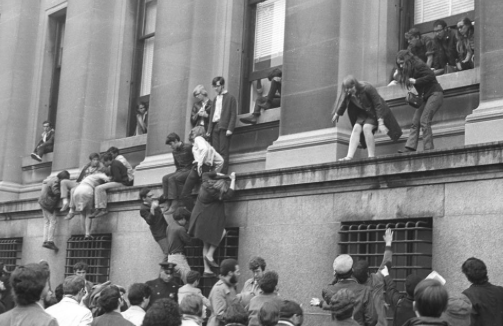
On April 23, 1968, students at New York City’s Columbia University held a demonstration to protest military research and the condemnation of part of the neighboring Morningside Heights section of Harlem to make way for a new student gymnasium. The protest escalated into a week-long occupation of five campus buildings before police moved in. Some 712 students were arrested, and over 100 injured during the forcible eviction. After the university-ordered police response, a student strike shut down the campus for the rest of the semester.

Categories
international affairs social media

The YouTubification of China

The speech-repressing Chinese government and the speech-repressing tech firm Google are apparently taking cues from each other.

Busy Google unit YouTube has been working overtime to cripple the YouTube channel China Uncensored, which is too brutal in its criticism of the Chinazi government.

YouTube has demonetized the channel’s latest video, “YouTube Helps Cover Up China’s Atrocities.” According to channel publisher America Uncovered LLC, the videos that tend to get penalized are those with footage “that makes the Communist Party look bad.”

Google often does much more to repress speech than flag and demonetize. But Google doesn’t want to always be super-blatant. So China Uncensored is still a YouTube channel. For now.

In contrast, the Chinese government usually goes full Chinazi. Its latest project is a snitch app to help neighbors turn in neighbors for voicing “wrong” opinions.

It’s about correcting misinformation. China’s Cyberspace Administration says the app will help counter online statements that are “maliciously distorting, slandering and denying Party, national and military history in an attempt to confuse people’s thinking,”

Ah, disagreement, a.k.a. “misinformation,” the too-steep cost of freedom! And who alone is qualified to determine which information is correct?

“Whatever the Party holds to be the truth, is truth,” says Orwell’s O’Brien. “It is impossible to see reality except by looking through the eyes of the Party.”

Deviate from the party line about the party, the pandemic, an election, lack of elections, or anything else, and supposedly it’s right and just to muzzle you.

Wrong.

This is Common Sense. I’m Paul Jacob.


PDF for printing

Photo by Jackie

See all recent commentary
(simplified and organized)
See recent popular posts

Categories
Thought

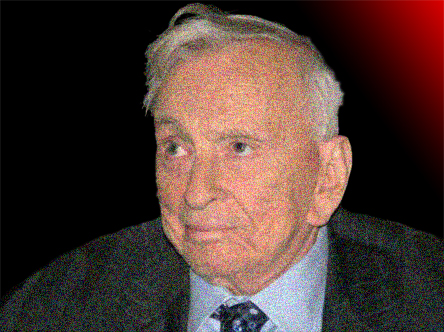
Gore Vidal

The United States was founded by the brightest people in the country — and we haven’t seen them since.

Gore Vidal, Matters of Fact and Fiction (1978)

Categories
Today

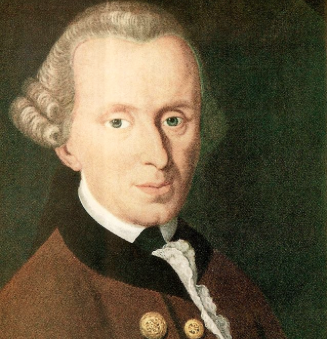
Immanuel Kant

On April 22, 1724, philosopher Immanuel Kant was born.

Aside from being the pre-eminent modern philosopher and originator of transcendental idealism, Kant was also a major figure of Enlightenment thought, a classical liberal, and the originator of the notion of the Categorial Imperative. He was an early and important astronomical theorist in his early career, but produced his greatest works towards the end of his life, including The Critique of Pure Reason and The Groundwork for the Metaphysics of Morals. He was also author of the 1795 essay “Perpetual Peace: A Philosophical Sketch.”

Arthur Schopenhauer is widely known as an admiring and astute critic of Kant’s thought, while philosophical opponents include Friedrich Nietzsche and Ayn Rand. Kant’s approach to ethics continues to excite interest today, with some of the revival a result of the work of John Rawls.

Kant died on February 12, 1804, in Königsberg, Prussia (now Kaliningrad, Russia), where he had lived the bulk of his life.

Categories
national politics & policies

Pick Your Poison

Are cigarettes containing menthol-flavored tobacco racist?

Follow the science! It is an absolute fact that those menthol smokes “disproportionately addict — and kill — Black Americans.”

The reason? “Only 29 percent of White smokers choose menthol, as opposed to 85 percent of African American smokers, according to a National Survey on Drug Use and Health,” The Washington Post explains, “fueled by more than half a century of Big Tobacco aggressively marketing them specifically to Black Americans.”

Catch that causation claim? The black-and-white difference between racial group affinity with this flavor is the fault of cunning (white?) advertising execs with a racist penchant for hooking unsuspecting blacks. 

Never addressed — or apparently even considered? The possibility that tobacco companies are targeting their promotional efforts in relation to the obvious preferences of their customers.

It is in the news because the U.S. Food and Drug Administration must officially address, by April 29, a formal regulatory petition “demanding menthol cigarettes be banned.”

Support for outlawing menthol-flavoring based on racial justice rationales meets plenty of opposition based on racial . . . sanity.

“Opposition,” notes The Post, “come[s] from GOP and Democratic officials as well as civil rights groups.” 

The idea of providing another police enforcement flashpoint by outlawing an addictive substance used overwhelmingly by blacks seems a non-starter. “We do not think kids should be put in jail or given a ticket for selling menthol,” offered Rev. Al Sharpton.* “You’re going to give the police another reason to engage our people?”

“Banning a certain type of cigarettes because black people tend to favor them is stupid and patronizing,” one Post reader commented. “Either have the courage of your convictions and ban all cigarettes (lol) or leave this alone.”

Leave us alone.

This is Common Sense. I’m Paul Jacob.


* Sharpton acknowledged to The Post that his National Action Network has received funding from “R.J. Reynolds, which makes Newport cigarettes, the most popular menthol cigarette and the No. 2 U.S. cigarette brand overall.”


PDF for printing

See all recent commentary
(simplified and organized)
See recent popular posts
Categories
Thought

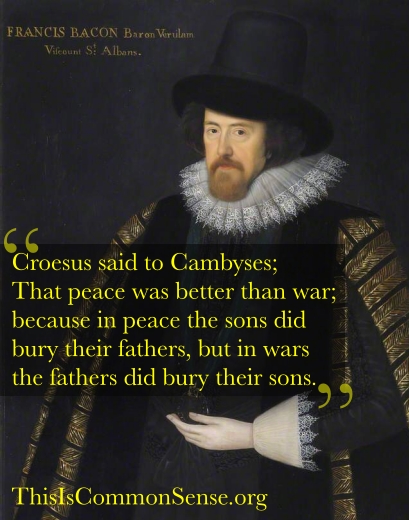
Sir Francis Bacon

Croesus said to Cambyses; That peace was better than war; because in peace the sons did bury their fathers, but in wars the fathers did bury their sons.

Francis Bacon, Apophthegms, New and Old (published 1625).
Categories
Today

F-Word Defined

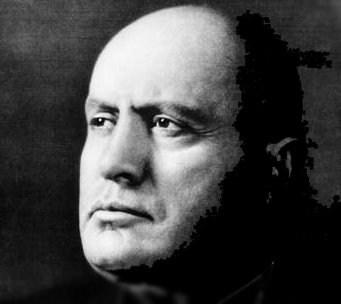
Nowadays, all sorts of people call their political opponents “fascist,” often on the shakiest of rationales. Well, The Manifesto of Fascist Intellectuals was first published in Il Mondo, then by most Italian newspapers on April 21, 1925 — the national, anniversary-day celebration of the Founding of Rome (ca.  April 21, 753 BC).

It might be a good idea to consult this original document, for a good idea what politics’ “f-word” originally meant:

Fascism was . . . a political and moral movement at its origins. It understood and championed politics as a training ground for self-denial and self-sacrifice in the name of an idea, one which would provide the individual with his reason for being, his freedom, and all his rights. The idea in question is that of the fatherland. It is an ideal that is a continuous and inexhaustible process of historical actualization. It represents a distinct and singular embodiment of a civilization’s traditions which, far from withering as a dead memory of the past, assumes the form of a personality focussed on the end towards which it strives. The fatherland is, thus, a mission.

The manifesto was written by Giovanni Gentile, in support of the regime of Benito Mussolini (pictured above).

Less than two weeks later, on May 1, 1925, Il Mondo published philosopher Benedetto Croce’s The Manifesto of the Anti-Fascist Intellectuals.

Categories
media and media people

Media Corrections

“Our focus was to get Trump out of office,” explains CNN Technical Director Charlie Chester in video surreptitiously recorded and recently released by the gotcha video journalists of Project Veritas. 

The group had reached higher at the cable network, last December, unveiling comments made by CNN Worldwide President Jeff Zucker and Political Director David Chalian during an internal conference call to spike coverage of the Hunter Biden laptop story . . . with plenty of obvious political prejudice. 

Last summer, as the presidential campaign settled into a two-man race pitting Republican Donald Trump against Democrat Joe Biden, The New York Times reported that, “Russia Secretly Offered Afghan Militants Bounties to Kill U.S. Troops, Intelligence Says,” adding, “The Trump administration has been deliberating for months about what to do about a stunning intelligence assessment.”

“There may not have been Russian bounties on US troops in Afghanistan after all,” reads the Military Times’ headline, after the Biden Administration acknowledged “low to moderate confidence” in the intel that previously seemed gospel-true.

Calling it “one of the most-discussed and consequential news stories of 2020,” Glenn Greenwald notes, “It was also, as it turns out, one of the most baseless.”

Yet another big narrative has unraveled with the Washington, D.C., medical examiner concluding that Capitol Police officer Brian Sicknick “suffered two strokes and died of natural causes.”

“So The New York Times on January 8 published an emotionally gut-wrenching but complete fiction that never had any evidence — that Officer Sicknick’s skull was savagely bashed in with a fire extinguisher by a pro-Trump mob until he died,” Greenwald summarizes at Substack, “and, just like the now-discredited Russian bounty story also unveiled by that same paper, cable outlets and other media platforms repeated this lie over and over in the most emotionally manipulative way possible.”

That’s “the news”?

This is Common Sense. I’m Paul Jacob.


PDF for printing

See all recent commentary
(simplified and organized)
See recent popular posts
Categories
Thought

Robert Nozick

Though not part of the official curricula, in the schools the intellectuals learned the lessons of their own greater value in comparison with the others, and of how this greater value entitled them to greater rewards.

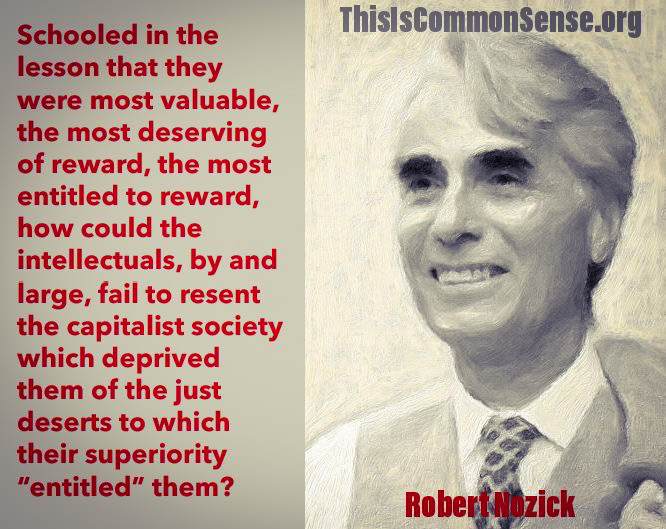
The wider market society, however, taught a different lesson. There the greatest rewards did not go to the verbally brightest. There the intellectual skills were not most highly valued. Schooled in the lesson that they were most valuable, the most deserving of reward, the most entitled to reward, how could the intellectuals, by and large, fail to resent the capitalist society which deprived them of the just deserts to which their superiority “entitled” them? Is it surprising that what the schooled intellectuals felt for capitalist society was a deep and sullen animus that, although clothed with various publicly appropriate reasons, continued even when those particular reasons were shown to be inadequate?

Robert Nozick, “Why Do Intellectuals Oppose Capitalism?” Cato Policy Report January/February 1998